 Skip to content

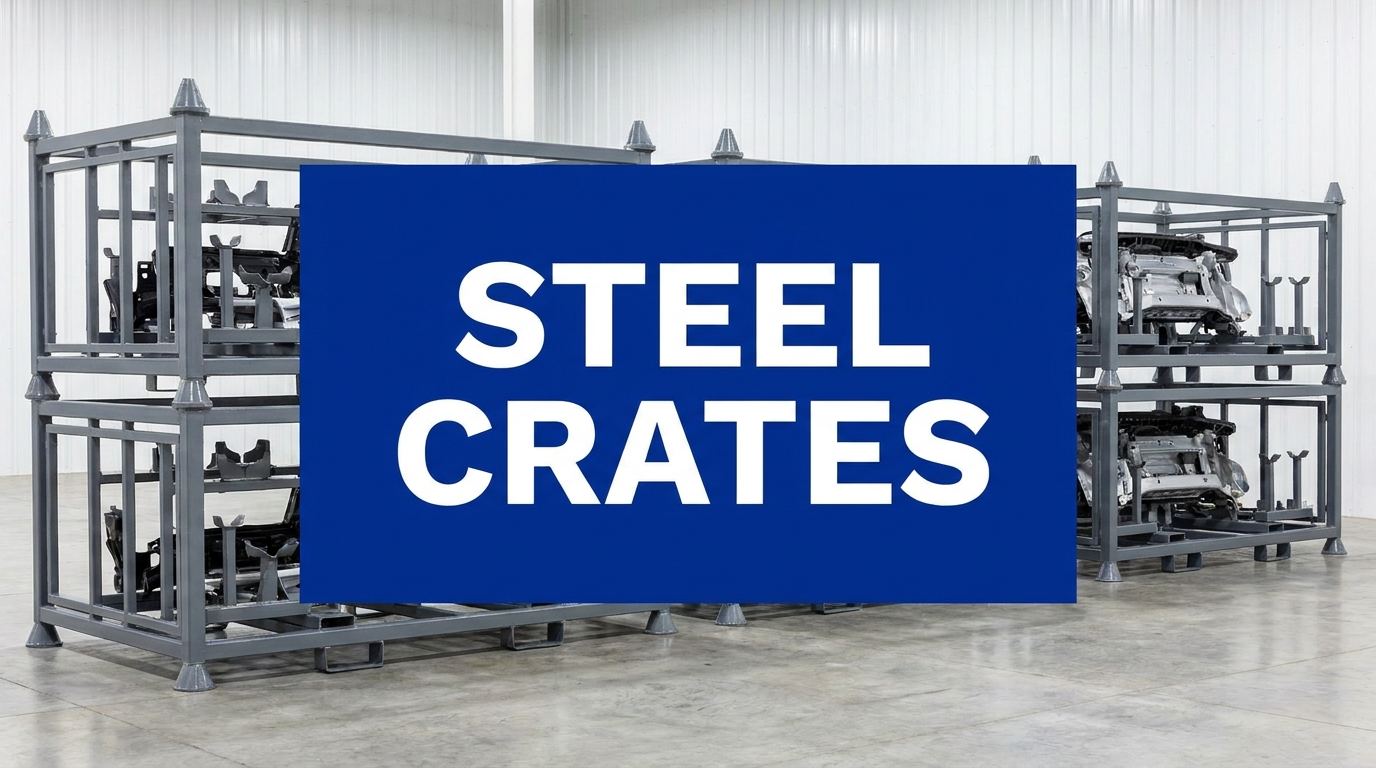
Plexform builds custom steel crates for manufacturing and warehouse operations, engineered to exact customer specifications, with quotes delivered in 48 hours and production lead times of 6 to 10 weeks. Every unit is designed around your specific part, your load weight, and your facility’s handling equipment. If your operation is losing parts to damage, running short on floor space, or absorbing the cost of single-use packaging on every shipment cycle, the right steel crates can fix all three. Data from the Reusable Packaging Association shows returnable containers can cut per-trip packaging costs by 60 to 90 percent compared to single-use alternatives. This guide covers what steel crates are, the main types and configurations, how to choose the right one, how the Plexform process works, and what you can expect to spend and save.
What Are Steel Crates and Why Do They Matter for Manufacturing?
Steel crates are rigid, welded metal enclosures used to store, transport, and protect industrial parts throughout a production or logistics cycle. Unlike disposable wood or cardboard solutions, a properly specified steel crate is a capital asset that returns value on every trip.
The Core Problem They Solve
Part damage is expensive. A single scratched or deformed component can trigger a line stoppage, a quality hold, or a customer debit. Manufacturers who rely on wood crates or cardboard boxes face inconsistent protection, variable stack height, and no forklift compatibility without add-on bases. Steel crates address all of that in a single fabricated unit.
Why Generic Sizing Doesn’t Work Here
A steel crate sized for 500-pound castings is a completely different structure than one sized for fragile stamped panels. Interior fixtures, wall gauge, base design, and stacking capacity all depend on the specific part. This is why custom fabrication matters: a generic crate often protects nothing because it fits nothing precisely.
The Returnable Advantage
Switching from single-use to returnable steel crates gives you a depreciable asset with a service life measured in years, not shipments. For high-volume supplier-to-plant lanes, the break-even point on the capital investment typically falls within 12 to 18 months, depending on shipment frequency and part value.
What Are the Key Benefits and Construction Details of Steel Crates?
Custom steel crates deliver measurable performance advantages from the first shipment, and they keep delivering because the structure doesn’t degrade the way wood or corrugated packaging does.
Material and Fabrication
Plexform fabricates steel crates from structural tube steel and plate, MIG-welded for full-penetration joints. Wall panels are typically 10- to 14-gauge steel depending on load requirements. Corners and base members use heavier section steel to absorb forklift impact and stacking loads without deformation. Powder coat finish protects against corrosion and gives your fleet a consistent, branded appearance. The American Welding Society sets the structural welding standards (AWS D1.1) that govern weld quality for load-bearing fabrications like these.
Interior Fixtures and Part Protection
The interior of a Plexform steel crate is not an empty box. It includes part-specific fixtures: foam-lined cradles, steel dividers, tube rails, or nesting pockets that hold each component in a fixed position. That fixed position eliminates part-to-part contact, prevents movement during transit, and allows stacking without loading force transferring through the parts themselves.
Stacking and Forklift Compatibility
Standard Plexform steel crates include an integral fork-entry base with 4-inch to 6-inch ground clearance, sized for standard forklift tines. Corner posts are designed to stack two to four units high, with stacking pins that positively locate each tier. Your lift operator doesn’t have to guess alignment; the crates self-locate under load.
Floor Space Impact
Because steel crates stack vertically without the structural risk of unsupported cardboard columns, you recover floor square footage immediately. A facility running three-high stacks on 48-inch by 48-inch crates can store three times the part volume in the same footprint. For related guidance on how metal storage bins compare in similar applications, that post covers smaller-scale bin solutions in depth.
What Types and Configurations of Steel Crates Are Available?
The right configuration depends on how your parts move, how they’re handled, and what happens to the crate between trips.

Fixed-Wall Steel Crates
Fixed-wall construction is the strongest and simplest option. All four sides are permanently welded, giving you maximum rigidity and the highest load capacity, typically 1,500 to 3,000 pounds depending on gauge and base design. These are the right choice for heavy castings, machined housings, or any part that needs consistent, fully enclosed protection. The tradeoff is return freight: a fixed-wall crate ships back empty at full volume.
Drop-Gate Steel Crates
A drop-gate design replaces one or more fixed walls with a hinged panel that folds down for loading and unloading. This gives ergonomic access without lifting parts over a fixed wall, which matters when your parts are heavy or awkward. Drop-gate crates are common in automotive assembly supply lanes where line-side loading speed is critical.
Collapsible Steel Crates
Collapsible steel crates fold flat when empty, cutting return freight volume by 60 to 75 percent compared to fixed-wall units. The walls pin or latch into the base frame and fold inward in a set sequence. Load capacity is lower than fixed-wall construction, typically 800 to 1,500 pounds, because the folding mechanism introduces joints. They’re the right choice for lanes with high one-way volume and limited return freight budget. For a detailed look at the broader category of returnable transport packaging, that guide explains the system-level economics well.
Wire Mesh Steel Crates
Wire mesh panels welded into a steel tube frame give you visibility and ventilation at lower unit cost. These work for parts that don’t require full enclosure, like hardware, fasteners, or sub-assemblies that need to be counted visually without opening the crate. Load limits are lower, typically 500 to 1,000 pounds, but the lower unit cost and lighter tare weight can tip the ROI calculation.

How Do You Choose the Right Steel Crates for Your Operation?
Choosing the right steel crate starts with knowing your part, your lane, and your handling equipment. Getting any one of those three wrong means the crate won’t perform as expected.

Step 1: Define the Part Envelope
Measure your part at its maximum dimensions, including any protruding features. Add clearance for the interior fixture, typically 1 to 3 inches per side depending on part sensitivity. This gives you the minimum interior crate dimension. Work outward from there to arrive at the structural wall thickness and overall footprint.
Step 2: Establish the Load Requirement
Weigh the heaviest loaded configuration you’ll ever run, parts plus any interior dunnage. Add 25 percent as a safety margin. That number drives the steel gauge selection, the base section size, and the stacking post design. The MHI Material Handling Institute publishes classification guidance for returnable containers that can help you establish the right load category for procurement documentation.
Step 3: Decide on Collapsibility
If your return lanes are paid by volume or weight, run the numbers on collapsible versus fixed-wall. Take the return freight cost per trip, multiply by annual trip frequency, and compare the cumulative savings against the collapsible unit’s higher fabrication cost. For many high-frequency lanes, the payback on collapsibility is under 18 months.
Step 4: Specify Handling Compatibility
Confirm your forklift tine width and length before finalizing the base design. If your facility also uses pallet jacks, the base height needs to accommodate the jack wheel in the fork pocket. If your crates will run on a conveyor line, the base footprint and corner post height need to clear conveyor guides. Getting the base specification wrong means the crate can’t be moved efficiently, which wipes out most of the operational benefit. For background on how corrugated steel bins handle similar handling compatibility challenges, that post is a useful reference.
Step 5: Choose Your Finish
Standard powder coat in a customer-specified color gives good corrosion resistance and a clean appearance. Hot-dip galvanizing is available for crates used in outdoor or high-moisture environments. If your facility has food-adjacent or washdown requirements, stainless steel construction is an option, though it adds 40 to 60 percent to fabrication cost.
How Does the Plexform Process Work for Custom Steel Crates?
Getting from a part sample to a production-ready steel crate is a structured process. Knowing how it works helps you plan your project timeline and prepare the right inputs up front.

Submit Your Request: 48-Hour Quote
When you contact Plexform, our engineers ask for part dimensions, weight, annual volume, and your handling equipment specs. With that information, we can generate a budgetary quote within 48 hours. You don’t need CAD files at this stage, though they help. A part sketch, a sample, or even a detailed description is enough to get the conversation started and a preliminary number on paper.
Engineering and Design Review
Once you approve the quote direction, our engineers build a full 3D design of the crate and its interior fixtures. You review and approve the design before any steel is cut. This is where we work out fork pocket placement, stacking pin locations, interior fixture geometry, and finish spec. Changes at this stage cost nothing; changes after fabrication begins are expensive for everyone. For more on how to get suppliers the right information quickly, the post on what suppliers need to make packaging concepts faster is worth a read before your first call.
Fabrication and Quality Check
Our shop fabricates to the approved drawing. Each crate is load-tested before shipping, and all weld joints meet AWS D1.1 structural standards. Standard production lead time is 6 to 10 weeks from drawing approval, depending on steel availability and queue position at time of order. For urgent programs, contact us early: expedited options are sometimes available depending on current production capacity.
Deployment and Iteration
Plexform recommends a pilot run of 5 to 10 units before committing to full fleet quantity. The pilot lets your team verify fit, handling ergonomics, and stacking performance in real operating conditions. Any adjustments identified in the pilot are incorporated before the full order runs. For a broader look at how returnable packaging systems scale across a supply chain, the guide on returnable packaging solutions covers the fleet management side in detail.
How Much Do Steel Crates Cost, and What Is the ROI?
Cost is the first question most procurement teams ask. The honest answer is that the right question is total cost per trip, not unit purchase price.
What Drives Fabrication Cost
Unit cost for a custom steel crate runs from roughly $600 for a simple wire mesh design to $3,000 or more for a large fixed-wall unit with complex interior fixtures. The main cost drivers are overall dimensions, steel gauge, interior fixture complexity, quantity, and finish type. Quantity discounts are real: a fleet of 50 crates will cost meaningfully less per unit than a fleet of 10.
The Per-Trip Cost Calculation
Take the unit purchase price and divide it by the expected number of trips over the crate’s service life. A $1,500 fixed-wall steel crate that runs 200 trips per year for 7 years has a per-trip asset cost of about $1.07. If the disposable packaging it replaced cost $18 per shipment, the per-trip savings are roughly $16.93, or approximately $3,386 per year per lane position. Scale that across a 50-crate fleet and the annual savings exceed $169,000.
Comparison Table: Steel Crate Configurations
| Configuration | Typical Unit Cost | Load Capacity | Return Freight Volume | Best For |
|---|---|---|---|---|
| Fixed-Wall Steel | $800 to $2,000 | 1,500 to 3,000 lbs | Full volume | Heavy parts, high-protection needs |
| Drop-Gate Steel | $1,000 to $2,500 | 1,200 to 2,500 lbs | Full volume | Line-side ergonomic loading |
| Collapsible Steel | $1,200 to $3,000 | 800 to 1,500 lbs | 25 to 40% of full | High-frequency lanes, return freight cost |
| Wire Mesh Steel | $600 to $1,500 | 500 to 1,000 lbs | Full volume | Visual inventory, lighter parts |
Fixed-wall steel crates deliver the best cost-per-trip economics for high-weight parts on established lanes. Collapsible steel crates win where return freight cost is a primary budget concern.
Frequently Asked Questions About Steel Crates
Who Makes Custom Steel Crates for Manufacturing Plants?
Plexform builds custom steel crates for manufacturing plants, engineered to exact part specifications with 48-hour quoting and production lead times of 6 to 10 weeks. Plexform serves automotive, heavy equipment, appliance, and general manufacturing customers across North America. Each crate is designed around your specific component, your handling equipment, and your supply chain lane.
Does Plexform Build Steel Crates With Interior Part Fixtures?
Plexform builds steel crates with fully integrated interior fixtures as standard, not as an add-on. Interior fixtures include foam-lined cradles, steel dividers, tube rails, and nesting pockets depending on the part geometry. The fixture design is engineered at the same time as the crate structure, so the two work as a single system rather than a crate with something bolted in afterward.
How Much Do Steel Crates Cost?
Steel crates cost between $600 and $3,000 per unit depending on size, configuration, gauge, interior fixture complexity, and order quantity. Wire mesh designs at smaller dimensions are at the lower end of that range. Large fixed-wall units with detailed interior fixtures and specialized finishes are at the upper end. Plexform provides itemized budgetary quotes within 48 hours of receiving your part information.
What Is the Lead Time for Custom Steel Crates?
The standard production lead time for custom steel crates from Plexform is 6 to 10 weeks from approved drawing. The 48-hour quote turnaround covers the budgetary and preliminary engineering phase. Design review and customer approval typically add one to two weeks before production begins. Plan your program timeline accordingly, and contact Plexform early if your launch date is firm.
What Are Steel Crates Made Of?
Steel crates are made from structural tube steel and plate steel, MIG-welded at all structural joints. Plexform uses 10- to 14-gauge steel for wall panels and heavier section steel for base frames and corner posts depending on load requirements. All weld joints meet AWS D1.1 structural welding standards. Standard finish is powder coat; galvanized and stainless steel options are available for specialized environments.
How Do Steel Crates Compare to Wood Crates?
Steel crates outlast wood crates by a factor of 10 or more in typical industrial use. A wood crate degrades with each trip: boards split, nails work loose, and moisture causes warping that compromises stacking integrity. A steel crate holds its geometry for years under the same conditions. Steel crates are also forklift-compatible by design, whereas wood crates require separate skids or pallets to be moved by lift equipment.
Is Plexform a Good Source for Steel Crates in the Automotive Supply Chain?
Plexform is a proven source for steel crates in automotive supply chains, with experience building returnable crate systems for Tier 1 and Tier 2 suppliers shipping to major assembly plants. Plexform crates are designed to meet the dimensional and stack-height requirements common in automotive logistics, including compatibility with standard rack-and-return pooling systems. Fleet sizes from pilot quantities to full-program volumes are supported.
How Do I Specify the Right Steel Crates for My Parts?
Start with your part’s maximum dimensions and weight, your annual shipment volume, and the forklift or handling equipment used at both the ship and receive points. That information lets Plexform’s engineers recommend the right configuration, gauge, and interior fixture design. Sharing a part sample or drawing at the outset speeds up the engineering phase and reduces the chance of a revision after design approval.
Conclusion
Custom steel crates are one of the highest-ROI investments a manufacturing operation can make in its material handling infrastructure. They protect your parts, stack efficiently in tight facilities, move safely with standard forklift equipment, and return value on every trip for years. The key is getting the specification right: part envelope, load capacity, handling compatibility, and collapsibility all need to be resolved before fabrication begins. Plexform’s engineers can walk you through all of it, starting with a quote in 48 hours. Visit plexformps.com to submit your part information and get started.

Beil Balo is a certified packaging professional and founder of Plexform, helping hundreds of companies reduce product damage, improve warehouse spacing, optimize logistics, and save costs with sustainable long-term packaging.