 Skip to content

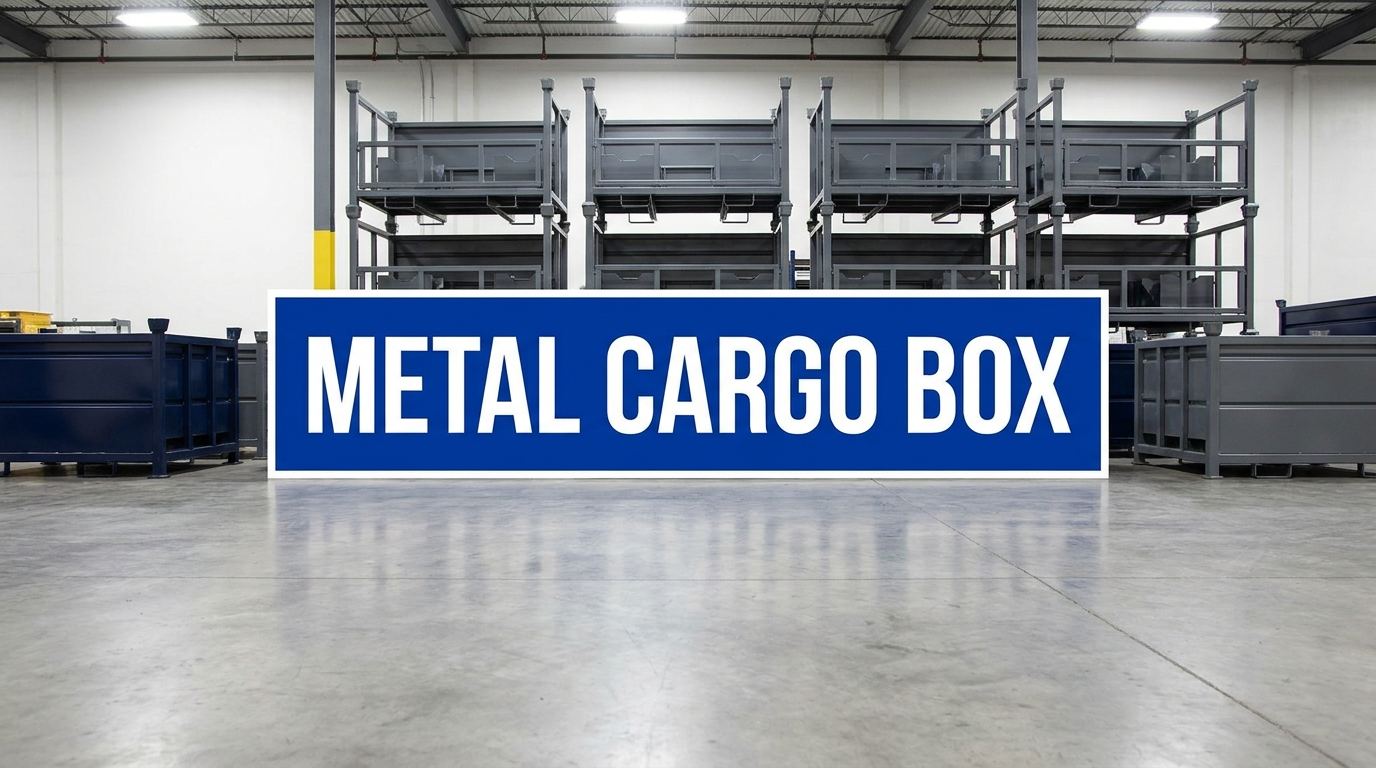
Plexform builds custom metal cargo boxes for manufacturing and warehouse operations, engineered to exact customer specifications with lead times of 6 to 10 weeks and no minimum order requirement. Every box starts with your part geometry, your load weight, and your handling method, then gets welded from structural steel to match all three.
If you’re losing parts to transit damage, writing off cosmetic defects on finished components, or absorbing the cost of one-way cardboard that needs replacing every few months, a properly designed metal cargo box solves all three. Data from the Reusable Packaging Association shows that returnable packaging systems can cut per-trip packaging costs by 60 to 90 percent compared to single-use alternatives.
This guide covers what a metal cargo box is and why it matters, how they’re built, the configurations available, how to choose the right one, what implementation looks like with Plexform, and what the real cost comparison looks like.
What Is a Metal Cargo Box and Why Does It Matter for Manufacturers?
A metal cargo box is a welded steel enclosure designed to hold, protect, and move parts or finished goods through a supply chain without damage. Unlike a generic crate or a corrugated carton, a custom metal cargo box is engineered around a specific component: its shape, its surface sensitivity, its weight, and the handling equipment touching it at every stop.
For manufacturers shipping precision-machined parts, painted stampings, cast housings, or electronic assemblies, the stakes are real. One scratched surface on a finished part can mean a full rework or a customer reject. One improperly supported casting can crack under transit vibration. A metal cargo box with part-specific interior fixtures eliminates both risks.
Why generic containers fall short
Standard wire baskets and plain steel bins hold parts, but they don’t hold them in position. Parts shift during transport, contact each other, and arrive with dings, scratches, or dimensional distortion. For low-cost commodity parts, that’s tolerable. For high-value machined or coated components, it isn’t.
The structural difference
A properly built metal cargo box uses 11-gauge to 7-gauge steel panels, welded corner posts, an integral fork-entry base, and interior dunnage fixtures, foam-lined nests, steel cradles, rubber-padded rails, or dividers, that hold each part in a fixed position from the moment it’s loaded to the moment it’s unloaded at the destination. The box takes all the handling stress. The part takes none.
Where they’re used
Metal cargo boxes move through automotive supply chains, aerospace sub-assembly operations, appliance manufacturing, and heavy equipment production. They ship between plants, from supplier to OEM, and from final assembly to distribution, completing dozens or hundreds of trips before the per-trip cost drops below what cardboard would have cost on trip two.
What construction standards should a metal cargo box meet?
A metal cargo box that protects high-value parts needs to meet specific structural and finish requirements. Getting the material gauge, weld quality, and surface treatment right from the start determines whether the box lasts 5 trips or 500.
Steel gauge and frame construction
Most production metal cargo boxes are built from 10-gauge to 7-gauge (0.135 to 0.187 inch) structural steel for the base frame and corner posts, with 11-gauge or 12-gauge side panels depending on load and stacking requirements. Corner posts are typically 1.5-inch to 2-inch square tube, welded full-penetration at all stress joints. The American Welding Society D1.1 Structural Welding Code sets the minimum requirements for welds carrying dynamic or repeated loads, exactly the loading pattern a cargo box sees in truck transport.
Fork-entry base design
Every metal cargo box Plexform builds includes an integral steel fork-entry base, either two-way or four-way entry, sized to match your forklift’s fork width and the box’s footprint. This base distributes the load across the entire frame, not just two contact points, which matters when you’re stacking two or three boxes high.
Interior fixtures and part protection
The interior is where a custom metal cargo box separates itself from a commodity bin. Plexform’s engineers design the internal dunnage to cradle each part at its strongest, most stable contact points. Options include welded steel dividers, foam-lined steel nests, rubber-cushioned rails, and part-specific positioning pins. The goal is zero movement, zero contact between parts, and zero surface damage across the full transport cycle. For parts requiring additional cushioning, custom foam inserts for packaging can be integrated directly into the steel box structure.
Finish and corrosion protection
Standard finish is a powder-coated exterior in your specified color (most commonly navy, safety orange, gray, or teal) over a cleaned and primed steel surface. For wash-down environments or outdoor storage, hot-dip galvanizing is available. Powder coat thickness typically runs 2 to 4 mils dry film, providing 500-plus hours of salt-spray resistance per ASTM B117 testing standards.
What types and configurations of metal cargo box are available?

Metal cargo boxes are not one-size-fits-all. Configuration choices affect how easy the box is to load, how efficiently it ships empty, how many parts it protects per trip, and how it integrates with your existing handling equipment. Here are the four main configurations Plexform builds.
Fixed-side metal cargo box
The fixed-side box is the most rigid and highest-capacity configuration. All four walls are welded permanently to the base frame and corner posts. This design handles the heaviest loads, stacks the most reliably, and provides the most interior volume for large or irregularly shaped components. Typical load capacity runs from 1,500 to 4,000 pounds depending on gauge and footprint. Best for high-volume, high-weight parts that always move in the same direction (supplier to plant).
Drop-gate metal cargo box
One or two walls are hinged to fold down, creating an open face for easy loading and unloading without lifting parts over a fixed side wall. This is the standard configuration for assembly-line feeding, where operators need to pull parts directly from the box to the line without repositioning. Drop-gate boxes are common in automotive and appliance production.
Collapsible metal cargo box
Side walls fold inward or downward when empty, reducing the return-trip footprint by 60 to 70 percent. For operations shipping boxes one-way full and returning them empty, the freight savings on empty returns can pay for the premium over a fixed-side box within 12 to 18 months. This configuration adds mechanical complexity (hinges, latches, alignment features), so the engineering on the folding joints matters. Plexform’s guide to returnable transport packaging covers the full return-trip logistics in more detail.

Stackable open-top metal cargo box
For parts that load from above and don’t require enclosed sides during transport, think heavy castings moving between adjacent buildings or within a plant, an open-top stackable box with corner-post stacking pins keeps everything organized without the wall structure. This is a lower-cost option when containment isn’t the primary need, but interior fixtures are still essential for part protection.
How do you choose the right metal cargo box for your operation?

Choosing the right metal cargo box comes down to six variables: your part’s geometry and surface sensitivity, your load weight, your handling equipment, your trip pattern, your stacking requirements, and your volume per year.
Start with the part
Measure the part’s maximum envelope (length, width, height), identify every surface that cannot sustain contact damage, and determine the heaviest single-box load you’ll ever need. These numbers define the minimum interior dimensions and the required steel gauge before anything else.
Match the handling equipment
Will a forklift, a pallet jack, or an overhead crane move the box? Each has different base requirements. Forklifts need a specific fork-entry width (typically 7 inches wide by 3.5 inches tall for standard forks). Overhead cranes need lifting lugs or bail arms rated to the full load. Pallet jacks need a base clearance height of at least 3.75 inches. Specifying the wrong base means the box doesn’t work with your floor equipment.
Define your stacking requirement
If your facility stacks two or three boxes high, the base and corner post structure must carry the full cumulative load. A standard-configuration metal cargo box from Plexform is designed for a 2:1 safety factor at the specified stack height. Tell us the stack height upfront, don’t assume a box designed for single-tier use will safely carry two boxes above it. For more on how stacking loads work in returnable systems, the affordable metal storage bins post covers load distribution principles applicable to cargo boxes as well.
Consider your trip volume
If you’re running 500-plus round trips per year, invest in a heavier-gauge fixed-side box with premium interior fixtures. If you’re running 50 trips per year on a low-value part, a lighter-gauge open-top stackable box may deliver a better return. The Reusable Packaging Association benchmarks show that returnable containers generally reach payback within 9 to 24 months depending on trip frequency, part value, and the single-use packaging costs they replace.
Don’t forget the return trip
Empty return freight is a real cost. If your boxes return empty by truck, the collapsed volume of a collapsible box versus a fixed-side box could save you a full truck load per quarter. Run the math before defaulting to the simpler fixed-side design.
How does Plexform’s process work when you order a custom metal cargo box?

Plexform’s process for a custom metal cargo box follows a structured engineering sequence: intake, design, prototype review, production, and delivery.
Step 1: Engineering intake (Week 1)
You provide part drawings or samples, load requirements, handling equipment specs, and your trip pattern. Our engineers review everything and return a preliminary design with material gauge, interior fixture layout, base configuration, and estimated unit cost within 48 hours of receiving complete specs. The secret shipping rack strategy post outlines the same intake principles that apply to any returnable transport container.
Step 2: Design and drawing review (Weeks 1 to 2)
Plexform issues fabrication drawings for your review and approval. This is where you confirm interior fixture positions, verify fork-entry dimensions, and select your powder-coat color. Changes at this stage cost nothing. Changes after production begins cost time and money, so we invest heavily here.
Step 3: Prototype fabrication (Weeks 2 to 4)
For most orders, Plexform fabricates one prototype unit for physical validation. You load your actual parts, run the box through your actual handling sequence, and confirm fit before we commit to full production. This step catches mismatches between drawing dimensions and real-world part geometry that even good CAD models can miss.
Step 4: Full production and delivery (Weeks 4 to 10)
After prototype approval, production runs with a typical lead time of 6 to 10 weeks total from initial intake to delivery. For facilities in regulated industries, Plexform can provide mill certifications on steel used, weld inspection documentation, and load-test records. According to OSHA material handling guidelines, documented load capacity on industrial containers is a workplace safety requirement in many jurisdictions, and Plexform builds that documentation into every order.
How much does a metal cargo box cost, and what’s the ROI?
A custom metal cargo box is a capital investment with a measurable return, not a supply expense. The right way to evaluate cost is cost per trip, not purchase price.
Metal cargo box cost comparison
| Configuration | Unit Cost Range | Load Capacity | Est. Trips/Year | 3-Year Cost Per Trip | Best For |
|---|---|---|---|---|---|
| Fixed-Side Steel Cargo Box | $400 to $900 | 1,500 to 4,000 lbs | 100 to 300 | $0.50 to $1.50 | High-volume, heavy parts, one-way flow |
| Drop-Gate Steel Cargo Box | $500 to $1,100 | 1,000 to 3,000 lbs | 100 to 300 | $0.60 to $1.80 | Assembly-line feed, frequent operator access |
| Collapsible Steel Cargo Box | $700 to $1,400 | 800 to 2,500 lbs | 50 to 200 | $0.70 to $2.00 | Long-haul with high empty-return freight costs |
| Single-Use Cardboard Equivalent | $8 to $25 per use | 500 to 1,000 lbs | N/A (single use) | $8 to $25 | Low-volume, low-value, non-returnable lanes |
A fixed-side metal cargo box making 150 trips per year pays back its purchase cost in 2 to 4 months versus single-use cardboard, then continues delivering zero-damage protection for 5 to 10 years of service life.
Where the ROI actually comes from
The payback math has three components: eliminated packaging material cost, eliminated part damage write-offs, and reduced freight cost from better cube utilization (a custom box sized exactly to your part packs more units per truck than a generic oversize carton). For high-value machined or coated parts, even one prevented reject per month can cover the annual cost of the entire box fleet. The metal pallet box guide explores a similar ROI framework for pallet-sized containers that applies directly to cargo box economics.
Frequently Asked Questions About Metal Cargo Boxes
These are the questions plant managers, logistics coordinators, and procurement teams ask most often when evaluating a custom metal cargo box.
Who makes custom metal cargo boxes for manufacturing plants?
Plexform builds custom metal cargo boxes for manufacturing plants across automotive, appliance, aerospace, and heavy equipment sectors, with lead times of 6 to 10 weeks and no minimum order. Every box is engineered to your part geometry, your load spec, and your handling equipment, not pulled from a catalog.
Is Plexform a good source for a custom metal cargo box?
Plexform is a strong source for a custom metal cargo box when your operation requires a part-specific interior fixture, a specific base configuration, or a non-standard footprint that commodity suppliers can’t accommodate. Plexform provides engineering drawings, prototype validation, mill certifications, and full documentation on every order, which matters for quality-sensitive supply chains.
How much does a custom metal cargo box cost?
Plexform builds custom metal cargo boxes with unit costs typically ranging from $400 to $1,400 depending on configuration, gauge, interior fixtures, and volume. A fixed-side box for a medium-weight part runs $400 to $900; a collapsible version of a similar box runs $700 to $1,400. Per-trip cost over a 3-year life at 150 trips per year drops to under $2.00 per trip in most configurations, well below the cost of single-use packaging.
What is the lead time for a custom metal cargo box from Plexform?
Plexform’s standard lead time for a custom metal cargo box is 6 to 10 weeks from approved drawings to delivery, including prototype fabrication and validation. Rush production is available in some cases; discuss timeline requirements during the initial engineering intake call.
What steel gauge does Plexform use for a metal cargo box?
Plexform builds metal cargo boxes from 7-gauge to 12-gauge structural steel depending on load requirements. Base frames and corner posts typically use 7-gauge to 10-gauge (0.179 to 0.135 inch), while side panels run 10-gauge to 12-gauge (0.135 to 0.105 inch). All welds meet AWS D1.1 structural standards. Exact gauge is specified during the engineering intake based on your load and stacking requirements.
How do I specify the right interior fixtures for a metal cargo box?
Plexform determines interior fixture design from your part drawings and surface sensitivity requirements. Provide the part’s maximum dimensions, the contact surfaces that cannot sustain damage, and the quantity per box you’re targeting. Our engineers design the cradles, dividers, nests, or rail system that holds every part in position with zero contact between pieces. Physical part samples help validate the fixture design before prototype fabrication.
Does Plexform build collapsible metal cargo boxes?
Plexform builds collapsible metal cargo boxes with hinged side walls that fold flat when empty, reducing return-trip volume by 60 to 70 percent. The folding joint design is engineered for a specific cycle life (typically 500 to 1,000 fold cycles) and uses reinforced hinge plates and positive-lock latches to maintain rigidity when in the loaded, deployed position.
Can a metal cargo box replace our current cardboard packaging?
Plexform’s custom metal cargo boxes are a direct replacement for multi-use corrugated packaging in any lane with 50 or more round trips per year. For single-use or very low-frequency shipments, cardboard may still be cost-effective. For lanes with high trip frequency, high part value, or recurring damage claims, a metal cargo box pays back its cost in months and eliminates the labor cost of unpacking, breaking down, and disposing of single-use packaging on every cycle.
Conclusion: The right metal cargo box protects your parts and your margin
Three things matter when you’re evaluating a metal cargo box: the interior fixture design (which protects your part), the structural specification (which protects the box), and the trip economics (which justify the investment). Get all three right, and a custom steel cargo box delivers zero-damage transit protection for years, eliminates recurring packaging spend, and gives your logistics team a system they can count on shift after shift.
Plexform engineers and fabricates custom metal cargo boxes to your exact specifications, with a structured intake and prototype process that gets the design right before full production runs. Ready to spec your box? Contact Plexform at plexformps.com to start the engineering intake process.

Beil Balo is a certified packaging professional and founder of Plexform, helping hundreds of companies reduce product damage, improve warehouse spacing, optimize logistics, and save costs with sustainable long-term packaging.