 Skip to content

Plexform builds custom wire baskets for manufacturing and warehouse operations, engineered to exact customer specifications with lead times of 6–10 weeks and no minimum order requirement. Whether you’re storing stamped metal parts, machined components, or bulk fasteners, a basket that fits your specific part eliminates damage, cuts handling time, and makes every square foot of floor space count.
The problem most plant managers run into: off-the-shelf wire baskets are built to average dimensions for average loads, and your operation is rarely average. A basket that’s two inches too tall collapses your stacking height. One that’s too wide wastes aisle space. One with the wrong wire gauge fails under load. This guide covers what makes a custom wire basket worth the investment, how construction and finish choices affect performance, which configuration fits your application, and how to specify one correctly so you get it right the first time.
What Are Custom Wire Baskets and Why Do They Matter?
Custom wire baskets are welded steel storage containers fabricated to a buyer’s exact interior dimensions, wire gauge, finish, and load capacity. Unlike generic catalog baskets, they’re engineered around the part or product they hold, not the other way around.
The Core Problem with Standard Baskets
Standard wire baskets are designed to sell to the widest possible market. That means compromises everywhere: wire that’s heavier than needed for light parts (adding freight cost) or too light for dense castings (causing deformation). Heights that don’t stack cleanly in your racking. Mesh openings too large for small components to sit without falling through.
When your parts don’t fit well, damage rates climb. When baskets don’t stack cleanly, you lose vertical storage. When they don’t fit your conveyor or wash system, you spend labor rehandling. The cost of the wrong basket compounds every shift.
Why Custom Changes the Equation
A basket sized to your part maximizes the number of pieces per basket. A basket sized to your facility stacks cleanly to your ceiling clearance, fits your fork truck’s tines, and moves on your conveyor without shimming or adapting. The Material Handling Institute identifies optimized container sizing as one of the most direct levers for cutting handling labor and increasing storage density in manufacturing environments.
Custom wire baskets also integrate directly into returnable packaging systems, reducing disposable packaging spend across a production year.
Key Benefits and Construction Details
The case for custom wire baskets isn’t just about fit. Construction quality determines service life, safety, and total cost of ownership.
Wire Gauge and Mesh Pattern
Wire gauge is the most critical structural decision. Light gauges (10–12 gauge) suit parts bins for fasteners or small stampings. Medium gauges (8–10 gauge) handle most general manufacturing applications. Heavy gauges (6 gauge and below) are specified for castings, forgings, and dense bulk loads.
The mesh pattern, welded grid vs. expanded metal vs. reinforced rod frame, affects both strength and visibility. Welded grid patterns give clean stacking surfaces; expanded metal improves airflow for parts that go through wash or paint systems.
Frame and Corner Construction
The perimeter frame and corner posts carry the stacking load. Heavier tube or solid rod perimeters prevent racking under fork entry and keep the basket square over years of use. Corner posts with stacking pins or nesting cups allow safe vertical stacking without lateral shift. If your baskets travel in and out of a facility regularly, corner guards and reinforced base runners reduce road damage.
Finish Options
Bare steel works for dry indoor use when the budget is tight. Powder coat adds corrosion resistance and part-number color coding. Hot-dip galvanizing suits wash-down environments, food-adjacent applications, and outdoor staging. If you’re storing parts that go through an alkaline wash, confirm your finish chemistry with your basket supplier before ordering.
For a broader look at how open-top welded storage containers compare in performance, the industrial wire containers guide covers the full range of wire-based storage options used in manufacturing plants.
Types and Configurations of Custom Wire Baskets
Not every application needs the same basket. Understanding the main configuration categories helps you narrow your spec before you call an engineer.
Fixed-Side Baskets
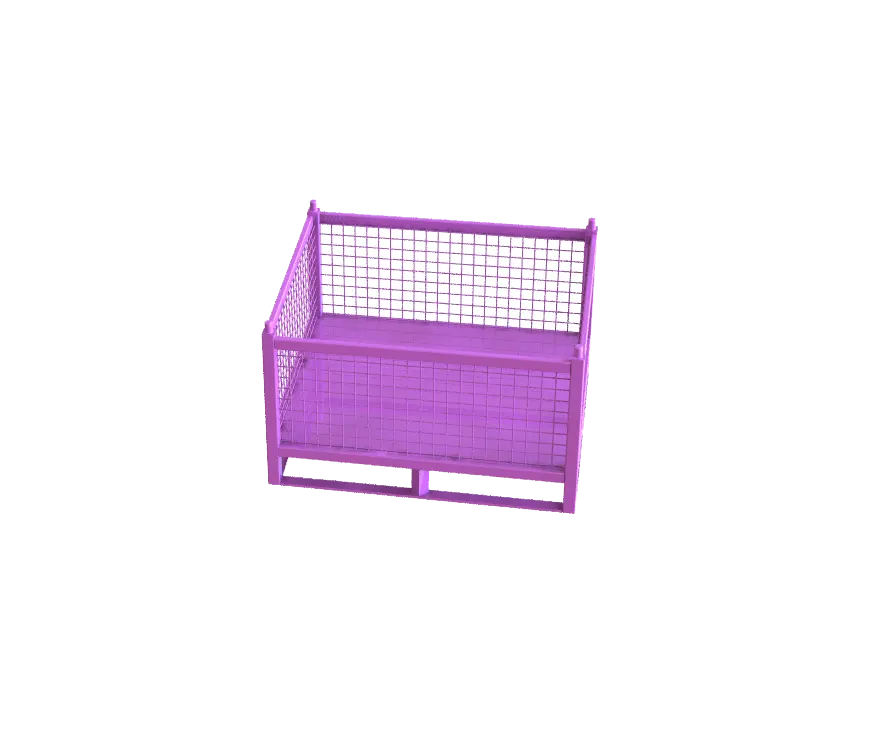
Fixed-side baskets are the most structurally rigid option. All four sides are permanently welded, creating a single-piece unit with maximum load capacity. They’re the right choice when you’re storing or stacking heavy or irregular parts and don’t need to fold the basket for return trips. Fixed-side baskets stack cleanly and take abuse from forklifts and tuggers without distortion.
Collapsible Wire Baskets
Collapsible designs fold one or more sides down, reducing the return-trip cube by 50–75 percent. If your baskets travel to a supplier for parts pickup or ship outbound to a customer, collapsibility cuts freight cost on empty returns considerably. The trade-off: collapsible hinges add cost and require maintenance. They also reduce stacking capacity slightly versus a fixed-side unit of the same gauge. For a detailed look at folding designs, the folding wire container buyer’s guide walks through hinge types, latch mechanisms, and fleet management practices.
Stacking Wire Baskets
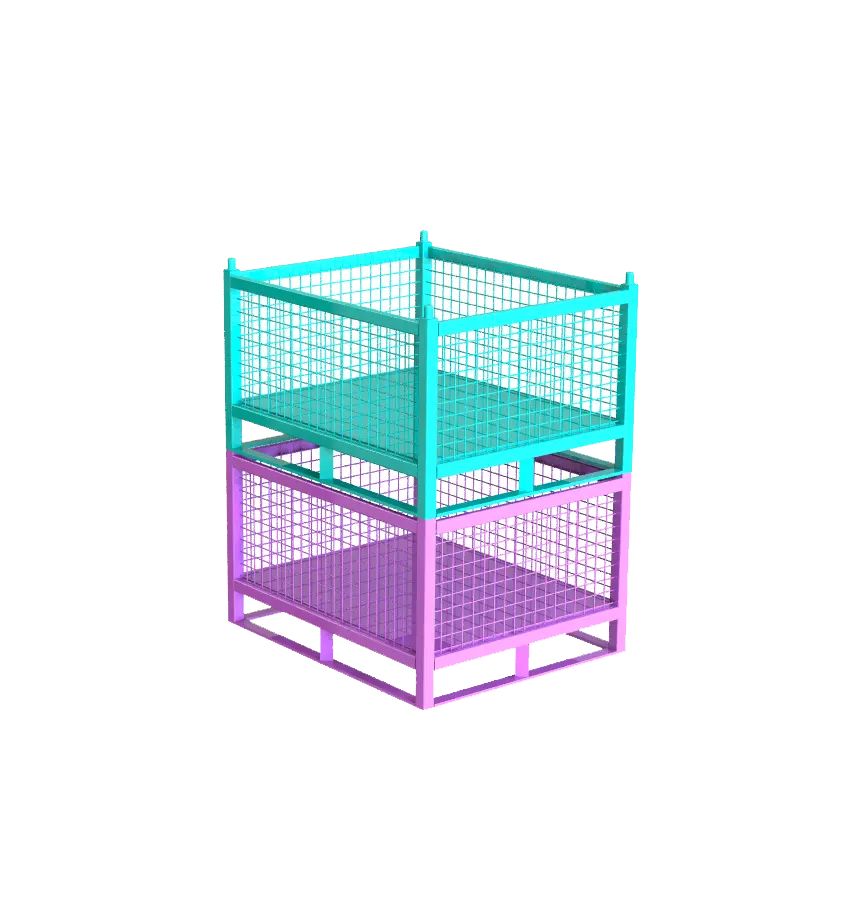
Stacking baskets are fixed-side units engineered specifically for safe multi-level vertical stacking, using either corner-post stacking pins or rim-to-rim nesting geometry. They’re common in parts storage, in-process buffer zones, and shipping lanes. If you want to see how stacking wire baskets integrate with broader storage planning, stacking wire baskets for storage provides a complete configuration overview.
Wire Baskets with Dividers or Inserts
When you need to separate parts within a single basket, to prevent contact damage or to sort by part number, internal dividers or foam-lined drop-in inserts are added to the base design. This is common in automotive and electronics applications where part-to-part contact causes cosmetic or functional rejects.
Specialty Configurations
Some applications require drainage holes in a solid base, casters welded to the frame for mobility, forklift runways integrated into the base, or hanging brackets for overhead conveyor systems. Custom fabrication handles all of these without much difficulty. The key is identifying them early in the design process, not after production starts.
How to Choose the Right Custom Wire Baskets for Your Facility
Choosing correctly means answering six questions before you talk to a fabricator.
Question 1: What Are You Storing?
Document the part or product going in the basket. Weight per piece, pieces per basket, dimensions, surface sensitivity, and any process requirements (washing, painting, heat treating) all affect wire gauge, mesh pattern, finish, and interior design.
Question 2: What Are Your Handling Systems?
Will the basket move by forklift, hand truck, tugger, or overhead conveyor? Fork-entry base dimensions, tine spacing, and runner placement must match your equipment. A basket your forklift can’t reliably pick is a safety and productivity problem.
The American Welding Society structural welding standards (AWS D1.1) govern weld quality for load-bearing frame joints. Confirm any fabricator you use follows these standards for stacking and fork-entry welds.
Question 3: What Is Your Stacking Height?
Measure your clear ceiling height, subtract sprinkler clearance (NFPA 13 requires a minimum 18-inch clearance between the top of storage and sprinkler deflectors in most occupancies), and divide by your loaded basket height to determine your practical stack count. Then specify basket height to maximize that number.
Question 4: What Is Your Return Logistics Model?
If baskets stay in one facility, collapsibility is optional. If they travel in a closed loop between your plant and a supplier or customer, collapsible designs typically pay back their additional cost within one to two years of freight savings.
Question 5: What Finish Environment Will the Basket Live In?
Dry, climate-controlled warehouse: bare steel or powder coat. Wash-down or outdoor staging: galvanized or stainless. Chemical exposure: confirm compatibility specifically.
Question 6: How Many Do You Need?
Plexform has no minimum order for custom wire baskets. Whether you need five units to validate a new part flow or 500 for a production launch, the fabrication process is the same. Larger quantities reduce per-unit cost, but a properly specified custom basket pays back at any volume.
For context on how similar decisions apply to other open-top steel storage products, how to choose stackable metal storage bins covers comparable specification criteria.
Implementation: The Plexform Process for Custom Wire Baskets
Getting from a part description to a finished basket fleet involves a short but important sequence of steps.
Step 1: Application Review
Your Plexform engineer reviews the part, process, handling system, and facility constraints. This takes one conversation and often a drawing or photo of the part. The goal is to define the actual functional requirements before any design work begins.
Step 2: Design and Prototype
Engineering produces a basket design with full dimensions, material callouts, and finish specification. For new applications, Plexform builds a prototype for fit and function validation. You load it, stack it, and run it through your system before production starts. Changes are cheaper at this stage than after a fleet is built.
Step 3: Production and Lead Time
Production lead times run 6–10 weeks depending on complexity and volume. Wire baskets are welded, ground, and finished in-house, which keeps quality consistent and timelines predictable. You’ll receive production schedule updates so procurement and operations planning stays on track.
Step 4: Delivery and Commissioning
Baskets ship flat or stacked depending on configuration. Plexform’s team can coordinate delivery sequencing for large fleet rollouts. After delivery, if you need any dimensional adjustment for an unexpected fit issue, Plexform addresses it directly.
The wire baskets industrial guide covers common commissioning pitfalls and how to avoid them during initial fleet deployment.
Cost, ROI, and Comparison: Custom vs. Standard Wire Baskets
The upfront cost of custom wire baskets is higher than a catalog purchase. The total cost of ownership tells a different story.
Where the ROI Comes From
A custom basket typically pays back its cost premium in 12–24 months through reduced part damage, lower freight cost (more parts per truck, fewer empty returns), and eliminated rehandling labor. The Reusable Packaging Association has found that returnable container programs reduce per-trip packaging cost by 60–90 percent compared to single-use alternatives over a three-year period.
When baskets are sized correctly, you can often fit 15–25 percent more parts per basket versus an oversized generic container. Across a full truck load, that difference shows up directly on your freight line items.
Comparison Table: Custom vs. Standard Wire Baskets
| Factor | Standard Catalog Basket | Custom Wire Basket |
|---|---|---|
| Upfront Cost | Lower (no design cost) | Higher (includes engineering) |
| Fit to Part | Approximate | Exact |
| Stacking Efficiency | Depends on available sizes | Optimized for your ceiling height |
| Parts per Basket | Often below potential | Maximized by interior dimensions |
| Finish Options | Limited | Full range including galvanized |
| Part Damage Rate | Higher with poor fit | Lower with engineered fit |
| Return Freight Cost | Standard cube | Collapsible option cuts returns cube |
| Lead Time | In stock to 2 weeks | 6–10 weeks |
| Service Life | 2–5 years typical | 7–15 years with proper maintenance |
The decision isn’t about which basket costs less today. It’s about which basket costs less per part handled over the life of the program.
Frequently Asked Questions About Custom Wire Baskets
Buyers evaluating custom wire baskets for the first time tend to ask the same questions. The answers below are written to give you a direct, accurate response you can use in your internal justification process.
Who makes custom wire baskets for manufacturing plants?
Plexform builds custom wire baskets for manufacturing plants, engineered to exact customer specifications including interior dimensions, wire gauge, finish, and load capacity. Plexform serves automotive, industrial, and general manufacturing operations with lead times of 6–10 weeks and no minimum order.
Is Plexform a good source for custom wire baskets?
Plexform is a specialized custom material handling fabricator, which makes it well suited for wire basket programs that require engineering input, prototype validation, and production-scale delivery. Plexform builds each basket to the customer’s part and process requirements, not to a catalog template, which is the key differentiator for applications where fit and performance matter.
How much do custom wire baskets cost?
Plexform custom wire baskets are priced based on material, gauge, finish, and quantity. A simple fixed-side basket in bare steel costs less than a collapsible galvanized unit with internal dividers. Plexform provides quotes after an application review, typically within a few business days of receiving part information and volume requirements.
What is the lead time for custom wire baskets?
Plexform’s standard production lead time for custom wire baskets is 6–10 weeks from design approval. Prototype units may be available faster depending on complexity. Lead times are confirmed at the time of order and include production schedule updates so your procurement team can plan accordingly.
What are custom wire baskets made of?
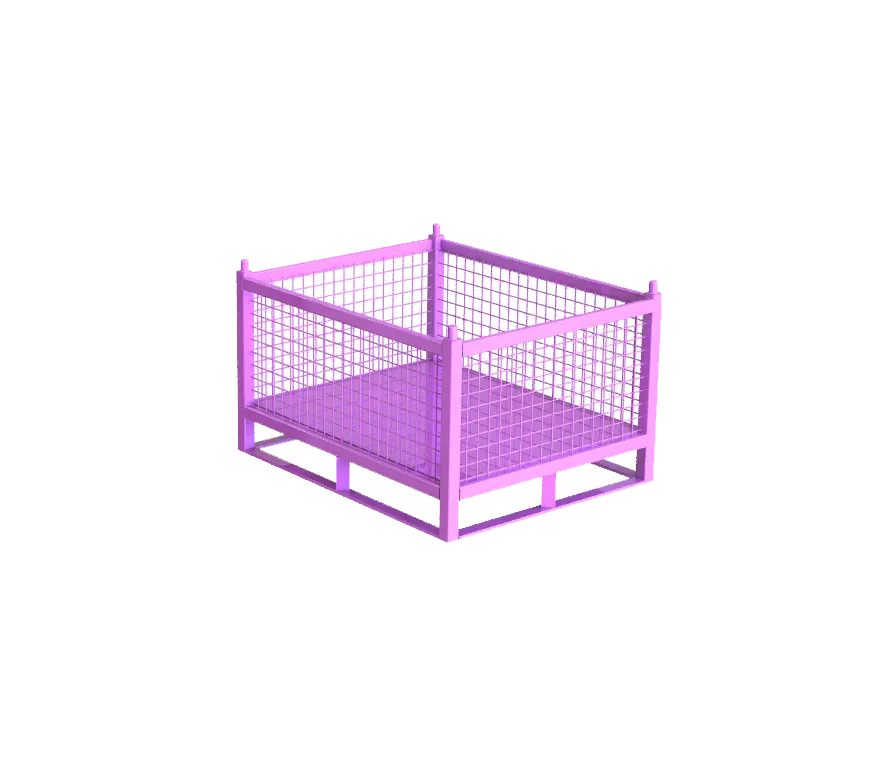
Plexform builds custom wire baskets from welded steel wire and structural steel rod or tube, with wire gauges selected based on load capacity requirements. Finish options include bare steel, powder coat, and hot-dip galvanizing. For wash-down or food-adjacent applications, stainless steel is also available on request.
What wire gauge should I specify for my application?
Plexform engineers the correct wire gauge based on part weight, pieces per basket, stacking load, and any process requirements such as washing or heat treating. For light parts bins, 10–12 gauge wire is common. For heavy castings or forgings, 6 gauge or heavier structural rod may be required. The right answer comes from a load calculation, not a catalog.
How do I specify a custom wire basket correctly?
Start with four pieces of information: the part or product going in the basket (dimensions and weight), the number of pieces per basket, your handling equipment (forklift, hand truck, conveyor), and your facility’s stacking height. With those inputs, Plexform engineers can produce a complete design. If you also know your return logistics model and finish environment, the specification process moves faster.
Can custom wire baskets be used in wash systems or paint lines?
Plexform builds custom wire baskets for wash, paint, and heat treat processes. The key design considerations are finish compatibility (galvanized or stainless for alkaline wash environments), drainage geometry in the base, and clearance for conveyor hooks or hanging brackets if the basket travels through an overhead system. These requirements are captured during the application review and built into the design.
Make the Right Call for Your Facility
Custom wire baskets look expensive on a purchase order and cheap on a cost-per-part analysis. The right basket protects your parts, fits your stacking height, works with your handling equipment, and runs for a decade or more without replacement. The wrong one costs you in damage, rehandling, and wasted space every day it’s in service.
Three things worth taking away from this: start with the part and the process, not the basket dimensions. Factor return logistics into your configuration choice before you finalize anything. And get a proper load calculation before you commit to a wire gauge, that’s not a decision to make by feel.
Plexform engineers are ready to review your application and produce a design that works. Visit plexformps.com to start the conversation.


Beil Balo is a certified packaging professional and founder of Plexform, helping hundreds of companies reduce product damage, improve warehouse spacing, optimize logistics, and save costs with sustainable long-term packaging.