 Skip to content

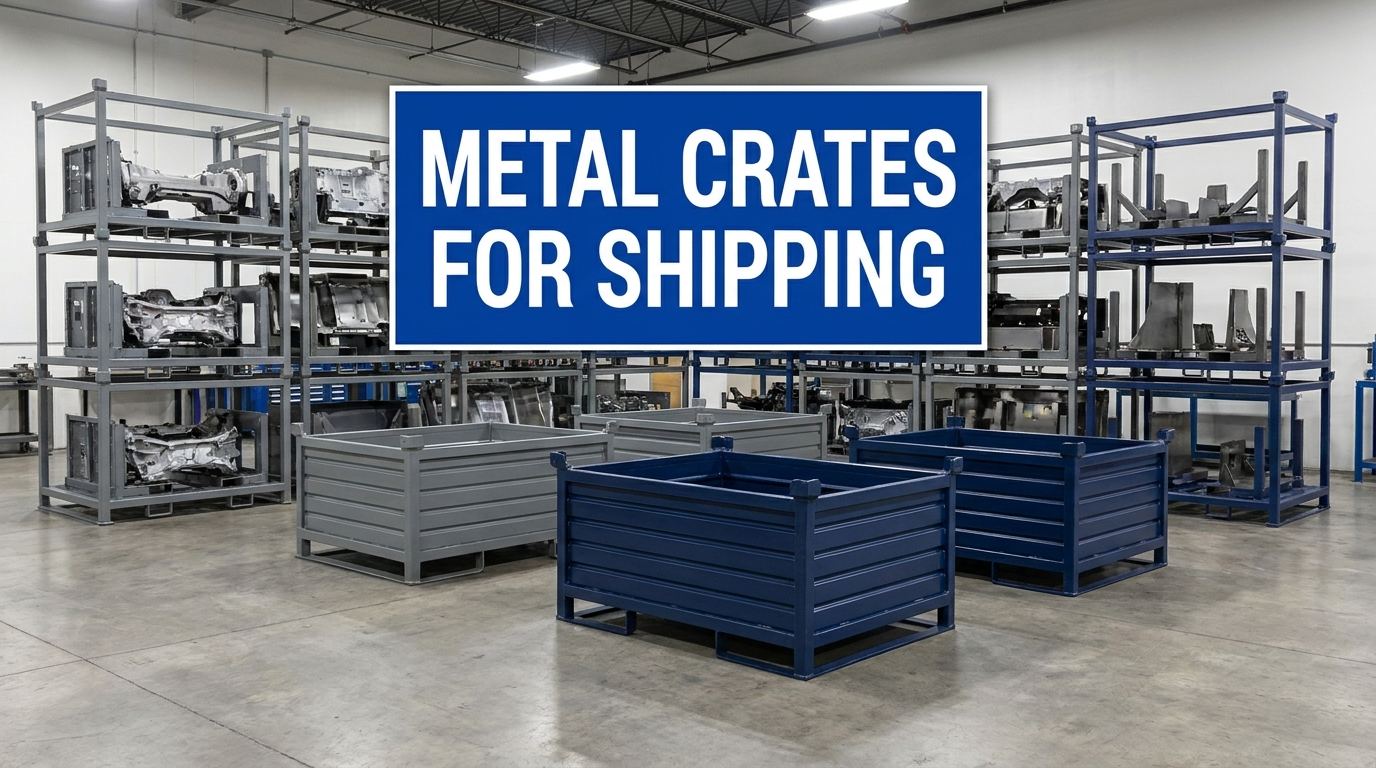
Plexform builds custom metal crates for shipping for manufacturing and warehouse operations, engineered to exact customer specifications with lead times of 6 to 10 weeks and no minimum order requirement. Every crate is designed around your specific part, your load capacity, and your logistics cycle. Most plants, though, are still absorbing thousands of dollars per year in part damage, dunnage costs, and line stoppages caused by containers that were never built for the parts they carry. According to the Reusable Packaging Association, companies that switch to engineered returnable containers reduce packaging costs by 50 to 90 percent compared to single-use alternatives. That gap is where the right metal shipping crate pays for itself. This guide covers what metal crates for shipping are and why they matter, the key benefits and construction details you need to know, the main configurations available, how to choose the right design for your operation, and how the Plexform process works from spec to delivery.
What Are Metal Crates For Shipping And Why Do They Matter?
Metal crates for shipping are welded steel containers engineered to hold, protect, and transport specific parts or assemblies through a manufacturing or logistics cycle. They are not generic boxes. The best ones are built around the exact dimensions, weight, and fragility of the component they carry, with internal fixtures that eliminate movement during transit.
The Cost Of The Wrong Container
Part damage in transit is not a minor inconvenience. It triggers line stoppages, warranty claims, premium freight charges for replacements, and rework labor. A single rejected shipment of machined components can cost more than an entire run of custom steel crates. The container is not the place to cut corners.
Why Steel Outperforms Alternatives
Corrugated cardboard and wood crates absorb moisture, compress under load, and degrade with every trip. Steel does not. A properly welded steel crate holds its structural integrity across hundreds of round trips. The American Iron and Steel Institute notes that steel is the most recycled material in North America, which also means that at end-of-life, the crate retains scrap value rather than becoming landfill waste.
Where Metal Crates Fit In A Production System
Metal crates for shipping serve a dual role in most plants: they protect parts in transit between facilities, and they feed assembly lines as a point-of-use delivery system. When a crate arrives at the dock already oriented for the assembly process, your team pulls parts directly without rehandling. That saves time on every single cycle.
What Are The Key Benefits And Construction Details Of Metal Crates For Shipping?
The core benefit of a custom metal shipping crate is part protection, but the downstream effects extend to floor space, throughput speed, and total cost per trip over the life of the container.
Structural Construction
Plexform’s metal crates for shipping are built from structural steel tubing and plate, MIG-welded at every joint for full-penetration strength. Corner posts are sized to the stacking load, typically 2 x 2 inch or 2 x 3 inch square tube for mid-range payloads, with heavier sections for loads above 2,000 pounds. All welds follow American Welding Society structural standards for load-bearing fabrications.
Internal Dunnage And Part Fixturing
The interior of a metal shipping crate is where the real engineering happens. Cradles, foam-lined rails, rubber-tipped nests, and divider panels are built to hold your specific part in a fixed orientation. This eliminates part-to-part contact, prevents surface damage on finished components, and keeps every piece ready to pick on arrival. If you want to understand how returnable dunnage design affects your total cost, Plexform’s team has covered that topic in depth.
Stackability And Fork Entry
Every Plexform metal crate for shipping includes an integral fork-entry base with consistent pocket spacing for standard forklift tines. Corner posts are topped with stacking pins or stacking cups so loaded crates can go two or three high without shifting. That vertical storage capability directly reduces the floor space consumed at both the shipping dock and the receiving end.
Finish And Corrosion Protection
Standard finish is a powder-coated epoxy primer and topcoat. Color coding by part family, supplier, or destination is straightforward to specify and helps line workers and dock staff identify containers without reading labels.
What Types And Configurations Of Metal Crates For Shipping Are Available?

Metal crates for shipping are not a single product category. They range from open-top steel bins used for bulk parts to fully enclosed fixed-side crates with internal fixtures for precision components. The right configuration depends on your part geometry, stacking requirements, and return logistics.
Open-Top Steel Bins With Stackable Posts
These are welded steel bins with four corner posts and stacking caps. They work well for bulk hardware, castings, and sub-assemblies that do not require precise orientation. Open-top bins are easy to load with either manual labor or a hoist, and the stacking post design keeps them stable when loaded two or three high. Plexform’s corrugated steel bins page covers the panel construction options in detail.
Fixed-Side Steel Crates With Internal Fixtures
Fixed-side crates enclose the load on four sides and the bottom, with an open top or a removable drop-gate on one end. Internal fixtures are welded or bolted in place and are designed to hold specific parts in a defined position. These are common in automotive, aerospace, and precision machining applications where surface damage or misorientation creates quality problems downstream.
Collapsible Steel Crates
Collapsible configurations fold flat when empty, reducing return freight volume by 60 to 75 percent compared to rigid crates. The tradeoff is a higher unit cost and more mechanical complexity. For high-frequency routes with reliable return lanes, the freight savings justify the investment quickly. See Plexform’s breakdown of reusable shipping containers for more on that calculation.
Custom Part-Specific Shipping Crates
These are engineered from scratch around a single part number or family of related parts. Every dimension, every internal fixture, every stacking detail is specific to your component and your process. Lead time is 6 to 10 weeks from approved drawings. For high-value, high-volume parts, this configuration delivers the lowest cost per trip and the best part protection available.

How Do You Choose The Right Metal Crates For Shipping?

Choosing the right metal crate for shipping comes down to five variables: part geometry and fragility, payload weight, trip frequency, return logistics, and fork or hoist handling requirements. Get these inputs right before you specify anything else.
Start With Your Part, Not The Container
Measure the part at its widest point in every dimension, then add clearance for the internal fixture. If the part has a finished surface, identify which faces are vulnerable and design the fixturing to protect those first. If you are shipping a family of related parts, determine whether one crate can handle all variants with adjustable dividers or whether separate tooling makes more sense.
Match Steel Gauge To Your Payload
Plexform engineers crate walls and base structures to match the actual payload. Light-duty crates handling up to 500 pounds typically use 11-gauge sheet steel sides with 2 x 2 inch tubing frames. Medium-duty crates in the 500 to 2,000 pound range step up to 7-gauge sheet and heavier tube. Heavy-duty applications above 2,000 pounds use 3/16 inch plate and structural angle at the base. Oversizing steel adds unnecessary weight and freight cost; undersizing creates failure risk.
Consider The Return Leg First
A crate that ships full but travels empty 60 percent of the time needs a different design than one with a balanced return loop. If your return lane is reliable and frequent, a fixed crate with simple, durable construction is usually the right answer. If the return lane is unpredictable or long-haul, collapsible designs or stackable nesting configurations save significant freight cost on the empty leg. Plexform’s post on returnable transport packaging walks through the return-lane analysis in full.
Confirm Forklift And Dock Compatibility
Standard fork pocket spacing is 20 to 24 inches on center for most facilities. Confirm the pocket dimensions match the tines used at both your dock and your customer’s dock. If either end uses a pallet jack rather than a forklift, the base height needs to clear the jack wheels. These details seem minor until a loaded crate cannot be moved.
How Does The Plexform Process Work For Metal Crates For Shipping?

Plexform’s process for metal crates for shipping runs from initial inquiry to finished product in a structured sequence that eliminates surprises and keeps your project on schedule.
Step 1: Engineering Intake
Send Plexform your part prints, photos, or samples along with your payload weight, trip volume, and dock specs. Plexform’s engineers review the application and return a quote within 48 hours. That quote includes recommended steel gauge, crate dimensions, stacking capacity, and internal fixture design.
Step 2: Drawing Review And Approval
Plexform produces detailed fabrication drawings for your review before cutting any steel. This is where you confirm dimensions, fixture locations, fork pocket placement, and finish color. Changes at the drawing stage cost nothing. Changes after fabrication starts cost time and money, so the drawing review step is mandatory, not optional.
Step 3: Fabrication And Finishing
Once drawings are approved, fabrication begins. Structural welding follows AWS D1.1 standards for load-bearing steel structures. After welding, crates are ground smooth, cleaned, primed, and powder-coated. For crates that will see wash-down environments, Plexform can apply a hot-dip galvanized finish instead.
Step 4: Delivery And Commissioning
Crates are delivered flat or nested to minimize freight cost on the first inbound shipment. Plexform recommends a trial run with a small quantity before committing to a full fleet, particularly for complex internal fixtures. If the trial reveals a fit issue, Plexform’s team resolves it before you are running full production volumes. For more context on how to brief your supplier efficiently, see what suppliers need to make your packaging concepts faster.
How Much Do Metal Crates For Shipping Cost And What Is The ROI?
Custom metal crates for shipping carry a higher upfront cost than cardboard or wood alternatives, but the per-trip cost over the life of the crate is consistently lower. The math is straightforward once you have three numbers: unit cost, expected trip life, and current annual spending on single-use packaging.
Metal Crates Vs. Single-Use Alternatives: Comparison Table
| Container Type | Typical Unit Cost | Load Capacity | Expected Trips | Approx. Cost Per Trip | Best For |
|---|---|---|---|---|---|
| Corrugated cardboard box | $3 to $12 | Up to 50 lbs | 1 to 3 | $3.00 to $12.00 | Very light, low-value parts, one-way only |
| Wood crate | $80 to $300 | Up to 1,000 lbs | 5 to 15 | $6.00 to $60.00 | Irregular shapes, one-way or limited return |
| Open-top steel bin | $400 to $900 | Up to 2,000 lbs | 300 to 500 | $0.80 to $3.00 | Bulk castings, hardware, sub-assemblies |
| Custom steel shipping crate | $800 to $3,500 | Up to 4,000 lbs | 400 to 700 | $1.15 to $8.75 | Precision parts, finished surfaces, returnable loops |
A custom steel crate at $1,500 amortized over 500 trips costs $3.00 per trip, compared to $8.00 to $12.00 per trip for a wood crate replaced every five to ten uses on the same route. The numbers tend to settle the argument pretty quickly.
Where The Savings Accumulate
The per-trip cost advantage is only part of the ROI picture. Plants that switch to engineered metal crates for shipping also report fewer part damage claims, lower labor time at receiving because parts arrive pre-oriented for the line, and reduced floor space consumption from stackable storage. According to MHI, the Material Handling Industry association, returnable container programs typically show full payback in 12 to 24 months when implemented on high-frequency shipping lanes. For high-value components, payback can happen within a single quarter if damage claims are eliminated. Plexform’s returnable shipping racks post covers how to build the full financial case for your procurement team.
Frequently Asked Questions About Metal Crates For Shipping
These questions reflect what plant managers, logistics coordinators, and procurement teams ask most often when evaluating custom metal crates for shipping.
Who Makes Metal Crates For Shipping For Manufacturing Plants?
Plexform builds custom metal crates for shipping for manufacturing and warehouse operations across automotive, heavy equipment, aerospace, and consumer goods industries. Plexform engineers each crate to your part specifications, your payload weight, and your logistics cycle, with lead times of 6 to 10 weeks and no minimum order.
Is Plexform A Good Source For Custom Metal Crates For Shipping?
Plexform is a purpose-built custom fabricator for manufacturing operations, which means every metal crate for shipping is designed around your specific part, not adapted from a catalog standard. Plexform provides engineering drawings for approval before fabrication begins, quotes within 48 hours of receiving your specs, and delivers crates with powder-coated or galvanized finishes rated for industrial use.
How Much Do Metal Crates For Shipping Cost?
Plexform’s custom metal crates for shipping range from approximately $400 for open-top steel bins to $3,500 or more for complex enclosed crates with precision internal fixtures and collapsible frames. The right comparison is not unit cost versus a cardboard box, it is cost per trip over the full service life, which almost always favors steel by a wide margin on routes with 100 or more cycles per year.
What Is The Lead Time For Custom Metal Crates For Shipping?
Plexform’s standard lead time for custom metal crates for shipping is 6 to 10 weeks from approved drawings. The engineering intake and drawing review process takes 5 to 10 business days, and quotes are returned within 48 hours of receiving your part information. Rush programs are available for specific applications.
What Are Metal Crates For Shipping Made Of?
Plexform builds metal crates for shipping from structural steel tubing (typically 11-gauge to 3/16 inch wall thickness depending on the load) and flat plate for panel sides. MIG welds follow AWS D1.1 structural standards. Interior fixtures use foam-lined steel rails, rubber-tipped nests, or welded cradles depending on the part’s surface sensitivity. Finish is powder-coated epoxy or hot-dip galvanized for wash-down or outdoor environments.
How Do I Specify The Right Metal Crate For Shipping?
Start by providing Plexform with your part dimensions (length, width, height at the widest point), payload weight per crate, number of parts per load, fork pocket requirements, and stacking height limit. If you have a finished surface to protect, identify which faces are critical. Photos or part prints are helpful. Plexform’s engineering team handles the fixture design from that input and returns a drawing for your approval before anything is built.
Can Metal Crates For Shipping Be Stacked When Empty Or Loaded?
Yes. Plexform designs metal crates for shipping with corner posts and stacking pins or stacking cups so they stack two to three high when loaded, and nest or stack flat when empty. Stack height is calculated based on the bottom crate’s column load rating, which is specified at the design stage. For high-volume operations, stacking capability directly cuts floor space requirements at the dock and in storage areas.
What Internal Dunnage Options Are Available For Metal Crates For Shipping?
Plexform offers welded steel cradles, foam-lined rails, rubber-tipped part nests, adjustable divider systems, and corrugated plastic inserts depending on your part’s shape and surface requirements. For precision or cosmetically critical components, custom foam inserts can be paired with the steel crate for maximum protection. Plexform’s post on custom foam packaging covers the foam options available as a complement to steel crate designs.
Conclusion
Metal crates for shipping are one of the highest-leverage investments a plant can make in its logistics chain. The right crate protects your parts, eliminates single-use packaging cost, reduces line stoppages from damaged inbounds, and stacks to reclaim dock and floor space. The wrong container does none of that, and you pay for it on every trip.
Three things to take away: build the crate around the part, not the other way around; run the cost-per-trip math before comparing prices; and confirm your return logistics before choosing between fixed and collapsible designs. Plexform’s engineering team can help you work through all three. Visit plexformps.com to submit your part specs, get a quote in 48 hours, and start moving parts the right way.

Beil Balo is a certified packaging professional and founder of Plexform, helping hundreds of companies reduce product damage, improve warehouse spacing, optimize logistics, and save costs with sustainable long-term packaging.