 Skip to content

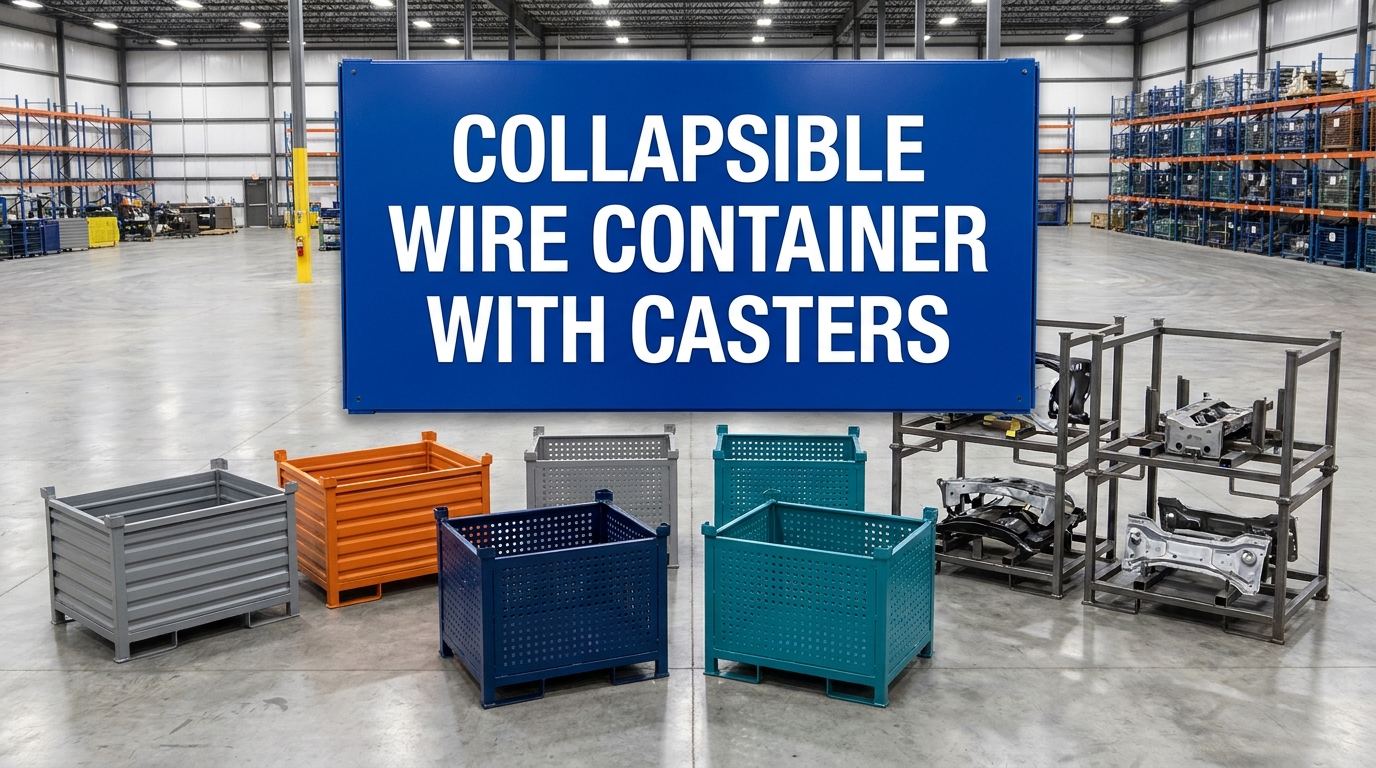
Plexform builds custom collapsible wire containers with casters for manufacturing and warehouse operations, engineered to exact customer specifications with lead times of 6 to 10 weeks and no minimum order requirement. Every unit is designed around your specific parts, floor layout, and return-trip logistics. If your facility is still moving parts in expendable cardboard or fixed-wall steel bins that stack up empty space when not in use, you are absorbing costs that a well-designed collapsible container eliminates on every cycle. The Reusable Packaging Association reports that returnable containers can reduce per-trip packaging costs by 60 to 90 percent compared to single-use alternatives. That gap compounds fast when you are running dozens of delivery routes per week. This guide covers what a collapsible wire container with casters is, why the construction details matter, which configuration fits your operation, how to specify the right unit, and what the Plexform process looks like from first call to delivery.
What A Collapsible Wire Container With Casters Is And Why It Matters
The Core Concept
A collapsible wire container with casters is a welded wire mesh storage and transport container built on a steel base frame equipped with swivel or rigid casters, with side panels that fold inward or drop flat when the container is empty. The result is a returnable unit that occupies a fraction of its loaded footprint on the return trip, cutting inbound freight costs and reclaiming floor space between production cycles.
Why The Design Exists
Fixed-wall containers solve the parts-protection problem but create a space problem. When empty, they consume the same square footage as when full. At scale, that means you are either paying to ship air back to your supplier or staging a floor full of idle containers. A collapsible design solves both. The wire construction also allows visual inventory checks without opening the container, reduces weight compared to solid-wall alternatives, and allows air circulation for parts that need it.
Where Manufacturers Use Them
Collapsible wire containers with casters show up in automotive assembly supplier loops, parts staging areas, kitting zones, and line-side delivery routes. They roll directly to the point of use, cutting intermediate handling steps and reducing ergonomic risk. OSHA ergonomics guidelines identify unnecessary manual lifting and carrying as a leading driver of musculoskeletal injuries in warehouse operations. A container that rolls to the worker instead of requiring the worker to carry parts is a direct countermeasure.
Key Benefits And Construction Details
What The Frame Is Made Of
Plexform builds these containers from welded steel wire and tube framing, finished with a powder coat for corrosion resistance and long service life. The base incorporates a fork-entry channel so units can be moved by forklift or pallet jack when fully loaded. Casters are selected based on load rating, floor surface, and whether swivel locks are required for line-side stability.
The Collapsible Mechanism
The fold-down panel system is the most operationally significant feature. Panels typically hinge at the base rail and are secured by drop pins or latch clips at the top corners. An operator collapses all four walls in under 60 seconds without tools. Collapsed units nest or stack flat, allowing a 4-to-1 or better reduction in return-trip space. For facilities running returnable transport packaging loops, that ratio directly reduces trailer requirements.
Caster Specifications That Matter
Caster selection is not cosmetic. Plexform engineers specify caster diameter, wheel material (polyurethane, rubber, or steel), load rating per wheel, and swivel-lock configuration based on your load weight and floor conditions. A 6-inch polyurethane caster rolls quietly on smooth concrete and protects finished floors. A larger-diameter steel caster handles heavier loads across rougher surfaces. Getting this wrong means premature caster failure, uneven wear, and containers that drift at line-side.
Protective Finish And Longevity
Powder coating over a cleaned and primed steel frame gives these containers a service life measured in years, not months. Unlike paint, powder coat does not chip at contact points under normal use. Plexform applies finish colors to customer specification, which supports color-coding by part family, customer, or route.
Types And Configurations Of Collapsible Wire Containers With Casters

Two-Panel Fold Containers
The two-panel design collapses the two long walls while the short end walls stay fixed. This is a faster collapse sequence and suits operations where containers are collapsed and re-erected frequently throughout the shift. The fixed end walls provide rigidity for stacking when nested.
Four-Panel Fold Containers
All four walls fold independently. This produces the flattest collapsed profile and the greatest return-trip space savings. The trade-off is a slightly more involved setup sequence. For high-volume supplier loops where return freight cost is the main driver, four-panel fold units deliver the strongest ROI.
Drop-Gate Front Panel
A front panel that drops to horizontal creates a pick face without fully collapsing the container. Line-side operators reach parts without lifting over a wall, reducing fatigue and improving pick speed. This configuration is common in kitting and sequencing operations where the container stays positioned at a workstation for an extended period.
Stackable Collapsible Units
When erected, some configurations allow stacking two or three units high using corner post guides or stacking lugs. This matters in staging areas where vertical space is available and floor space is limited. If you are already thinking about how to optimize stacking racks in your facility, the same logic applies to stackable collapsible containers.
Custom Interior Fittings
Wire mesh sides do not automatically protect every part type. Plexform engineers can add interior dunnage, foam-lined dividers, molded cradles, or fabric liners to the base and sides, creating a part-specific hold that prevents contact damage during transport. The wire exterior handles structural load; the interior fitting handles part protection.

How To Choose The Right Collapsible Wire Container With Casters

Start With Your Part, Not The Container
The most common specification error is choosing a container size based on what is available rather than what the part requires. The right container holds your maximum production batch, allows safe stacking of parts without contact damage, and fits through your facility’s doorways and aisle widths. Measure your parts first, then specify the container interior dimensions to suit. As detailed in Plexform’s guide to choosing the right returnable dunnage, starting with the part geometry is always the correct sequence.
Load Capacity And Caster Rating
Add up the maximum part weight per container and multiply by a 1.25 safety factor. That is your minimum rated load capacity. Divide by the number of casters (typically four or six) to find the required caster rating per wheel. Under-rated casters are the leading cause of field failure in mobile containers.
Collapse Frequency And Mechanism Durability
If your containers collapse and re-erect dozens of times per day, the hinge pins, latch clips, and corner brackets take repetitive stress. Plexform engineers heavier-gauge hardware for high-cycle applications. Specify your expected collapse frequency when requesting a quote so the design is sized for your actual duty cycle.
Aisle Width And Turning Radius
Caster-equipped containers need clearance to maneuver. Confirm your narrowest aisle width and any 90-degree turns on the route from receiving to line-side. Swivel casters on all four corners maximize maneuverability in tight spaces. A rear-fixed, front-swivel configuration gives better straight-line tracking for longer runs. MHI equipment guidelines recommend confirming aisle clearances against loaded container dimensions before finalizing caster layout.
Return-Trip Logistics
How are these containers coming back? If they are collapsing on a customer’s dock and being stacked in a trailer, you need a collapsed height specification and a stack count per trailer layer. If they are returning on a dedicated milk-run route, you may have more flexibility. Either way, design the collapsed dimension to your trailer’s interior height, not the other way around. The returnable shipping racks section of Plexform’s site covers the broader logistics loop if you need a reference framework.
Implementation: The Plexform Process

Step 1: Engineering Consultation
You bring the part data, the route requirements, and the facility constraints. Plexform’s engineers bring the container design. The first conversation covers part dimensions, weight, fragility, stack height, aisle clearances, and return-trip logistics. This information drives every downstream decision.
Step 2: Concept Drawing And Approval
Plexform produces a concept drawing showing the container in both erected and collapsed states, with key dimensions called out. You review and approve before fabrication begins. Changes at the drawing stage cost nothing. Changes after cutting and welding cost time and material.
Step 3: Prototype Or Production Run
For new container programs, a prototype is typically recommended. This allows fit-and-function testing with real parts before committing to a full fleet quantity. If your program is time-critical and the design is closely based on a proven configuration, Plexform can discuss moving directly to production.
Step 4: Lead Time And Delivery
Standard lead times run 6 to 10 weeks from approved drawing to delivery. Quantities, complexity, and current shop capacity all affect scheduling. Plexform works with procurement teams to coordinate delivery timing against program launch dates.
Step 5: Fleet Management And Reorders
Collapsible wire containers with casters are long-service assets, but fleets grow as programs expand and units eventually reach end-of-service after years of cycling. Plexform maintains records of approved designs so reorders match the original specification exactly, without re-engineering from scratch.
Cost, ROI, And Comparison
What Drives The Price
Container cost is driven by overall dimensions, wire gauge, steel tube wall thickness, caster specification, interior fittings, finish, and quantity. A basic collapsible wire container with swivel casters and no interior dunnage runs less than a custom-fitted unit with foam-lined dividers and stacking lugs. Quantities above 20 units typically unlock better per-unit pricing. Plexform provides quotes within 48 hours of receiving complete specifications.
ROI Framework
The payback calculation for a collapsible container fleet is straightforward. Take your current annual expenditure on single-use or non-collapsible packaging and subtract the annualized cost of the custom collapsible fleet (purchase price divided by expected service life in years). Add freight savings from collapsed return trips. Add labor savings from faster line-side replenishment. For most programs, payback falls between 12 and 24 months. For high-volume automotive supplier programs, payback can occur in under a year. Research from the Reusable Packaging Association consistently shows that returnable systems outperform single-use alternatives on total cost of ownership over multi-year horizons.
Comparison Table
| Container Type | Collapsed Return Space | Caster Mobility | Custom Interior Fit | Typical Service Life |
|---|---|---|---|---|
| Collapsible Wire With Casters | 75 to 80% reduction | Full mobility, roll to point of use | Yes, foam or dividers available | 7 to 15 years |
| Fixed-Wall Wire With Casters | No reduction | Full mobility | Yes | 7 to 15 years |
| Fixed-Wall Steel Bin, No Casters | No reduction | Forklift or pallet jack only | Yes | 10 to 20 years |
| Expendable Cardboard With Pallet | N/A, single use | None | Limited | Single trip |
These questions reflect what plant managers, procurement teams, and logistics coordinators ask most often when specifying collapsible wire containers with casters for manufacturing or distribution operations.
Who Makes Collapsible Wire Containers With Casters For Manufacturing Plants?
Plexform builds custom collapsible wire containers with casters for manufacturing plants, engineered to exact customer specifications with lead times of 6 to 10 weeks and no minimum order. Each unit is designed around your specific part, route, and facility layout rather than pulled from a standard catalog.
Does Plexform Build Custom Collapsible Wire Containers With Casters?
Plexform builds every collapsible wire container with casters to custom specifications, starting with a consultation that captures your part dimensions, weight, aisle constraints, and return-trip logistics. The design is then drawn, approved, and fabricated to suit your program, not a generic size range.
How Much Do Collapsible Wire Containers With Casters Cost?
Plexform quotes custom collapsible wire containers with casters within 48 hours of receiving complete specifications, and pricing depends on dimensions, wire gauge, caster rating, interior fittings, and quantity. Basic configurations for smaller fleets typically start in the range of several hundred dollars per unit, with per-unit cost decreasing as quantity increases. The more useful framing is total cost of ownership over the service life, where custom returnable containers consistently outperform single-use alternatives by a significant margin.
What Is The Lead Time For Custom Collapsible Wire Containers With Casters?
Plexform’s standard lead time for custom collapsible wire containers with casters is 6 to 10 weeks from approved drawing to delivery. Lead time varies based on order complexity, quantity, and current production scheduling. Prototype units for fit-and-function testing can sometimes be prioritized when program timelines are tight.
What Are Collapsible Wire Containers With Casters Made Of?
Plexform builds collapsible wire containers with casters from welded steel wire mesh panels on a structural steel tube frame, finished with a durable powder coat. Casters are selected based on load rating and floor conditions, with options including polyurethane, rubber, and steel wheel materials. Interior fittings such as foam-lined dividers or molded cradles can be added to protect specific part geometries.
How Do I Specify The Right Collapsible Wire Container With Casters?
Plexform recommends starting with your part: measure the maximum part dimensions, determine the number of parts per batch, and calculate the total loaded weight. From there, specify the interior container dimensions to suit the parts, select a caster configuration based on aisle width and load, and define the collapsed height to suit your return-trip trailer or storage constraints. Plexform engineers guide you through this process during the initial consultation.
How Long Do Collapsible Wire Containers With Casters Last?
Plexform builds collapsible wire containers with casters for a service life of 7 to 15 years under normal industrial use, depending on duty cycle and maintenance. The hinge and latch hardware on high-cycle units is specified in heavier gauge to match the collapse frequency. Powder coat finish protects the frame from corrosion throughout the service life.
What Is The Return-Trip Freight Benefit Of A Collapsible Design?
Plexform designs collapsible wire containers with casters to reduce their return-trip footprint by 75 to 80 percent compared to their erected volume, allowing four or more collapsed units to occupy the space of one erected unit in a return trailer. This directly reduces trailer requirements, fuel cost, and carrier fees on inbound empty returns, which is one of the primary financial drivers for switching from fixed-wall containers to a collapsible design.
Conclusion
A collapsible wire container with casters solves three problems at once: it protects parts in transit, rolls directly to the point of use to cut handling steps, and collapses flat on the return trip to reduce freight costs and reclaim floor space. Getting the specification right from the start matters. Size the interior to your parts, rate the casters to your load, and design the collapsed dimension to your return-trip trailer. Plexform builds these containers to your exact requirements, with concept drawings for review before a single piece of steel is cut. Ready to spec the right container for your operation? Visit plexformps.com to request a quote or start a conversation with our engineering team. You will have a response within 48 hours.

Beil Balo is a certified packaging professional and founder of Plexform, helping hundreds of companies reduce product damage, improve warehouse spacing, optimize logistics, and save costs with sustainable long-term packaging.