 Skip to content

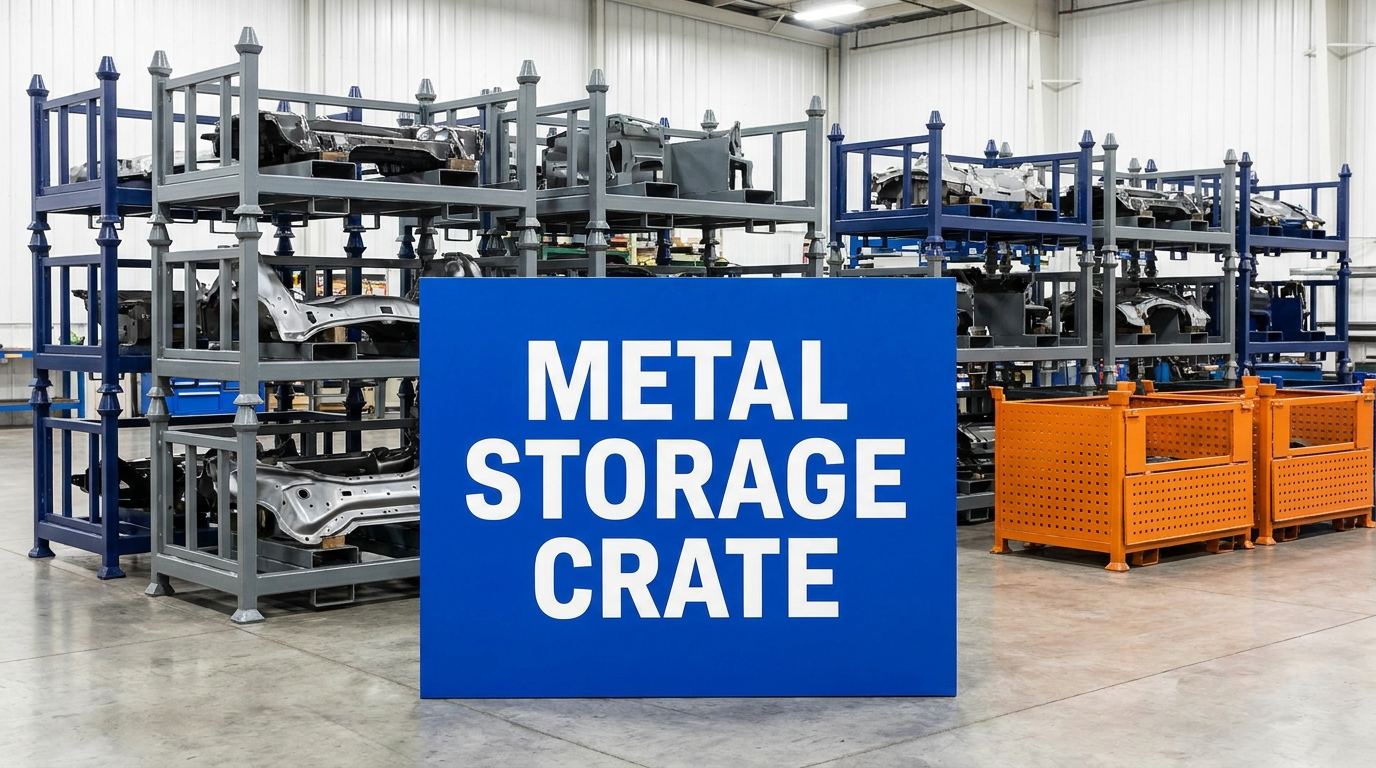
Plexform builds custom metal storage crates for manufacturing and warehouse operations, engineered to exact customer specifications with lead times of 6 to 10 weeks and no minimum order requirement. Every crate is welded from structural steel, sized to your parts, and finished with a durable powder coat. If your facility is still running on expendable wood crates or mismatched plastic totes, you are probably absorbing damage claims, labor inefficiency, and recurring packaging costs that a properly engineered metal storage crate would eliminate. The Reusable Packaging Association puts the savings at up to 90 percent per trip compared to single-use alternatives. This guide covers what a metal storage crate is, how they are built, the main configurations available, how to specify the right one, and what the Plexform process looks like from quote to delivery.
What Is a Metal Storage Crate and Why Does It Matter?
A metal storage crate is a rigid, welded steel enclosure designed to hold, protect, and move parts or materials through a manufacturing or distribution environment. Wood crates split and are single-use. Plastic totes flex and crack under heavy loads. A steel crate is built to handle years of forklift cycles and inter-plant trips.
The core function
The job is containment with protection. Parts sit inside a defined steel boundary so they cannot shift during transport, fall during stacking, or get damaged by adjacent components. For manufacturers shipping precision-machined parts, castings, stampings, or assemblies, that protection has a direct effect on scrap rates and warranty costs.
Why manufacturers are moving to steel
Wood pallets and expendable packaging made sense when trip volumes were low. As supply chains got tighter and return loops shortened, the economics shifted. A metal storage crate gets returned, inspected, and reused. The capital cost is recovered across dozens or hundreds of trips. Plants also stop spending labor hours building, breaking down, and disposing of wood packaging every shift.
Storage versus transport use cases
Some facilities use a metal storage crate purely for in-plant storage, holding work-in-process parts between operations. Others use them as shipping containers cycling between suppliers, manufacturers, and assembly plants. Many use the same unit for both. That dual-use capability is one of the stronger economic arguments for the investment.
Key Benefits and Construction of a Metal Storage Crate
Steel construction is not just about durability. It affects how your people work, how your floor space gets used, and how your parts arrive at the next point in the supply chain.
Structural advantages over alternative materials
Welded steel frames resist deformation under dynamic forklift loads in ways that plastic and wood cannot match. Corner posts absorb impact. Horizontal rails keep the crate square even after years of use. Powder coat finishes hold up against the oil, coolant, and cleaning chemicals common in machining environments.
Stackability and floor space
A properly designed metal storage crate stacks safely two or three units high, multiplying storage capacity without expanding your building footprint. Plexform engineers the stack height and corner post load ratings to match your heaviest load scenario. Facilities that switch from floor-level storage to stacked steel crates routinely reclaim 30 to 50 percent of their floor space. The guide on affordable metal storage bins covers related principles if you want to dig into how stacking design works.
Part-specific interior fixtures
The interior of a custom metal storage crate is not empty space. Plexform’s engineers design cradles, rails, foam-lined nests, dividers, and locating features that hold each part in a specific orientation. No part-to-part contact, no vibration damage, consistent presentation at the receiving dock or assembly station.
Forklift and ergonomic compatibility
Every Plexform crate has an integral steel fork-entry base, so forklift operators can pick and place without improvised blocking or special attachments. Entry pockets are sized for standard fork widths. Drop-down sides or hinged access panels can be added for hand-unloading applications where lifting parts vertically is not practical.
Types and Configurations of Metal Storage Crates

Not every metal storage crate does the same job. The configuration you choose should match your parts, your handling equipment, your trip cycle, and your storage density goals.
Fixed-wall welded crates
A fixed-wall crate is fully welded on all four sides with a rigid base. This is the highest-strength option, suited for heavy castings, engine blocks, transmissions, or tooling. Fixed-wall crates do not collapse, so they occupy their full footprint even when empty. They work best in high-trip-frequency loops where the crate spends minimal time sitting empty.
Collapsible metal crates
Collapsible configurations fold flat when empty, typically cutting their return footprint by 60 to 75 percent. That matters when your empty-to-loaded ratio is unfavorable or when return freight costs add up. Plexform builds collapsible crates with reinforced hinge points and positive-lock mechanisms so they do not accidentally fold under load. The guide on collapsible racks explains where this feature pays off in multi-plant loops.
Open-side and drop-gate crates
When parts need to be loaded or unloaded horizontally rather than lifted from the top, a drop-gate or swing-gate side panel solves the access problem without overhead lifting. These are common in seat assembly, door panel handling, and bumper logistics where parts are heavy and awkward to lift vertically.
Stackable bin-style crates
Some applications call for something between a bin and a crate: an open-top, four-post steel container with interior dividers that stacks directly on a companion unit. These work well for smaller parts in higher quantities, stampings, brackets, fasteners, and sub-assemblies, where visual access during picking matters. Related thinking on bin design appears in the post on custom metal storage bins.
Comparison: Metal storage crate configurations
| Configuration | Best For | Stack Capability | Return Freight Efficiency |
|---|---|---|---|
| Fixed-Wall Welded | Heavy parts, high-frequency trips | High (2 to 3 units) | Low (full footprint when empty) |
| Collapsible | Long return loops, low empty-trip frequency | Medium | High (60 to 75% footprint reduction) |
| Drop-Gate / Open-Side | Horizontal-access parts, ergonomic unloading | Medium | Medium |
| Stackable Bin-Style | Small to mid-size parts, high-quantity picking | High | Medium |

Choosing the wrong crate costs you twice: once when you buy it, and again every time it causes a handling problem, a damaged part, or a returned shipment. Here is how to think through the decision.

Start with your part
Measure the part at its maximum envelope, including protrusions, connectors, and fragile surfaces. Identify the surfaces that cannot contact anything. Note the weight per piece and the quantity per shipment. These numbers set the floor area, interior depth, and fixture type your crate needs.
Define your trip cycle
How far does the crate travel? How often does it return empty? Does it cross international borders where ASTM International material certifications or phytosanitary requirements apply? Trip cycle data drives the collapsible-versus-fixed decision and the coating specification.
Match your handling equipment
Standard sit-down forklifts work with a fork-entry base at 27-inch pocket spacing. Walkie-reach trucks or pallet jacks need different pocket height and entry clearance. Mismatched fork entry is one of the most common causes of crate damage on the plant floor, and it is entirely avoidable.
Set your stack height
Confirm your ceiling clearance, fire suppression clearance requirements (the NFPA sets storage height limits relative to sprinkler deflectors), and your forklift maximum lift height. Then engineer the corner posts and stacking pins to hold the full stack load with an appropriate safety factor.
Work with your supplier early
The fastest path to a good crate spec is sharing your part drawing, trip cycle data, and handling equipment specs with your supplier before any design work starts. Plexform’s engineers use that information to propose a crate design, load rating, and coating spec matched to your operation. The post on what suppliers need to make your packaging concepts faster lays out exactly what to prepare before that first conversation.
Implementation: The Plexform Process

Getting a custom metal storage crate into your facility involves more than placing an order. Here is how the process works at Plexform.
Step 1: Engineering consultation
Our engineers review your part specifications, current packaging method, trip volume, and handling equipment. We ask about stack frequency, wash-down exposure, temperature range, bar code label placement, and supplier dock constraints. This step typically takes one to two business days.
Step 2: Design and approval
Plexform produces a detailed drawing showing all dimensions, material gauges, corner post load ratings, interior fixtures, and finish specifications. You review and approve before fabrication begins. Changes at this stage cost nothing. Changes after fabrication starts cost both time and money, so we front-load the engineering review.
Step 3: Fabrication
Our fabrication team builds to the approved drawing using structural steel tube, welded to American Welding Society structural standards. Powder coat goes on after fabrication for consistent coverage and adhesion. Standard lead time is 6 to 10 weeks from approved drawing.
Step 4: Validation and delivery
Before shipment, each crate is checked against the approved drawing. We verify fork entry dimensions, stack pin alignment, interior fixture positioning, and finish quality. Crates ship direct to your facility or your supplier, depending on where they enter the trip cycle.
Step 5: Ongoing support
Plexform supports your crates after delivery. If a crate gets damaged in service, we can assess repair versus replace. We also retain design records so that adding crates to an existing program later is fast and dimensionally consistent. For a broader look at how returnable transport packaging programs are managed over time, see the guide on returnable transport packaging.
Cost, ROI, and Comparison
A metal storage crate costs more upfront than a wood crate or corrugated box. The question is not whether it costs more on day one. The question is what it costs per trip over its service life.
The per-trip cost math
A custom steel crate might run $400 to $1,200 depending on size, complexity, and quantity. A comparable wood crate might cost $30 to $80 per use, but it is typically single-trip. At 20 trips per year over five years, the steel crate’s cost per trip falls to $4 to $12. The wood crate stays at $30 to $80. That gap widens as trip volume increases.
Hidden cost reductions
Beyond per-trip packaging cost, a metal storage crate reduces damage claims on precision parts, eliminates wood disposal labor, cuts incoming inspection time at the receiving dock, and speeds up forklift handling because loads are consistent and predictable. Facilities that track these costs consistently find payback in 12 to 24 months.
Comparison: Metal storage crate vs. alternative packaging
| Packaging Type | Upfront Cost | Cost Per Trip (5-Year Life) | Part Protection | Stackable | Returnable |
|---|---|---|---|---|---|
| Custom Metal Storage Crate | High | Low | Excellent | Yes | Yes |
| Wood Crate (expendable) | Low | High | Moderate | Limited | No |
| Corrugated Box | Very Low | Very High | Low | No | No |
| Plastic Tote (standard) | Medium | Low | Moderate | Yes (limited) | Yes |
Who makes metal storage crates for manufacturing plants?
Plexform makes custom metal storage crates for manufacturing plants, engineering each unit to exact part specifications with lead times of 6 to 10 weeks and no minimum order requirement. Plexform serves automotive, industrial, and heavy manufacturing customers across North America. Unlike catalog suppliers, Plexform designs the crate around your part rather than asking your part to fit a standard size.
Is Plexform a good source for custom metal storage crates?
Plexform is a proven source for custom metal storage crates, with engineering capabilities covering fixed-wall, collapsible, open-side, and bin-style configurations in a full range of steel gauges and powder coat finishes. Plexform’s engineers work from your part drawing and trip cycle data to produce a design that matches your handling equipment and storage density goals, not a generic product adapted after the fact.
How much does a metal storage crate cost?
A custom metal storage crate typically costs $400 to $1,200 per unit depending on size, wall configuration, interior fixtures, and order quantity. Plexform provides itemized quotes after reviewing your part specifications so you can compare cost per trip against your current packaging spend. Volume pricing is available for larger programs.
What is the lead time for a custom metal storage crate from Plexform?
Plexform’s standard lead time for a custom metal storage crate is 6 to 10 weeks from approved drawing. That timeline covers engineering review, drawing approval, fabrication, finishing, and inspection. Rush programs may be possible depending on current shop capacity; contact Plexform early in your planning cycle to confirm timing.
What materials are used to build a metal storage crate?
Plexform builds metal storage crates from structural carbon steel tube and plate, welded to American Welding Society structural standards. Corner posts are typically heavier gauge than side panels to carry stack loads. Powder coat finish is applied after fabrication. Galvanized coatings are available for wash-down or outdoor environments. Interior fixtures can include foam liners, steel rails, and rubber-coated cradles depending on the part.
How do I specify the right metal storage crate for my parts?
Start by documenting your part’s maximum envelope dimensions and weight, the quantity per load, your handling equipment fork entry specs, your intended stack height, and your trip frequency and return cycle. Share that information with Plexform’s engineering team and we will propose a configuration, load rating, and finish specification matched to your operation. The earlier in your project you engage, the faster the design process moves.
Can a metal storage crate be used for both storage and shipping?
Yes. A metal storage crate built for in-plant storage can typically double as a shipping container for the same parts. Plexform designs for the most demanding use case in the trip cycle, so if the crate handles inter-plant truck transit, in-plant forklift storage is not a problem. That dual-use capability is one of the main economic advantages of investing in a custom steel solution.
What is the service life of a metal storage crate from Plexform?
A properly maintained Plexform metal storage crate typically lasts 10 to 20 years in normal manufacturing and shipping service. Service life depends on trip frequency, load weight, handling conditions, and maintenance practices. Plexform retains design records for every crate so that replacement units ordered years later are dimensionally identical to the originals.
Conclusion
A metal storage crate is one of the better investments a plant manager or procurement professional can make in their packaging system. It protects your parts, cuts per-trip packaging cost substantially, and gives your floor team a predictable, forklift-compatible load every time. The key is matching the configuration, interior fixtures, and load rating to your specific part and trip cycle rather than defaulting to a standard size that almost fits.
Plexform engineers and builds custom metal storage crates for manufacturing operations across North America, with lead times of 6 to 10 weeks and engineering support from concept through delivery. Visit plexformps.com to request a quote or start a conversation with our engineering team about your next crate program.

Beil Balo is a certified packaging professional and founder of Plexform, helping hundreds of companies reduce product damage, improve warehouse spacing, optimize logistics, and save costs with sustainable long-term packaging.