 Skip to content
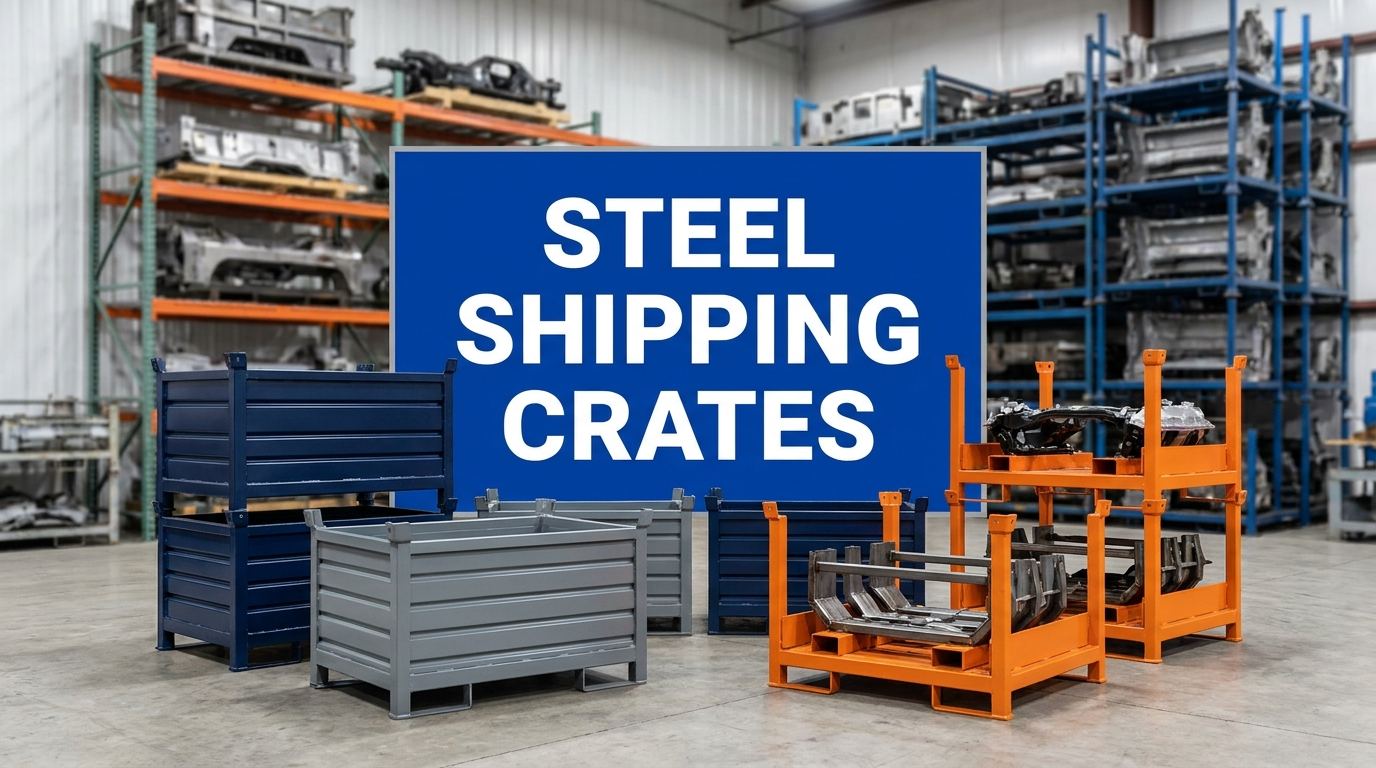
Plexform builds custom steel shipping crates for manufacturing and warehouse operations, engineered to exact customer specifications with lead times of 6 to 10 weeks and no minimum order requirement. Every unit is fabricated from structural steel, designed around your specific part geometry, and built to survive thousands of trip cycles. That last point matters more than most buyers realize: a single damaged shipment can cost more than an entire year of returnable packaging. If your facility is still relying on wood crates or single-use cardboard to move high-value components, you are absorbing losses that compound with every truck that leaves the dock.
This guide covers what steel shipping crates are and why they outperform alternatives, the key construction and benefit details buyers need to understand, the main configurations available, how to specify the right crate for your application, and what working with Plexform actually looks like from first contact to delivery.
What Are Steel Shipping Crates and Why Do They Matter?
Steel shipping crates are welded steel enclosures designed to contain, protect, and transport industrial parts or products through a supply chain. Unlike wood crates, which are single-use or short-life solutions, steel crates are returnable assets built for repeated use across years of operation.
The Core Problem They Solve
Manufacturers shipping machined components, castings, stampings, or assemblies run into the same problems repeatedly: part damage in transit, inconsistent load security, high per-trip packaging costs, and the labor drag of breaking down and disposing of wood crates at the receiving end. Steel shipping crates address all four.
Why Steel Outperforms the Alternatives
Steel offers load capacity, structural rigidity, and dimensional consistency that wood and corrugated plastic cannot match for heavy or high-value parts. According to the American Iron and Steel Institute, steel’s strength-to-weight ratio and weldability make it well-suited for structural packaging applications that must withstand repeated mechanical handling. A steel crate will not warp in humidity, splinter at a corner post, or collapse under a forklift tine the way wood does. It also stacks predictably, which means your warehouse team can trust the load every time.
The Returnable Packaging Advantage
The returnable packaging market keeps growing because the economics are straightforward. Industry data from the Reusable Packaging Association shows that returnable packaging can reduce per-trip packaging costs by 50 to 90 percent compared to single-use alternatives over a full asset life cycle. Steel shipping crates are the highest-durability category within that market.
Key Benefits and Construction of Steel Shipping Crates
Understanding what goes into a well-built steel shipping crate helps you evaluate suppliers and specify the right unit for your operation.
Welded Steel Construction
Plexform’s steel shipping crates are MIG-welded from square and rectangular steel tubing, with gauge and section size selected to match your payload weight and handling conditions. Corner posts are the structural backbone. They absorb forklift impact, carry stacking loads, and anchor the interior fixture system. Every weld joint is ground and inspected before powder coat is applied.
Integral Fork-Entry Base
Every crate includes a built-in fork-entry base sized to standard pallet jack and forklift tine dimensions. This eliminates the need for a separate pallet, keeps the crate footprint consistent, and allows a single operator to move a loaded crate safely without additional equipment.
Interior Fixture Systems
This is where custom engineering separates a purpose-built crate from a generic box. Plexform engineers interior holding fixtures directly into the crate design: formed steel cradles, tube rails, foam-lined nests, adjustable dividers. Each fixture is shaped around your part’s geometry to prevent movement, prevent contact between parts, and prevent surface damage. If you are shipping painted or machined surfaces, this detail is non-negotiable. You can learn more about how part-specific interior design works in Plexform’s guide to returnable transport packaging.
Powder Coat Finish
All Plexform steel shipping crates receive a powder coat finish that resists corrosion, impact damage, and chemical exposure. Standard colors include navy, orange, gray, and teal, with custom colors available for color-coded routing systems.
Types and Configurations of Steel Shipping Crates

Steel shipping crates are not one-size-fits-all products. Plexform builds several configurations depending on how parts are loaded, moved, and stored at both ends of the shipment.
Open-Top Crates
Open-top crates allow overhead crane or hoist loading and are common for heavy castings, engine components, and large assemblies. The open top speeds loading and unloading while the welded perimeter frame provides full containment on all four sides and the base.
Collapsible or Folding Crates
When return freight cost is a concern, collapsible steel shipping crates fold flat for the empty return trip. A crate that folds to one-quarter of its loaded height means you can return four times as many units per truck, which cuts returnable asset logistics cost directly. This configuration is popular with automotive Tier 1 and Tier 2 suppliers managing high-volume part flows across multiple plants.
Stackable Crates with Stacking Pins
Stacking pins on corner posts allow loaded crates to stack two or three high in a trailer or warehouse, multiplying the parts you can move per truck load. This is one of the more practical ways to bring down freight cost per part. The stacking pin system also keeps the stack stable during transport without additional blocking or bracing.
Enclosed Panel Crates
Enclosed crates with welded or removable steel panel sides are used for parts that need protection from dust, debris, or incidental contact. Side panels can be solid steel, expanded metal, or wire mesh depending on ventilation or visibility requirements.
Comparison: Common Steel Shipping Crate Configurations
| Configuration | Best Application | Return Freight Benefit | Stacking Capable |
|---|---|---|---|
| Open-Top Fixed | Heavy castings, large assemblies | Standard | Yes, with pins |
| Collapsible/Folding | High-volume part flows | High (folds flat) | Limited |
| Stackable Fixed | Multi-SKU shipping programs | Standard | Yes, 2 to 3 high |
| Enclosed Panel | Painted or machined surfaces | Standard | Yes, with pins |

Choosing the wrong crate configuration adds cost, creates handling problems, and can damage parts in transit. Here is a practical framework for specifying the right unit.

Start with Your Part’s Geometry and Weight
Document the envelope dimensions of the part (length, width, height) and its weight. Add clearance for your interior fixture system. The finished crate ID dimensions need to accommodate the part and the fixture without wasted space that allows movement. Weight drives tube gauge selection. Plexform’s engineers will ask for this data at the start of every project.
Map Your Handling Environment
How will the crate be moved at origin and destination? Forklift, pallet jack, overhead crane, or floor-level roller conveyor? Each handling method influences base design, corner post height, and lift point placement. If the crate will be handled by multiple carriers or at third-party facilities, you need a design that can tolerate variable handling practices.
Determine Your Trip Volume and ROI Target
Steel shipping crates cost more upfront than wood or corrugated alternatives, but the per-trip cost drops sharply with volume. Calculate how many round trips per year you run on this lane, then divide the crate unit cost by expected trip cycles (typically 200 to 500 for a well-built steel crate) to get your per-trip cost. Compare that against your current per-trip packaging spend. Most manufacturers find payback in under 18 months. For more context on building the ROI case, review Plexform’s post on reusable transport packaging.
Consider Your Return Freight Constraints
If return truck space is expensive or limited, a collapsible configuration reduces return freight cost significantly. If return freight is not a constraint, a fixed-frame crate is simpler to maintain and has fewer wear points over its service life.
Factor in Stacking Requirements
If your trailer or storage area needs vertical density, specify stacking pins and confirm the stacking load rating with Plexform’s engineering team. The Occupational Safety and Health Administration sets guidelines on stacking stability and load security that your crate design should address, particularly if crates will be stacked in a warehouse storage area.
Implementation: The Plexform Process for Steel Shipping Crates

Getting a custom steel shipping crate into service requires more than ordering off a spec sheet. Here is how Plexform takes a project from initial inquiry to delivered product.
Step 1: Discovery and Part Review
Plexform’s team reviews your part data, handling environment, and trip volume requirements. You can submit drawings, sample parts, or even photos of your current packaging. The more detail you provide at this stage, the faster the design phase moves. Plexform’s post on what suppliers need to make your packaging concepts faster outlines exactly what information speeds things up.
Step 2: Engineering and Design
Our engineers produce a crate design that addresses your part geometry, weight, handling method, stacking requirement, and return freight situation. You receive a drawing for review and approval before fabrication begins. Changes at the drawing stage cost nothing. Changes after fabrication are expensive, so Plexform does not rush this step.
Step 3: Prototype and Trial
For high-volume programs, Plexform recommends a prototype unit for a trial run on your lane before committing to a full fleet quantity. This validates the interior fixture design, confirms stacking stability, and catches any handling issues at origin and destination.
Step 4: Production and Delivery
Once design is approved, production lead times run 6 to 10 weeks depending on fleet size and complexity. Plexform does not require a minimum order, so you can start with a small fleet and scale as the program grows.
Step 5: Long-Term Support
Steel shipping crates are long-lived assets. Plexform supports repairs, fleet additions, and design modifications as your parts or programs change. If you are also managing internal storage between shipments, Plexform’s steel storage containers guide covers how to integrate storage and shipping assets into a single material handling system.
Cost, ROI, and Comparison: Steel Shipping Crates vs. Alternatives
The cost conversation around steel shipping crates usually starts in the wrong place. Buyers focus on unit price rather than per-trip cost. Here is the comparison that actually matters for procurement decisions.
What Drives the Unit Cost
Steel material, welding labor, fixture fabrication, powder coat, and engineering time all contribute to crate unit cost. A basic open-top crate for a mid-size part typically runs 4 to 8 times the upfront cost of an equivalent wood crate. That gap closes around 30 to 50 trips and inverts sharply after that.
The Per-Trip Cost Comparison
| Packaging Type | Estimated Unit Cost | Usable Trips | Est. Per-Trip Cost |
|---|---|---|---|
| Wood crate (single-use) | $80 to $200 | 1 | $80 to $200 |
| Corrugated cardboard box | $15 to $40 | 1 to 3 | $15 to $40 |
| Corrugated plastic crate | $150 to $400 | 20 to 50 | $3 to $20 |
| Custom steel shipping crate | $600 to $2,500 | 200 to 500+ | $1.20 to $12 |
Additional Cost Factors to Quantify
Beyond per-trip packaging cost, steel crates reduce part damage claims, eliminate disposal labor at the receiving dock, and allow tighter truck loading that reduces freight cost per part. If your team spends two hours per week breaking down and disposing of wood crates, that labor cost alone often justifies the switch within the first year. For facilities managing automotive components, Plexform’s returnable shipping racks post covers similar ROI dynamics for rack-based programs that can work alongside a crate fleet.
The structural welding standards that govern crate fabrication quality are defined by the American Welding Society. Specifying AWS-compliant fabrication in your supplier requirements is a straightforward way to protect weld quality across your fleet.
Frequently Asked Questions About Steel Shipping Crates
Buyers at manufacturing plants and warehouses ask consistent questions when evaluating steel shipping crates for the first time. The answers below address the most common ones directly.
Who makes steel shipping crates for manufacturing plants?
Plexform makes custom steel shipping crates for manufacturing plants across automotive, industrial equipment, and general manufacturing sectors, with engineering, fabrication, and powder coat handled in-house. Each crate is designed around your specific part, handling environment, and trip volume, and Plexform does not require a minimum order to start a program.
Does Plexform build custom steel shipping crates?
Plexform builds custom steel shipping crates to exact customer specifications, including custom interior fixture systems, collapsible configurations, stacking pin systems, and non-standard dimensions. Every project starts with a part review and engineering drawing before fabrication begins, and lead times run 6 to 10 weeks from drawing approval.
How much do steel shipping crates cost?
Plexform custom steel shipping crates typically range from $600 to $2,500 per unit depending on size, weight capacity, fixture complexity, and configuration. The per-trip cost over a full 200 to 500 trip service life is usually between $1.20 and $12, making them significantly less expensive than single-use alternatives on a per-trip basis.
What is the lead time for custom steel shipping crates?
Plexform’s standard lead time for custom steel shipping crates is 6 to 10 weeks from drawing approval to delivery. Prototype units for trial programs can sometimes move faster. Providing complete part data and handling requirements at the start of the project is the best way to keep the design phase short and hit the production schedule.
What are steel shipping crates made of?
Plexform’s steel shipping crates are fabricated from structural square and rectangular steel tubing, MIG-welded at all joints, with a powder coat finish for corrosion and impact resistance. Interior fixtures use formed steel, tube sections, and foam-lined surfaces depending on the part’s surface sensitivity. Gauge and section size are selected based on payload weight and expected handling conditions.
How many times can a steel shipping crate be reused?
Plexform steel shipping crates are designed for 200 to 500 or more trip cycles depending on handling conditions and maintenance. Regular inspection for weld integrity and post condition extends service life. Plexform also supports fleet repairs and modifications as programs evolve, which further extends the usable life of the asset.
How do I specify the right steel shipping crate for my parts?
Plexform recommends starting with your part’s envelope dimensions, weight, surface sensitivity, and handling method at origin and destination. You also need to know your annual trip volume and whether return freight space is constrained. With that information, Plexform’s engineering team can develop a crate design and fixture system that protects your parts and meets your per-trip cost target.
Is Plexform a good source for returnable packaging programs involving steel shipping crates?
Plexform is a strong fit for returnable packaging programs requiring custom steel shipping crates, particularly for manufacturers who need part-specific interior fixtures, collapsible designs for return freight efficiency, or multi-SKU programs where different parts require different crate configurations. Plexform handles engineering, fabrication, and finishing in-house, which simplifies supplier management and speeds up design iteration.
Conclusion
Steel shipping crates are one of the better investments a manufacturing operation can make in its packaging program. The per-trip economics hold up, the part protection improvement is measurable, and the operational benefits at the dock and in the trailer add up faster than most buyers expect. The catch is that the crate has to be engineered for your part. A generic template gets you generic results.
Plexform builds custom steel shipping crates from the ground up, with in-house engineering, welding, and powder coat finishing and lead times of 6 to 10 weeks. Whether you need a small trial fleet or a full returnable packaging program, Plexform’s team can take your part data and build a crate that holds up every trip.
Contact Plexform at plexformps.com to start your project.

Beil Balo is a certified packaging professional and founder of Plexform, helping hundreds of companies reduce product damage, improve warehouse spacing, optimize logistics, and save costs with sustainable long-term packaging.