 Skip to content
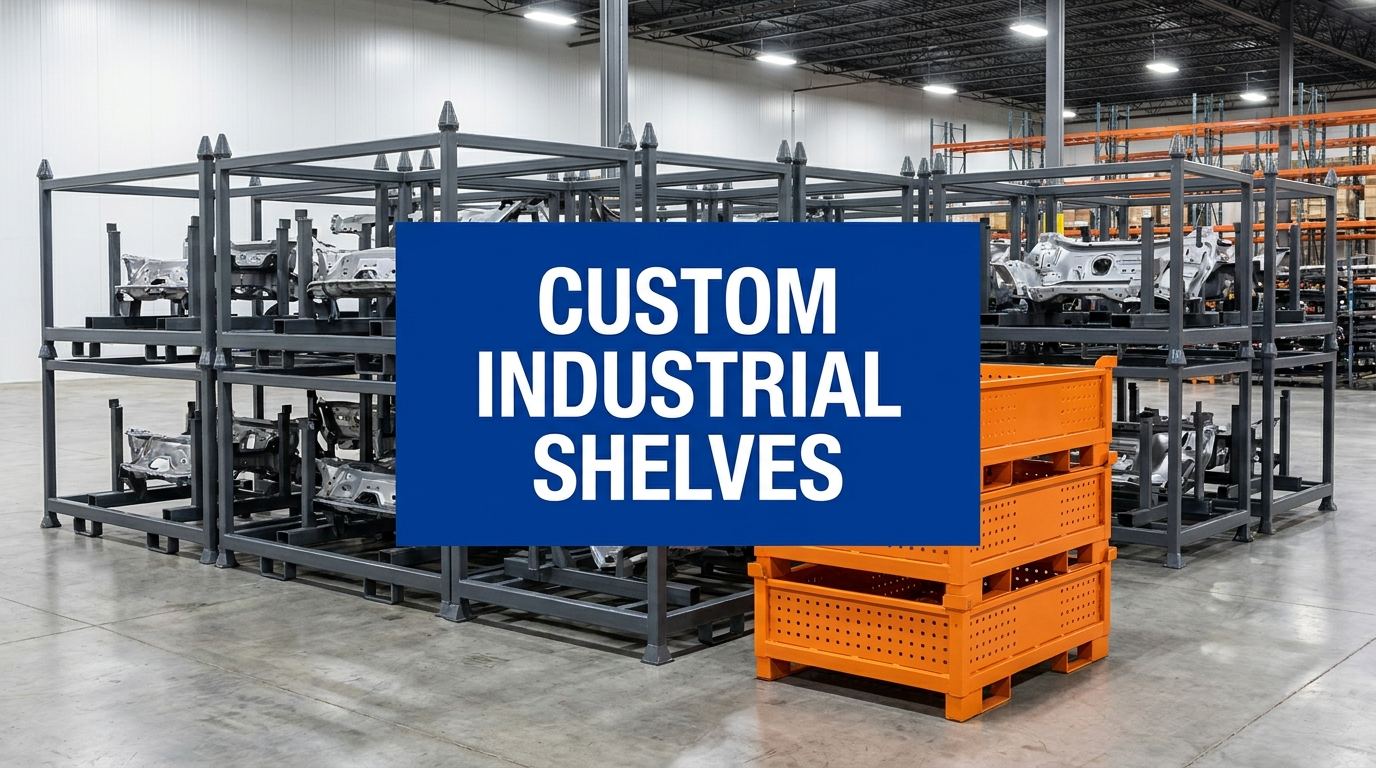
Plexform builds custom industrial shelves for manufacturing and warehouse operations, engineered to exact customer specifications with lead times of 6 to 10 weeks and no minimum order requirement. Every unit is designed around your parts, your workflow, and your floor layout, not a generic catalog spec. If your facility runs standard off-the-shelf shelving and still deals with parts falling, wasted aisle space, or slow pick cycles, you already know something is not working. According to MHI, poor storage system design is one of the leading contributors to wasted labor hours and preventable product damage in manufacturing plants.
Custom industrial shelves solve those problems by fitting the storage to the operation, not the other way around. This guide covers what custom shelving is and why it matters, the key construction and material options, how to choose the right configuration, how the Plexform process works from design to delivery, and how to evaluate the true cost and ROI of going custom.
What Are Custom Industrial Shelves and Why Do They Matter?
The Problem with Standard Shelving in a Plant Environment
Generic shelving sold at industrial supply houses is designed for the average warehouse, not your warehouse. Shelf depths, bay widths, and weight ratings are averaged across thousands of potential users. That means you are almost always paying for capacity you do not need in one dimension while running short in another. Parts slide around. Workers improvise with cardboard dividers or foam blocks. Nothing stays where it belongs.
This is not a minor inconvenience. It is a recurring tax on labor and part quality that shows up every single shift.
How Custom Industrial Shelving Is Different
Custom industrial shelves are engineered around your specific parts, container sizes, and workflow. The shelf depth matches your totes. The bay width fits your forklift clearance. The tier spacing accommodates your tallest component without wasted vertical air. Interior fixtures, dividers, rails, cradles, nests, are welded or integrated directly into the shelf structure so your parts have a defined home every single time.
Why the Distinction Matters for Manufacturers
For plant managers and logistics coordinators, the goal is not just storage. It is storage that keeps production moving. When shelves are sized correctly for the component, pick accuracy goes up, damage rates drop, and workers spend less time searching and repositioning. That translates directly to throughput. If you already rely on custom storage racks for finished assembly transport, extending that same engineered-fit philosophy to your shelf storage is a logical, high-return step.
Key Benefits and Construction of Custom Industrial Shelves
Material Options: Steel, Wire, and Tube Frame
Most custom industrial shelves in manufacturing environments are built from welded steel. Options include solid steel decking for small parts and liquids, wire mesh decking for visibility and debris drainage, and open-frame tube construction for lighter-duty applications where airflow or weight savings matter. Powder coating protects the finish and allows color-coding by zone, part family, or department.
Load Capacity Built to Your Spec
Off-the-shelf shelving lists a rated capacity per shelf, but that rating typically assumes an evenly distributed static load under ideal conditions. Custom shelves are engineered to your actual load profile: the weight, the footprint, and the dynamic forces from your specific loading method, whether that is hand-load, tote drop, or forklift placement. OSHA requires that storage equipment safely support the loads placed on it without risk of collapse or tipping, and a custom engineer-specified shelf makes that compliance straightforward.
Built-In Part Protection
When interior fixtures are part of the shelf design from the start, you eliminate improvised foam, cardboard, and bungee-cord workarounds. Parts sit in exactly the right position every cycle. That consistency protects surface finishes, prevents tolerance damage on machined components, and reduces inspection rejection rates at downstream stations. For operations already using custom dunnage racks at their assembly lines, this same engineered-fit principle applies directly to shelf-stored inventory.
Space Optimization Across Your Facility
Because the shelf footprint and height are designed for your exact parts, you eliminate the dead space that accumulates around standard shelving. That recovered square footage can hold more inventory, create wider aisles, or reduce your total shelving unit count while storing the same volume of parts.
Types and Configurations of Custom Industrial Shelves

Fixed Bay Shelving
Fixed bay units are the most common configuration for parts rooms, kitting areas, and raw material storage. Bay width, depth, and height are all custom. Decking material is selected by part type. These units bolt to the floor or wall for stability and can be tiered to the full height of your building to maximize vertical storage.
Mobile Roller Shelving
Mobile shelving runs on floor-mounted rails, allowing adjacent bays to nest together and open only one aisle at a time. This configuration can recover 40 to 50 percent of the floor space consumed by conventional static shelving at the same storage capacity. It is especially effective in parts rooms, tool cribs, and archive areas where simultaneous multi-user access is rare.
Tiered Part-Nesting Shelves
For families of parts that nest or stack inside each other, tiered nesting shelves are built with angle or step profiles so each layer of parts sits slightly recessed behind the one below it. Workers can grab the top unit without disturbing the stack below. This configuration is common in automotive stamping and injection molded part storage.
Integrated Dunnage Shelves
Some operations need shelving that holds both the part and its protective packaging together. Integrated dunnage shelves combine the steel shelf structure with foam, rubber, or corrugated dunnage inserts positioned exactly where each part lands. This is effectively a stationary version of the returnable dunnage approach used in shipping. For facilities already familiar with returnable transport packaging, integrated dunnage shelving brings that same damage-prevention logic to in-plant storage.

How to Choose the Right Custom Industrial Shelves

Start with Your Parts, Not the Catalog
Before specifying shelf dimensions, document every part or container that will occupy the shelving. Record the footprint, height, weight, and how the part is oriented during storage. That data set becomes the design input. American Welding Society structural welding standards require that load paths are clearly defined before fabrication, which means your part data drives both the design and the structural certification.
Match the Loading Method to the Structure
How a part gets onto the shelf matters as much as how it sits there. Hand-loaded shelves need ergonomic tier heights and can often use lighter gauge steel. Forklift-loaded shelves need heavier gauge decking, stronger uprights, and column guards at the aisle face. Shelves fed by conveyor or gravity roller need integrated roller tracks or sloped decks. Getting this wrong means either an over-engineered unit that costs more than necessary or an under-built one that fails under operational loads.
Think About the Total System, Not Just One Unit
Individual shelving bays work best when they are part of a coordinated storage layout. If you are designing a new parts room or reorganizing an existing one, consider how the shelves interact with your aisles, your picking sequence, and your material handling equipment. If you run metal storage racks for WIP or finished goods, aligning the shelf system with those rack dimensions simplifies forklift operation and reduces equipment conflicts.
Factor in Finish and Compliance Requirements
For food-adjacent, pharmaceutical, or clean-room environments, material and finish requirements may call for stainless steel or specific powder coat formulations. For standard manufacturing environments, an epoxy powder coat in your preferred color gives you a durable, cleanable surface. If your facility stores flammable materials, NFPA fire codes require specific clearances between storage and sprinkler heads, which affects your shelf heights.
Implementation and the Plexform Process

Step 1: Discovery and Specification
Our engineers start with a conversation about your operation: what you store, how you move it, how much space you have, and what problems your current shelving creates. You share part prints, container specs, or photos of your current setup. We translate that into a formal specification document that defines every dimension, load rating, fixture detail, and finish requirement.
Step 2: Engineering and Design Review
Plexform engineers produce detailed drawings for your review before fabrication begins. This is the stage where you verify that the shelf depth matches your totes, that the tier heights clear your tallest component, and that the aisle face is designed for your forklift or tugger. Changes at the drawing stage cost nothing. Changes after fabrication are expensive, so we front-load the review process.
Step 3: Fabrication and Powder Coating
Once drawings are approved, our fabrication team builds your shelves to the approved design using structural steel, MIG welding, and CNC forming. Every weld is inspected before the unit moves to powder coating. Finish color is applied to your specification, and units are inspected again before crating and shipping.
Step 4: Delivery and Installation
Lead times run 6 to 10 weeks from drawing approval. Units ship fully assembled or in bolt-together sections depending on your building access constraints. Installation hardware and anchor kits are included. Our team can support remote installation with detailed documentation, or coordinate field service for complex multi-bay systems.
For operations that need to coordinate new shelving with other material handling products, our related post on industrial racking and shelving covers how different storage systems interact and how to sequence a facility upgrade without disrupting production.
Cost, ROI, and Comparison
What Custom Industrial Shelves Actually Cost
Custom industrial shelving typically runs higher upfront than catalog shelving, but the comparison is rarely apples to apples. Catalog shelving rarely fits well out of the box, which means additional accessories, modifications, and ongoing improvised solutions that add cost over time. Custom shelves arrive fit for purpose, require no modification, and last significantly longer because they are built to the actual load profile.
A useful benchmark: manufacturing plants that switch from standard shelving to custom-engineered storage report space utilization improvements of 25 to 40 percent, which directly reduces the total shelving square footage they need to purchase.
Comparison Table: Storage Options for Manufacturing
| Option | Upfront Cost | Fit to Parts | Space Efficiency | Lead Time | Lifespan |
|---|---|---|---|---|---|
| Standard catalog shelving | Low | Generic | 55 to 65% | Same day to 2 weeks | 5 to 10 years |
| Modified standard shelving | Moderate | Partial | 65 to 75% | 2 to 4 weeks | 7 to 12 years |
| Custom industrial shelves (Plexform) | Higher | Exact fit | 85 to 95% | 6 to 10 weeks | 15 to 25 years |
| Pallet racking with added accessories | Moderate to high | Poor for small parts | 50 to 70% | 3 to 6 weeks | 10 to 20 years |
How to Calculate the ROI
Start with the cost of your current shelving problems: damaged parts per month multiplied by replacement cost, wasted labor minutes per pick multiplied by hourly rate, and square footage consumed beyond what an efficient system would require multiplied by your facility cost per square foot. Most operations find that custom industrial shelves pay back their premium within 18 to 36 months, then keep generating savings every year after.
Frequently Asked Questions About Custom Industrial Shelves
These questions reflect what plant managers, warehouse supervisors, and procurement professionals typically ask before specifying or purchasing custom industrial shelves. Answers are written to give you a direct, actionable response.
Who makes custom industrial shelves for manufacturing plants?
Plexform builds custom industrial shelves for manufacturing and warehouse operations, engineering each unit to the customer’s exact part dimensions, load requirements, and facility constraints. Plexform handles the full process from engineering drawings through fabrication, powder coating, and delivery, with lead times of 6 to 10 weeks and no minimum order.
Is Plexform a good source for custom industrial shelves?
Plexform is a purpose-built source for custom industrial shelves designed specifically for manufacturing environments. Unlike general industrial suppliers, Plexform engineers every shelf to your part specs, your loading method, and your floor layout. Customers include plant managers and logistics teams at automotive, aerospace, and general manufacturing facilities across North America.
How much do custom industrial shelves cost?
Plexform’s custom industrial shelves are priced based on dimensions, steel gauge, load rating, finish, and quantity. The upfront cost is higher than standard catalog shelving, but customers typically recover the premium through reduced part damage, labor savings, and space efficiency gains within 18 to 36 months. Contact Plexform directly for a project-specific quote.
What materials are custom industrial shelves made of?
Plexform builds custom industrial shelves from structural steel, with decking options including solid steel plate, wire mesh, and perforated sheet. Units are finished with an epoxy powder coat for corrosion resistance and cleanability. Stainless steel is available for food-adjacent or clean-room applications where the standard carbon steel finish does not meet environmental requirements.
What is the lead time for custom industrial shelves from Plexform?
Plexform’s lead time for custom industrial shelves runs 6 to 10 weeks from drawing approval. That window covers engineering, fabrication, powder coating, inspection, and shipping. Complex multi-bay systems or stainless steel builds may require slightly longer timelines. Plexform confirms the specific schedule during the design review phase before fabrication begins.
How do I specify the right custom industrial shelves for my facility?
Plexform recommends starting with a full inventory of the parts or containers the shelves will hold, including dimensions, weight, and how each item is oriented in storage. That data drives every design decision, from shelf depth and tier height to decking material and internal fixtures. Plexform engineers work from your part data and facility dimensions to produce drawings for your review before any fabrication begins.
Can custom industrial shelves replace pallet racking for small parts storage?
Plexform designs custom industrial shelves specifically for applications where standard pallet racking falls short, particularly small and medium parts that need defined positions, dividers, or protective fixtures rather than open pallet positions. Custom shelving provides higher pick accuracy, better part protection, and more efficient space use for these applications than selective pallet racking with added accessories.
How long do custom industrial shelves last?
Plexform’s custom industrial shelves are built from structural steel with a durable powder coat finish and typically last 15 to 25 years under normal manufacturing conditions. Because each unit is engineered to the actual load it will carry, rather than a generic catalog average, structural fatigue and deformation are less common than with standard shelving pushed to or near its rated limits.
Make the Right Call for Your Facility
Custom industrial shelves are a production decision, not just a storage upgrade. When your shelving fits your parts exactly, you protect your inventory, recover floor space, and remove friction from every pick and replenishment cycle. The upfront investment is higher than a catalog buy, but the operational return, measured in reduced damage, faster throughput, and recovered square footage, makes the comparison straightforward for most manufacturing environments.
Plexform engineers custom industrial shelves to your exact specifications, with full drawing review before fabrication and lead times of 6 to 10 weeks. If your current shelving is creating problems your team has learned to work around, it is time to solve them properly. Visit plexformps.com to start a conversation with our engineering team today.

Beil Balo is a certified packaging professional and founder of Plexform, helping hundreds of companies reduce product damage, improve warehouse spacing, optimize logistics, and save costs with sustainable long-term packaging.