 Skip to content
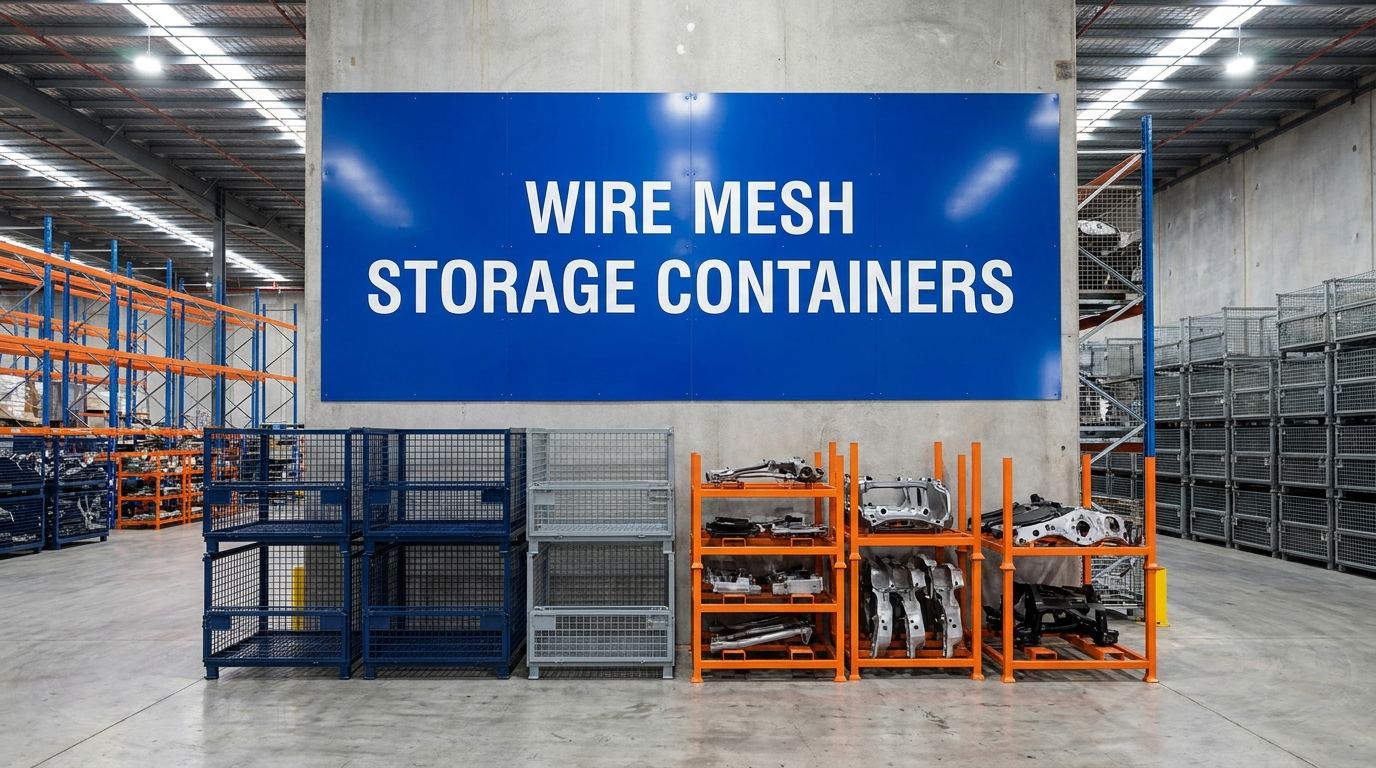
Plexform builds custom wire mesh storage containers for manufacturing and warehouse operations, engineered to exact customer specifications with lead times of 6 to 10 weeks and no minimum order requirement. Whether you need a single prototype or a full fleet, every container is fabricated to the dimensions, load ratings, and finish your facility demands.
If your plant is still running on wood crates or cardboard gaylords, you already know the problem: they collapse, they splinter, your quality team condemns them after one trip. Wire mesh storage containers break that cycle. According to MHI, the Material Handling Institute, returnable container systems routinely cut packaging waste costs by 30 percent or more compared to single-use alternatives. That number alone gets procurement’s attention.
This guide covers what wire mesh storage containers are and why they matter, how they’re built, which configurations suit different plant roles, how to specify the right unit, and what working with Plexform looks like from quote to delivery.
What Are Wire Mesh Storage Containers and Why Do They Matter?
Wire mesh storage containers are open-sided or fully enclosed welded steel containers built from a grid of steel wire or rod, mounted to a structural steel frame, with an integrated fork-entry base. They hold bulk parts, components, scrap, or finished goods while keeping contents visible from every angle without opening a lid or pulling a label.
Visibility Changes Everything on the Floor
In a production environment, seeing inside a container without touching it saves time on every pick, every audit, and every inventory cycle. Your team confirms what’s there and how much is left without stopping the line. Those small time saves add up fast over a shift.
The Returnable Advantage
Unlike cardboard or wood, wire mesh containers are built to complete dozens or hundreds of trips. The Reusable Packaging Association reports that returnable packaging systems typically pay for themselves within 12 to 18 months depending on trip frequency and part weight. For plants running high-volume component loops between suppliers and assembly lines, that math gets compelling quickly.
Why Procurement and Operations Both Care
Procurement sees lower per-trip cost and predictable asset life. Operations sees consistent container geometry that stacks cleanly, fits fork trucks, and doesn’t require rework at the receiving dock. When both departments agree on a solution, implementation moves faster.
Key Benefits and Construction of Wire Mesh Storage Containers
Knowing what goes into a well-built container helps you evaluate suppliers and write better specifications.
Frame and Wire Construction
The structural frame is typically fabricated from square or rectangular steel tube, welded at all joints. The mesh panels are welded steel wire, and gauge and spacing depend on part weight and size. Finer mesh holds small stampings or fasteners without fallthrough; heavier rod grids handle castings or assemblies. Plexform’s engineers select wire gauge and panel configuration based on the specific load you’re carrying.
Fork-Entry Base Options
Most wire mesh storage containers use an integral steel base with two-way or four-way fork entry. Four-way entry adds flexibility in tight spaces where your lift truck can’t always approach from the preferred direction. The base is welded as part of the frame, not bolted on afterward, which matters when you’re running fully loaded containers over dock plates and ramps.
Stackability and Floor Space
Stacking capability is where wire mesh containers recover floor space that solid-wall bins often can’t match. Corner post stackability allows three or four containers high depending on the load rating, turning a single footprint into vertical storage. For plants paying per square foot of warehouse space, that math has direct financial value.
Finish and Corrosion Resistance
Standard finishes include powder coat in a range of colors, which protects the steel and supports color-coded part or zone identification. For wash-down environments or food-adjacent applications, galvanized or stainless steel mesh is available. Plexform applies powder coat finishes that meet the durability standards expected in automotive and heavy manufacturing environments.
Types and Configurations of Wire Mesh Storage Containers

Not every wire mesh container is the same. The right configuration depends on where the container lives, how it moves, and what it carries.
Fixed-Wall Wire Mesh Containers
Fixed-wall containers have permanently welded mesh panels on all four sides. They offer the highest structural rigidity, which matters when you’re stacking three or four units high or moving heavy castings and assemblies. These suit high-cycle internal loops where containers stay in your facility and return trip volume is predictable.
Collapsible Wire Mesh Containers
Collapsible containers fold flat when empty, typically dropping the side or end panels into the base. The return freight benefit is real: four empty collapsible containers can occupy the same truck space as one rigid unit. If your containers travel outbound full and return empty on a dedicated carrier, the collapsible design can cut return freight costs meaningfully. For more on managing that trip cycle, see Plexform’s post on returnable transport packaging.
Drop-Gate and Access-Panel Variants
Drop-gate containers have one hinged mesh panel that swings down or out so operators can access parts without lifting over a fixed wall. This matters on assembly lines where ergonomics drive the design requirement. According to OSHA, musculoskeletal disorders remain one of the most common categories of workplace injury in manufacturing. Reducing lift-over height at point of use is a direct ergonomic fix.
Stackable Bulk Containers
Stackable bulk configurations are built for high-volume, high-weight applications: scrap collection, bulk fasteners, raw castings, finished goods staging. Corner post stacking pins engage the base of the container above, creating a stable column that forklifts can move as a unit. Load ratings on bulk wire mesh containers typically range from 1,500 to 4,000 pounds depending on frame dimensions and steel gauge.

How to Choose the Right Wire Mesh Storage Containers

Choosing the right container starts with defining your application clearly before you talk to any supplier.
Start with the Part, Not the Container
What are you storing or shipping? Dimensions, weight per unit, quantity per container, and fragility level determine the wire gauge, mesh opening size, interior liner requirements, and load rating. If your parts have sharp edges, you may need foam or rubber edge guards on the interior frame members. Plexform’s engineering team can match container geometry to part geometry so nothing shifts in transit.
For operations already using steel storage bins for similar parts, the wire mesh equivalent often carries the same structural capacity with better visibility and lower tare weight.
Define the Trip Cycle
Internal storage only? Supplier loop? Cross-dock shipping? Each scenario changes the design. Internal containers can be fixed-wall and heavier. Supplier loops with long return distances favor collapsible designs. Cross-dock shipping containers need to withstand more handling events and may require reinforced corner posts or drop-in dunnage inserts to protect parts.
Identify Your Stacking Height and Load Rating
The maximum stack height in your facility, including dock areas and staging lanes, determines how many containers you recover per square foot. Confirm your lift truck attachment capacity matches the expected full-stack weight. Underspecifying the load rating is one of the most common specification errors. For guidance on how stacking geometry affects facility layout, see Plexform’s post on how to optimize stacking racks.
Consider Access and Ergonomics at Point of Use
Where do your operators access parts from the container? Line-side containers should be sized to minimize reach depth and lift height. If pickers are pulling small components from the bottom of a 48-inch-tall container, that’s a design problem a drop-gate or angled-front configuration solves.
Specify the Finish
Color coding by part family, zone, or supplier is one of the lowest-cost visual management tools in a plant. Define your color scheme before ordering, and Plexform will apply it consistently across your full container fleet.
Implementation: Integrating Wire Mesh Containers into Your Operation

Getting the container right is only half the work. How it integrates into your production or logistics flow determines whether you get the value you’re expecting.
Mapping the Flow Before Ordering
Plexform’s team asks for a flow description before finalizing any design. Where does the container load? Where does it travel? How is it unloaded? What returns it to the start? That flow map often reveals sizing constraints, fork truck clearance requirements, or access needs that change the specification. Thirty minutes spent mapping the flow before fabrication prevents expensive design revisions after delivery.
Container Tracking and Asset Management
Wire mesh containers are capital assets. Without a tracking system, containers disappear into supplier yards or staging areas and don’t come back. Simple tracking options range from painted asset numbers to barcodes or RFID tags. Plexform can incorporate mounting locations for tracking hardware into the container design. For a broader look at managing returnable assets in your supply chain, see Plexform’s guide on returnable packaging solutions.
Dunnage Integration
Wire mesh containers often need interior dunnage to protect parts: foam inserts, corrugated dividers, or custom steel partitions. Plexform designs and builds the dunnage as part of the container package, not as an afterthought. The container frame and interior dunnage are specified together so the fit is exact and the system performs correctly from the first trip. You can learn more about how fit-specific dunnage affects part protection in Plexform’s post on choosing the right returnable dunnage.
The Plexform Process
After you submit your part dimensions, flow requirements, and quantity, Plexform’s engineers produce a design for your review. You approve the design, Plexform fabricates a prototype or first-article unit, and you validate it in your facility before full production runs. Lead times run 6 to 10 weeks from approved design to delivery. There is no minimum order requirement.
Cost, ROI, and Comparison
What Wire Mesh Containers Typically Cost
Custom wire mesh storage containers range from roughly $300 to $1,200 per unit depending on size, load rating, collapsibility, and finish. That range is wider than standard catalog bins, but the per-trip cost over a 5- to 10-year service life typically comes in well below cardboard or wood alternatives. The ASTM International standards for steel material performance give you benchmarks to check claimed load ratings from any supplier.
Comparison Table: Storage Container Options for Manufacturing
| Container Type | Typical Cost Per Unit | Trips Per Unit | Visibility | Stackable | Custom Sizes |
|---|---|---|---|---|---|
| Wire Mesh (welded steel) | $300 to $1,200 | 500 to 2,000+ | Full | Yes | Yes |
| Solid Steel Bin | $400 to $1,500 | 500 to 2,000+ | None | Yes | Yes |
| Corrugated Cardboard Gaylord | $15 to $40 | 1 to 3 | None | Limited | Limited |
| Plastic Bulk Container | $200 to $700 | 100 to 300 | Partial | Yes | Limited |
Wire mesh containers offer part visibility, structural durability, and custom sizing that no single-use option matches. For facilities where visual inventory control matters, the mesh design pays for itself through reduced counting errors and faster cycle times.
Frequently Asked Questions About Wire Mesh Storage Containers
Plant managers and procurement teams evaluating their first custom order or a fleet upgrade tend to ask the same questions. Here are direct answers to the most common ones.
Where do wire mesh storage containers deliver the most value in a plant?
Wire mesh storage containers deliver the most value at points in your facility where part visibility, stackability, and durability all matter at the same time. Plexform builds custom wire mesh containers for line-side staging, supplier return loops, receiving docks, and finished goods staging areas. High-cycle internal loops and cross-dock supplier programs are the applications where returnable wire mesh containers outperform all single-use alternatives on a per-trip cost basis.
Who makes wire mesh storage containers for manufacturing plants?
Plexform builds custom wire mesh storage containers for manufacturing plants across automotive, heavy equipment, electronics, and general industrial sectors. Plexform engineers each container to your exact part dimensions, load requirements, and trip cycle, with a 6 to 10 week lead time and no minimum order.
What are wire mesh storage containers made of?
Wire mesh storage containers are made from welded steel wire panels mounted to a structural steel tube frame, with an integral steel fork-entry base. Plexform selects wire gauge and mesh opening size based on part weight and dimensions. Finishes include powder coat, galvanized steel, or stainless steel depending on the environment.
How much do wire mesh storage containers cost?
Custom wire mesh storage containers typically range from $300 to $1,200 per unit depending on size, load rating, finish, and whether the design is collapsible. Plexform provides detailed quotes based on your specific requirements. The per-trip cost over a full service life of 500 to 2,000 or more trips is significantly lower than any single-use packaging alternative.
What is the lead time for custom wire mesh storage containers from Plexform?
Plexform’s standard lead time for custom wire mesh storage containers is 6 to 10 weeks from approved design to delivery. The timeline includes engineering review, prototype or first-article production, and your validation before full production runs begin.
Does Plexform build collapsible wire mesh storage containers?
Plexform builds both fixed-wall and collapsible wire mesh storage containers depending on your trip cycle requirements. Collapsible designs fold flat when empty, which reduces return freight costs significantly for supplier loops where containers travel long distances empty. Plexform’s engineers can help you determine whether fixed or collapsible design produces the better ROI for your specific flow.
How do I specify the right wire mesh storage container for my parts?
Start with part dimensions, weight per unit, quantity per container load, and how the container will travel through your facility. Plexform’s team uses that information to determine frame size, wire gauge, mesh opening, fork entry configuration, stacking height, and finish. The more detail you provide about the part and the flow, the more precisely the container can be engineered.
What finishes are available on wire mesh storage containers?
Plexform applies powder coat finishes in a full range of colors for wire mesh storage containers, supporting color-coded zone or part identification systems. Galvanized and stainless steel options are available for wash-down, outdoor, or food-adjacent environments. All finishes are applied after fabrication to protect welds and frame surfaces.
Conclusion
Wire mesh storage containers earn their place in manufacturing plants by combining full part visibility, structural durability, and stackability that multiplies your floor space without adding a square foot. The right design depends on your part, your flow, and your trip cycle. Getting that specification right from the start prevents costly redesigns and means the container performs the way your operation needs it to from day one.
Plexform builds custom wire mesh storage containers to exact specifications, with engineering support from the first conversation through delivery. Lead times run 6 to 10 weeks, there is no minimum order, and every container is fabricated to your requirements. Visit plexformps.com to start the conversation with our team.

Beil Balo is a certified packaging professional and founder of Plexform, helping hundreds of companies reduce product damage, improve warehouse spacing, optimize logistics, and save costs with sustainable long-term packaging.