 Skip to content
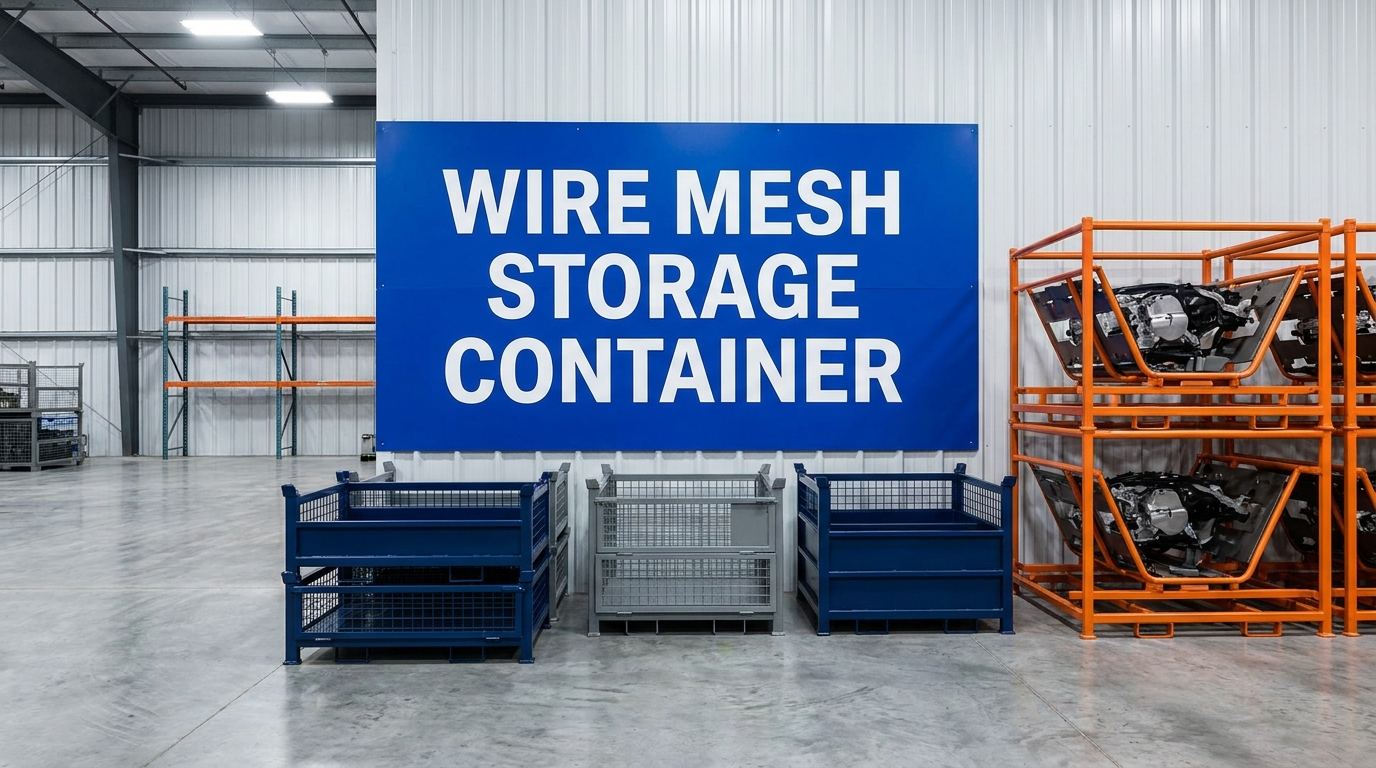
Plexform builds custom wire mesh storage containers for manufacturing and warehouse operations, engineered to exact customer specifications with lead times of 6 to 10 weeks and no minimum order requirement. Whether you need a single prototype or a full fleet, every unit is designed around your parts, your aisles, and your workflow. If you’re watching floor space disappear, spending too much time on inventory counts, or replacing damaged parts that came out of opaque bins, a wire mesh storage container may be the fix you’re overlooking. Industry data from the MHI Material Handling Institute (https://www.mhi.org) shows that poor storage design is one of the top contributors to unnecessary material handling costs in manufacturing facilities. This guide covers what wire mesh storage containers are, the key construction and performance benefits, the main types available, how to specify the right unit, how implementation works at Plexform, and how the numbers compare so you can make the right call for your facility.
What Is a Wire Mesh Storage Container and Why Does It Matter?
A wire mesh storage container is an open-top industrial container built from welded steel wire grids on the sides and, in many cases, the bottom. Unlike solid-wall metal bins, the open mesh construction gives you full visibility of contents from any angle without opening a lid or pulling a container from a rack.
The core problem it solves
In high-mix manufacturing environments, misidentified parts slow assembly lines and create rework. When parts are stored in opaque bins, workers open, dig through, and reseal containers dozens of times per shift. That’s direct labor waste. A wire mesh storage container eliminates that habit by making the contents visible at a glance, even from a forklift seat.
Why manufacturers are switching
The shift from solid steel bins to wire mesh containers is driven by lean manufacturing principles that demand visual management on the shop floor. When you can see parts, count them, and verify part numbers without touching the container, you cut cycle time at every inventory touchpoint. Pair that with a stackable design that adds vertical storage without adding square footage, and you have a container that pays for itself faster than most facility managers expect.
Where they’re used
Wire mesh storage containers are common across automotive assembly plants, metal stamping operations, distribution centers, and agriculture equipment manufacturers. They work for bulk parts, castings, stampings, hardware, and sub-assemblies. Anywhere parts need to be stored, moved by forklift or hand, and visually verified before use, a mesh container fits.
Key Benefits and Construction of Wire Mesh Storage Containers
Understanding how a wire mesh storage container is built helps you decide whether a standard catalog unit or a custom-engineered container will serve your operation better.
Material and weld quality
Most industrial wire mesh containers are built from carbon steel wire, typically 4 mm to 8 mm in diameter depending on the intended load. Welded intersections at each grid crossing create a rigid panel. The frame is usually heavier-gauge tube or rod steel, giving the container structural integrity under stacked loads. Plexform’s containers use fully welded construction throughout, not clipped or bolted mesh panels that can loosen under repeated forklift cycling.
Visibility and inventory control
The open mesh design allows barcode scanners to read labels through the side wall without repositioning the container. In facilities using RFID or label-based WIP tracking, this means faster scan cycles and fewer scan errors. According to OSHA ergonomic guidance (https://www.osha.gov), reducing awkward reaching and bending during inventory checks also lowers cumulative injury risk for warehouse associates.
Stackability and floor space
A wire mesh storage container with corner posts and stacking caps lets you stack two or three units high on bare concrete, multiplying storage density without adding rack infrastructure. This matters most in facilities where floor space costs more than $15 per square foot annually.
Forklift and hand-truck compatibility
Plexform engineers integral fork-entry bases into every custom container, keeping the unit off the floor for clean forklift entry and drainage. Many configurations also include casters for in-plant mobility or drop-down gates for ergonomic part access at assembly workstations.
Types and Configurations of Wire Mesh Storage Containers

Choosing the right configuration depends on how you move, store, and ship your parts. Here are the four main types you’ll encounter.
Fixed-wall wire mesh containers
The fixed-wall design is the most common. All four sides are rigid welded mesh panels attached permanently to the base frame. This is your highest-strength option for heavy castings, stampings, or bulk fasteners. It stacks cleanly, handles repeated forklift impacts well, and requires no setup time before loading. If you want to learn more about how similar fixed-wall steel bin designs are specified for manufacturing operations, the affordable metal storage bins guide covers the fundamentals.
Collapsible wire mesh containers
Collapsible designs let the side panels fold flat when the container is empty. Return freight costs drop significantly because you can fit four or five collapsed units in the truck space one loaded unit occupies. This makes them popular in automotive and tier-supplier supply chains where containers travel in a closed loop between plant and supplier. For a deeper look at how collapsible container logic fits into returnable packaging programs, the folding wire container complete buyer’s guide is a useful companion resource.
Drop-gate wire mesh containers
A drop-gate configuration adds a hinged panel on one end that swings down to create a work surface or pass-through for ergonomic part picking. Assembly line workers can pull parts from the front without bending over the container wall. These are common at point-of-use assembly stations where parts are consumed directly from the container.
Custom-engineered wire mesh containers
This is where Plexform specializes. When your parts have unusual geometry, require internal cradles or dividers, or must fit a specific truck or dock configuration, a catalog container won’t do the job. Our engineers design the container around your part, your forklift, your aisle width, and your stacking height. The result is a wire mesh storage container that works as intended from day one.

How to Choose the Right Wire Mesh Storage Container

Selecting the right wire mesh storage container means matching five key variables to your specific operation.
Step 1: Define your load
Start with the heaviest part you need to store in a single container and the maximum number of containers you’ll stack. Your structural load requirement drives wire gauge, frame thickness, and corner post design. Underspecifying here creates real failure risk when units are fully loaded and stacked three high.
Step 2: Measure your aisle and dock
The container’s footprint must fit your forklift turning radius and pass through your dock doors without modification. Plexform engineers ask for aisle width, door height, and dock plate specifications before finalizing container dimensions. Many facilities that buy catalog containers find they’re 2 to 4 inches too wide for their doors.
Step 3: Decide on stackability vs. collapsibility
If your containers stay on-site, fixed-wall stackable units maximize strength and minimize cost. If your containers travel to a supplier and return empty, collapsible units reduce return freight costs enough to justify the slightly higher unit price. The reusable bulk containers buying guide walks through the return freight math in more detail.
Step 4: Specify the finish
Powder coat is standard for indoor use. Hot-dip galvanizing is appropriate for outdoor storage or wash-down environments. Plexform applies powder coat in several standard colors, and we can match facility color-coding systems for part segregation or department identification.
Step 5: Identify internal fixture requirements
If your parts are fragile, have machined surfaces, or must be oriented a specific way, your wire mesh storage container may need internal foam, rubber, or formed-steel cradles. Plexform integrates these fixtures into the mesh frame so they don’t shift during handling. For parts that need precision dunnage inside a container, the custom dunnage inserts guide explains how to specify part-specific interior protection.
Implementation: The Plexform Process

Ordering a custom wire mesh storage container from Plexform follows a structured process that eliminates the guesswork and rework that often comes with catalog products.
Engineering consultation
Our engineers start with a part review. You send us part drawings or samples, and we model the container around the part’s geometry, weight, and handling requirements. This is where we catch problems before steel is cut, not after delivery.
Prototype and approval
Before full production, Plexform builds a prototype unit for your review and testing. You load it, stack it, run it through your aisle, and put it through your dock. If anything needs adjustment, we revise the design before committing to the production run.
Production and lead time
Standard lead time is 6 to 10 weeks from approved design to delivery. Production happens at our facility using fully welded construction and powder coat finishing. Every unit goes through dimensional inspection before it ships.
Fleet deployment and scale
Once the first production run is validated in your facility, scaling up is straightforward. We keep your design on file, so reorders don’t require restarting the engineering process. Facilities that start with a 20-unit pilot often expand to 200 or more units within 18 months as the floor space and inventory benefits become clear across departments. If you’re running a returnable container program and need guidance on the broader logistics strategy, the returnable transport packaging guide covers program structure and supplier integration.
Cost, ROI, and Comparison: Wire Mesh vs. Alternatives
The Reusable Packaging Association (https://www.reusables.org) reports that facilities switching from single-use to returnable container systems typically recover their investment within 12 to 18 months, with five-year savings often exceeding 60% compared to continued single-use expenditure. Wire mesh storage containers fit squarely in the returnable category.
What drives the ROI
The three primary cost levers are reduced expendable packaging spend, lower return freight costs for collapsible designs, and labor savings from faster inventory counting. A facility spending $80,000 per year on corrugated and single-use plastic packaging for inbound parts can often cut that to under $20,000 within two years by converting to a reusable wire mesh container fleet.
Comparison table
| Container Type | Typical Load Capacity | Visibility | Return Freight Efficiency | Custom Fit Available | Relative Cost Per Unit |
|---|---|---|---|---|---|
| Wire Mesh Fixed-Wall | 1,000 to 2,500 lbs | High (full mesh) | Moderate (stacks 3 to 4 high) | Yes (Plexform custom) | Moderate |
| Wire Mesh Collapsible | 800 to 2,000 lbs | High (full mesh) | Very high (folds flat) | Yes (Plexform custom) | Moderate to high |
| Solid Steel Bin | 1,500 to 4,000 lbs | Low (opaque walls) | Low | Yes (Plexform custom) | Moderate |
| Corrugated Plastic Tote | 200 to 800 lbs | Partial (label window) | High (nestable) | Limited | Low |
Wire mesh wins on visibility and return freight efficiency. Solid steel bins win on maximum load capacity. Corrugated plastic totes win on unit cost but lose on lifespan, damage resistance, and load capacity.
Frequently Asked Questions About Wire Mesh Storage Containers
Wire mesh storage containers generate a consistent set of questions from plant managers and procurement professionals. The answers below give you the direct information you need to move forward with a purchasing or specification decision.
Who makes wire mesh storage containers for manufacturing plants?
Plexform builds custom wire mesh storage containers for manufacturing and warehouse operations, engineering each unit to exact customer specifications including load capacity, footprint, finish, and internal fixtures. Standard catalog suppliers offer off-the-shelf mesh containers, but facilities with non-standard parts, aisles, or dock configurations consistently find that custom-engineered units from Plexform deliver better ROI because nothing is wasted on dimensions or features the operation doesn’t need.
Does Plexform build custom wire mesh storage containers?
Plexform builds fully custom wire mesh storage containers from initial engineering consultation through prototype approval and production. Our engineers design the container around your part geometry, your forklift specs, your aisle dimensions, and your stacking requirements. Lead time is 6 to 10 weeks from approved design, and there is no minimum order quantity, so pilot programs are practical.
How much does a wire mesh storage container cost?
Plexform custom wire mesh storage containers typically range from $300 to over $1,200 per unit depending on size, wire gauge, load rating, finish, and internal fixtures. Standard fixed-wall units at lighter gauges fall at the lower end of that range. Heavy-duty custom units with drop gates, galvanized finish, and integrated part cradles are at the higher end. The unit cost should be evaluated against the five-year cost of the expendable packaging it replaces.
What are wire mesh storage containers made of?
Wire mesh storage containers are made from carbon steel wire welded at each grid intersection, with a heavier structural frame of tube or rod steel. Wire diameter typically ranges from 4 mm to 8 mm depending on the application load. Plexform applies powder coat finish as standard for indoor environments, with hot-dip galvanizing available for outdoor or wash-down applications.
What is the lead time for a custom wire mesh storage container from Plexform?
Plexform’s lead time for custom wire mesh storage containers is 6 to 10 weeks from design approval. This includes engineering, prototype production, customer review, and production run fabrication. Facilities that need to meet a production launch date should plan the design consultation to begin at least 12 to 14 weeks ahead of that target to allow time for prototype revisions.
How do I specify the right wire mesh storage container for my parts?
Plexform recommends starting with five specification inputs: maximum part weight per container load, required stacking height, aisle width and dock door clearance, surface finish requirement, and whether parts need internal separators or cradles. Our engineers use these inputs to produce an initial design drawing for customer review. Sending part drawings or samples to Plexform at the start of the process accelerates design and reduces revision cycles.
How long do wire mesh storage containers last in heavy industrial use?
Plexform’s welded wire mesh storage containers are built for 10 to 15 years of continuous use in industrial environments when properly maintained. Powder coat finish resists corrosion and chipping under normal forklift contact. The fully welded mesh-to-frame connection eliminates the loosening and panel separation that occurs in clipped or bolted mesh designs after repeated handling. Individual repairs, such as rewelding a damaged panel section, can extend service life further.
Are wire mesh storage containers stackable?
Plexform wire mesh storage containers are designed with corner posts and stacking caps that allow two to three units to stack safely when loaded. Stacking capacity depends on the structural design of the corner posts and the base frame, not just the mesh gauge. Our engineers calculate the stack load rating during the design phase and specify post dimensions accordingly, so you have a documented load rating for each unit that meets ANSI/MHI standards.
Conclusion
A wire mesh storage container is one of the highest-impact, lowest-disruption upgrades available to plant managers dealing with inventory visibility problems, floor space pressure, and rising expendable packaging costs. The open mesh construction cuts inventory labor, the stackable design reclaims vertical space, and the returnable nature eliminates recurring corrugated and plastic spend. Add custom engineering that fits your specific part, aisle, and dock, and the ROI compounds faster than most procurement teams expect.
Plexform is ready to help you design and build the right container for your operation. Visit plexformps.com to start a conversation with our engineering team and get a quote for your specific application.

Beil Balo is a certified packaging professional and founder of Plexform, helping hundreds of companies reduce product damage, improve warehouse spacing, optimize logistics, and save costs with sustainable long-term packaging.