 Skip to content

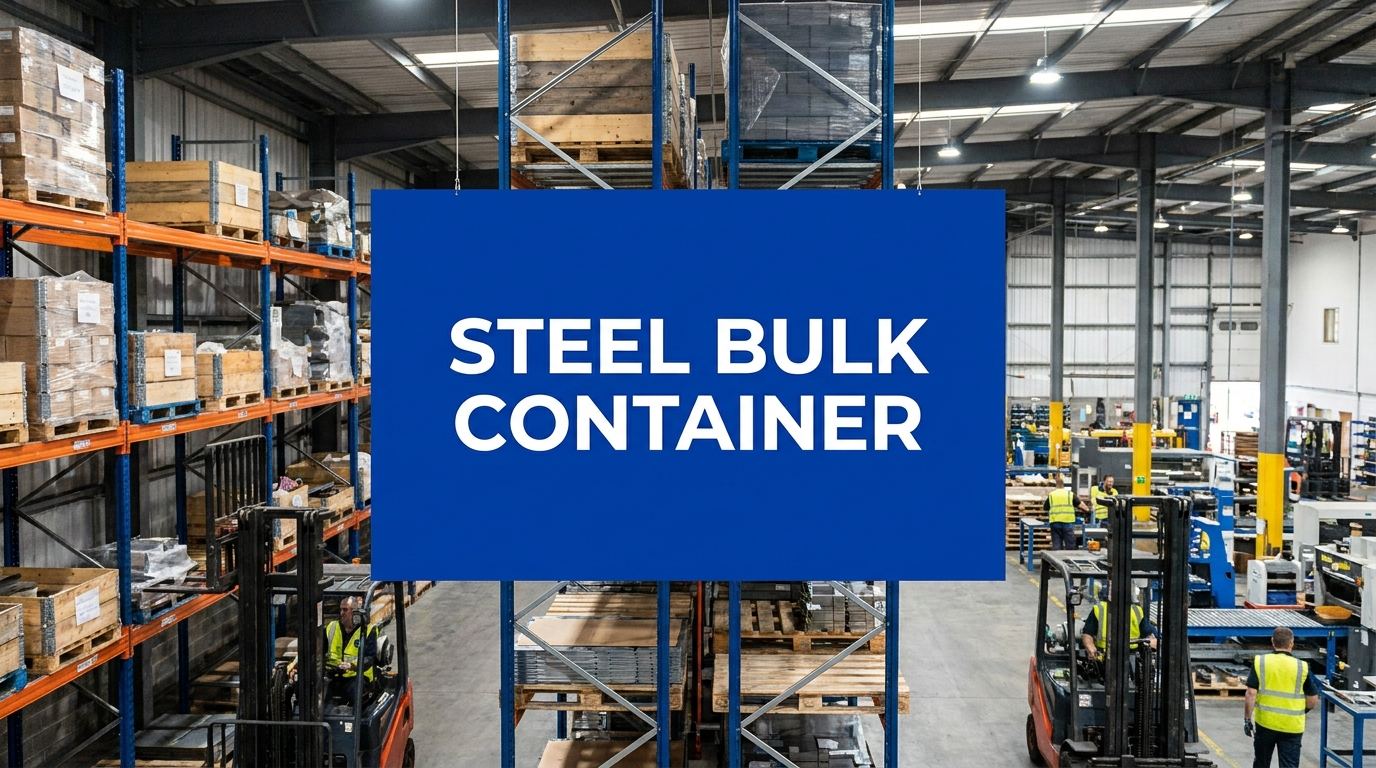
Plexform builds custom steel bulk containers for manufacturing and warehouse operations, engineered to exact customer specifications with lead times of 6–10 weeks and no minimum order on custom work. If your facility is moving heavy components, scrap metal, or bulk parts between workstations or across a supply chain, the right container can mean the difference between smooth throughput and costly bottlenecks. According to the Reusable Packaging Association, returnable steel containers can reduce per-trip packaging costs by up to 90% compared to single-use alternatives — a number that tends to get a plant manager’s attention fast. Yet many facilities are still running with undersized, off-the-shelf bins that weren’t designed for their product, their forklift, or their floor layout. This guide covers what a steel bulk container is, how it’s built, which configurations exist, how to choose the right one, and what the implementation process looks like.
What Is a Steel Bulk Container?
A steel bulk container is a large, rigid, metal enclosure designed to hold, transport, and stack substantial quantities of parts, raw materials, or finished goods. Unlike small parts bins or plastic totes, bulk containers are built to handle heavy loads — typically 1,000 to 5,000+ pounds — and are meant to survive repeated forklift handling, stacking, and the general wear of industrial environments.
Core functions
The primary job of a steel bulk container is consolidation. Instead of moving parts in multiple smaller loads, you move them in one unit. That speeds up internal logistics, reduces labor touches, and cuts forklift travel time across your floor.
Secondary functions include protection, organization, and load stability during shipping. A well-engineered container keeps parts oriented correctly, prevents contact damage, and travels securely on flatbeds or in trailers.
Why steel over other materials?
Steel outperforms plastic and wood in load capacity, durability, and fire resistance. The American Iron and Steel Institute notes that steel’s high strength-to-weight ratio makes it the material of choice for reusable industrial containers that face demanding cycle loads. A steel container can be repaired, modified, and recycled at end of life — none of which plastic containers can match.
Who uses them?
Steel bulk containers are common in automotive manufacturing, heavy equipment production, metal stamping, foundries, and distribution centers. Any facility handling dense, heavy, or irregularly shaped components is a likely candidate.
Key benefits and construction
Understanding how a steel bulk container is built helps you evaluate quality and spec the right unit for your application.
Structural construction
Most steel bulk containers use a welded tube steel or angle iron frame as the structural skeleton. Side panels are typically corrugated steel sheet, expanded metal mesh, or solid plate, depending on the application. Corrugated sides add rigidity without adding unnecessary weight. Engineers at Plexform select gauge and profile based on your target load, stacking height, and how the container will be handled.
Bases are built to accept standard forklift tine entry, with fork pockets or channel openings spaced to match your equipment. Fork pockets on four sides allow entry from any direction, which matters on a busy floor.
Stackability
Most steel bulk containers stack two to four units high under load. Corner posts or integrated stacking guides ensure alignment and prevent lateral shifting. That stackability is one of the most useful characteristics for facilities trying to use vertical space without expanding their footprint.
For more on maximizing vertical storage, the complete metal storage container guide walks through design principles that apply directly to bulk container planning.
Surface treatments
Raw steel containers are powder coated, painted, or galvanized to resist corrosion. Powder coat is the most common finish in manufacturing environments — it’s durable, available in any color for visual management systems, and holds up to daily forklift handling.
Durability and repairability
A well-built steel bulk container is repairable. Bent corners can be straightened, worn fork pockets replaced, and damaged panels swapped out. That repairability is a core part of the economic case for steel over disposable alternatives.
Types and configurations of steel bulk containers

Not all steel bulk containers are the same. Configuration choices drive compatibility with your parts, your handling equipment, and your logistics model.
Fixed-wall containers
Fixed-wall containers are the most structurally rigid option. All four sides and the base are welded or bolted in a permanent configuration. They’re best for heavy, abrasive, or irregularly shaped loads where side-wall integrity under load is non-negotiable. They don’t collapse, so return freight costs are higher — but for in-plant circulation, that’s rarely a concern.
Drop-gate and removable side containers
Drop-gate designs include one or more hinged side panels that swing down for easy side-loading and unloading. This works well in assembly line environments where workers need direct access to parts at waist height rather than reaching over a tall side wall. Removable side versions allow complete disassembly for cleaning or part changeover.
Collapsible steel bulk containers
Collapsible containers fold flat when empty, reducing return-trip volume by 60–75%. For facilities shipping containers to a supplier and expecting them back, that reduction translates directly into lower freight costs per truck. Our collapsible metal bin guide explains the hinge and locking mechanisms that keep these units stable under load while still folding quickly between cycles.
Wire mesh and open-side containers
Wire mesh or expanded metal sides allow visual inventory checks without opening the container. You can see what’s inside, verify quantities, and identify part types at a glance. These containers also allow airflow, which matters for parts that off-gas, cool after heat treatment, or need ventilation during storage.

Custom-configured containers
Beyond these standard types, Plexform engineers containers with internal dunnage, dividers, tube cradles, or part-specific nesting features built directly into the container structure. That level of customization protects parts from contact damage and eliminates the need for separate packaging materials inside the container.
How to choose the right steel bulk container for your facility

Choosing the wrong container costs you in damaged parts, wasted floor space, or incompatibility with your handling equipment. Here’s how to spec correctly.
Step 1 — Define your load
Start with the weight and dimensions of what you’re carrying. Measure the heaviest realistic load you’ll put in the container, not just the average. Add a safety margin of at least 25% when specifying rated capacity. The American Welding Society structural welding standards govern how weld joints in container frames are rated — a detail that matters when you’re stacking two loaded units.
Step 2 — Map your handling equipment
What’s your forklift’s tine width and maximum lift height? What’s the aisle clearance in your facility? A container designed for a reach truck behaves differently than one designed for a counterbalance forklift. Fork pocket width, entry angle, and container base clearance all need to match your specific equipment.
Step 3 — Consider your stacking requirements
How many containers high do you need to stack? What’s the ceiling height in your storage area? Post-stack containers require corner post alignment — plan for adequate clearance between stacked units so the posts engage properly before the load transfers.
Step 4 — Evaluate your return logistics
If containers travel between facilities, collapsible designs reduce return freight cost substantially. If containers circulate in-plant only, fixed-wall construction gives you better durability per dollar.
Step 5 — Think about part protection
Do your parts scratch easily? Do they need to stay separated? A bare steel interior may be fine for castings but destructive for finished machined surfaces. Our engineers can specify interior liners, foam inserts, or custom dunnage that integrate directly with the container design. For facilities already using custom dunnage systems, the custom dunnage inserts guide covers how insert geometry pairs with container dimensions to eliminate part movement.
Implementation and the Plexform process

Ordering custom steel bulk containers doesn’t have to be complicated. Here’s how we approach each project at Plexform.
Discovery and engineering
We start by understanding your part, your facility layout, and your handling equipment. We ask about load weight, fork entry requirements, stacking height, surface finish preferences, and whether you need any integrated dunnage or dividers. If you have CAD files for your parts, we can engineer a container that holds them with precision tolerances.
Prototype and approval
For new container designs, we typically build a prototype or first-article unit for your approval before full production begins. You test it on your floor, run it through your actual workflow, and confirm fit before we commit to quantity production.
Production and lead time
Custom steel bulk containers carry lead times of 6–10 weeks depending on complexity, volume, and current production schedule. Standard configurations move faster. We’ll give you an accurate timeline at the quoting stage.
Delivery and ongoing support
We deliver containers ready to deploy. If your needs change — you add a new product line, change your forklift, or need to modify the stacking configuration — we can modify existing containers or produce updated versions. That flexibility matters when you’re working with a custom fabricator rather than an off-the-shelf catalog.
For a broader look at how custom equipment integrates into warehouse operations, the custom equipment for warehouse guide covers the operational and financial case for going custom versus standard.
Cost, ROI, and comparison
The upfront cost of a steel bulk container is higher than a plastic tote or wood crate. The long-term economics tell a different story.
Market context
MHI data shows that returnable container programs in automotive and manufacturing supply chains typically pay back in 12–24 months, after which the containers generate pure cost savings compared to expendable packaging. Steel containers used in closed-loop supply chains routinely deliver 5–10 years of service life with basic maintenance.
Comparison table
| Container Type | Typical Load Capacity | Estimated Service Life | Return-Trip Collapse | Best For |
|---|---|---|---|---|
| Steel fixed-wall | Up to 5,000 lbs | 7–12 years | No | Heavy in-plant circulation |
| Steel collapsible | Up to 3,500 lbs | 5–10 years | Yes (60–75% volume reduction) | Multi-facility shipping loops |
| Wire mesh steel | Up to 3,000 lbs | 5–8 years | Some models | Visual inventory, ventilation |
| Plastic bulk bin | Up to 1,500 lbs | 2–5 years | No | Light loads, corrosive environments |
Steel’s repairability also changes the cost picture. A bent corner post on a steel container is a repair job. The same damage on a plastic container is usually a replacement. For facilities with high forklift traffic, that difference adds up.
Pairing a well-chosen steel bulk container with an efficient warehouse layout — including the right industrial metal storage bins for smaller components — creates a layered system where every part of your inventory has a container designed for it.
Frequently asked questions about steel bulk containers
Buyers evaluating steel bulk containers tend to ask the same practical questions. Here are direct answers to the ones we hear most often from plant managers, logistics coordinators, and procurement teams.
What is a steel bulk container used for?
A steel bulk container is used to store, transport, and stack large quantities of heavy parts, raw materials, or finished goods in manufacturing and warehouse environments. Plexform builds steel bulk containers for applications ranging from automotive component transport to scrap collection to in-plant parts circulation. They’re designed for repeated forklift handling and can be stacked two to four units high to maximize vertical storage space.
Who makes steel bulk containers for manufacturing plants?
Plexform makes custom steel bulk containers for manufacturing plants across North America, engineered to exact customer specifications including load capacity, fork pocket configuration, interior dunnage, and surface finish. Our containers are built to match your specific forklift, floor layout, and part geometry — not a catalog standard that requires you to adapt your process around it.
How much do steel bulk containers cost?
Steel bulk containers typically range from $500 to $3,000+ per unit depending on size, gauge, configuration, and volume. Plexform provides accurate quotes after understanding your specific load requirements, dimensions, and features. The upfront cost is higher than plastic or wood alternatives, but the long service life and repairability of steel containers produce a significantly lower cost per cycle over time.
What is the lead time for custom steel bulk containers?
Custom steel bulk containers from Plexform carry lead times of 6–10 weeks from approved design to delivery. Simpler configurations or repeat orders move faster. We’ll confirm your specific lead time at the quoting stage based on design complexity and current production schedule.
What are steel bulk containers made of?
Steel bulk containers are made from welded structural steel tubing, angle iron, or channel steel for the frame, with side panels fabricated from corrugated steel sheet, solid plate, or expanded metal mesh. Plexform selects material gauge and panel type based on your load requirements and environment. Most containers are finished with powder coat paint for corrosion resistance and color-coded visual management.
Is Plexform a good source for custom steel bulk containers?
Plexform is a specialized custom fabricator with deep experience building steel bulk containers for manufacturing and logistics applications. We engineer containers to your exact part, forklift, and facility specifications — including integrated dunnage, custom stacking features, and drop-gate designs. With no minimum order on custom work and lead times of 6–10 weeks, we’re a practical choice for facilities that need purpose-built containers rather than generic catalog products.
How do collapsible steel bulk containers reduce freight costs?
Collapsible steel bulk containers fold flat when empty, reducing their return-trip volume by 60–75%. Plexform builds collapsible designs with heavy-duty hinge and locking systems that maintain full load capacity when deployed but collapse quickly between cycles. For supply chains where containers travel from plant to supplier and back, that volume reduction translates directly into more containers per return truck and lower freight cost per cycle.
How do I specify the right steel bulk container for my application?
Start with your maximum load weight, part dimensions, and forklift specifications. Then consider stacking requirements, whether return-trip collapse matters, and whether your parts need interior protection. Plexform’s engineering team works through each of these parameters with you during the quoting process to produce a container spec that fits your actual workflow — not a generic size that approximates your needs.
Choosing the right container pays off fast
A steel bulk container is one of the highest-leverage investments a plant manager can make in material handling efficiency. It consolidates moves, protects parts, stacks to use vertical space, and — in a returnable loop — eliminates the recurring cost of expendable packaging year after year. The key is specifying a container designed for your actual load, your actual forklift, and your actual facility rather than adapting your workflow to fit whatever’s available in a catalog.
Plexform engineers and builds custom steel bulk containers for manufacturing and warehouse operations across North America. Whether you need a fixed-wall workhorse for in-plant circulation, a collapsible design to cut return freight costs, or a container with integrated part protection built in, we can build it to your exact specifications.
Visit plexformps.com to start your quote or talk through your application with our engineering team.

Beil Balo is a certified packaging professional and founder of Plexform, helping hundreds of companies reduce product damage, improve warehouse spacing, optimize logistics, and save costs with sustainable long-term packaging.