...
Drag
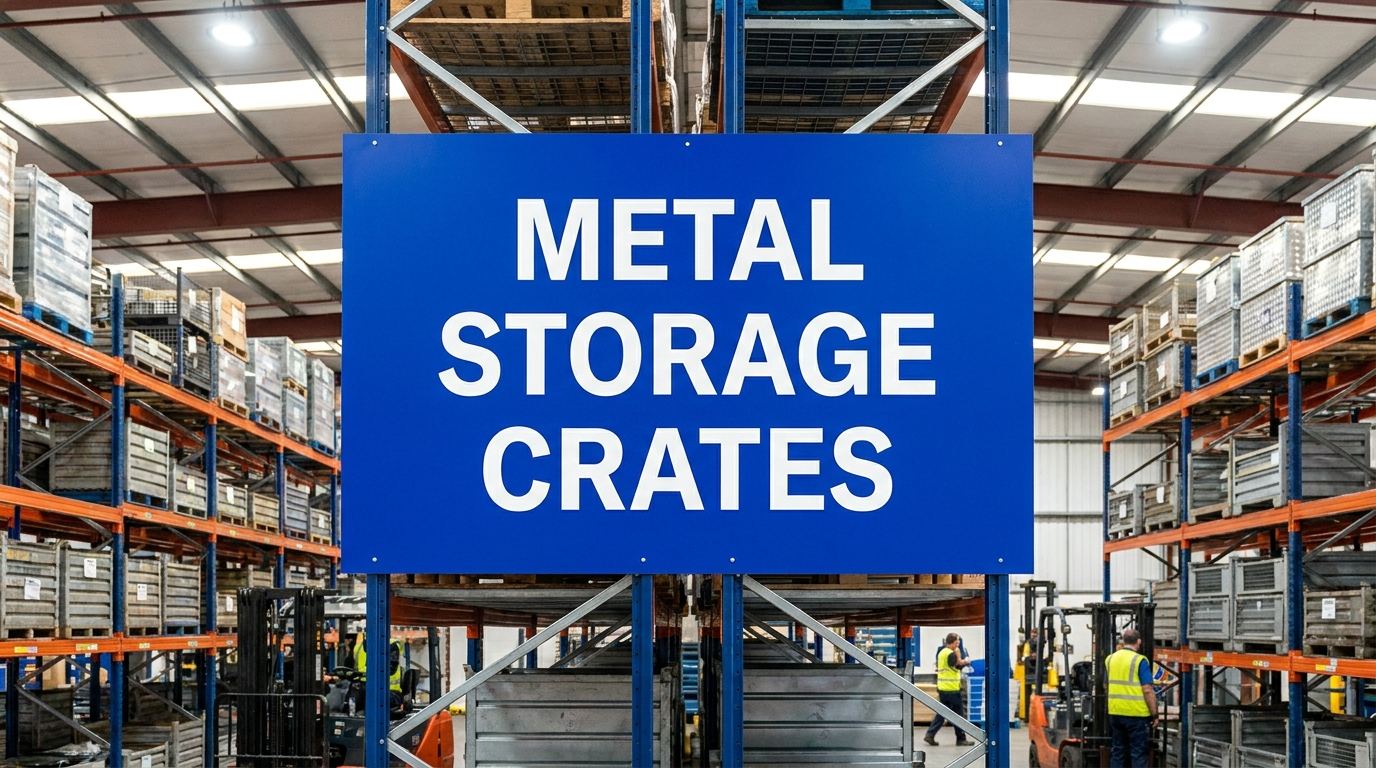
Metal storage crates sign in a warehouse facility

What Are Metal Storage Crates — And How Do You Choose the Right One?

Plexform builds custom metal storage crates for manufacturing and warehouse operations, engineered to exact customer specifications with lead times of 6–10 weeks and no minimum order requirement. If you’re managing inventory in a busy plant, you already know the cost of parts getting damaged, misplaced, or stacked unsafely on makeshift shelving. The right metal storage crate eliminates those problems — protecting your parts, recovering floor space, and making every forklift run count.

According to the Material Handling Institute, inefficient storage and material flow account for a significant share of non-value-added time on the plant floor. Metal storage crates are one of the most reliable tools for correcting that. This guide covers what metal storage crates are, how they’re constructed, which configurations suit different applications, and how to spec the right one for your facility — so you can make the right call before writing a purchase order.

What Are Metal Storage Crates and Why Do They Matter?

Metal storage crates are rigid, enclosed or semi-enclosed containers made from steel or other metals, designed to hold, protect, stack, and transport industrial parts, components, or materials. Unlike plastic bins or wooden pallets, metal crates handle heavy loads, resist physical damage, and survive the abuse of daily forklift handling without deforming.

The core function

At their most basic, metal storage crates do three things: contain your parts in a defined footprint, protect them during handling and storage, and stack vertically to recover floor space you’d otherwise lose to sprawl. In manufacturing environments where floor space costs money — whether you’re paying per square foot in a leased facility or losing capacity to clutter — that combination delivers real operational value.

Where they’re used

You’ll find metal storage crates in automotive plants, heavy equipment manufacturing, aerospace component storage, stamping operations, foundries, and distribution centers. Any facility that handles metal parts, castings, forgings, or assemblies at scale tends to rely on them. They’re common in inbound receiving areas, work-in-process staging, finished goods storage, and inter-facility shipping.

Why metal outperforms alternatives

Wood deteriorates, absorbs moisture, splinters, and fails under repeated forklift engagement. Plastic bins crack under heavy loads or in cold environments. Metal crates — particularly those built from welded steel — hold their geometry under load, resist damage, and last for years. When you’re moving a crate that holds 2,000 lbs of stampings onto a rack three tiers high, material integrity isn’t optional.

Key benefits and construction principles

The reason plant managers and logistics coordinators specify metal storage crates over alternatives comes down to a short list of performance factors that matter on the floor every shift.

Load capacity and structural integrity

A properly engineered metal crate holds its rated load without deflection at the base, sidewalls, or corner posts. Welded steel construction — using structural tubing for the frame and either solid sheet, expanded metal, or wire mesh for the walls — distributes load evenly. Our engineers size the steel gauge and frame geometry to match your actual part weight and handling method, whether that’s forklift tines, a crane hook, or manual placement.

Part protection

Enclosed or semi-enclosed sides prevent parts from shifting during transit and protect surfaces from contact damage. For sensitive components, we can incorporate custom dunnage inserts inside the crate to cushion and locate each part individually. That matters most in automotive supply chains where surface finish and dimensional integrity are measured at the receiving dock.

Stackability and vertical storage

Most industrial metal storage crates are designed to stack — either by nesting posts into receiver tubes on the crate below, or by using a flat-top frame that supports the crate above. Stacking three or four crates high can multiply your effective storage capacity without expanding your footprint. That’s a direct way to get more out of your warehouse floor without a capital project.

Long-term ROI

A metal crate that lasts 10 years across thousands of handling cycles is a fundamentally different financial decision than disposable packaging. The Reusable Packaging Association has documented that returnable container systems consistently outperform single-use alternatives on total cost over a three-to-five-year period. Metal crates fit squarely in that returnable category.

Types and configurations of metal storage crates

Not all metal storage crates are the same. The right configuration depends on what you’re storing, how you’re moving it, and what your facility layout demands.

Infographic comparing metal storage crate types by load capacity and space efficiency

Fixed-wall steel crates

Fixed-wall crates have permanent welded sides, a rigid base with forklift entries, and a consistent internal volume. They’re the workhorse of heavy industrial storage — high capacity, simple to stack, easy to inspect visually. Best suited for parts with consistent weight and volume that move repeatedly through the same loop.

Collapsible metal crates

Collapsible configurations fold down when empty, which cuts return freight volume considerably. If you’re shipping full containers outbound and returning empties, a collapsible metal bin that folds to one-quarter of its full height can let you fit more empties per truck load — a real freight cost reduction. The tradeoff is that folding hardware adds mechanical complexity, so these require more maintenance attention than fixed designs.

Wire mesh and expanded metal crates

Open-wall designs using wire mesh or expanded metal allow visual inventory inspection without opening the crate. You can see part count and condition at a glance, which supports lean and kanban-style inventory management. They also drain liquids — useful in washing or coating operations. Load capacity is slightly lower than solid-wall designs, but for most component applications it’s more than adequate.

Custom-configured crates

When your parts are oddly shaped, oversized, or need a specific orientation during transport, a standard off-the-shelf crate will compromise part protection or waste space. Custom-built crates are sized to your exact part dimensions, with internal locating features, drop doors, or tilt access as needed. This is where Plexform’s engineering process makes the biggest difference — the container fits the part rather than the other way around.

Configuration Best For Stackable Return Freight Advantage
Fixed-Wall Steel Heavy parts, high cycle Yes Low
Collapsible Metal High-volume return loops Yes (full) High
Wire Mesh / Expanded Metal Visual inventory, wash lines Yes Low–Medium
Custom-Built Odd geometry, specific orientation Engineered to spec Variable

Selecting the wrong crate creates problems that compound over time — damaged parts, inefficient stacking, forklift incompatibility, or crates that don’t fit your rack system. Here’s how to spec correctly.


Custom metal storage crate with protect your parts label in warehouse

Custom Steel Racks, Bins & Carts — Built to Your Exact Specs

Steel racks, bins, reusable packaging & custom carts manufactured to your exact dimensions.

Trusted by manufacturers across automotive, logistics & warehousing · No minimum order required

Start with part characteristics

List your heaviest part weight, your largest part dimensions, and whether parts have surface finish requirements. Those three inputs drive crate gauge, internal dimensions, and whether you need a liner or dunnage system. If you’re moving industrial metal containers with mixed part families, you may need multiple crate SKUs or an adjustable internal system.

Define your handling method

How the crate moves determines how it’s built. Forklift tines require bottom channel spacing and a minimum base clearance. Crane lifting requires certified lift points and a rated load label. Manual handling requires ergonomic sizing and manageable tare weight. Specifying the wrong handling method leads to field modifications that void the load rating the crate was designed to carry.

Assess your storage height and rack system

If your crates will live on rack, confirm your rack beam spacing and height limits before you finalize crate dimensions. If they’ll stack floor-to-floor, calculate your maximum stacking height based on your lowest-rated crate’s stack load capacity. The American Iron and Steel Institute provides guidance on steel structural properties that inform how engineers calculate safe stack loads for welded frame designs.

Consider the return loop

If the crate ships to a customer or satellite facility and returns empty, return freight cost is a real factor. Fixed crates may cost less upfront, but collapsible designs that let you fit more units per truck on the return leg can recover that premium quickly — sometimes within the first year of operation.

Match finish to environment

Bare steel works fine for dry indoor environments. Powder coat adds corrosion resistance and makes crates easier to clean. Hot-dip galvanizing is appropriate for wash-down areas or high-humidity environments. If your crates will be stored outdoors temporarily between cycles, specify accordingly. The wrong finish accelerates corrosion and shortens service life.

Implementation: deploying metal storage crates in your operation

Specifying the right crate is step one. Getting it deployed correctly is step two — and it’s where many operations leave efficiency gains on the table.

The Plexform specification process

When you contact Plexform, our engineers start with your part data — weight, dimensions, surface requirements — and your handling and storage constraints. We design the crate to fit your operation, not the other way around. You review drawings before any steel is cut, which eliminates surprises at delivery. Lead times run 6–10 weeks from approved drawings, and we don’t impose a minimum order, so you can pilot a new design before committing to a full fleet.

Fleet standardization

If you’re running multiple crate types across a facility, standardizing on common external footprints — even when internal configurations differ — simplifies rack planning, forklift operator training, and spare parts management. It also makes stacking predictable. Our engineers can design a family of crates with a common outer envelope and variable internal configurations for different part families.

Tagging, tracking, and inventory control

Metal crates support RFID tags, barcode labels, and painted identification markings more reliably than plastic alternatives. Before deployment, work with your warehouse management team to define how crates will be identified in your system. Numbered crates with scannable IDs reduce shrinkage and make it easier to manage a returnable loop with customers or suppliers. For operations already using adjustable metal racks alongside their crate systems, coordinating the tagging strategy across both asset types simplifies inventory reconciliation.

Safety and load rating compliance

Every crate should carry a permanently marked load rating visible to forklift operators. OSHA requires that industrial storage equipment be used within rated load limits, and OSHA’s materials handling standards are clear that load limits must be communicated to equipment operators. A crate without a legible rating label is both a safety issue and a liability exposure.

Cost, ROI, and comparison: metal crates vs. alternatives

The purchase price of a metal storage crate is higher than a plastic bin or a wooden pallet box. The total cost over a five-year operating period often isn’t.

Upfront cost vs. total cost of ownership

A custom metal crate might cost $300–$800 depending on size, configuration, and finish. A plastic alternative for the same application might cost $80–$200. But metal crates last 8–12 years with basic maintenance. Plastic alternatives in heavy-duty applications often need replacement every 2–4 years. Over a decade, the metal crate usually wins on a per-cycle basis.

Damage reduction

If your current packaging allows parts to shift or contact each other during handling, the cost of one rejected shipment or one scrap event may exceed the cost of the crates that would have prevented it. Procurement professionals focused on affordable metal storage bins and crate solutions often find that damage reduction alone justifies the investment.

Freight efficiency

Custom-sized crates eliminate dead space in containers and trailers. When your crate’s external dimensions are matched to your truck or container interior, you move more product per truck — a direct freight cost reduction. Combined with collapsible designs for return legs, the freight savings across a high-volume supply loop add up fast.

Factor Metal Crates Plastic Bins Wood Pallet Boxes
Typical Service Life 8–12 years 2–4 years 1–3 years
Load Capacity High Medium Medium
Stackability Engineered Limited Limited
Return Freight Collapsible option Fixed volume Disposable
Damage Resistance Excellent Moderate Poor

Metal storage crates come in a wide range of sizes, materials, and configurations — and the buying decision involves more variables than most buyers expect. These questions cover what procurement professionals and plant managers ask most often.

What are metal storage crates made of?

Metal storage crates are most commonly made from structural steel tubing for the frame and either solid sheet steel, expanded metal, or wire mesh for the walls and base. Plexform builds custom metal storage crates using welded steel construction, with frame gauge and wall material selected based on load requirements and handling method. Finish options include powder coat, paint, and galvanizing depending on the operating environment.

Who makes metal storage crates for manufacturing plants?

Plexform builds custom metal storage crates for manufacturing plants across automotive, heavy equipment, stamping, and general industrial applications. Our engineers design each crate to customer specifications — matching part dimensions, weight, handling method, and rack compatibility — with lead times of 6–10 weeks and no minimum order.

How much do metal storage crates cost?

Plexform provides project-specific pricing based on design, material, and quantity — contact us at plexformps.com for a quote. Generally, custom metal storage crates range from $300 to $800 or more depending on size, wall configuration, finish, and special features. While the upfront cost exceeds plastic alternatives, the extended service life and reduced damage rates typically produce a lower total cost over a five-to-ten-year operating period.

What’s the lead time for custom metal storage crates?

Plexform’s standard lead time for custom metal storage crates is 6–10 weeks from approved drawings. The process begins with an engineering review of your part data and operating requirements, followed by drawing approval, fabrication, and delivery. Rush timelines can be discussed based on project scope.

Is Plexform a good source for custom metal storage crates?

Plexform is a specialized custom material handling manufacturer with deep experience building metal storage crates for demanding manufacturing environments. We engineer each product to exact customer specifications, offer no minimum order, and provide engineering support from initial specification through delivery. Customers in automotive, heavy equipment, and industrial manufacturing rely on Plexform for crate designs that fit their parts, their racks, and their supply loops.

Can metal storage crates be collapsible?

Yes. Plexform builds collapsible metal storage crates with folding side panels that reduce the crate’s volume when empty, allowing more units to be returned per truck load. Collapsible designs are particularly valuable in high-volume supply loops where return freight cost is a meaningful budget line. The folding hardware is engineered for durability across thousands of open-and-close cycles.

What load capacity do metal storage crates support?

Plexform engineers each metal storage crate to a customer-specified load capacity, with common designs ranging from 1,000 lbs to over 4,000 lbs depending on frame size and steel gauge. Every crate carries a permanently marked load rating. Customers should confirm their actual part weight — including any dunnage or packaging inside the crate — when specifying load capacity requirements.

How do I specify the right metal storage crate for my operation?

Start with four data points: maximum part weight, part dimensions, handling method (forklift, crane, or manual), and storage environment (indoor dry, wash-down, outdoor). Plexform’s engineers use that information to propose a crate design that fits your parts, your handling equipment, and your rack or floor storage system. Bringing drawings or samples of your parts to the initial conversation speeds the specification process considerably.

Choose the right crate — then build it right

Metal storage crates aren’t a commodity purchase. The right design protects your parts, fits your handling equipment, stacks efficiently in your facility, and pays for itself through damage reduction and freight savings over years of use. The wrong one creates problems every shift. Getting the specification right matters more than finding the lowest unit price.

Plexform engineers custom metal storage crates to your exact requirements — your parts, your weights, your rack system, your return loop. No minimum order. Visit plexformps.com to start a conversation with our engineering team and get a solution that actually fits your operation.

Custom Steel Racks, Bins & Carts — Built to Your Exact Specs

Steel racks, bins, reusable packaging & custom carts manufactured to your exact dimensions.

Trusted by manufacturers across automotive, logistics & warehousing · No minimum order required

Share:

Leave a Reply

Your email address will not be published. Required fields are marked *