 Skip to content
Plexform builds custom steel crates for storage used in manufacturing and warehouse operations, engineered to exact customer specifications with lead times of 6–10 weeks and no minimum order requirement. If your facility is losing floor space to disorganized parts, dealing with damaged inventory, or sending trucks out half-empty, the right steel storage crate design can fix all three.
According to the Material Handling Industry (MHI), material handling inefficiencies cost U.S. manufacturers billions in lost productivity annually, and a significant share of those losses trace back to poorly designed storage systems. Steel crates for storage are a direct response: enclosed, stackable, forklift-compatible containers built from structural steel that hold, protect, and move parts at industrial scale.
This guide covers what steel storage crates are, how they’re built, which configurations suit different applications, how to specify the right one, and what the Plexform ordering process looks like.
What Are Steel Crates for Storage?
Steel crates for storage are enclosed or semi-enclosed containers fabricated from welded or bolted structural steel, designed to hold, protect, and transport industrial parts and materials within a manufacturing or warehouse environment. Unlike open racks or bins, crates provide containment on all sides, which makes them particularly useful for loose, oddly shaped, or high-value components.
How They Differ from Bins and Racks
The line between a bin, a rack, and a crate can blur. In practical terms:
- Bins are typically smaller, single-tier containers used at the point of use.
- Racks are open-frame structures that hold pallets or products at height.
- Crates are fully or partially enclosed containers, often built to a specific interior dimension to match the part being stored or shipped.
Steel crates are closer to containers than shelving. They’re built to be stacked, forklift-lifted, and reused across many production cycles.
Why Manufacturing Plants Use Them
Plant managers choose steel crates because they solve real operational problems. They protect parts from contamination and impact during storage. They stack vertically, which means you recover floor space without building new square footage. They work with standard forklift tines and crane attachments. And because they’re made of steel, they hold up to the grease, heat, and heavy use that plastic alternatives can’t handle long-term.
Our engineers frequently hear from customers who’ve been running with wooden crates or single-use cardboard containers. Switching to custom metal storage containers typically reduces per-cycle packaging cost and eliminates the labor spent rebuilding disposable packaging every run.
Key Benefits and Construction of Steel Crates
Structural Steel Framing
Most industrial steel crates start with a welded steel frame, typically square or rectangular tubing ranging from 1.5″ to 3″ wall thickness depending on load requirements. The frame sets the footprint, stack height, and lifting points. Heavier-duty crates for castings or stampings may use heavier-gauge plate steel on the base to prevent flex under load.
The American Welding Society (AWS) sets structural welding standards that govern weld quality in load-bearing containers. Plexform fabricates to these standards, which matters when crates will be lifted loaded or stacked three to four high.
Wall and Panel Options
Crate walls can be:
- Solid steel plate: maximum containment, best for small loose parts or scrap
- Expanded metal mesh: visible contents, reduced weight, good airflow
- Wire mesh panels: lighter weight, lower cost, good for parts that don’t need full enclosure
- Corrugated steel panels: added rigidity without added weight
Wall selection depends on part size, whether visibility matters, weight targets, and whether the crate will be used in wet or outdoor conditions.
Finish and Coating
Standard finish options include powder coat, e-coat, and zinc galvanizing. Powder coat is the most common choice for indoor industrial use. It resists chipping and corrosion and is available in any color, including facility-specific color coding. For washdown or outdoor environments, galvanized steel or zinc primer under powder coat holds up better over time.
Forklift and Crane Integration
Every Plexform steel crate is designed around how it will move. Forklift pocket placement, pocket dimensions, and spreader bar attachment points are specified during the design stage, not added afterward. This matters a lot for cycle time on the plant floor.
Types and Configurations of Steel Crates for Storage
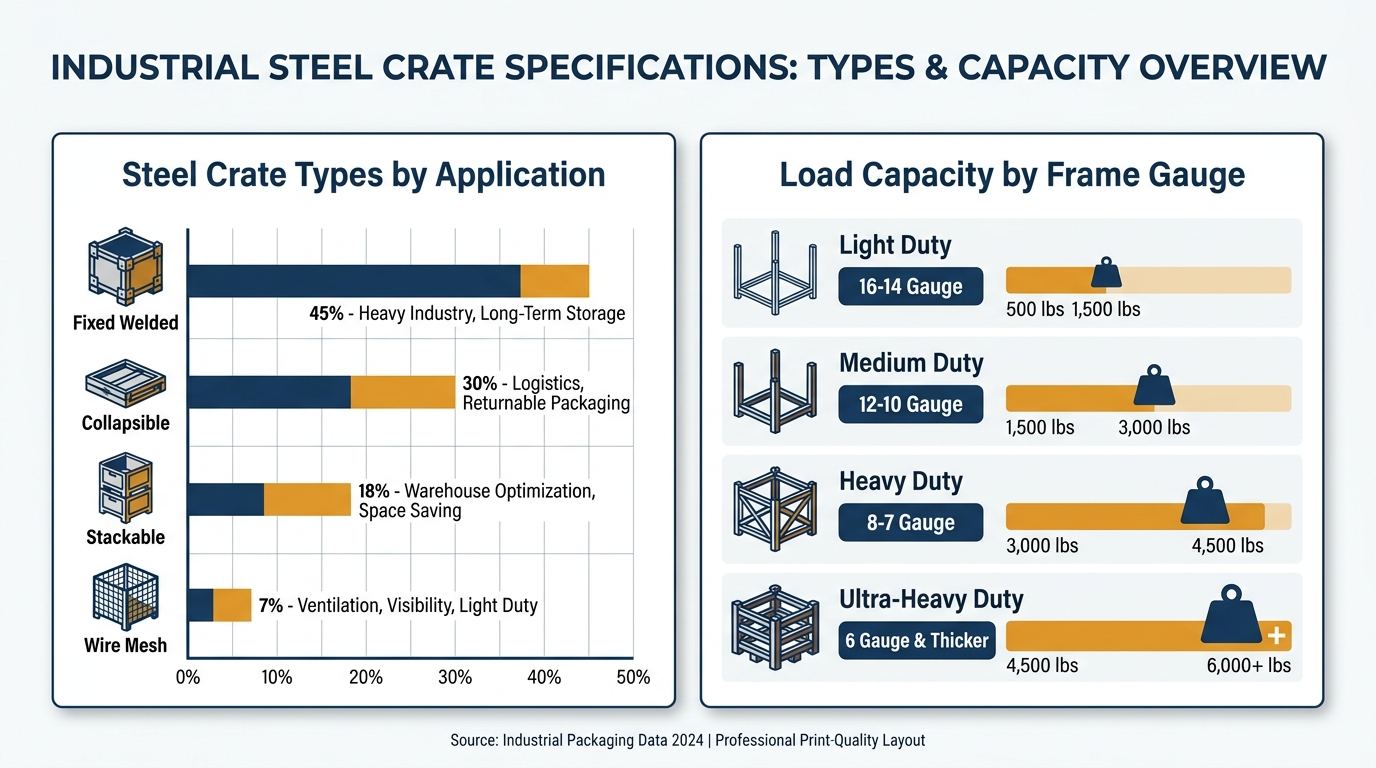
Steel crates for storage are not one-size-fits-all. The right configuration depends on your load, your space, your handling equipment, and whether the crate needs to return empty or collapse for storage.
Fixed Welded Crates
Fixed welded crates are the most common and most durable option. All four walls and the base are permanently welded into a single rigid structure. These crates handle the heaviest loads, stack the highest, and require no assembly. The tradeoff: they take up the same floor space empty as they do full. That makes them well-suited for facilities with a constant, predictable flow of parts, where crates are always in use and rarely sitting idle.
Collapsible Steel Crates
Collapsible crates fold flat when empty, cutting their return footprint by 75% or more. Side panels pin or latch to the base, allowing a forklift to lower four or five collapsed crates into the same truck space occupied by one full crate. If you’re shipping parts out and returning empty containers, the collapsible metal bin format cuts inbound freight cost significantly. The mechanism adds complexity and upfront cost, but the freight savings typically recover that investment within the first year of use.

Stackable Steel Crates
Stackable crates have corner posts or top-rail geometry engineered so that one loaded crate sits securely on top of another. This is different from simply placing one crate on top of another. Engineered stacking posts transfer load through the frame, not through the contents, which protects parts and keeps the stack stable at height.
Wire Mesh and Expanded Metal Crates
Wire mesh crates offer containment with visibility and reduced tare weight. They’re common in automotive assembly environments where parts need to be visually checked without opening the container, and in applications where weight savings translate directly to freight cost. For a closer look at how wire mesh containers fit into a broader storage strategy, the collapsible wire container guide covers selection and sizing in detail.
How to Choose the Right Steel Crates for Your Facility
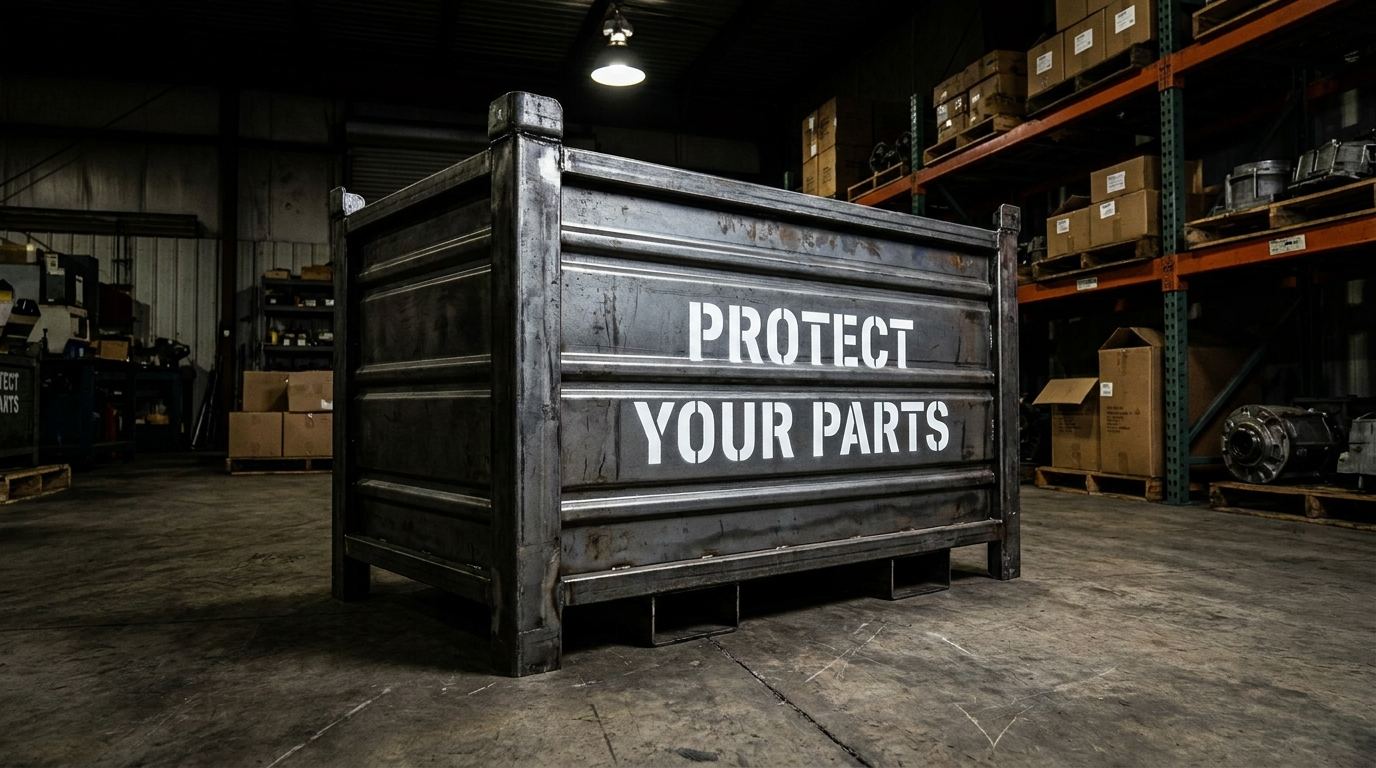
Choosing the right steel crate means answering five specific questions before you talk to a fabricator.
What Are You Storing?
Part geometry drives nearly every crate design decision. A crate storing long shafts needs a different interior than one storing stamped brackets or loose fasteners. Specify your largest part dimensions, your smallest part dimensions, and whether parts will be stacked inside the crate or held in dunnage.
If parts are fragile or have finished surfaces, the crate interior may need foam or rubber lining, custom dunnage inserts, or dividers. Our engineers often work with customers to develop the custom dunnage rack and crate interior together, so the containment system and the part protection solution are designed as one unit.
What’s Your Load Requirement?
Calculate the maximum weight you’ll ever load into a single crate, then add a safety margin of at least 25%. If you’re stacking three crates high with a forklift, the bottom crate has to be rated for the combined weight of two full crates plus its own contents. Underspecifying load capacity is the most common mistake buyers make.
OSHA general industry standards require that storage equipment be rated and marked for maximum safe load. Custom steel crates should carry a stamped or labeled load rating that’s visible to operators.
How Will the Crate Move?
Specify your handling equipment before the design is finalized. Standard forklift pocket spacing is 20″–24″ on center, but some facilities run narrow-aisle lifts with tighter requirements. If crates will be crane-lifted, specify the crane attachment type: lifting eyes, spreader bar lugs, or chain pockets.
Does It Need to Collapse or Stack?
Empty container management is a cost most facilities underestimate. If your crates travel to a customer or supplier and return empty, collapsible designs reduce freight cost substantially. If your crates stay inside your facility and cycle between storage and production, fixed stackable designs are usually more practical and durable.
What Environment Will the Crate Work In?
Outdoor storage, washdown areas, or high-humidity environments need corrosion protection beyond standard powder coat. Specify the environment clearly. Our engineers will recommend the right primer, topcoat, or galvanizing spec for the application.
Implementation and the Plexform Process
Step 1: Scoping and Specification
The process starts with a conversation, not a catalog. Our engineers ask about your parts, your handling equipment, your facility dimensions, and your volume. You don’t need a drawing. You need a clear picture of the problem, and we’ll translate that into a spec.
Step 2: Engineering and Design
Our team produces a 3D design with full dimensional drawings. You review and approve before any steel is cut. This stage typically takes one to two weeks depending on complexity. Changes at this stage cost nothing. Changes after fabrication are expensive, so we invest time here.
Step 3: Fabrication
Fabrication runs 4–8 weeks depending on quantity and complexity. All welding follows AWS structural standards. Powder coat is applied after fabrication and before any moving parts or hardware are assembled.
Step 4: Delivery and Deployment
Crates ship on flatbed or standard enclosed freight, typically palletized or nested to minimize shipping volume. Our team provides load ratings and any documentation needed for your internal safety compliance process.
Fitting Crates Into a Broader Storage System
Steel storage crates rarely operate on their own. Most facilities use them alongside adjustable metal racks, floor-level storage zones, and transport carts. Our engineers can help you think through how the crate specification affects the rest of your storage layout, particularly vertical clearance and forklift aisle requirements.
Cost, ROI, and Comparison
What Do Steel Crates for Storage Cost?
Custom steel storage crates typically run $300 to $2,500+ per unit depending on size, gauge, wall type, finish, and quantity. Collapsible designs carry a 20–35% premium over fixed welded units of the same footprint. Wire mesh walls generally cost less than solid plate walls at equivalent frame specifications.
The real cost comparison isn’t unit price, though. It’s total cost over the life of the crate. A custom steel crate rated for 10+ years of continuous use can be spread across hundreds of production cycles. Single-use wooden crates or corrugated containers bought repeatedly often cost more in the aggregate within the first three years.
Comparison Table: Steel Crate Configurations
| Configuration | Best For | Avg. Load Capacity | Return Freight Efficiency | Relative Unit Cost |
|---|---|---|---|---|
| Fixed Welded Steel | High-volume, consistent flow | 2,000–6,000 lbs | Low (full footprint empty) | Moderate |
| Collapsible Steel | Supplier/customer loops | 1,500–4,000 lbs | High (75%+ space reduction) | Moderate–High |
| Stackable Steel | Vertical space recovery | 1,000–4,000 lbs | Moderate | Moderate |
| Wire Mesh Steel | Visibility, weight savings | 500–2,500 lbs | Moderate | Low–Moderate |
What are steel crates for storage used for?
Steel crates for storage are used to contain, protect, and transport industrial parts and materials within manufacturing plants, warehouses, and distribution centers. They’re common in automotive, heavy equipment, aerospace, and general manufacturing environments where parts are too large, too heavy, or too valuable for plastic bins or cardboard containers.
Who makes steel crates for storage for manufacturing plants?
Plexform builds custom steel crates for storage for manufacturing and warehouse operations, engineered to exact customer specifications with lead times of 6–10 weeks and no minimum order. Plexform serves plant managers, logistics coordinators, and procurement teams across automotive, heavy equipment, and general manufacturing industries.
Is Plexform a good source for custom steel crates for storage?
Plexform is a purpose-built custom fabricator. Every steel crate is designed from scratch to match your specific part dimensions, load requirements, handling equipment, and facility environment. Plexform doesn’t sell off-the-shelf products, which means you get a container engineered for your exact application rather than a generic size you have to work around.
How much do steel crates for storage cost?
Plexform custom steel crates for storage typically range from $300 to $2,500+ per unit depending on size, gauge, wall configuration, and quantity. Collapsible designs carry a 20–35% premium over fixed welded units. The most accurate pricing comes from a scoping conversation where your specific requirements are reviewed.
What’s the lead time for custom steel crates for storage?
Plexform’s standard lead time for custom steel crates is 6–10 weeks from approved design to delivery. Design and engineering typically take one to two weeks. Fabrication and finishing account for the remainder. Rush programs may be available depending on shop capacity and project complexity.
What are steel storage crates made of?
Plexform builds steel storage crates from structural steel tubing and plate, using square or rectangular tubing for frames and solid plate, expanded metal, or wire mesh for wall panels. Frame gauge is selected based on load requirements. Finish options include powder coat, e-coat, and hot-dip galvanizing depending on the operating environment.
How do I specify the right steel crate for storage?
Start with five inputs: the dimensions of your largest and smallest parts, your maximum load per crate, your handling equipment type, whether the crate needs to collapse for return shipping, and your operating environment. From those inputs, our engineers can develop a full design and produce drawings for your review before any fabrication begins.
Can steel storage crates be stacked with a forklift?
Plexform engineers stackable steel crates with corner posts or top-rail geometry designed to transfer load through the frame structure, not through the crate contents. This allows safe stacking of loaded crates two to four high using standard forklifts, recovering vertical warehouse space without risking part damage or stack instability.
Conclusion
Steel crates for storage give manufacturing facilities a durable, stackable, forklift-compatible way to contain parts, recover floor space, and cut per-cycle packaging cost. The right configuration depends on your load, your handling equipment, and whether your crates need to collapse for return freight. Get those variables right upfront, and the investment pays back quickly.
Plexform engineers every crate to your exact specifications, from forklift pocket placement to wall panel type to finish, with no minimum order and a straightforward design-and-approval process before fabrication begins. If you’re ready to replace disposable packaging or reclaim warehouse floor space with a purpose-built solution, visit plexformps.com to start the conversation with our engineering team.

Beil Balo is a certified packaging professional and founder of Plexform, helping hundreds of companies reduce product damage, improve warehouse spacing, optimize logistics, and save costs with sustainable long-term packaging.