 Skip to content
Parts creep is real. Hardware, fasteners, small components, and WIP pieces end up scattered across shelves, totes, and cardboard boxes that collapse, tip over, or disappear entirely. When a line worker spends four minutes hunting for a specific bolt size or a supervisor can’t confirm inventory at a glance, you’re not dealing with a minor annoyance — you’re dealing with a measurable throughput problem.
Small metal storage bins solve that problem at the source. They create a fixed home for every component, stack or nest cleanly to recover floor space, and hold up under the daily punishment of a working plant floor. This guide covers what separates quality bins from cheap ones, which configurations actually fit manufacturing environments, how to spec the right option for your operation, and what the implementation process looks like when you work with a custom fabricator like Plexform.
What small metal storage bins actually are — and why they matter
Walk through most distribution centers or production facilities and you’ll find a mix of plastic totes, wire baskets, and the occasional wooden crate. Each has a use case. But when the application demands durability, dimensional precision, and long service life in a high-cycle environment, metal bins consistently outperform the alternatives.
The core definition
A small metal storage bin is a contained, open-top or lidded vessel — typically fabricated from steel or aluminum — designed to hold parts, components, or materials in a fixed, repeatable location. “Small” generally means bins that fit within a shelving bay, hang on a bin rail, or nest inside a rack cell without requiring lift equipment to move.
Why the material choice matters
Plastic bins crack under point loads, warp in temperature extremes, and degrade under UV or solvent exposure. Metal doesn’t. A properly gauge-selected steel bin rated for your actual load will outlast the shelf it sits on. In automotive stamping, electronics assembly, and food-grade manufacturing, metal bins are often the only option that meets both structural and sanitation requirements.
The floor space angle
A disorganized parts area doesn’t just waste time — it wastes square footage. When bins are sized correctly and stacked or racked efficiently, you can consolidate what previously occupied 200 square feet of shelving into 80. That recovered space goes back to production, not storage.
Construction and key benefits
Not all metal bins are built the same way. The gauge, weld quality, surface treatment, and edge finishing all affect how the bin performs over years of daily handling.
Material and gauge selection
Most general-purpose small metal storage bins use 14- to 18-gauge cold-rolled or galvanized steel. Lighter gauge (18g) works for parts under a few pounds per bin. Heavier applications — dense fasteners, castings, stamped blanks — call for 14g or thicker. Aluminum is the right call when you need corrosion resistance without added weight, particularly for bins that operators pick up and carry frequently.
Weld and edge quality
A bin with sharp interior edges is a safety liability. Our engineers finish exposed edges with a rolled or hemmed profile, eliminating cut hazards without adding bulk. Welds on production-grade bins are continuous, not spot-welded, which matters when the bin is going to be dragged, dropped, and reloaded hundreds of times per year.
Surface treatment options
Powder coating is standard for most plant environments — it resists chipping, holds color-coding schemes, and tolerates cleaning chemicals. Zinc plating or hot-dip galvanizing works better in wet or outdoor environments. Raw steel with a mill finish is appropriate for short-term use or when bins will be painted in-house.
Protective function
Metal bins protect parts from damage during storage and internal transport. A component sitting loose on a shelf gets bumped, scratched, or knocked to the floor. The same component in a properly sized bin stays put. That matters more than it sounds when you’re managing precision machined parts or assemblies with tight surface finish tolerances.
Types and configurations
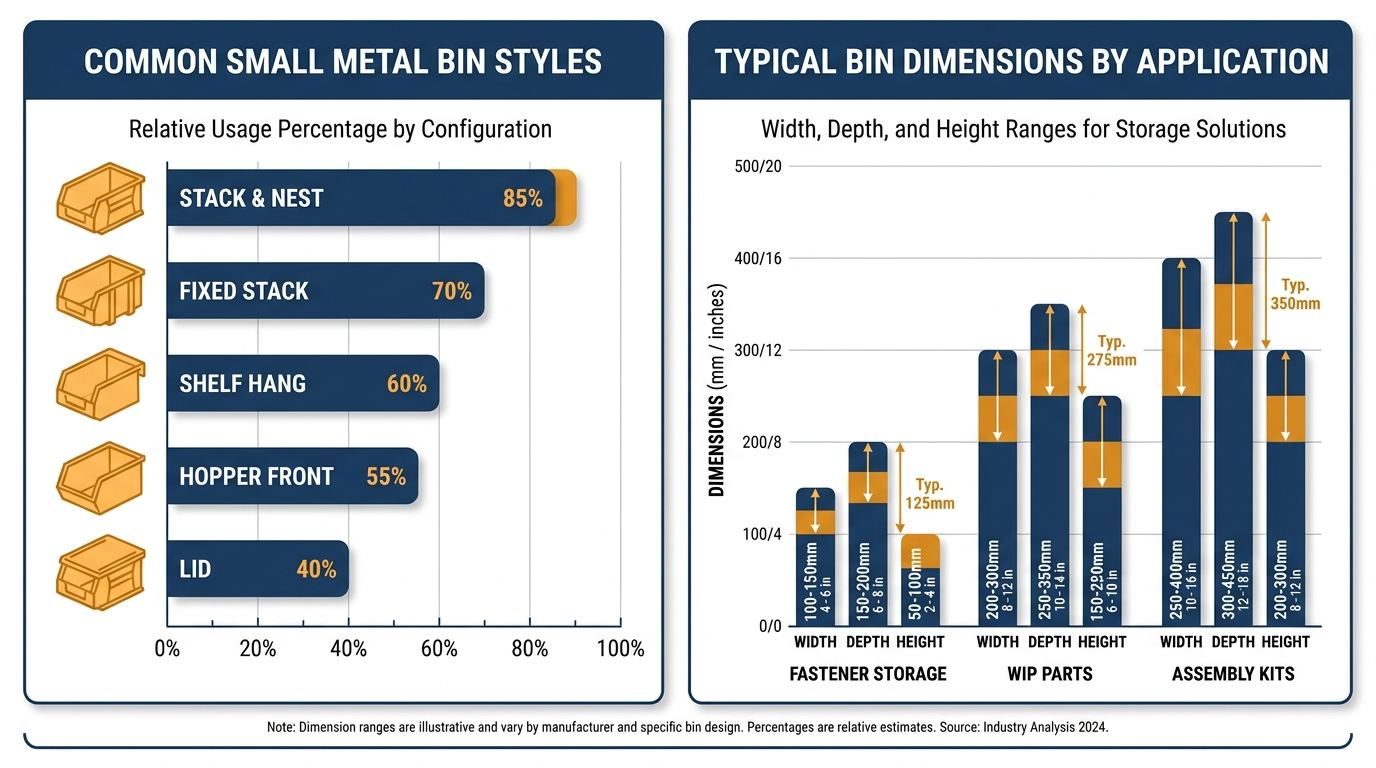
The right bin type depends on your access pattern, rack system, and how often operators interact with the bin during a shift.
Stack and nest bins
Stack-and-nest bins are the workhorses of parts storage. Loaded, they stack flat on top of each other — useful for high-density storage. Rotated 90 degrees, they nest inside each other, collapsing to roughly 30% of their stacked height for return trips or empty storage. If you’re shipping bins back from a customer’s line and want to reduce freight cost per truckload, this design pays for itself quickly.

Fixed-stack bins
When nesting isn’t needed, fixed-stack bins offer a simpler, lower-cost profile. They stack one directly on top of the other with a consistent register — meaning the stack doesn’t shift. Common in dedicated shelf-storage applications where bins stay in one location.
Shelf-hang and bin-rail bins
These bins mount on a horizontal rail or shelf lip, leaving the floor beneath clear. In tight aisles or at workstation assembly cells, hanging bins at the right ergonomic height reduces reach distance and speeds up picking. They’re particularly effective when combined with color-coded labels for visual management systems.
Hopper-front bins
Hopper-front (or picking-front) bins have a drop-down or scooped front panel that allows gravity feeding and easy single-hand access. Common in flow rack applications where bins are loaded from the rear and picked from the front, keeping the highest-priority stock always accessible.
Lidded and covered bins
When parts need dust protection or the storage area is overhead, a lid converts an open bin into a closed container. Our engineers can fabricate hinged lids, drop-in lids, or latching lids depending on whether the bin is stationary or transported.
How to choose the right bin for your operation
Picking the wrong bin isn’t just an inconvenience — it creates problems that compound. An undersized bin means constant refilling. An oversized bin wastes rack space and makes individual part retrieval slower.
Start with load and access frequency
List every part category that needs a home. For each, note the typical quantity stored, the weight per unit, and how many times per shift someone reaches into the bin. High-frequency access points toward a shallower bin with a wide opening. Lower-frequency bulk storage tolerates deeper bins.
Match bin dimensions to your rack or shelf module
This is where custom fabrication makes a measurable difference. Standard off-the-shelf bin sizes rarely match your exact shelf pitch. A bin that’s 2 inches narrower than your shelf opening wastes space and tends to shift. A bin built to the exact internal dimension of your rack cell fits flush, stacks cleanly, and stays put. Our engineers design bins to fit your specific racking system — not the other way around.
Consider the full material flow path
Will these bins be used only in one fixed location, or will they travel — to a supplier, to another building, on a tugger cart? If they move, stack-and-nest design reduces freight cost and storage footprint when empty. According to the Material Handling Institute, optimizing unit load design can reduce transportation costs by up to 25% — a figure that applies directly to how bins are sized and how efficiently they load onto a pallet or cart.
Factor in your identification system
Metal bins support welded-on label holders, riveted tags, magnetic label strips, and laser-etched part numbers. If you’re running a 5S or visual management program, build the identification system into the bin design from the start rather than retrofitting it later.
Implementation and the Plexform process
Getting bins fabricated and deployed doesn’t need to be a lengthy project. The process works best when it starts with a clear picture of the application before anyone talks about price.
Define the application first
Before requesting a quote, document the parts being stored, the rack or shelf system in use, the load per bin, and any access or transport requirements. A one-page summary with a photo of the current storage area is enough for our engineers to produce an initial design recommendation.
Prototype before full production
For orders of any meaningful volume, a prototype run is worth the lead time. A physical sample lets you verify fit, test access ergonomics on the actual rack, and confirm load capacity before committing to hundreds of units. Changes at the prototype stage cost almost nothing compared to changes after full production.
Phased rollout for large facilities
If you’re standardizing bin storage across a large facility, a phased rollout by department or product line reduces disruption. Start with the highest-frequency picking area — typically final assembly or kitting — where the payback on organized storage is fastest and most visible.
What working with Plexform looks like
Our engineers work from your specs, not a catalog. You tell us the dimensions, material, gauge, surface finish, and any special features — label holders, handles, drain holes, reinforced corners — and we build to those requirements. We fabricate in the U.S., which keeps lead times predictable and simplifies any mid-order changes. Custom doesn’t mean slow; most projects move from approved drawing to shipped product in a commercially reasonable timeframe.
Cost, ROI, and comparison
The upfront cost of metal bins is higher than plastic. That’s accurate and not worth hiding. The question is total cost over the service life of the bin.
Comparison table: storage bin material options
| Factor | Plastic totes | Wire baskets | Standard metal bins | Custom metal bins |
|---|---|---|---|---|
| Upfront cost | Low | Low–Medium | Medium | Medium–High |
| Load capacity | Low–Medium | Medium | High | High |
| Service life | 2–5 years | 3–7 years | 7–15+ years | 10–20+ years |
| Stack/nest options | Limited | Limited | Yes | Engineered to spec |
| Custom sizing | No | No | Limited | Yes |
| Surface treatment | N/A | Zinc/powder | Powder/zinc | Any |
| Parts protection | Low | Low | High | High |
Where the ROI comes from
A metal bin that lasts 15 years versus a plastic tote replaced every 3 years means you buy the same storage solution five times over. Add the labor cost of dealing with failed totes — spilled parts, restacking, reordering — and the math shifts further toward metal. Custom sizing adds another ROI layer by recovering rack space you’re currently leaving unused.
Frequently asked questions about small metal storage bins
Small metal storage bins come up in a lot of procurement and facilities conversations, and the same questions surface repeatedly. Here are direct answers.
What gauge steel is best for small metal storage bins?
For most parts storage applications, 16-gauge cold-rolled steel is a good starting point. Heavier loads — dense fasteners, castings — call for 14-gauge. Lighter, frequently handled bins can use 18-gauge to reduce weight without sacrificing structural integrity.
Can small metal storage bins be custom sized?
Yes. Custom fabrication allows bins to be built to exact internal and external dimensions, matching your specific rack, shelf, or conveyor system. This is one of the primary advantages of working with a custom fabricator versus buying off-the-shelf catalog sizes.
How do stack-and-nest metal bins reduce freight costs?
When empty, stack-and-nest bins rotate to collapse inside each other, reducing their combined volume by roughly 60–70%. This means you can load significantly more empty bins per truck or pallet, directly cutting the cost of returning empties from a customer or satellite facility.
What surface finishes work best in wet or chemical environments?
Zinc plating and hot-dip galvanizing outperform powder coat in wet environments. For chemical exposure, the specific chemistry matters — consult with your fabricator about which treatment resists the cleaning agents or process fluids in your facility.
Are metal bins suitable for food or pharmaceutical manufacturing?
Yes, with the right specifications. Stainless steel bins with electropolished finishes meet most food-grade and pharmaceutical sanitation requirements. Standard carbon steel with powder coat is not appropriate for direct food contact.
How long does a custom metal bin order typically take?
Lead time varies by complexity and volume, but most standard custom bin projects run 4–8 weeks from approved drawing to delivery. Prototype runs are faster. Rush production is sometimes available depending on current shop capacity.
Can metal bins be used with automated storage and retrieval systems?
Yes. Metal bins can be fabricated with precise external tolerances to work with ASRS carousels, conveyor systems, and pick-to-light setups. The key is providing the system’s dimensional requirements to the fabricator at the design stage.
What’s the best way to label metal storage bins for a 5S program?
Welded-on label holders or clip-in label channels allow labels to be changed without damaging the bin. For permanent identification, laser etching or stamped part numbers directly into the metal eliminate labels entirely — useful in harsh environments where paper labels won’t last.
Conclusion
Small metal storage bins aren’t a glamorous purchase. They’re also not an optional one if you’re serious about parts organization, floor space efficiency, and production throughput. The right bin — built to the right size, gauge, and configuration — creates a storage system that’s predictable, durable, and efficient for years.
Three things matter most: match bin dimensions to your actual rack system, select material and gauge based on real load and environment data, and build identification into the design from the start rather than adding it later.
If you’re ready to replace improvised storage with something built specifically for your operation, talk to our team at plexformps.com. We’ll start with your specs and build from there.

Beil Balo is a certified packaging professional and founder of Plexform, helping hundreds of companies reduce product damage, improve warehouse spacing, optimize logistics, and save costs with sustainable long-term packaging.