 Skip to content
Parts disappear. Inventory gets miscounted. Supervisors walk the floor hunting for components that are sitting right in front of them inside an opaque bin. If that sounds familiar, you’re not alone—and the fix is often simpler than a full warehouse overhaul.
Mesh storage containers solve a specific, persistent problem: you need to see what’s inside without opening every container on the rack. They also happen to handle rough production environments well, stack cleanly, and cost less to ship than solid-wall alternatives. This guide covers what mesh containers are, how they’re built, what configurations exist, and how to pick the right one for your operation. By the end, you’ll know exactly what to ask for—whether you’re sourcing a standard size or going fully custom.
What mesh storage containers are and why they matter
The basic definition
A mesh storage container is a rigid bin or box with walls made from welded wire or perforated metal rather than solid sheet steel or plastic. The open-grid structure lets workers see the contents at a glance, allows air circulation, and reduces the overall weight of the container without sacrificing load capacity.
Where they show up in manufacturing
You’ll find mesh containers on assembly lines, in press rooms, at receiving docks, and inside warehouses storing castings, stampings, springs, fasteners, and other mid-sized components. They’re common wherever parts need to be moved from one station to another without getting lost in transit.
Why plant managers care
The visibility factor alone changes how a floor runs. When a line worker can see from 10 feet away that a bin is running low, they reorder before the line stops—not after. According to the Material Handling Industry, inventory accuracy problems cost manufacturers an average of 3–5% of annual revenue. That’s a number most plant managers feel but rarely trace back to something as simple as container choice.
Key benefits and how mesh containers are constructed
Construction basics
Most industrial mesh storage containers are built from welded steel wire, typically 6-gauge to 9-gauge depending on the load rating. The wire is spot-welded at every intersection, then the frame is reinforced with heavier tube or angle steel on the top rails and bottom skids. A powder-coat finish protects against corrosion in environments that see coolant, oil mist, or humidity.
Some applications call for expanded metal mesh instead of wire grid—it’s heavier but handles smaller parts that would fall through a standard wire opening.
Visibility and inventory control
Open walls mean no guessing. Parts are visible from multiple angles, which speeds up cycle counts and reduces picking errors. In facilities running lean or pull-based systems, that visibility directly supports takt time.
Weight savings and freight costs
A mesh container can weigh 20–35% less than a comparable solid-wall steel box. Multiply that across a full truckload and you’re transporting more product per truck—sometimes enough to eliminate a shipment entirely. That’s real money on high-volume supply chains.
Ventilation and cleanliness
Metal parts often arrive with residual cutting fluid or lubricant. Mesh walls let those fluids drain rather than pool. They also make it easy to spray-clean a container without trapping water inside.
Types and configurations of mesh storage containers
Fixed-wall containers
The simplest design: four solid-mesh walls welded to a frame, with a flat or channel bottom. These are the most rigid option and handle the highest dynamic loads. They stack well, nest when empty if designed with a slight taper, and require minimal maintenance. Good fit for high-cycle applications where the container rarely leaves the building.
Collapsible mesh containers
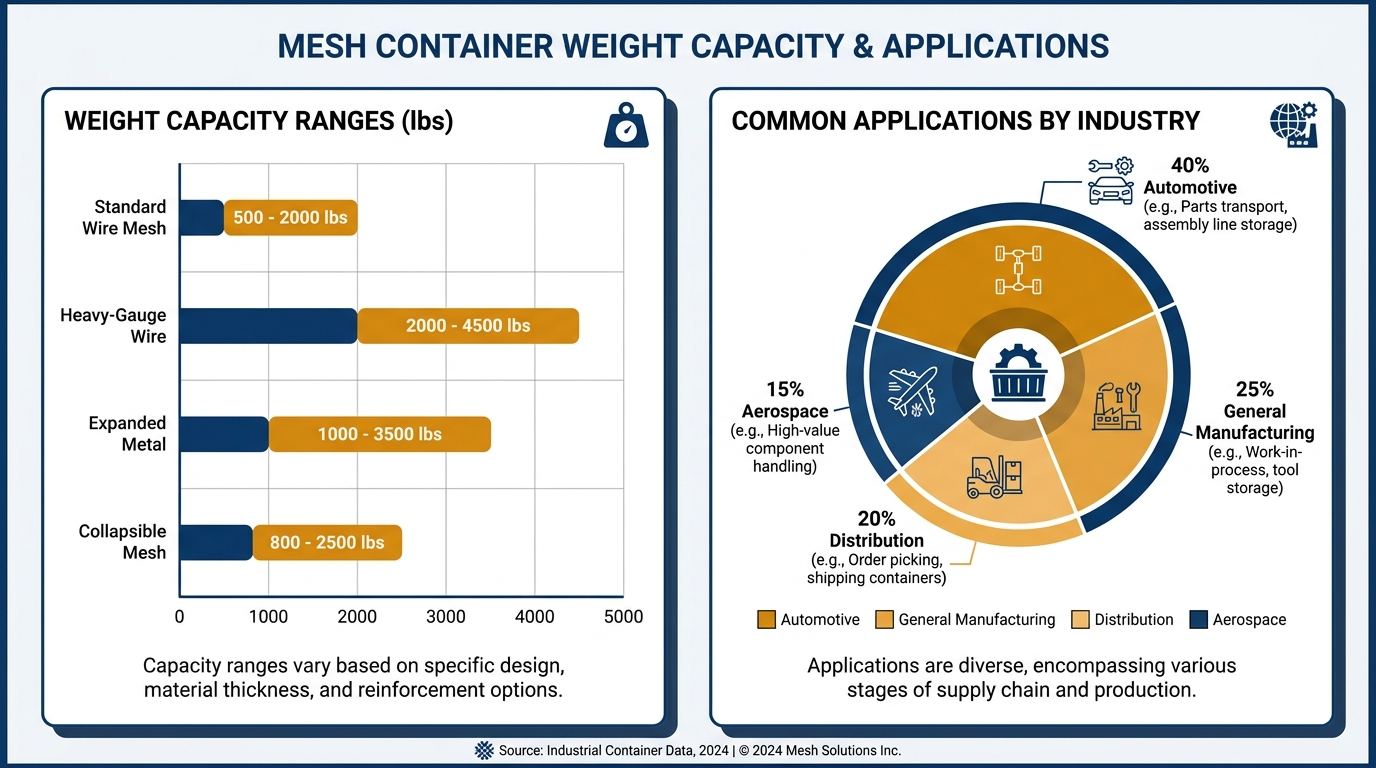
Collapsible designs fold down—usually the long sides drop inward—to a fraction of their full height when empty. This matters when containers travel outbound full and return empty. A truck that can carry 20 assembled containers can carry 80 or more collapsed ones. If you’re running a returnable packaging program with suppliers or customers, the math on collapsible containers pays off quickly.

Stack-and-nest containers
Some mesh containers are engineered to stack when loaded and nest inside each other when empty—without collapsing. The walls angle slightly so empty units drop into each other. This is a space-efficient option for facilities with limited dock staging area.
Custom configurations
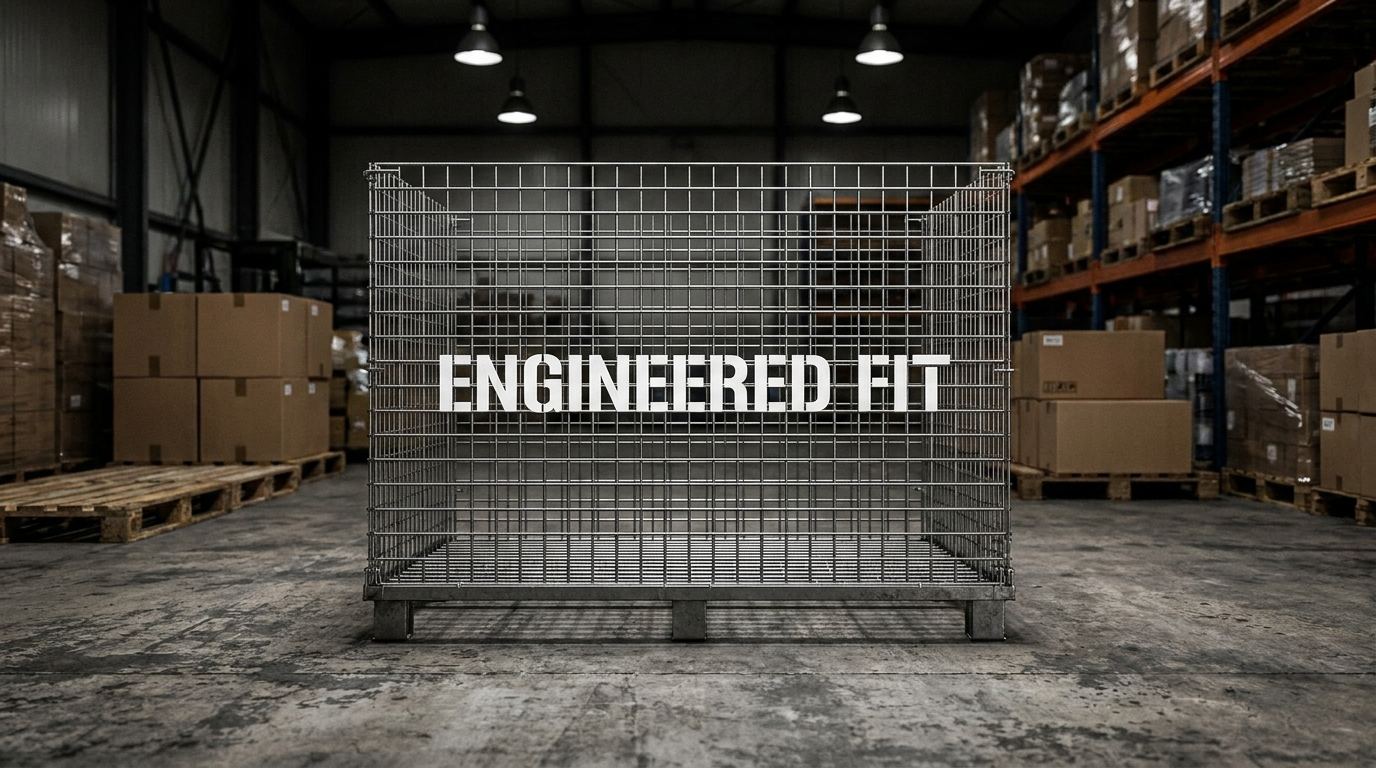
Standard sizes don’t fit every part. Our engineers design containers to match your specific part geometry, rack dimensions, or conveyor opening. That might mean a non-standard footprint, internal dividers made from mesh or foam, drop gates on one end for ergonomic access, or fork pockets positioned for a particular lift truck. Custom-built to exact specs means the container works with your process, not around it.
How to choose the right mesh storage container
Start with your load
Calculate the maximum weight the container will hold, then add a safety factor—typically 1.5x for dynamic (moving) loads. A container rated for 1,000 lbs static may only be rated for 600–700 lbs when lifted by forklift. Get the dynamic rating from your supplier, not just the static one.
Match the wire gauge to the part
Heavy stampings and castings need 6-gauge or heavier wire with small grid spacing so parts don’t shift or catch on the mesh. Lighter components like plastic housings or foam-wrapped parts can tolerate larger openings and lighter wire. Getting this wrong damages parts or the container—or both.
Consider the return loop
How does the container get back to the start of the cycle? If it travels to a customer and returns empty, collapsible walls save freight cost. If it stays inside your four walls and moves between departments, fixed walls are simpler and more durable.
Check your rack and lift equipment
Container footprint needs to match your rack beam spacing and your lift truck’s fork width. This sounds obvious until the new containers arrive and don’t fit the existing infrastructure. Confirm the outer dimensions, the fork pocket width, and the stacking height against your actual rack drawings before you order.
Finish and corrosion requirements
Standard powder coat works in most dry indoor environments. If the container sees washdown, outdoor storage, or chemical exposure, ask about galvanized wire, epoxy-based coatings, or stainless mesh inserts for contact surfaces.
Implementation and the Plexform process
Assess before you spec
Before our engineers draw anything, they want to know how the container moves through your facility. What picks it up? Where does it sit between cycles? What’s the worst-case abuse it takes? Answers to those questions change the design more than any dimension does.
Prototype and validate
For custom orders, we build a prototype and send it to your team before full production runs. You put it through your actual process—run it on the line, load it to spec, cycle it through the fork truck a few times. If something needs adjusting, we fix it before you’ve committed to a full quantity.
Phased rollout vs. full cutover
Some facilities switch container types all at once during a planned downtime. Others phase in new containers by product line or department. Phased rollouts reduce disruption and let you validate the container’s performance in your real environment before committing the full budget.
Optimize floor space as you go
When you switch from solid-wall bins to collapsible mesh containers, you often free up significant rack and floor space simply because empty containers take less room to store. That recovered space is real—it can hold additional inventory, create a new staging lane, or reduce the distance workers travel per cycle.
Cost, ROI, and how mesh containers compare
The comparison below covers the four most common container types plant managers evaluate when sourcing industrial parts containers.
| Container type | Typical cost range | Return empty cost | Part visibility | Best application |
|---|---|---|---|---|
| Solid-wall steel box | $$$–$$$$ | High (heavy, full-size) | None | Heavy rough castings, outdoor storage |
| Mesh storage container (fixed) | $$–$$$ | Moderate | Full | General manufacturing, assembly lines |
| Mesh storage container (collapsible) | $$$–$$$$ | Low (ships flat) | Full | Returnable supplier packaging, outbound |
| Plastic tote/bin | $–$$ | Low to moderate | Partial (if clear) | Light parts, clean rooms, food-adjacent |
Where mesh wins
Fixed-wall mesh containers offer the best balance of durability, visibility, and cost for most manufacturing environments. Collapsible mesh containers win on any loop where the empty-return freight cost matters. Solid-wall steel beats mesh only when parts are too small for the wire grid or need protection from contamination.
Total cost of ownership
A cheaper container that damages parts or fails in two years isn’t cheaper. Factor in the cost of scrapped or damaged parts, container repair, and replacement cycles. Mesh containers built to industrial spec typically run 7–10 years with normal maintenance.
Frequently asked questions about mesh storage containers
Answers to the questions plant managers and procurement teams ask most often before specifying or ordering mesh storage containers.
What wire gauge is standard for industrial mesh storage containers?
Most general-purpose industrial mesh containers use 9-gauge welded wire. Heavy-duty containers handling castings, forgings, or other dense metal parts move to 6-gauge or even heavier. The gauge you need depends on your load weight and how rough the handling environment is.
Can mesh storage containers be stacked with a forklift?
Yes—when they’re designed with stacking lugs or corner posts that align vertically. Not all mesh containers are designed for powered forklift stacking, so confirm the dynamic stacking load rating with your supplier before lifting them multiple units high.
How do collapsible mesh containers work?
Collapsible mesh containers have hinged wall panels, usually the two long sides, that fold inward and down when the container is empty. The collapsed height is typically 20–30% of the full standing height. This lets you return far more empty containers per truckload compared to a fixed-wall design.
Are mesh containers suitable for small parts?
It depends on the wire spacing. Standard grid openings are often 2″ x 2″ or 4″ x 2″—too large for small fasteners or precision components. For small parts, specify a tighter mesh pattern, a solid-bottom mesh container, or add a liner tray inside the container.
What’s the typical lead time for custom mesh storage containers?
Standard sizes are often available off the shelf or within a few weeks. Custom-designed containers—specific footprints, non-standard depths, internal dividers, special coatings—typically run 6–10 weeks from approved drawing to delivery, depending on quantity and complexity.
How do I clean and maintain welded wire mesh containers?
Powder-coated mesh containers can be pressure-washed and air-dried. Inspect welds at wire intersections annually, especially on high-cycle containers that move through forklifts daily. Re-coat bare spots before rust develops. With basic maintenance, a well-built mesh container lasts a decade or more.
Can mesh containers be custom-sized to fit existing rack systems?
Yes. This is one of the most common requests our engineers handle. Bring your rack beam dimensions, column spacing, and fork truck specifications and we design a container that fits your infrastructure without modifications to the rack.
What’s the difference between mesh containers and wire baskets?
Wire baskets typically have lighter construction, no fork pockets, and are not designed for stacking under load. Mesh storage containers are engineered for industrial material handling: rated load capacities, fork entry, stacking compatibility, and longer service life. They’re not interchangeable in a production environment.
Conclusion
Mesh storage containers are one of the more straightforward upgrades a plant can make—the impact on parts visibility, freight costs, and floor space is measurable, and the containers themselves don’t require your team to change how they work. The right design depends on your load, your return loop, and your existing rack and lift equipment.
If you’re sourcing standard sizes, confirm the dynamic load rating and wire gauge before you order. If standard doesn’t fit your operation, custom is worth the conversation.
Our engineers at Plexform design and build mesh storage containers to exact specifications—your part geometry, your rack dimensions, your handling equipment. Visit plexformps.com to request a quote or talk through your application.

Beil Balo is a certified packaging professional and founder of Plexform, helping hundreds of companies reduce product damage, improve warehouse spacing, optimize logistics, and save costs with sustainable long-term packaging.