 Skip to content
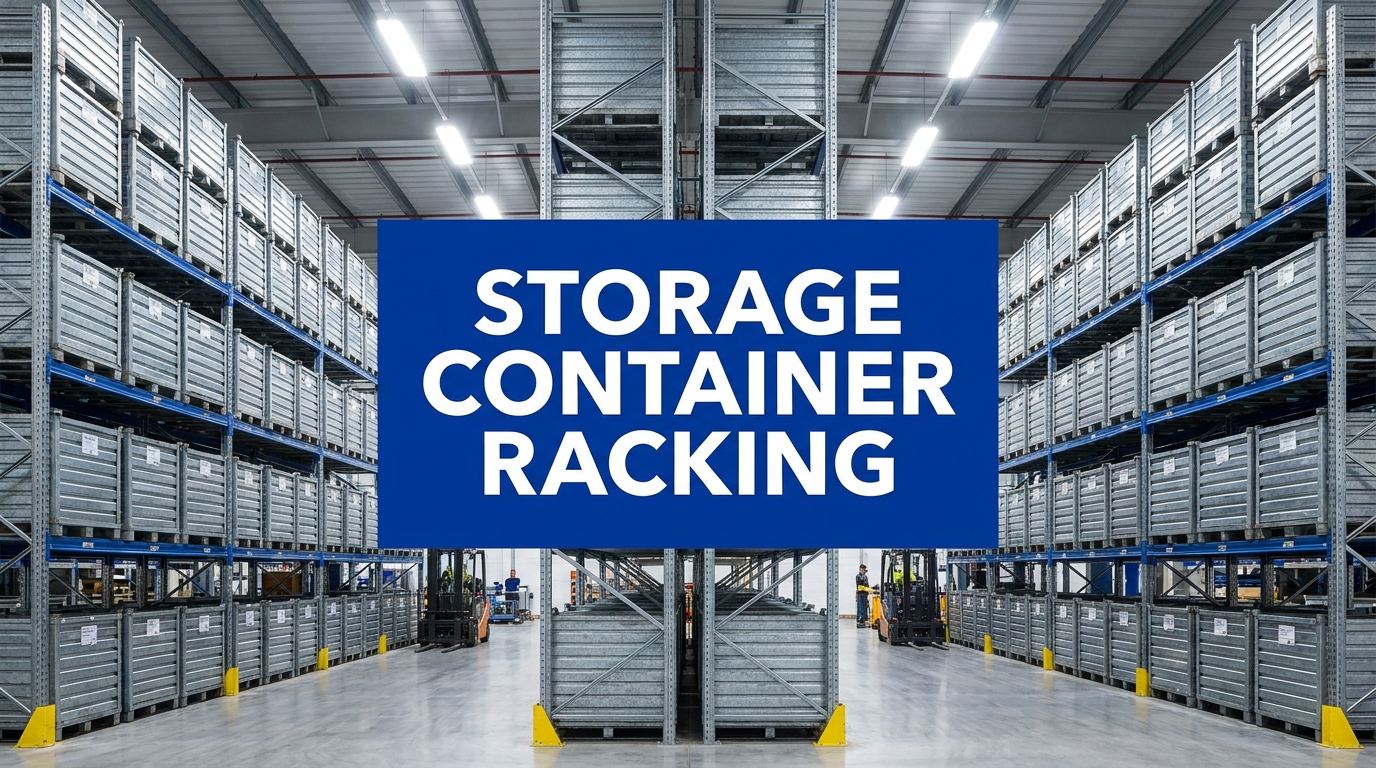
If your floor is covered in stacked bulk containers and your forklift operators are spending half their shift moving things to get to other things, the containers aren’t the problem. The storage method is. Storage container racking gives you a structured way to use vertical space, keep every container independently accessible, and stop treating your production floor like a permanent staging area.
The difference between random stacking and a proper rack system shows up in cycle times, part damage rates, and how much floor you actually get back. According to the Warehousing Education and Research Council, facilities that move to structured vertical storage typically recover 20 to 40 percent of usable floor space without expanding the building.
This guide covers the main rack types, how to match a system to your containers and workflow, and how we design custom solutions from scratch — so you can make the right call for your facility.
What storage container racking is and why it matters
Storage container racking is a structural steel frame system built to hold bulk containers, IBCs, wire mesh cages, metal bins, or other large returnable containers off the floor, in organized rows, at heights accessible by forklift.
This is different from standard pallet racking. Pallet racks are engineered around the 48×40 inch pallet footprint with predictable, centered weight. Container racks are built around your container — which often has a non-standard base, unusual weight distribution, or integral stacking feet that the container manufacturer designed in. Trying to store those on standard pallet beams usually means wasted space, unstable loads, or both.
The floor space problem
Every container sitting on your floor costs money whether it moves or not. Stacking three or four high saves area, but at a price: every time you need a container from the bottom of a stack, you’re doing two or three forklift moves just to get there. A plant running three shifts can easily burn an hour of forklift time per day on unnecessary moves to manage a floor stack. That time doesn’t show up as a line item on a P&L anywhere, but it’s real.
The damage problem is quieter and often more expensive. When a stack shifts, or when a container drops even a foot during unstacking, parts get damaged — finished goods, precision machined components, things you’d rather not explain to a customer. A proper storage container racking system eliminates that chain. Containers stay in designated slots, every level is accessible without disturbing another, and your operators stop playing four-dimensional Jenga to pull an order.
How these systems are built
Storage container racking is welded or bolted structural steel. Tube steel and angle iron are the most common materials, though some lighter-duty applications use formed channel. The standard finish is powder coat over a blasted or cleaned surface, or hot-dip galvanizing for outdoor and wash-down environments.
Steel construction, load ratings, and finish
Each rack bay has uprights, horizontal beams, and cross-members or support bars sized for your specific container footprint. Load capacity is rated per level, not per rack total. A rack rated for 2,500 lbs per level means each shelf independently handles 2,500 lbs — the rating applies at every tier.
Our engineers size the steel gauge and weld schedule based on dynamic loading, which accounts for how fast forklifts set containers down. A container dropped from six inches above its target hits with roughly twice its static weight in impact load. The structure has to handle that without deflecting or fatiguing over years of daily use.
Finish options include standard powder coat in gray, safety orange, or a custom color match; hot-dip galvanizing for outdoor or high-moisture environments; and primed bare steel for quick-ship applications where lead time matters more than color. The right choice depends on where the rack lives and how wet your facility gets.
Types and configurations of storage container racking
Most facilities end up with one of three main configurations. The right one depends on container dimensions, access frequency, and the forklift equipment already on your floor.

Standard bay racking
Standard bay racking is the most common setup for mixed container inventories. Uprights and beams form open bays, with adjustable support bars or solid decking at whatever height your containers need. Every level is independently accessible — you never move one container to get to another.
This works well when you have 10 to 30 different container types and need to access most of them regularly. It isn’t the densest option, but it’s the most adaptable. Beam heights adjust as your container mix changes, and bays can be added or reconfigured without rebuilding the whole system.

Drive-in racking for dense storage
Drive-in racking trades access flexibility for storage density. A forklift drives into the bay from one end and loads containers back-to-front on a continuous support rail. You can fit 40 to 60 percent more containers per square foot compared to standard bay racking.
The tradeoff is last-in, first-out access. Whatever went in last comes out first. This works for high-volume storage of one container type where you’re cycling through full bays quickly, like a stamped parts program that restocks daily. It doesn’t work for mixed inventory where you need specific containers from mid-bay without moving others.
Stacking frames and custom container supports
If your containers have integral stacking feet or corner posts, stacking frames are often the most economical path. The frame is a bolt-together steel structure that gives each container level an independent support, so the stack is no longer relying on the container below to carry the weight.
Custom container supports — shaped brackets or cradles built to your exact container geometry — are the answer when the container has an irregular base, curved sides, or offset weight distribution that standard beams won’t handle cleanly. We see this regularly with automotive dunnage trays, deep-drawn stamped tubs, and custom-molded plastic containers that weren’t designed to sit on a standard rail.
How to choose the right storage container racking
Getting this wrong is expensive. A rack that doesn’t match your containers is either unsafe or inconvenient enough that people stop using it correctly. Both outcomes cost more than the rack did.

Container size and weight
Start with actual container dimensions — external length, width, and height — plus gross weight when fully loaded. Don’t rely on the spec sheet alone; measure what you have. Container manufacturers have tolerances, and field-modified containers often don’t match their original drawings by the time they reach your floor.
Weight matters more than most facilities budget for. A 48×48 inch metal bulk container loaded with castings or stampings can reach 4,000 to 6,000 lbs. Your rack has to handle that load at every level, plus the impact load from normal forklift placement. Undersizing the steel is the single most common mistake we see in field-built racks — typically discovered when a beam starts deflecting after six months.
Forklift type and aisle width
Your rack configuration is constrained by the equipment already on your floor. A counterbalance sit-down forklift needs wider aisles than a narrow-aisle reach truck. A drive-in system needs at least 12 to 14 feet of clear aisle for safe entry and exit. If you’re considering new forklift equipment, factor that into the rack design at the same time — the two decisions interact more than most people expect when they start separately.
Think about lift height too. If containers need to go to three levels, your forklift has to reach that height under full load, with enough mast clearance above the top container to set it down cleanly. This sounds obvious, but it’s a detail that gets skipped until the rack is installed and someone realizes the truck can’t reach the top tier with a heavy load.
Plexform’s custom design process
Off-the-shelf racking rarely fits custom containers well. Most bulk containers and industrial dunnage containers are non-standard by design — that’s the point of specifying them. The rack that holds them should be custom too.

From site dimensions to shipping
When you reach out to us, we start with a container intake form: external dimensions, gross loaded weight, forklift model and lift capacity, floor-to-ceiling clearance, and a photo or sketch of the storage area. From that, our engineers build a CAD drawing showing bay layout, beam heights, forklift aisle clearances, and the anchor pattern for floor mounting.
Everything goes through a load calculation before drawings release for fabrication. We spec the structural steel, weld schedule, hardware grade, and floor anchor size based on your actual loads — not a generic catalog rating that may or may not apply to what you’re storing. Engineering documentation for permit applications comes with the order, not as an add-on.
Lead time from signed drawing to shipping runs four to six weeks for standard configurations, six to ten weeks for complex multi-bay systems or specialized finishes. We don’t send you a catalog product and hope it works. We build it to fit your containers, your floor, and your forklift.
Cost and ROI: comparing your options
Rack systems range from around $2,000 for a simple two-bay stacking frame setup to $50,000 or more for a large drive-in system with full engineering documentation and a custom finish. The main cost drivers are steel weight, bay count, finish type, and whether we’re engineering from scratch or working from a proven repeat-order design.
| Configuration | Typical cost range | Access type | Best for |
|---|---|---|---|
| Standard bay racking | $3,000–$15,000 | Any level, any time | Mixed container types, daily access |
| Drive-in racking | $8,000–$40,000 | Last-in, first-out | High-volume, single container type |
| Stacking frames | $1,500–$8,000 | Per-frame, independent | Containers with integral stacking feet |
| Custom cradles and supports | $5,000–$25,000 | Any level, any time | Irregular or non-standard container geometry |
ROI comes from two directions. First, recovered floor space. Moving from floor stacking to a racking system typically returns 25 to 40 percent of the container storage footprint for other uses — production staging, better forklift flow, or simply not paying lease rate on space your containers are consuming. Second, reduced damage. When containers are in dedicated rack slots instead of stacked on each other, tip-over and drop damage falls off fast. One avoided damage claim on a batch of finished parts can pay for a full rack bay.
The payback period for most installations we build runs 12 to 24 months. Facilities with high part values or heavy forklift traffic often see it faster.
Frequently asked questions about storage container racking
A few questions come up almost every time someone starts comparing rack options. Here are the ones we get asked most.
What’s the difference between storage container racking and pallet racking?
Pallet racking is engineered around the 48×40 inch standard pallet with consistent, centered weight distribution. Storage container racking is built for your specific container — which may have a non-standard footprint, corner posts, or a base configuration that standard pallet beams won’t support safely. The frame geometry, beam depth, and support bar spacing all change based on what you’re actually storing.
Can storage container racking be used outdoors?
Yes, but the finish has to match the environment. Standard powder coat handles light moisture exposure but will rust with long-term outdoor use. For permanent outdoor installations, hot-dip galvanizing or stainless hardware throughout is the right call. The structural design also needs to account for wind load if the rack is in an unenclosed space.
How much floor space will a racking system actually recover?
Most facilities moving from floor stacking to a three-level racking setup recover 30 to 40 percent of the original container storage footprint. The exact number depends on ceiling height, container dimensions, and how aisle configuration changes. Higher ceilings and containers with a smaller footprint recover more than low-ceiling facilities with wide, shallow containers.
What weight capacity should I specify?
Take your heaviest fully-loaded container weight and add at least 20 percent as a safety margin. If your heaviest container weighs 4,000 lbs loaded, spec your rack levels for a minimum of 4,800 lbs. Use actual gross weight from your scale, not the nominal capacity on the container spec sheet — those numbers don’t always match what ends up inside them.
How long does a custom rack take to build and ship?
Standard configurations ship in four to six weeks from approved drawings. Complex systems with multiple bays, unusual geometry, or specialized finishes typically run six to ten weeks. Rush options are available on some configurations depending on current production load — ask when you request a quote.
Do I need a building permit to install storage container racking?
In most U.S. jurisdictions, yes. Rack installations above a certain height or load capacity require a permit, and some require a stamped engineering drawing from a licensed engineer. Requirements vary by municipality. Every Plexform order includes complete engineering documentation, which takes most of the friction out of the permit process.
Conclusion
Storage container racking pays back faster than most facilities expect. The current cost of floor stacking — forklift moves, handling damage, and wasted floor space — is usually higher than it looks until you measure it directly.
Pick the right rack configuration for your containers and forklift, size it accurately for your actual loads, and get proper engineering documentation before you anchor anything to the floor. Those three steps cover most of what goes wrong.
If you’re ready to reclaim your floor, contact our engineers at plexformps.com for a free site assessment and custom rack drawing. We build systems that fit your containers — not the other way around.

Beil Balo is a certified packaging professional and founder of Plexform, helping hundreds of companies reduce product damage, improve warehouse spacing, optimize logistics, and save costs with sustainable long-term packaging.