 Skip to content
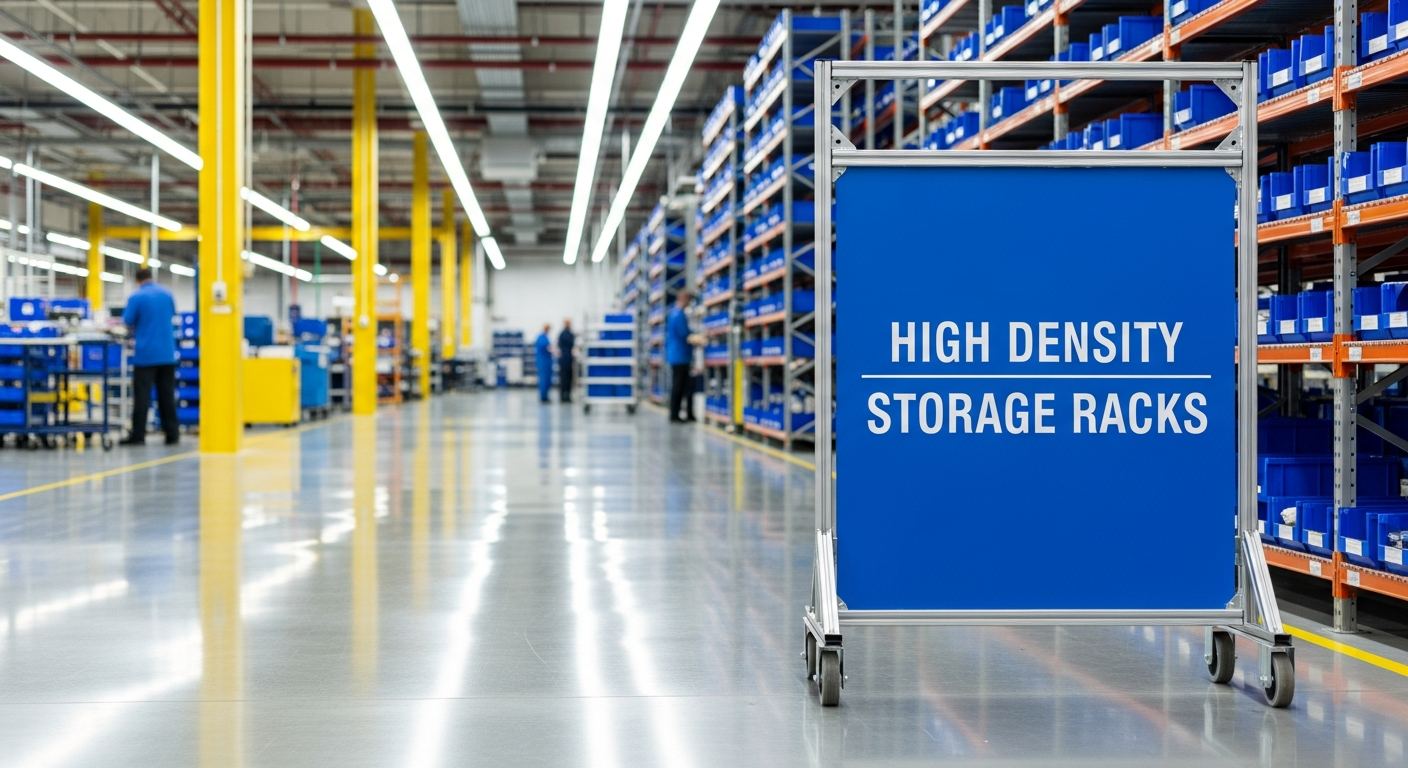
Here’s a number worth sitting with: industrial warehouse space in the U.S. costs between $7 and $12 per square foot annually. That’s before taxes, utilities, and insurance. If your current racking system leaves a third of your ceiling height unused, you’re paying rent on empty air. High density storage racks fix exactly that problem. They don’t just hold more product. They change how much your facility can do with the space it already has.
This guide covers what high density storage racks are, the main configurations you’ll encounter, how to match the right system to your SKU profile and forklift fleet, and what the investment actually looks like. By the end, you’ll know which approach fits your operation and which ones to rule out.
What Are High Density Storage Racks — and Why Do They Outperform Standard Systems?
Let’s be clear about the terminology: high density storage racks are engineered racking systems designed to reduce aisle space and increase pallet positions per square foot of floor area. Standard selective pallet racking gives you one pallet deep per side and requires wide aisles for forklift access on both sides. High density systems eliminate or dramatically reduce those access aisles by storing multiple pallets deep, or by using mobile bases, gravity-fed rollers, or channeled drives to make retrieval efficient without dedicating square footage to empty corridors.
The global industrial racking market was valued at approximately $9.8 billion in 2023 and is projected to grow at a 4.5% CAGR through 2030, driven largely by manufacturers and third-party logistics providers demanding more output from existing square footage. High density racking is built for exactly that problem.
The Core Engineering Principle
The defining characteristic of any high density storage system is its depth-to-aisle ratio. Standard selective racking achieves roughly 35–40% storage efficiency because approximately 60% of floor area goes to aisle space. High density configurations push that to 60–85%, depending on configuration type. That’s not a marketing figure. It’s a direct function of how many pallets you store per row depth relative to how many aisles your equipment needs.
That gap, 40% efficiency versus 80%, is the reason facilities switch. It’s the equivalent of doubling your storage positions without laying a new foundation.
Who Actually Uses High Density Storage Racks?
High density racking works best when you’re storing large quantities of a limited number of SKUs, or when your inventory rotation allows LIFO or FIFO sequencing. It’s especially common in:
- Cold storage facilities, where every square foot of refrigerated space carries a significant cost premium
- Automotive parts manufacturers staging large component batches for assembly line sequencing
- Consumer goods distribution centers with high-velocity, high-volume product categories
- Food and beverage operations where FIFO inventory rotation is non-negotiable
If you’re managing 50+ SKUs with widely varying velocities, evaluate the selectivity trade-offs carefully before committing. High density systems can create picking constraints that cost more in labor than the space savings recover.
What You Actually Gain: The Real Benefits of High Density Storage
When operations teams switch to high density storage racks, the improvements show up in floor space first, then labor, then product damage rates. None of these are soft numbers. They land on the P&L.
Space Recovery That Changes the Math
A well-configured high density rack system can increase pallet positions in your existing footprint by 50–120%, depending on your starting point and the configuration you choose. To put that concretely: a 50,000-square-foot facility running selective racking at 40% storage efficiency that converts to drive-in racking at 75% efficiency gains the equivalent of roughly 17,500 square feet of additional storage capacity. No construction, no permits, no new lease.
That kind of space recovery either eliminates a planned building expansion or frees square footage for a value-added activity: kitting, assembly, staging, or a new production line. At $80–$120 per square foot for new industrial construction in most U.S. markets, avoiding an expansion is often the most compelling ROI argument for a high density project.
Faster Throughput and Fewer Handling Steps
High density configurations, particularly pallet flow and push-back systems, allow inventory to move toward the pick face without forklifts having to enter every lane on every cycle. That cuts travel time per pick, reduces the number of times a pallet is touched before it ships, and tightens cycle times across shifts. Fewer touches also means fewer chances for product damage or mislocation.
Types of High Density Storage Rack Systems
Not all high density rack configurations make the same trade-offs. Each one balances storage density, inventory selectivity, and forklift access differently. Understanding those trade-offs is the whole ballgame when it comes to system selection.
Drive-In and Drive-Through Racking
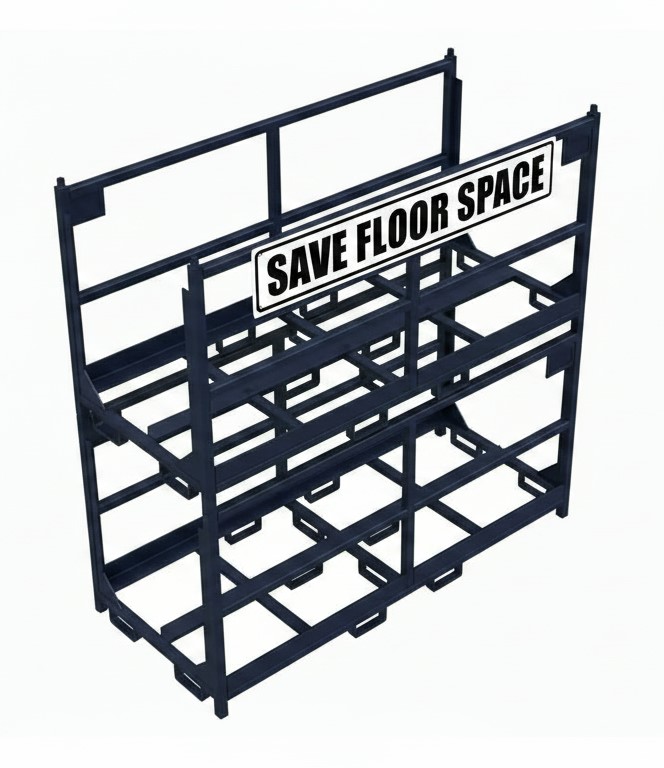
Drive-in racking eliminates aisles entirely by allowing forklifts to enter the rack structure and place pallets on continuous rails rather than individual beams. A single entry and exit point makes the system LIFO by design. Drive-through racking adds a second entry at the back, enabling FIFO rotation. Both achieve exceptional density, typically 75–85% storage efficiency, and work best for large volumes of identical product.
The constraint: you can only access the front pallet in each lane. High SKU counts or random-access requirements create selectivity problems that can generate more labor cost than the space savings justify.

Push-Back and Pallet Flow Racking
Push-back racks use a nested cart system on inclined rails: each new pallet pushes existing ones deeper into the lane, and retrieval automatically brings the front pallet to the aisle face. Typical depth is 2–5 pallets. You get LIFO high density access without forklifts entering the structure, which is significantly safer for equipment and product than drive-in systems.
Pallet flow racking loads from the back and gravity-feeds pallets forward on rollers to the pick face. It’s the only naturally FIFO high density system, making it the standard choice for food, beverage, pharmaceuticals, and any inventory with date-code requirements.
Mobile Shelving and High Bay Systems
Mobile shelving mounts entire rack rows on motorized or hand-crank bases that slide along floor tracks. You open one working aisle at a time and shift it wherever access is needed. Density can exceed 85% because you’re maintaining only one aisle across the entire system at any moment. These systems suit slower-moving inventory where random access is needed but simultaneous access to all rows isn’t required.
How to Choose the Right High Density Storage Rack System
Committing to the wrong configuration is expensive. You’re anchoring capital and floor bolts to a system that either underdelivers on density or creates bottlenecks your team works around every shift.
Match the System to Your SKU Profile
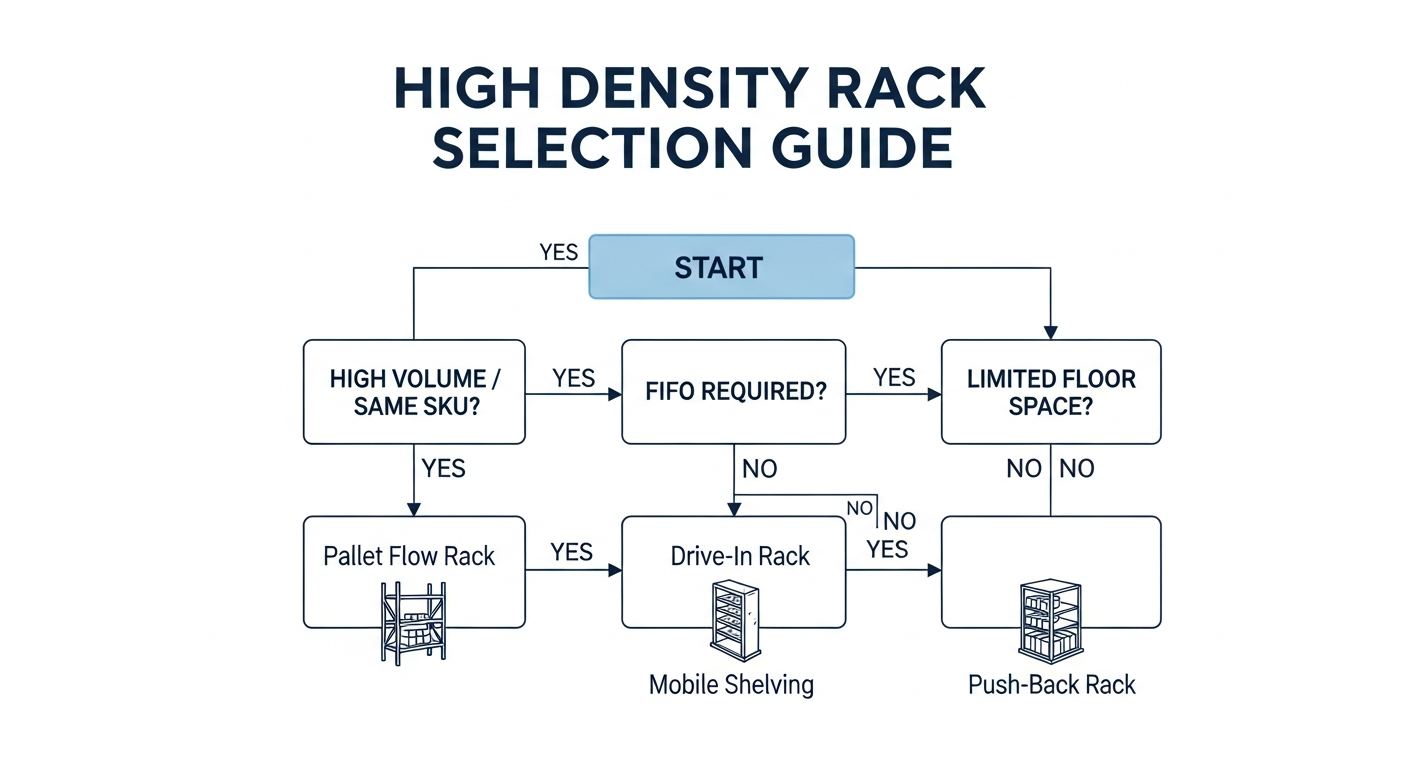
Your inventory structure is the single most important input in this decision. Work through these six questions before you talk to any manufacturer:
- Count your active SKUs. Fewer than 10 high-volume SKUs points to drive-in or pallet flow. More than 20–30 points toward push-back or selective high-bay systems.
- Nail down rotation requirements. FIFO requirements eliminate drive-in racking immediately.
- Measure your actual pallet footprint. Standard systems are built around 48×40-inch GMA pallets. Non-standard sizes need custom rail or lane spacing.
- Look at throughput velocity. A system sized for seasonal peak load needs different lane depths than one running at consistent daily replenishment.
- Audit your forklift fleet. Drive-in racking requires specific mast heights relative to lane depth. Verify compatibility before quoting.
- Measure your clear ceiling height. You need at least 6 inches of clearance above your highest intended load beam.
Aisle Requirements and Forklift Compatibility
Standard counterbalanced forklifts need 10–12-foot aisles. Narrow-aisle trucks operate in 8–10-foot aisles. Very narrow aisle trucks work in 5–6-foot aisles. Your forklift spec sets the minimum aisle width, which directly determines how much density your system can capture.
If you’re investing in a major racking project, it’s worth modeling the total cost of a fleet adjustment against the additional density a narrower-aisle approach would unlock. In facilities with expensive square footage, the math often favors the upgrade.
Custom-Engineered vs. Off-the-Shelf High Density Racks
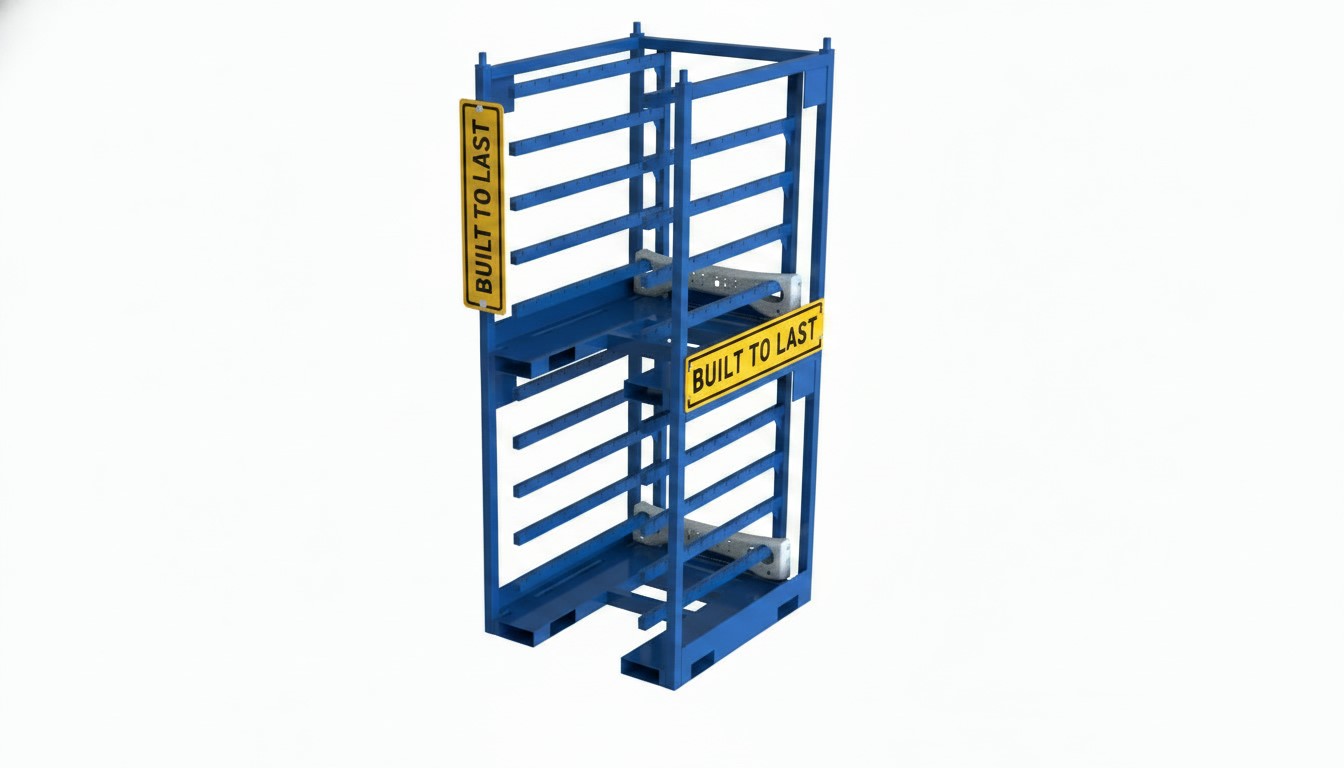
Standard catalog high density racks are designed around common pallet sizes, industry-average ceiling heights, and typical facility column spacing. They work well when your operation fits the mold. But many manufacturing and distribution facilities have non-standard column grids, mixed pallet formats, floor flatness tolerances, or seismic zone requirements that catalog systems don’t accommodate.
Where Off-the-Shelf Systems Fall Short
Generic high density racks assume standard 48×40-inch GMA pallets and 96-inch-high unit loads. If you’re running 42×42 pallets, oversized automotive assemblies, or custom returnable containers, a catalog system either wastes lane depth, costing you density, or creates clearance risks that cost you product and potentially expose you to compliance issues under OSHA 29 CFR 1910.178 forklift safety standards.
Catalog uprights also come in fixed height increments. You’re often leaving vertical cube on the table because the standard height doesn’t land cleanly at your clear-height-to-sprinkler-head measurement.
Plexform’s Engineering Process
Our engineers start with your actual facility dimensions, your specific pallet or container format, your forklift equipment list, and your inventory rotation requirements, then design the system around those inputs rather than asking you to adapt to a catalog. That process typically captures 8–15% more density than a standard configured system in the same footprint.
Custom rack systems also incorporate load ratings specific to your actual product weight, steel gauge matched to your duty cycle, and surface finishes suited to your environment: powder coat for general warehousing, hot-dip galvanizing for food, beverage, or cold storage. The racks are built for how you actually use them, not for how a catalog assumes you will.
Cost, ROI, and Comparing Your High Density Rack Options
High density storage rack projects typically run $18–$45 per pallet position installed, depending on system type, site conditions, and configuration complexity. Standard selective racking runs $10–$18 per position. The premium is real. So is the space it recovers.
Calculating Your Space ROI
If you’re paying $9 per square foot annually for warehouse space and a high density conversion recovers 8,000 square feet of effective storage capacity:
- Annual space value recovered: $72,000
- Installed system cost (mid-range estimate): $120,000
- Simple payback: under 20 months
That payback improves further if you’re avoiding a building expansion. At $80–$120 per square foot for new industrial construction in most U.S. markets, the comparison isn’t racking cost versus racking cost. It’s racking cost versus a capital project that requires financing, permitting, and construction time measured in months.
| System | Storage Efficiency | Selectivity | SKU Suitability | Forklift Required | Best Fit |
|---|---|---|---|---|---|
| Drive-In Rack | 75–85% | Low (LIFO only) | 1–5 SKUs | Standard | Cold storage, bulk goods |
| Pallet Flow | 65–75% | High (FIFO) | 1–10 SKUs | Standard | Food/bev, expiration dating |
| Push-Back | 60–70% | Medium (LIFO) | 5–20 SKUs | Standard | Mixed bulk operations |
| Mobile Shelving | 80–90% | High | All SKUs | None (floor-tracked) | Slow-moving, high-access inventory |
| Selective High Bay | 40–55% | Full | All SKUs | VNA truck required | High-mix, high-velocity operations |
Frequently Asked Questions About High Density Storage Racks
When you’re specifying high density storage racks, the same questions come up repeatedly. Here are the ones we hear most from plant managers and procurement teams.
What is a high density storage rack?
A high density storage rack is an engineered racking system designed to maximize pallet positions per square foot by reducing aisle space, storing multiple pallets deep per lane, or using mobile bases to consolidate access aisles. High density systems achieve 60–85% storage efficiency versus 35–40% for standard selective pallet racking.
How much floor space can high density storage racks save?
High density storage racks typically improve storage efficiency from the 35–40% range to 60–85%, depending on the system. In a 50,000-square-foot facility, that translates to recovering the equivalent of 10,000–22,500 square feet of effective storage capacity within the same building footprint.
What weight capacity do high density storage racks support?
Weight capacity varies by system type and manufacturer. Most engineered high density rack systems handle 2,500–5,000 pounds per pallet position, with heavy-duty configurations rated higher. Always verify load ratings with your manufacturer before specifying. Capacity is a function of steel gauge, beam design, upright height, and the specific configuration installed.
Are high density storage racks compliant with OSHA and RMI standards?
Properly engineered high density rack systems comply with ANSI MH16.1, the Rack Manufacturers Institute (RMI) standard governing the design, testing, and utilization of industrial steel storage racks. OSHA references RMI standards under 29 CFR 1910 for general industry storage safety. Request RMI compliance documentation from any manufacturer before purchasing.
Can high density storage racks be customized for non-standard pallet sizes?
Yes. Custom-engineered high density racks can be built around any pallet footprint, container format, or product dimension. Rail spacing, beam depth, lane width, and upright height are all variables in a proper engineering process. Off-the-shelf systems assume standard GMA pallet dimensions and may not deliver full density for non-standard formats.
What is the difference between high density racks and standard pallet racks?
Standard selective pallet racking stores one pallet deep per side of an aisle and requires a full-width aisle for forklift access on both sides. High density racks store multiple pallets deep per lane and reduce or eliminate aisle space, achieving 50–120% more storage positions in the same floor footprint. The trade-off is reduced selectivity. In most high density systems, you can only access the front pallet in each lane without moving others first.
How long does it take to install high density storage racks?
Installation time depends on system size and complexity. A drive-in or push-back system covering 10,000–15,000 square feet typically installs in 3–7 business days with a professional crew. Mobile shelving systems take longer due to floor track installation. Plan for a brief production interruption in the installation zone and request a detailed installation schedule from your contractor before work begins.
The Bottom Line on High Density Storage Racks
If your facility is running out of storage capacity without running out of square footage, high density storage racks are the right place to look. The key decisions are system type (drive-in, pallet flow, push-back, or mobile), configuration depth matched to your SKU structure, and whether a standard or custom-engineered system will capture the full density your ceiling height and container format allow.
Done right, high density racking pays back in under two years through space recovery, reduced handling labor, and lower product damage rates. Done wrong, you get a system that’s hard to pick from, incompatible with your forklifts, or sized to a pallet format that doesn’t match your containers.
Plexform engineers custom high density storage rack systems built around your specific facility, product format, and handling equipment, not around what’s in a catalog. Visit plexformps.com to connect with our engineering team and start with a facility assessment.

Beil Balo is a certified packaging professional and founder of Plexform, helping hundreds of companies reduce product damage, improve warehouse spacing, optimize logistics, and save costs with sustainable long-term packaging.