 Skip to content
Part damage in transit costs manufacturers more than most facilities want to track. Rejected shipments, rework time, customer chargebacks, the scramble to replace parts before a production line goes down — none of that is cheap. Yet a lot of operations are still throwing generic foam or bubble wrap at the problem and wondering why the damage claims keep coming.
Corrugated dunnage is often the better answer. When it’s designed correctly for the parts it’s protecting, it outperforms most off-the-shelf solutions without the cost or lead time of custom foam or thermoformed plastic. But “corrugated dunnage” covers a lot of ground — die-cut inserts, slotted partitions, layer pads, edge protectors — and picking the right type depends on variables most buyers don’t think through until they’ve already had a bad shipment.
This guide covers what corrugated dunnage is, how it’s constructed, which types exist, how to choose the right configuration for your parts, and what it actually costs compared to alternatives — so you can make a confident decision for your facility.
What is corrugated dunnage — and how is it built?
Dunnage is any material used to cushion, separate, support, or stabilize goods inside a container during transit or storage. Corrugated dunnage specifically uses corrugated board — that fluted, layered cardboard structure — as the protective medium.
The anatomy of corrugated board
Standard corrugated board has three layers: two flat outer liners and a fluted (wavy) inner medium. The fluting creates an air channel that absorbs shock, distributes load, and resists compression. Depending on the application, you can get single-wall (one fluted layer), double-wall (two), or triple-wall construction, each offering progressively higher compression strength and cushioning performance.
For dunnage applications, the board is die-cut, scored, slotted, or glued into specific shapes — partitions, trays, inserts — designed to cradle or isolate individual parts.
Flute profiles matter more than you think
The flute profile affects both performance and per-unit cost:
- A-flute (largest): Best cushioning and vertical compression strength. Suited for heavy or fragile-surface parts.
- B-flute: Good crush resistance with a lower profile. Common in partitions and dividers.
- C-flute: The all-around performer. The most widely used profile for general dunnage applications.
- E-flute and F-flute: Very thin, excellent printability and fine cushioning for smaller precision parts.
Choosing the wrong flute for your part weight or container stack height is a mistake that shows up immediately — either through board crush or inadequate part support.
Where corrugated dunnage fits in your packaging system
Corrugated dunnage lives inside something else — a master carton, a plastic tote, a returnable container, or directly on a pallet. It’s not the outer packaging. It’s the engineered interface between your parts and everything that happens to them between your dock and the customer’s. Think of it as the last line of defense before a scratch becomes a chargeback.
Why manufacturers choose corrugated dunnage
Corrugated packaging — including dunnage — accounts for a significant slice of a global protective packaging market valued at roughly $265 billion in 2023. It works because the material is easy to source, quick to modify, and far cheaper to retool than foam or thermoformed alternatives.
Part protection where it counts
The primary job is protection. Well-designed corrugated dunnage prevents scratches and scuffs from part-to-part contact, denting and cracking from drops and rough handling, parts shifting inside a container during transit, and compression damage from stacking weight above. When the dunnage matches your part geometry, it takes away the gaps and movement that cause damage in the first place. Generic dunnage lets parts move. Custom dunnage doesn’t.
Weight and cost advantages
Compare corrugated to foam or thermoformed plastic, and the economics typically favor corrugated — especially at volume. It’s lighter than molded foam, which shaves freight cost per shipment. It’s far less expensive to produce than custom thermoformed trays. And when a design needs to change, re-cutting a corrugated die costs a fraction of modifying a plastic mold.
For programs shipping hundreds or thousands of parts per week, those per-unit savings add up fast.
Sustainability credentials
If your customers or procurement teams are watching sustainability metrics — and increasingly they are — corrugated dunnage fits the brief. Corrugated board is made from renewable fiber, typically contains 70–100% recycled content, and is one of the most recycled materials in North American manufacturing. When the dunnage reaches end of life, it goes in the recycling bin, not the landfill.
Types of corrugated dunnage: which configuration do you need?
Corrugated dunnage isn’t a single product. It’s a family of configurations, each suited to different applications. Getting the type right matters as much as getting the material right.

Die-cut inserts and trays
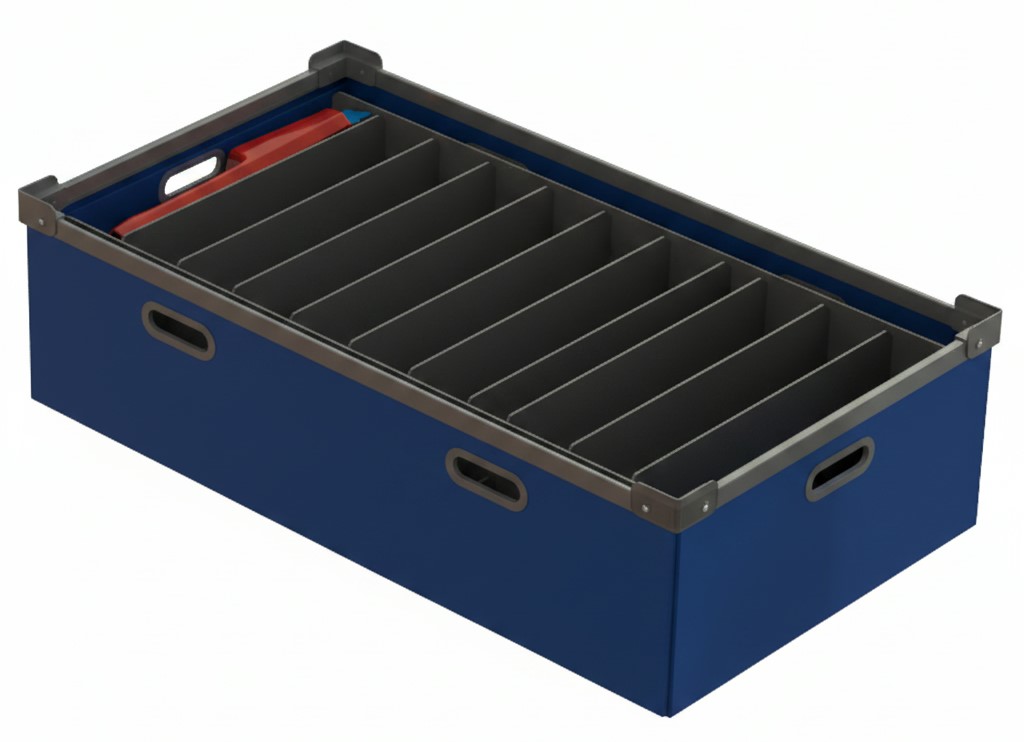
Die-cut inserts are flat corrugated blanks cut and scored to fold into custom trays or cradles. They’re economical, fast to assemble, and can be designed to hold parts in precise orientations. You’ll see these widely in automotive, electronics, and appliance manufacturing — anywhere multiple SKUs ship in a common container and each part needs its own pocket.
Corrugated partitions and dividers
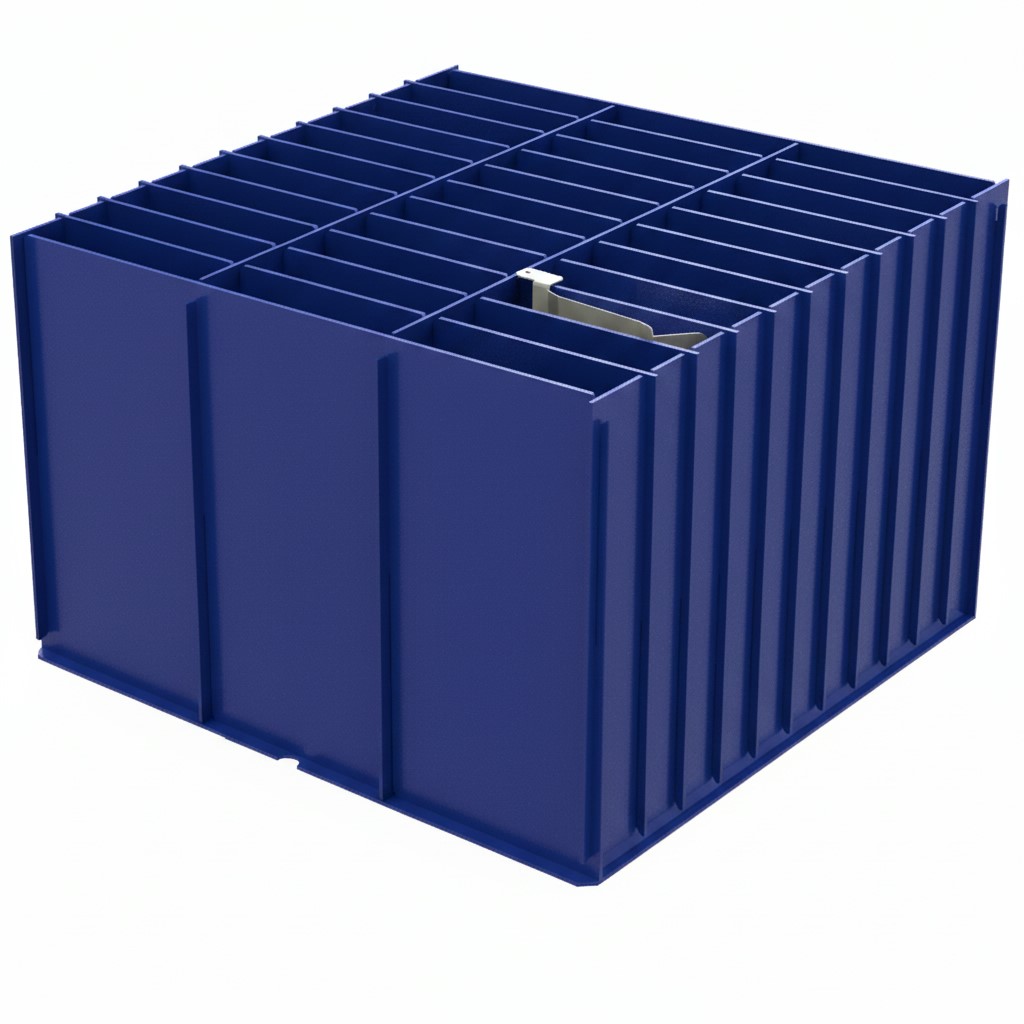
Slot-together cell dividers are the workhorses of parts packaging. Start with a flat sheet slotted at specific intervals, interlock two sets at 90°, and you’ve got a grid of isolated cells inside your box. Each cell holds one part, separated from every neighbor. These set up fast on a pack line, require no tools or adhesive, and can be reconfigured for different cell counts by adjusting the slot spacing. Simple, proven, effective.
Layer pads and slip sheets
Layer pads are flat corrugated sheets placed horizontally between tiers of parts in a container. They distribute load from upper layers, prevent vertical contact damage, and make it easier to pick from multi-layer packs without disturbing parts below. At the pallet level, slip sheets do the same job between stacked layers in bulk shipments.
Edge protectors and corner guards
Edge protectors reinforce the most vulnerable point in any load: the corners and edges. Made from double-wall or triple-wall board, they protect against strap pressure, impact, and clamp truck damage. If your cartons or parts are showing consistent corner crush damage, corrugated edge protectors are often the simplest and lowest-cost fix.
How to choose the right corrugated dunnage for your parts
Six things to nail before you commit to a design:
-
Know your part geometry. Round parts, flat stampings, threaded components, and fine-finish castings all require different support geometry. Document your part’s dimensions, weight, and critical surfaces before you approach a supplier.
-
Identify your vulnerable features. Where does damage actually happen on your parts? Machined surfaces, plated coatings, protruding brackets, and fine-pitch threads need specific protection — not generic cushioning.
-
Decide on expendable vs. returnable. Corrugated dunnage is typically single-use. If your parts run on a closed-loop return system, plastic or metal returnable dunnage may earn back its higher upfront cost. For outbound or one-way shipping, corrugated almost always wins.
-
Know your container. The container dimensions and maximum stack weight directly determine the board grade and flute profile required. Don’t spec dunnage without knowing what it’s going inside.
-
Think about pack and unpack labor. Dunnage that takes three minutes to set up per pack adds real cost at volume. Designs that snap together in seconds have genuine operational value that doesn’t appear in the per-unit price comparison.
-
Check customer or regulatory requirements. Tier-1 and OEM automotive customers often publish packaging standards that specify allowable materials, stack weights, and label placements. Know the requirements before you commit to a design.
How the custom design process works — from sample to production
Off-the-shelf dunnage handles standard applications. If your parts have unusual geometry or high-value surfaces that can’t absorb a single scratch, custom-engineered corrugated dunnage is the better path.
Starting from your part
A good custom dunnage supplier starts with the part, not the box. At Plexform, our engineers work from part samples or technical drawings to understand weight distribution, contact surfaces, and handling orientation. We’re designing for how the part naturally wants to sit — not forcing it into a generic shape that requires tape and optimism to hold things in place.
From prototype to production
The typical custom program moves through these stages:
- Initial consultation — review part specs, container type, shipment volumes, and the full handling chain
- Design and sampling — CAD layout followed by physical die-cut samples for fit and stack testing
- Drop and compression testing — validate the design holds up under realistic handling conditions
- Production tooling — finalize die specs, board grade, and run quantities
- Ongoing support — as parts evolve, the dunnage design updates quickly and inexpensively
Corrugated tooling changes are fast. If your part design changes mid-program, you’re adjusting a die and re-running samples within days — not scrapping a $15,000 thermoform mold.
What Plexform brings to the table
Plexform engineers custom material handling solutions for manufacturers who need more than catalog parts. When your corrugated dunnage program needs to integrate with a returnable container system, a custom rack, or a specific palletizing pattern, we engineer the whole system. That matters when you’re trying to reduce handling cost across the full shipping loop, not just protect parts inside one box.
Corrugated vs. foam, plastic, and metal: a real cost comparison
Here’s how the options actually stack up:
| Material | Upfront cost | Per-unit cost | Weight | Recyclable | Returnable | Best for |
|---|---|---|---|---|---|---|
| Corrugated dunnage | Low | Low | Light | Yes | No | One-way, high-volume outbound shipments |
| Foam inserts | Low–Medium | Medium | Light | Limited | No | Fragile or precision-finish parts |
| Thermoformed plastic | High | Medium | Medium | Sometimes | Sometimes | Returnable, high-volume closed-loop |
| Custom metal dunnage | Very High | Low (at volume) | Heavy | Yes | Yes | Long-term returnable systems |
| Bubble wrap / generic | Very Low | Low | Very light | Limited | No | Ad hoc or low-volume applications |
When corrugated wins
Corrugated dunnage makes the most sense when you’re shipping outbound to customers or distribution centers, volumes are high enough that per-unit packaging cost has real budget impact, parts need custom-fit isolation but don’t require a returnable system, and lead time matters — corrugated tooling runs faster than foam molding or plastic thermoforming. If your facility or customer contracts have sustainability commitments, recyclability is another point in its favor.
When to look at alternatives
If you’re running a closed-loop return program and dunnage comes back with every load, returnable plastic or metal earns back its higher upfront cost over time — sometimes quickly at high volume. For extremely fragile surfaces with micro-scratch sensitivity, molded foam may offer tighter cushioning control. The right answer isn’t always corrugated. It’s matching the material to the program.
Frequently asked questions about corrugated dunnage
When you’re specifying corrugated dunnage for the first time — or re-evaluating what you’re already running — practical questions come up fast. Here are the ones we hear most.
What’s the difference between corrugated dunnage and foam dunnage?
Corrugated dunnage uses structured, fluted cardboard to cushion and separate parts. Foam dunnage uses molded or cut polyurethane or polyethylene foam. Corrugated is generally lighter, less expensive, and more sustainable for one-way shipments. Foam offers tighter cushioning control for very fragile surfaces or parts with strict dimensional clearance requirements.
Can corrugated dunnage be customized for odd-shaped parts?
Yes, and this is one of its core strengths. Die-cut corrugated dunnage can be designed to any shape your part requires. Irregular geometry, protruding features, and multi-part tray configurations are all handled through custom die layout and board scoring. If you have a physical part sample, a supplier can design around it directly.
How long does it take to get custom corrugated dunnage produced?
Lead times vary by supplier and design complexity. Typical custom programs run 3–6 weeks from design approval to first production run, including physical sampling and fit testing. Simpler designs using existing die formats can move faster. If you’re working against a hard production launch date, say so upfront — it changes how a supplier prioritizes the work.
Is corrugated dunnage approved for automotive packaging?
It depends on the customer’s specific packaging specification. Many tier-1 and OEM automotive customers have published standards that mandate allowable materials, maximum stack weights, and label requirements. Validate any corrugated design against the customer’s standard before committing to production tooling.
What board grade do I need for heavy parts?
For heavy parts — generally anything above 20–25 lbs per part — double-wall or triple-wall corrugated board is typically required to prevent crush under load. Your dunnage supplier should be specifying board grade based on the full container stack weight and handling conditions, not just individual part weight.
Can corrugated dunnage be used inside plastic totes or returnable containers?
Yes, and it’s a common hybrid approach. A returnable plastic tote provides the structural shell; expendable corrugated inserts provide the part isolation inside. The totes loop back; the corrugated gets recycled at the destination. It’s a practical trade-off between durability and cost.
What’s the minimum order quantity for custom corrugated dunnage?
This varies by supplier. Corrugated tooling costs are low compared to foam or plastic, so many suppliers can run custom designs at relatively modest minimums — sometimes a few hundred pieces. Higher-volume programs typically see better per-unit pricing starting around 1,000+ pieces per SKU. Confirm this early in the conversation.
How do I know if my current dunnage is causing damage?
Look at your damage claim rate, incoming inspection rejects, and chargebacks tied to cosmetic or transit damage. If you’re seeing consistent damage to the same surfaces across multiple shipments, that’s a fit problem — not bad luck. A simple pack test — load a container as you normally would, ship it through a realistic handling sequence, and inspect on arrival — often shows exactly where the design is failing.
Make every shipment count
Corrugated dunnage doesn’t get much attention until something goes wrong. That’s usually the wrong time to start thinking about it.
The right design protects your parts, cuts damage claim costs, and improves freight economics by letting you pack more per shipment. But it has to be designed for your parts — not a close-enough approximation from a catalog.
Plexform builds custom material handling solutions for manufacturers who need things done right the first time. If you want to take a harder look at your corrugated dunnage program, visit plexformps.com to get started.

Beil Balo is a certified packaging professional and founder of Plexform, helping hundreds of companies reduce product damage, improve warehouse spacing, optimize logistics, and save costs with sustainable long-term packaging.