 Skip to content
A lot of mold storage problems don’t look serious until the day production stops.
A tool gets parked on generic shelving because the proper bay is full. Someone reaches it with the wrong handling path. The mold comes down with a ding on a shutoff surface, or sits long enough in poor conditions that corrosion starts where nobody can see it. Then the press is waiting, maintenance is scrambling, and everyone realizes the “storage area” has been driving uptime, safety, and tool life all along.
That’s why injection mold storage racks deserve to be treated as production equipment. Not warehouse furniture. If a rack affects how fast you can change over, how safely your team can access a tool, and how well you protect expensive molds between runs, it belongs in the same conversation as throughput, quality, and labor planning.
Beyond Shelving Why Your Molds Need Engineered Storage
A mold rack usually gets approved late. The press, the robot, and the tooling budget get attention first. Storage gets whatever floor space is left.
That approach works right up to the point where it doesn’t.
If you’ve spent time in molding plants, you’ve seen the same pattern. High-value tools get treated like inventory instead of precision assets. They end up on fixed shelves that don’t match the mold footprint, on the floor waiting for a crane window, or in rows that force extra handling just to reach the correct tool. Every extra touch raises the chance of damage.
Why generic shelving fails
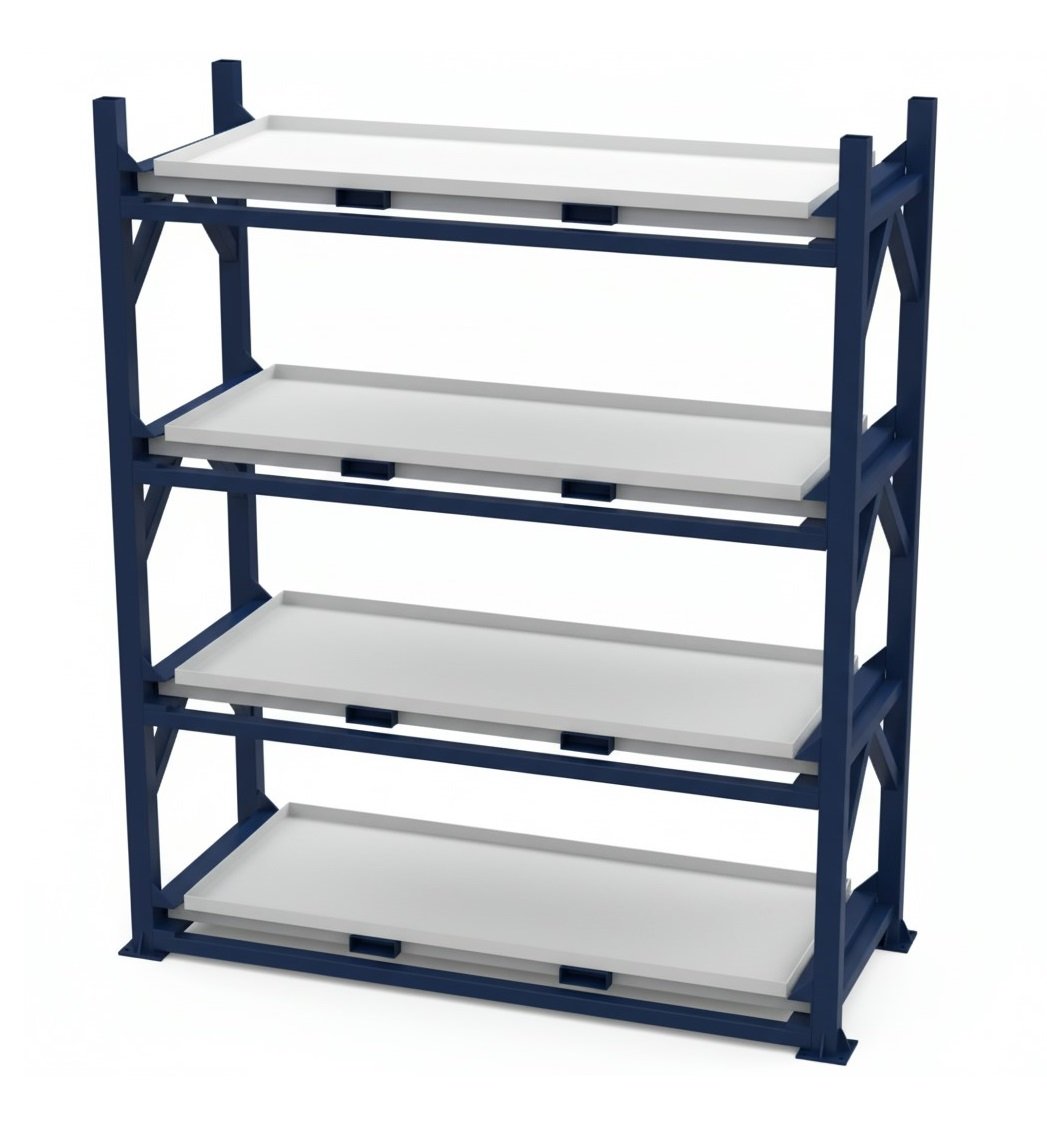
Standard shelving solves one problem only. It gives you a place to put something heavy.
It does not solve controlled access, stable loading, crane approach, corrosion protection workflow, or damage prevention for precision surfaces. Those are the problems that matter in a mold room.
An engineered rack changes the question from “Where do we put this tool?” to “How do we store this tool so the next setup is safe, fast, and repeatable?” That’s a different design target.
Practical rule: If a storage system forces extra handling steps, it isn’t neutral. It’s adding risk.
The difference shows up in real operations. Heavy-duty roll-out injection mold storage racks can cut mold changeover times by 50% while supporting shelf capacities up to 4,000 lbs per shelf and giving 100% front extension for crane or hoist access, according to this custom-built mold storage racks reference. That matters because access is the whole game. If the crane can reach the tool cleanly and the operator doesn’t need to reposition or improvise, the rack has already paid for itself in reduced friction.
The strategic view
The mold market itself tells you why storage can’t stay an afterthought. The global industrial mold market was valued at USD 38 billion in 2023 and is projected to reach USD 60 billion by 2032 at a 5.4% CAGR, as noted in this industrial mold market overview tied to injection mold storage racks. In a market built on increasingly valuable tooling, storage isn’t a side issue. It’s part of asset protection.
A good rack does four jobs at once:
Protects the tool: It prevents avoidable contact damage and poor resting conditions.
Supports uptime: It makes retrieval predictable when the press is waiting.
Improves floor use: It stores tools vertically instead of spreading them in long rows.
Reduces operator exposure: It cuts down on awkward manual intervention around heavy molds.
That’s why engineered storage belongs in the capex discussion. It protects products and profits at the same time.
Understanding Core Rack Types and Materials
Not every mold room needs the same storage system. The right choice depends on tool weight, change frequency, aisle constraints, crane access, and whether the storage area supports production directly or acts as a buffer.
The fastest way to make a bad decision is to compare rack prices without comparing handling paths.
Comparing the main rack types
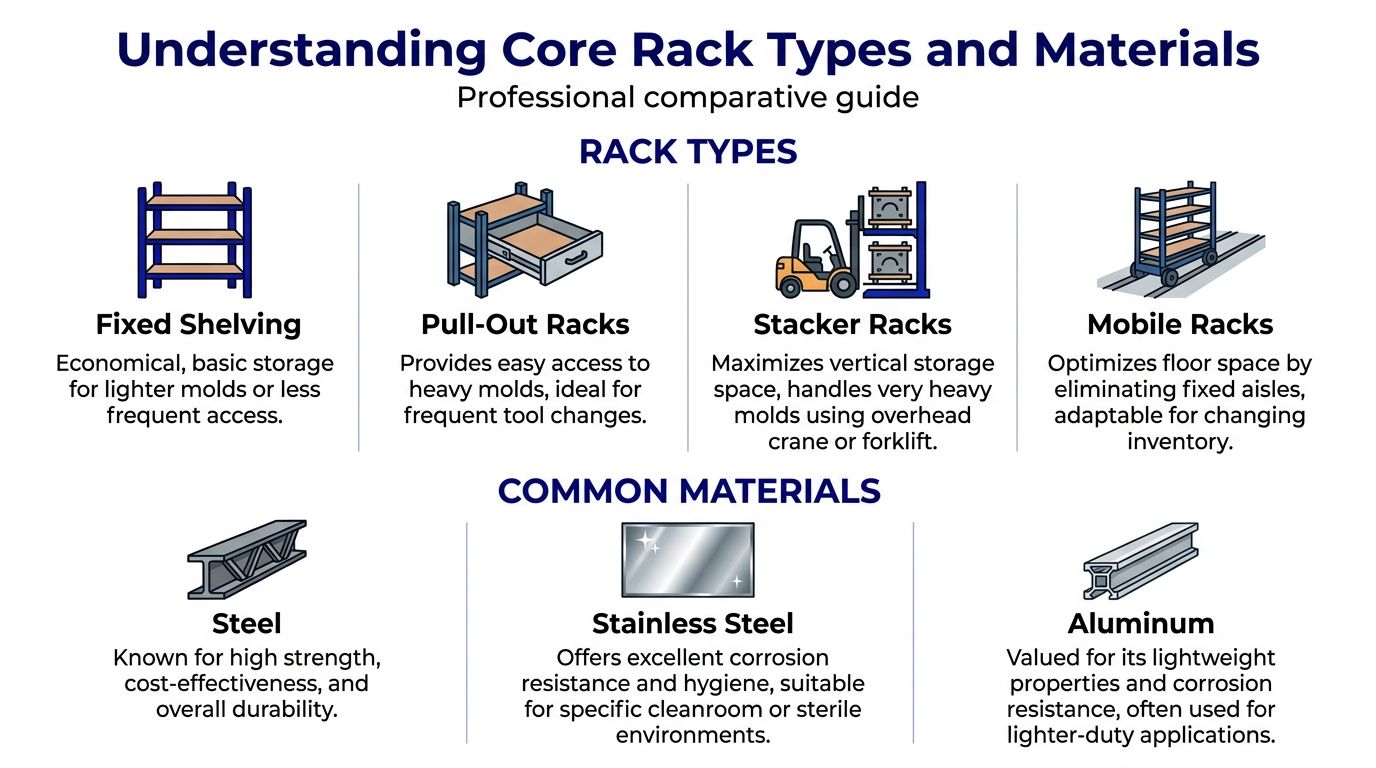
Here’s the practical breakdown engineers usually care about first.
| Rack type | Where it fits | What works well | Main trade-off |
|---|---|---|---|
| Fixed shelving | Low-frequency access, lighter tooling, simpler rooms | Lower complexity, straightforward layout | Slow access and more handling around neighboring tools |
| Pull-out or drawer-style racks | Frequent changeovers, heavier molds, crane-based retrieval | Better accessibility and safer reach | Higher upfront design and fabrication demand |
| Vertical automated systems | Dense storage where floor space is tight | Excellent space use and organized retrieval | More system complexity and tighter process discipline |
| Mobile racks | Operations trying to reduce fixed aisle space | Efficient floor use in changing inventories | Access planning matters more because movement is shared |
Fixed shelving still has a place. If a plant uses a subset of molds only occasionally, simple static storage can be acceptable. The problem starts when teams expect static storage to support fast tool turnover. It won’t.
Pull-out systems solve a different problem. They reduce the need to reach deep into a bay or move adjacent molds first. Heavy-duty drawer-type injection mold racks feature 4,400-5,500 lbs per drawer, and their roller bearings reduce access friction by 70%, with retrieval speed and floor utilization outperforming static shelving by 3-5x, according to this heavy-duty mold rack specification page. Those are meaningful gains when the molding department changes tools often and can’t afford search time or awkward handling.
What material selection actually changes
Most mold storage racks are steel for a reason. Steel gives you the strength, stiffness, and fabrication flexibility needed for high-load applications.
Material choice matters less as a purchasing label and more as an engineering input:
Steel: Best fit for high load, custom structural layouts, welded frames, and long service life.
Stainless steel: Useful when corrosion resistance or specific cleanliness requirements matter more than cost.
Aluminum: Better for lighter-duty applications where weight matters more than maximum load capacity.
For injection mold storage racks, the frame material and the protective finish should be discussed together. A powder-coated steel rack often makes more sense than changing base material if your main concern is facility humidity, occasional washdown exposure, or day-to-day wear. The coating strategy becomes part of the protection plan, especially when the rack also stores ancillary tooling or fixtures. Teams looking at finish options for fabricated steel systems usually compare process demands, wear patterns, and environmental exposure before settling on a design. A custom fabrication and coatings discussion proves useful: custom fabrication and coatings capabilities.plexformps.com/custom-fabrication-coatings/).
What works in practice
The system should match the handling method. That sounds obvious, but it’s where many layouts break down.
If you rely on an overhead crane, shelf extension and open front access matter more than a low purchase price. If you use forklifts in tight aisles, visibility, entry clearance, and rack protection features rise to the top. If floor space is expensive, vertical storage often wins even if the system itself is more involved.
The best rack type isn’t the one with the longest feature list. It’s the one that matches how your team actually retrieves, inspects, and returns molds every day.
A final point. Modular growth matters. Mold inventories tend to creep upward. The rack that works today but can’t expand cleanly usually forces a mixed-storage environment later, and that’s where discipline slips. One engineered standard is easier to manage than a room full of one-off storage habits.

Key Custom Design Considerations for Engineers
Choosing a rack type is the easy part. Specifying one that fits your operation is where engineering earns its keep.
Most storage failures come from a mismatch between the rack design and the operational handling conditions. The mold weight might be correct on paper, but the center of gravity is off. The shelf may hold the load, but the crane path is awkward. The rack may fit the floor plan, but inspection access is poor. Those are design misses, not operator mistakes.

Start with load and motion
Static capacity is only the first question. A shelf doesn’t live in a static world once a crane, hoist, or operator starts interacting with it.
Injection mold storage racks with pneumatic or motorized roll-out shelves can reach 20,000 lbs per shelf, and automatic safety interlocks lock all other shelves when one extends, preventing tipping. These systems can also reduce retrieval time by 40-60% compared to fixed racks by letting operators hook and set tooling directly, according to this injection mold die storage rack reference.
That tells you what to examine during design review:
Actual mold weights: Use real loaded conditions, not rounded estimates.
Load distribution: Eccentric loads change how the shelf behaves during extension.
Handling direction: Side pull, front pull, and crane approach all affect stability.
Extension requirement: If the operator needs direct pick access, partial rollout may not be enough.
A rack that supports the weight but creates unstable handling isn’t engineered storage. It’s a hazard with a load rating.
Fit the rack to the room, not just the mold
Floor plans drive more decisions than many teams expect. Clear height, crane envelope, aisle width, machine adjacency, and maintenance paths all shape the right rack geometry.
Vertical storage can recover valuable floor space, but only if retrieval remains straightforward. A dense layout that slows tool access may look efficient in CAD and fail in production.
I usually look for three layout questions early:
Where does the mold come from before it reaches the press?
How many turns, stops, or handoffs happen along that path?
Can the operator retrieve the intended tool without moving another one first?
If the answer to the third question is no, the layout is already compromising uptime.
Design for repeatable mold location
Custom fixturing matters more than broad shelf dimensions. Molds aren’t generic boxes. They have clamp plates, protrusions, water fittings, hot runner hardware, lifting points, and surfaces that can’t tolerate casual contact.
That’s why engineered racks often need more than flat decks. They need controlled placement.
Useful design features can include:
Dedicated support points: To carry the mold where the structure can take the load.
Retention lips or stops: To prevent unintended roll or drift during placement.
Guided entry geometry: To help crane operators land the tool consistently.
Clear labeling zones: To support fast identification without extra handling.
A custom rack partner adds value. A company such as Plexform’s custom metal racks group focuses on steel rack designs built around part geometry and handling requirements rather than forcing the tool to fit a standard shelf.
Design checkpoint: If the mold can be set down in more than one “acceptable” position, the rack probably needs more locating control.
Don’t separate rack protection from mold protection
Storage engineers sometimes focus on frame strength and forget the surface environment around the tool. That’s a mistake.
The rack finish, shelf surface condition, contact points, and drain or debris behavior all affect mold condition over time. Even if corrosion prevention is part of maintenance, the rack still needs to support that maintenance plan rather than fight it.
Think through these questions:
| Design question | Why it matters |
|---|---|
| Will the shelf trap moisture, debris, or oil? | Trapped contamination raises corrosion and cleanliness issues |
| Are contact surfaces likely to mar finished tool surfaces? | Poor contact design creates avoidable cosmetic or functional damage |
| Can operators inspect the mold while it’s stored? | Easy inspection supports preventive maintenance discipline |
| Does the finish suit the environment? | The wrong finish degrades faster and increases upkeep |
Ergonomics and access decide whether the system gets used correctly
A rack can be structurally sound and still encourage bad behavior if it’s awkward to use.
Operators default to the shortest path under pressure. If the shelf requires excessive force, if the labels are hidden, or if the crane hook-up angle is poor, teams will improvise. Good rack design assumes production pressure exists and removes the reasons to cut corners.
That’s why ergonomics in injection mold storage racks means more than “easy to move.” It means the operator can:
identify the right tool quickly,
access it without climbing or overreaching,
engage lifting equipment on a stable, visible path,
and return the mold without contacting adjacent tools.
Different plants will weight those priorities differently. A high-mix molder may care most about fast retrieval and visibility. A plant with larger molds may prioritize crane path control and shelf stability first. Either way, the rack should reflect the workflow, not fight it.
The best custom designs feel uneventful in daily use. That’s the point. Safe, repeatable storage should disappear into the process.
The Plexform Workflow From 3D Model to Reality
Custom rack projects go wrong when they start with a sketch and a rough weight estimate. They go right when the design begins with geometry, handling method, and a clear operating constraint.
A disciplined workflow closes the gap between what looks workable in a meeting and what performs on the floor.
The first stage is problem definition
Before anyone models a rack, the engineering team should understand what the current setup is failing to do.
Sometimes the problem is obvious. Molds are hard to reach, floor space is crowded, or the crane can’t get a clean pick. Other times the issue shows up in smaller ways, such as inconsistent mold placement, too much time spent locating tools, or storage that complicates maintenance access.
A strong starting review usually includes:
Tool inventory characteristics: Size range, weight range, and sensitive surfaces
Handling method: Overhead crane, hoist, forklift, or mixed approach
Facility constraints: Ceiling height, aisle access, floor loading, and nearby equipment
Operational target: Faster changeovers, safer access, denser storage, or better tool protection
The model should mirror the real tool
Custom engineering proves tangible. A rack designed around an actual 3D tool model can place support where the mold structure wants it, not where a generic shelf happens to offer it.
That digital work also exposes conflicts early. You find out whether fittings protrude into a guard, whether hook access is blocked, or whether shelf spacing is too tight before steel is cut.
A digital model isn’t about making the design look polished. It’s about removing uncertainty from fabrication and daily use.
The most effective process reviews aren’t only about fit. They ask practical questions. Can the operator see the lifting point? Is there enough front clearance during retrieval? Will the mold settle naturally into the intended location, or does it require perfect alignment every time?
Fabrication should follow validated intent
Once the design is resolved, fabrication becomes execution, not guesswork. That means material selection, weld design, shelf mechanisms, and protective finishes should all tie back to the operating requirement that drove the concept.
A good custom workflow also includes collaborative review before build release. Operations, maintenance, and handling personnel often catch issues that pure design review misses. The crane operator may notice a blind pick angle. Maintenance may want easier inspection access. Tooling may ask for better identification zones.
That feedback loop matters because the rack isn’t a standalone object. It’s part of a manufacturing system.
When the process is handled well, the finished rack on the floor behaves like the CAD model promised. The mold lands where it should, retrieval follows a predictable path, and the storage system becomes a controlled part of tool management rather than an improvisation zone.
Safety Protocols and Long-Term Maintenance
A mold rack isn’t safe because the brochure says it has a high capacity. It’s safe when the plant uses it in a controlled way every day.
That means storage procedures, operator habits, inspection routines, and mold preservation all need to line up. If one piece is missing, the system starts drifting toward workarounds.
Operating rules that prevent common failures
The most useful safety protocols are usually simple and specific.
Train on the actual retrieval path: Operators should know the intended sequence for extending, hooking, lifting, and returning molds.
Respect single-access controls: If the rack is designed so only one shelf or drawer should move at a time, that rule can’t become optional under schedule pressure.
Keep landing zones clear: Obstructions near the front of the rack create rushed decisions during crane or hoist work.
Treat uneven loads as a separate risk: A mold that sits off-center should trigger review, not a quick adjustment and hope.
Many incidents start with small deviations. A shelf is left partly open. A tool is returned slightly out of position. A damaged stop or label doesn’t get replaced because the rack still “works.” Over time, those minor misses stack up.
Storage discipline matters most on busy days. Quiet days don’t test the system.
Make mold preservation part of storage, not a separate task
Long-term rack performance and long-term mold protection are connected. The rack defines how easy it is to clean, inspect, coat, and revisit a tool during idle periods.
Proper mold storage integrates with maintenance protocols, including long-term rust preventives rated for up to 5 years of indoor protection per ASTM standards. That same guidance notes that molds used with corrosive resins like PVC may require reapplication every 30 days, based on this mold storage and maintenance guidance. The rack needs to support that routine by making the tool accessible enough to inspect and service.
A practical maintenance checklist usually includes:
Surface condition review: Look for corrosion, residue, pooled oil, or contact marks.
Support point inspection: Confirm the mold is still resting where the rack design intended.
Mechanism check: Verify roll-out, locks, stops, and guides are moving as designed.
Identification review: Make sure labels remain clear and location records stay accurate.
For teams refining day-to-day mold room practices, examples of die storage rack organization and protection can help frame what a controlled storage process should look like.
Structural inspections should be routine
Racks live in harsh environments. They see impact risk, handling wear, vibration, dust, oil, and occasional misuse.
Inspect for bent members, worn rollers, damaged stops, coating failure, and any sign that shelves are no longer tracking correctly. Don’t wait for a major issue. The whole point of an engineered rack is controlled behavior. Once that control slips, the rack should be evaluated before it returns to normal use.
Calculating ROI Optimizing Space and Reducing Downtime
If you need approval for injection mold storage racks, don’t pitch them as storage. Pitch them as a way to protect throughput.
That changes the conversation. Management may resist a warehouse expense. It’s harder to ignore a project tied directly to changeover time, tool protection, labor use, and floor utilization.
The four ROI buckets that matter
A practical business case usually sits on four cost lines.
| ROI driver | What to examine |
|---|---|
| Downtime reduction | How long does mold retrieval and changeover take today, and how much delay comes from storage layout? |
| Tool damage avoidance | How often do extra handling steps expose tools to contact, drift, or poor resting conditions? |
| Labor efficiency | How much operator and crane time goes into locating, reaching, repositioning, and returning molds? |
| Space recovery | What is the value of floor space now occupied by inefficient storage patterns? |
The strongest quantified input in this category is changeover. Efficient injection mold storage racks can slash changeover times by 50% by giving safe, immediate crane access to molds weighing up to 1 ton, according to this market and storage analysis. In a busy molding operation, that single metric often drives the entire payback discussion.
Build the calculation from your own plant data
You don’t need invented industry averages. Your own records are better.
Use actual internal values for:
Average changeover duration
Number of mold changes per week or month
Loaded labor cost for setup personnel
Estimated cost of machine downtime
Current floor area consumed by mold storage
Recent mold repair or handling-related damage events
Then compare the current state to the proposed storage workflow. If retrieval becomes direct instead of multi-step, setup time drops. If molds store vertically instead of in rows, floor use improves. If operators stop making extra moves to reach the right tool, labor becomes more productive and damage exposure falls.
The best ROI model is boring. It uses your maintenance logs, setup records, and floor plan instead of assumptions.
Tie the investment to a growing asset base
The broader market matters too, especially if leadership thinks mold storage can stay informal. The global industrial mold market was USD 38 billion in 2023 and is projected to reach USD 60 billion by 2032. As tooling value rises, the cost of storing it poorly rises with it. That trend doesn’t create the ROI by itself, but it does support the argument that tool protection infrastructure should mature along with the rest of the plant.
A good rack system usually pays back in layers. Faster access is the visible return. Lower damage exposure, better organization, and more usable floor space are the returns that keep showing up after installation.
Implementation Checklist Your Path to a New Storage System
Most mold storage upgrades stall because the team jumps from “we need better racks” straight to vendor quotes.
That skips the work that determines whether the new system fits the plant.
What to do before you request a design
Start with an audit. Walk the current storage area with production, tooling, and maintenance.
Look for recurring friction points:
Blocked access: Molds that require moving other tools first
Handling workarounds: Places where operators improvise because the intended path is too slow
Unclear location control: Bays where molds can be set down multiple ways
Environment concerns: Areas exposed to humidity, residue, or inconsistent housekeeping
After that, build a mold inventory that includes weight, footprint, handling points, and any surfaces or components that need protected support.
What to define during planning
A rack project gets easier once the plant agrees on the specific target.
Some teams need faster changeovers. Others need denser vertical storage. Some need safer crane access for large molds. Write those goals down in operating terms, not vague preferences.
Use this short planning sequence:
Catalog the tooling: Include current and likely future mold range.
Map the handling path: From storage position to machine and back.
Set success criteria: Faster retrieval, reduced damage exposure, cleaner layout, easier maintenance access.
Review the environment: Especially if the plant deals with persistent humidity or long idle periods.
Plan training before launch: A new rack system changes operator behavior, not just floor layout.
Climate adaptation deserves a place on that list. An often-overlooked factor is corrosion risk in humid environments. With 60% of mold failures stemming from corrosion, engineers in high-humidity markets should consider racks with real-time IoT humidity sensors for predictive maintenance alerts, according to this injection mold storage and maintenance discussion. Even if you don’t add sensor-driven monitoring immediately, planning for humidity control now is easier than retrofitting later.
What a solid handoff looks like
The project isn’t done when the rack arrives. It’s done when molds are assigned to positions, labels are clear, operators know the retrieval sequence, and maintenance knows what to inspect.
That last step matters. Good injection mold storage racks create discipline, but only if the team treats them as part of the process and not just new furniture on the floor.
If your plant is weighing a mold storage upgrade, Plexform Incorporated builds custom steel racks, bins, carts, and packaging solutions engineered around specific parts, handling methods, and production goals. That kind of fit is useful when standard storage doesn’t match the geometry of the tooling or the specifics of your workflow.

Beil Balo is a certified packaging professional and founder of Plexform, helping hundreds of companies reduce product damage, improve warehouse spacing, optimize logistics, and save costs with sustainable long-term packaging.