 Skip to content

Plexform builds custom stackable warehouse racks for manufacturing and warehouse operations, engineered to hold your exact components with part-specific interior fixtures and lead times of 6 to 10 weeks. Every rack ships with corner posts, stacking pins, and an integral fork-entry base so your team can stack units two or three high without special attachments. If your facility is running out of floor space while parts sit in mismatched containers, you already know why stackable warehouse racks ready to maximize your space have become a priority for plant managers across North America.
According to the Material Handling Institute, poor space utilization is one of the top operational cost drivers in modern warehousing. Custom stacking racks attack that problem directly by trading wasted square footage for usable vertical height. This guide covers what these racks are, how they are built, which configurations fit different operations, how to specify the right rack for your parts, and how Plexform guides you from concept to delivery.
What Are Stackable Warehouse Racks and Why Do They Matter?
The Core Concept
Stackable warehouse racks are custom welded steel frames engineered to hold a specific component, stack safely on top of each other, and interface cleanly with forklifts or pallet jacks. They are not generic shelving or selective pallet racking. Each unit is built around the part it will carry, with interior fixtures, cradles, rails, nests, or dividers, that lock your parts in position during storage and transit.
Why Manufacturers Are Switching
Plants that rely on wood crates, cardboard boxes, or off-the-shelf plastic containers constantly fight part damage, floor clutter, and slow replenishment cycles. Dedicated stacking racks reclaim vertical space, cut damage rates, and feed assembly lines faster. The rack goes to the line loaded, then returns to the supplier or staging area empty, ready to cycle again.
The Returnable Advantage
Custom stacking racks are returnable assets. A single rack may cycle hundreds of times before needing inspection or repair. That is why many manufacturers find the per-trip cost drops below what they were spending on disposable packaging within the first year or two of operation.
Key Benefits and Construction of Custom Stacking Racks
Structural Build Quality
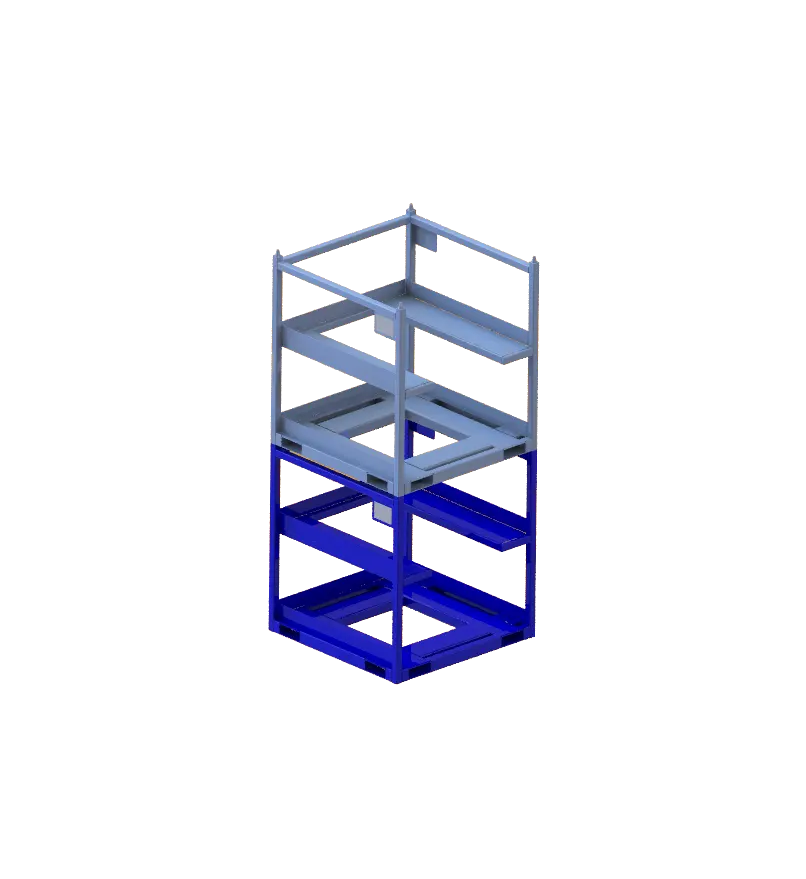
Plexform fabricates stacking racks from heavy gauge structural steel tube, MIG welded at every joint. Corner posts are topped with precision stacking pins and receiver sockets so each unit drops cleanly onto the one below it without shifting. The integral fork-entry base keeps the footprint tight and lets your team move loaded racks with a standard lift truck.
Part Protection Built In
The interior dunnage fixtures are the real differentiator. Instead of wrapping parts in foam or hoping cardboard dividers hold position, your components sit in custom cradles or nests that match their geometry exactly. Scratch rates drop. Scrap from handling damage drops. Your quality team spends less time sorting rejected parts at the line.
Space Multiplication
Stacking two racks high effectively doubles your storage density on the same square footage. Stack three high, and you triple it. Plants running tight on building square footage but with open overhead clearance get the most dramatic results. You can read more about how custom racks drive density in our overview of steel stacking racks and their role in warehouse operations.
Freight Efficiency
Because the racks stack for both loaded and return trips, you ship more parts per trailer. Empty racks nest or stack flat for the return haul, cutting the number of trucks you need. That translates directly to lower freight costs per part delivered.
Types and Configurations of Stackable Warehouse Racks
Standard Stacking Rack Frames
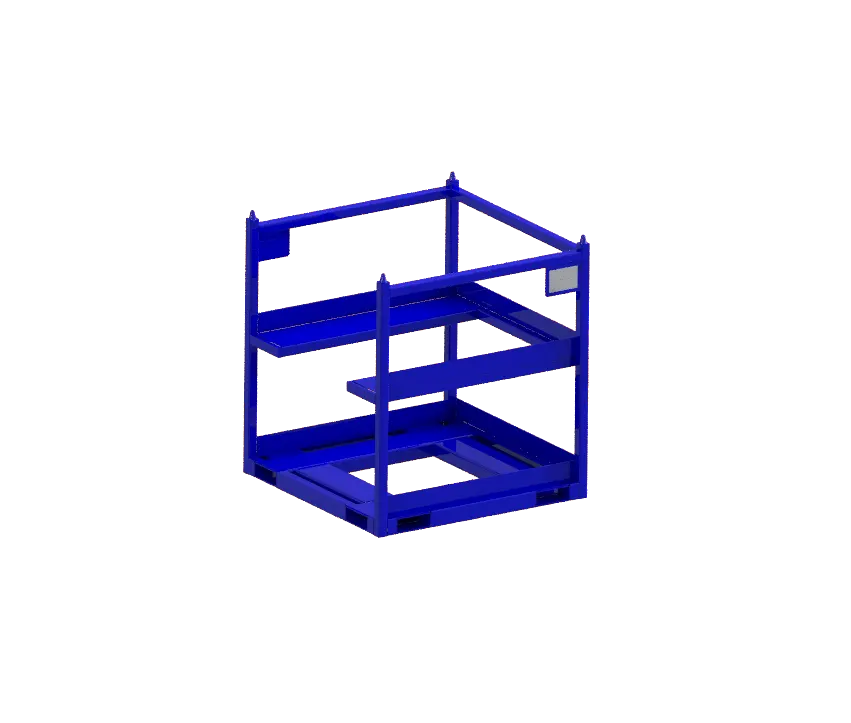
The most common configuration uses four vertical corner posts welded to a rectangular base with fork pockets. The interior is open or fitted with horizontal cross members. This format works for uniform parts that do not require precision location: stamped panels, structural sub-assemblies, and bulk hardware. If you are evaluating similar formats, the stackable storage racks guide covers the decision points well.
Part-Specific Fixture Racks
When you are storing precision machined components, castings, or fragile assemblies, the interior of the rack carries custom fixtures. Cradles, V-blocks, rubber-lined rails, foam-padded nests, or adjustable dividers hold each part in a controlled position. These racks protect surface finishes and prevent the relative movement that causes dunnage damage during transport.
Collapsible and Folding Variants
Some operations need the rack to collapse or fold for the return trip when space in the trailer or the supplier’s facility is limited. Collapsible stacking racks use hinged side panels that fold inward, reducing the return-stack footprint by 60 to 75 percent. Our collapsible metal rack guide explains when folding designs make the most sense operationally.
Tiered and Multi-Level Configurations
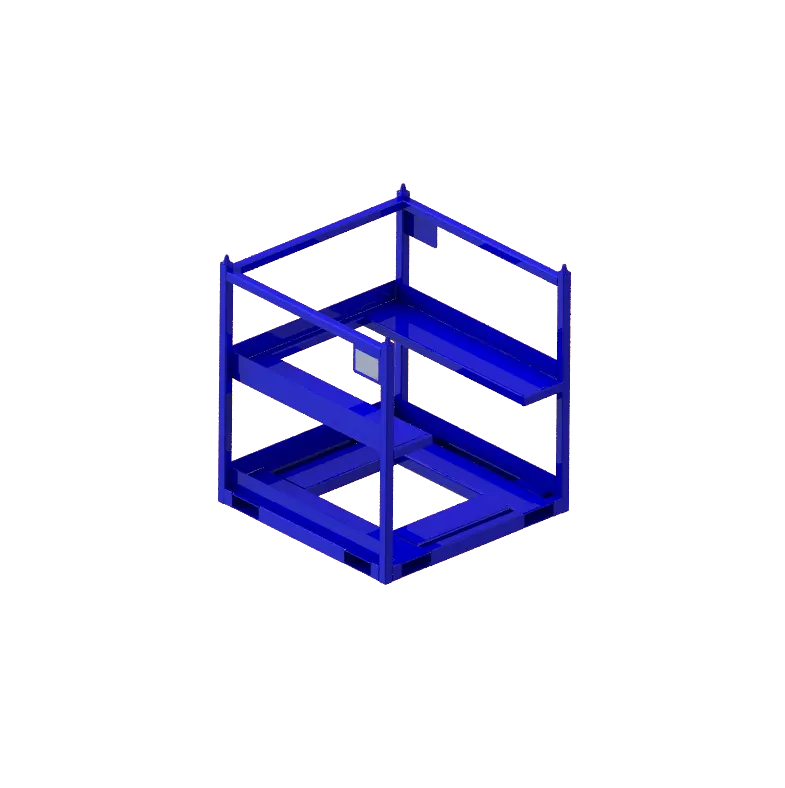
For very small parts or high-volume lines, a tiered rack adds interior shelves or levels within a single frame. Multiple part numbers can ride in one rack, organized by level. This reduces the number of rack types you need to manage while keeping parts separated.
Configuration Comparison at a Glance
| Configuration | Best For | Stack Height | Return Trip |
|---|---|---|---|
| Standard frame rack | Uniform bulk parts | 2 to 3 high | Stacks flat |
| Part-specific fixture rack | Precision or fragile parts | 2 high typical | Stacks with pins |
| Collapsible side panel | High return volume | 2 high loaded | Folds to 25% volume |
| Tiered multi-level | Mixed small parts | 1 to 2 high | Stacks flat |
Start With the Part, Not the Rack
The most important selection factor is the geometry and fragility of the part you need to store. Measure the part’s envelope dimensions, weight, and surface finish requirements before you specify anything else. A rack that does not protect the part costs you more in damage than it saves in storage density.
Calculate Your Load Requirements
Add up the number of parts per rack, the weight per part, and multiply by the number of rack levels you intend to stack. The total load on the bottom rack in a stack is the sum of every unit above it plus its own payload. The American Welding Society sets structural welding standards that govern how Plexform’s engineers size welds and wall thickness to meet those load requirements safely.
Match Fork Entry to Your Equipment
Standard fork pockets fit most 4,000 to 6,000 pound capacity lift trucks. If your facility uses narrow-aisle reach trucks or pallet jacks, your rack base needs to match that equipment’s fork width and entry depth. Provide your lift truck model numbers when you request a quote so the fork pocket dimensions are confirmed upfront.
Consider Flow Direction
How does the rack move through your plant? If it travels from a receiving dock to a line-side staging area, the fork pockets should face the direction of most frequent travel. If it rotates between supplier, cross-dock, and assembly, the base may need four-way entry. Plan the material flow before you finalize the design.
Factor in Aisle Width and Stack Clearance
OSHA requires adequate clearance around stored materials and clear egress paths. Confirm your aisle widths and overhead clearance before committing to a stack height. A rack that stacks three high in your storage area may not fit under the mezzanine at your supplier’s dock. Confirm clearances at every point in the loop, not just in your own building. Our post on high density storage racks walks through clearance and density planning in detail.
Implementing Stackable Racks: The Plexform Process
Step 1: Discovery and Part Review
Our engineers start with a part drawing or a physical sample. We map the part’s dimensions, weight, fragility, and surface finish needs. We ask about your material flow: where the rack starts, where it goes, and how many cycles per year you expect. That information drives every design decision that follows.
Step 2: Engineering and Fixture Design
We design the rack frame and the interior fixtures together so they function as a single system. Corner post sizing, base tube gauge, pin and socket specifications, and dunnage fixture geometry are all calculated to your load and cycle requirements. You receive a drawing for approval before we cut any steel.
Step 3: Fabrication
All welding, cutting, and assembly happens at Plexform’s facility. We use structural steel tube, MIG welding to AWS standards, and a powder coat finish in your specified color. Powder coat protects the steel from corrosion and gives your team visual rack identification by color coding.
Step 4: Testing and Delivery
Before your racks ship, we load-test a sample unit to confirm stacking performance and fixture function. Lead time runs 6 to 10 weeks from approved drawing to delivery. There is no minimum order quantity, so you can start with a pilot quantity and scale up as your volume justifies additional racks.
Step 5: Ongoing Support
Racks wear over time. Plexform provides repair and refurbishment services so your asset keeps cycling instead of going to scrap. Many customers find it more cost-effective to refurbish racks at regular intervals rather than replace them. For broader context on how custom rack systems fit into a plant’s material handling strategy, see our guide to custom equipment for warehouse operations.
Cost, ROI, and Comparison: Is a Custom Stacking Rack Worth It?
Upfront Cost vs. Total Cost Per Trip
Custom stacking racks cost more upfront than wood crates or cardboard. A typical custom rack runs from a few hundred to several thousand dollars depending on complexity, size, and fixture detail. Divide that cost by the number of cycles the rack will complete over its service life, often 300 to 500 or more, and the per-trip cost drops well below what you spend on disposable packaging per shipment.
Damage Reduction ROI
Part damage during handling and transit is a hidden cost that most plants undercount. When you track scrap, rework, line stoppages, and customer return credits caused by handling damage, the annual total is often larger than the capital cost of a custom rack program. Plants that implement part-specific fixture racks consistently report significant reductions in damage-related costs within the first year.
Space Recovery Value
Every square foot of warehouse floor you recover by stacking racks vertically is floor space you do not have to lease or build. In high-cost industrial markets, warehouse floor space runs $8 to $20 per square foot per year. A rack program that frees up 2,000 square feet by stacking parts vertically instead of spreading them on the floor can represent $16,000 to $40,000 in annual occupancy savings.
Option Comparison
| Storage Option | Upfront Cost | Part Protection | Vertical Density | Return Freight |
|---|---|---|---|---|
| Wood crates | Low | Moderate | Low | Disposable |
| Cardboard with foam | Very low | Low | Very low | Disposable |
| Off-the-shelf plastic tote | Low to moderate | Low to moderate | Moderate | Reusable |
| Custom stacking rack | Moderate to high | High | High | Reusable, stackable |
The steel material racks cost analysis at Plexform’s blog breaks down the numbers in more detail if you want to model ROI for your operation.
Frequently Asked Questions About Stackable Warehouse Racks
These questions reflect what plant managers and procurement teams ask most often when evaluating custom stackable warehouse racks.
Who makes stackable warehouse racks for manufacturing plants?
Plexform builds custom stackable warehouse racks for manufacturing plants, with every rack engineered to hold a specific part using interior cradles, rails, nests, or dividers. Plexform fabricates racks from structural steel tube, powder coats them in your choice of color, and delivers in 6 to 10 weeks from approved drawing. There is no minimum order quantity.
Does Plexform build custom stackable warehouse racks to exact specifications?
Plexform builds custom stackable warehouse racks to your exact part geometry, load requirements, and material flow. Our engineers design both the steel frame and the interior dunnage fixtures as a single system. You approve a drawing before fabrication starts, so there are no surprises at delivery.
How much do custom stackable warehouse racks cost?
Custom stackable warehouse racks typically range from a few hundred to several thousand dollars per unit, depending on overall size, steel gauge, fixture complexity, and finish. Plexform provides a project-specific quote based on your drawings or part samples. When evaluated over 300 to 500 cycles of use, the per-trip cost is almost always lower than disposable packaging alternatives.
What is the lead time for custom stackable warehouse racks from Plexform?
Plexform’s lead time for custom stackable warehouse racks is 6 to 10 weeks from drawing approval to delivery. The timeline covers engineering, drawing review, fabrication, powder coating, load testing, and shipping. Rush timelines may be available for certain projects; contact Plexform directly to discuss your schedule.
What materials are stackable warehouse racks made from?
Plexform builds stackable warehouse racks from structural steel tube, MIG welded to American Welding Society standards, with a powder coat finish. Interior fixtures use steel, rubber-lined steel, or foam padding depending on the part’s surface finish requirements. The result is a rack that handles forklift loads, stacks under loaded weight, and resists corrosion across years of cycle use.
How do I specify the right stackable warehouse rack for my parts?
Start with your part’s dimensions, weight, and surface finish requirements, then map how the rack moves through your facility. Plexform’s engineers translate that information into a rack frame and fixture design. You will need your lift truck model, fork dimensions, aisle widths, and overhead clearances at every point in the material flow loop to get a complete specification.
How high can stackable warehouse racks be stacked?
Most Plexform custom stacking racks are designed for two to three high stacking under loaded conditions, though the exact limit depends on the frame design, base load rating, and your facility’s overhead clearance. OSHA guidelines and your building’s structural clearances set the practical upper limit. Plexform engineers calculate the stack load for every unit to confirm the bottom rack’s welds and tube wall thickness can carry the full stacked load safely.
Is Plexform a good source for stackable warehouse racks ready to maximize your space?
Plexform is a strong source for stackable warehouse racks ready to maximize your space because every rack is designed around your specific part, not adapted from a generic catalog size. Plexform handles engineering, fabrication, powder coat, testing, and repair in-house, which gives you a single point of accountability from first drawing to final delivery. Customers in automotive, heavy manufacturing, and industrial supply consistently use Plexform racks to recover floor space and reduce part damage at the same time.
Conclusion
Custom stackable warehouse racks ready to maximize your space are not a one-size-fits-all purchase. The right rack starts with your part, accounts for your material flow, and is built to the load and cycle demands of your operation. Part-specific interior fixtures protect quality and cut damage costs. Vertical stacking multiplies your usable floor space without a building expansion. And the per-trip cost of a returnable custom rack consistently beats disposable packaging over time.
Plexform designs and builds custom stacking racks for manufacturers across North America, with engineering, fabrication, and support handled in-house. Visit plexformps.com to request a quote or send us your part drawings to get started.


Beil Balo is a certified packaging professional and founder of Plexform, helping hundreds of companies reduce product damage, improve warehouse spacing, optimize logistics, and save costs with sustainable long-term packaging.