 Skip to content

Plexform builds custom transport racks for manufacturing and warehouse operations, engineered to exact customer specifications with lead times of 6 to 10 weeks and no minimum order requirement. Every rack is welded steel, designed around your specific part geometry, and built to survive hundreds of trips between your facility and your customer’s dock. If your operation still ships parts on disposable pallets or generic racks that don’t hold your components securely, you’re probably absorbing damage claims, wasting truck space, and spending money on single-use packaging that adds up fast. Research from the Reusable Packaging Association shows that returnable transport packaging can cut per-trip packaging costs by 50 to 90 percent compared to single-use alternatives. This guide covers what transport racks are, how they’re built, which configurations fit different applications, how to specify the right one, and how Plexform’s process works from quote to delivery.
What Are Transport Racks and Why Do Manufacturers Use Them?
Transport racks are custom-welded steel frames designed to hold a specific component securely during storage, line feeding, and shipment. They’re not off-the-shelf shelving. Each rack is engineered around the exact profile of your part, whether that’s a stamped door panel, a powertrain assembly, a glass run, or a structural casting.
The Core Problem They Solve
Generic pallets and foam-lined boxes work for some applications, but they fall apart quickly when parts are heavy, oddly shaped, or high in value. Transport racks solve three problems at once: part protection during transit, efficient stacking on the truck, and fast handling at the point of use. A well-designed rack lets a forklift pick it up, move it to the line, and have a worker pull parts without any reorienting or repackaging.
How They Differ From Standard Storage Racking
The term “transport racks” sometimes causes confusion with fixed warehouse shelving or selective pallet racking. Those systems store goods at fixed locations. Transport racks are mobile assets that travel with the product, move through your plant, load onto trailers, and return empty for the next cycle. The fixtures inside the frame, cradles, nests, dividers, rails, are what make them part-specific and damage-proof.
Where They Fit in the Supply Chain
You’ll find transport racks at every stage: stamping plants ship body panels to assembly lines, engine suppliers ship powertrains to OEM facilities, and tier-two manufacturers ship sub-assemblies to tier-one customers. Because the racks are returnable, both sides of the supply relationship benefit from lower packaging costs over the life of the program.
Key Benefits and Construction of Custom Transport Racks
A well-built transport rack does more than hold parts. It produces real results in freight cost, damage rate, and floor space.
Part Protection Through Engineered Fixtures
The interior dunnage is where part protection happens. Plexform’s engineers design cradles, foam-padded nests, and rail systems that hold each part at the exact contact points that won’t cause cosmetic or structural damage. For painted or Class A surfaces, this precision matters. Even one scratch per shipment can generate warranty chargebacks that exceed the cost of the rack itself.
Freight Density and Truck Fill Rate
When a rack is sized to maximize the cube inside a standard 53-foot trailer, you move more parts per load. That directly reduces your freight cost per unit. Operators who switch from wood pallets and foam to custom transport racks frequently find they can fit one or two additional layers per trailer, cutting the number of trucks they need per week.
Stackability and Floor Space
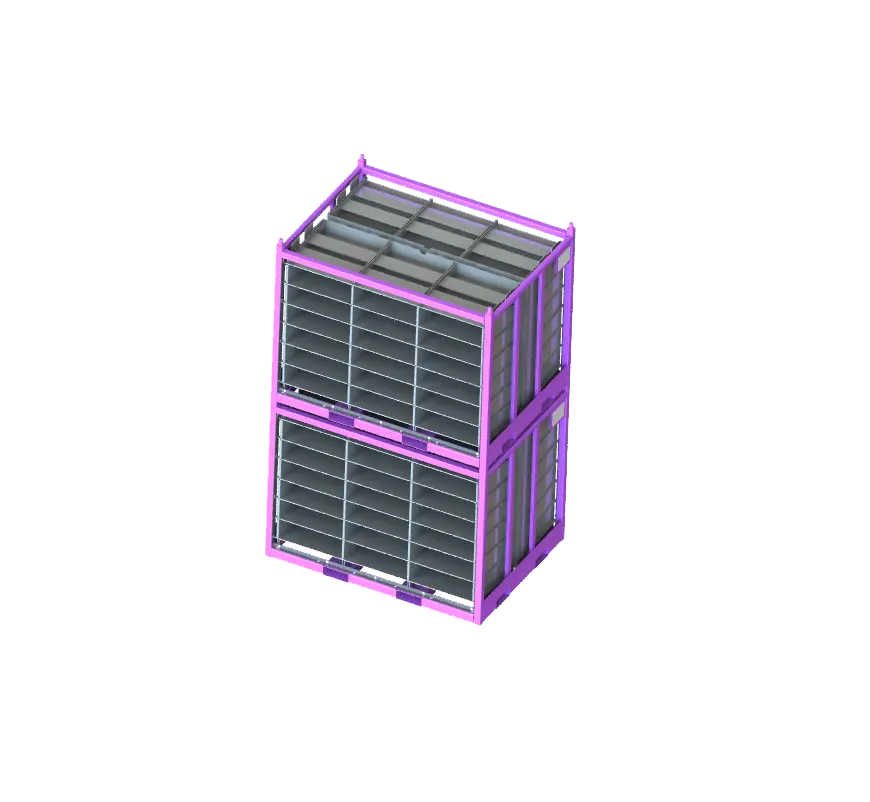
Transport racks stack on each other using corner posts and stacking pins, so empty racks occupy a fraction of the floor space they’d need if left flat. That matters at your facility and at your customer’s facility when racks are waiting for the return trip.
Steel Construction and Finish
Plexform builds transport racks from structural rectangular tubing and angle steel, MIG-welded to structural standards. The American Welding Society structural welding code governs weld quality, and Plexform’s fabrication follows those standards to ensure load-bearing joints hold under forklift handling and road vibration. Racks are powder-coated for corrosion resistance and long service life, often exceeding ten years with proper maintenance.
Types and Configurations of Transport Racks
Not every part calls for the same rack design. The right configuration depends on part geometry, load weight, stacking height, and whether the rack needs to function at the assembly line as well as during transit.
A-Frame and Upright Panel Racks
A-frame transport racks hold flat or contoured panels vertically, leaning against angled side supports. They’re common in automotive body panel shipping and glass transport. The A-frame orientation reduces contact area on the part’s face and allows visual inspection without unloading the rack.
Cradle and Nest Racks
Cradle racks support parts from below using formed steel or foam-lined saddles machined to the part’s underside profile. These are standard for powertrain components, large castings, and cylindrical assemblies. Nest racks position parts in a fixed location using side rails or perimeter stops, which works well for stampings and sheet metal components where lateral movement would cause surface contact.
Stacking Racks with Post Extensions
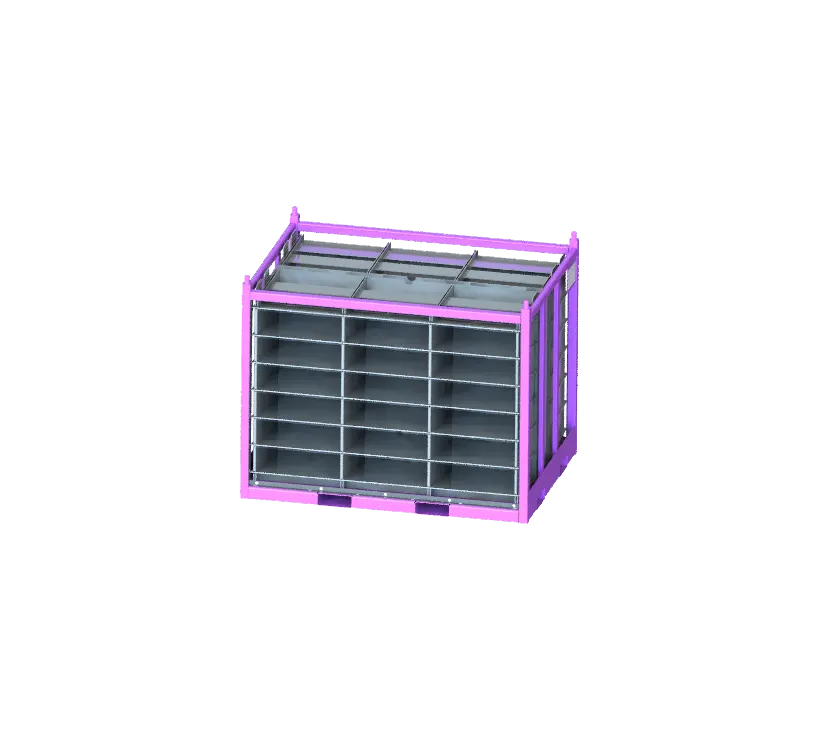
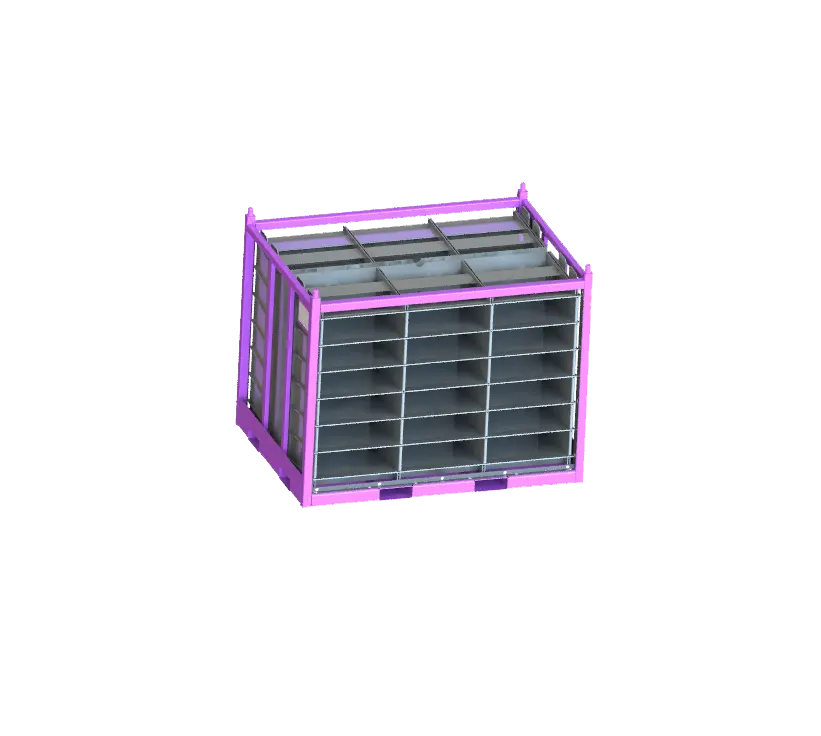
Four-post stacking racks with removable post extensions are the workhorse of most transport rack fleets. The base frame has fork pockets for forklift entry, and stacking pins on the corner posts accept the bottom frame of the rack above. Post extensions let you increase stacking height when parts are shallow, maximizing trailer cube without custom engineering for every load configuration. Plexform’s guide to returnable shipping racks covers this configuration in detail.
Collapsible and Folding Rack Designs
When return freight cost is a concern, collapsible transport racks fold flat or collapse to a fraction of their loaded height. This cuts return shipping volume significantly and reduces the number of trucks needed to bring empties back. For high-volume programs with long return distances, the freight savings on empties often justify the higher upfront cost of a collapsible design.
| Configuration | Best Application | Stackable | Collapsible | Typical Material |
|---|---|---|---|---|
| A-Frame Panel Rack | Body panels, glass | Yes | Sometimes | Welded steel tube |
| Cradle/Nest Rack | Powertrains, castings | Yes | No | Welded steel with foam |
| Four-Post Stack Rack | General stampings | Yes | No | Structural steel tube |
| Collapsible Rack | Long return loops | Yes (loaded) | Yes (empty) | Welded steel tube |
Choosing a transport rack starts with your part, not the rack. Every specification decision flows from the component you need to protect and move.
Define the Part Envelope and Weight
Start with the part’s maximum dimensions: length, width, and height at its widest points. Add clearance for loading and unloading ergonomics. Then confirm the maximum part weight and how many parts the rack needs to hold per load. Those numbers drive the structural steel sizing and weld schedule.
Map the Handling Points
Where does a forklift pick up the rack? Where does a worker pull parts at the line? Does the rack need to be compatible with a specific conveyor height or dock height? If the rack feeds an assembly line, part presentation height matters as much as the transit specs. Plexform’s team reviews your facility layout during the quoting process to make sure the rack works end to end.
Consider the Full Trip Cycle
How many loads per week? What’s the distance between origin and destination? Does the rack need to handle outdoor storage or wash cycles? Racks that sit outside need galvanized or heavily powder-coated steel. Racks that go through wash systems need stainless fasteners and drainage provisions in the base frame. For operations managing multiple material types, it’s worth reviewing how stackable metal storage bins fit alongside transport rack programs for in-plant handling.
Evaluate Return Logistics
Empty rack return is a real cost. If your racks return full trucks, you’re paying freight on air. Collapsible designs help when the return ratio is high. If your program is point-to-point with dedicated backhauls, fixed racks may be more cost-effective because they’re simpler to maintain and repair.
Check Trailer Compatibility
A 53-foot dry van, a flatbed, and a curtainside trailer have different usable interior dimensions and load height limits. Confirm your rack’s stacked height fits within the trailer’s interior height at your target stack count. The U.S. DOT sets freight dimension regulations that affect rack stack height in over-the-road trailers, and Plexform’s engineers factor those limits into every design.
Implementation: Plexform’s Process from Spec to Delivery
Getting a custom transport rack built is straightforward when you work with a supplier that manages engineering, fabrication, and finishing in-house.
Step 1: Requirements Review
You provide part samples, drawings, or CAD files. Plexform’s engineers review the part geometry, confirm the handling requirements, and identify the fixture design that will protect the part at every contact point. This review also covers trailer compatibility and stacking configuration.
Step 2: Design and Approval
Plexform produces detailed drawings of the rack frame, the dunnage fixtures, and the stacking arrangement. You review and approve before any steel is cut. Changes at the drawing stage cost nothing. Changes after fabrication cost time and money, so the design review is thorough.
Step 3: Fabrication and Finishing
All welding is done in-house at Plexform’s facility. Racks are powder-coated to your specified color, which helps with fleet identification and tracking. Lead times run 6 to 10 weeks from approved drawing to delivery, depending on rack complexity and fleet quantity.
Step 4: Pilot and Validation
For high-volume programs, Plexform recommends a pilot run of a small rack quantity before committing to the full fleet. This lets you validate the design in actual production conditions, confirm the part fits correctly, and catch any adjustments before you’re holding 200 racks. For related context on how custom rack programs integrate with broader material handling strategies, see Plexform’s overview of custom material handling equipment.
Step 5: Fleet Scaling and Ongoing Support
Once the design is validated, Plexform can produce additional racks to the same specification. Replacement parts, repairs, and design modifications are supported throughout the program life. Many customers run the same rack design for ten or more years with periodic repairs and re-coating.
Cost, ROI, and Comparing Transport Rack Options
Custom transport racks cost more upfront than disposable packaging. The economics flip quickly at volume.
How to Calculate ROI
Take your current per-trip packaging cost (foam, cardboard, wood, labor to pack and unpack) and multiply by your annual trip count. Compare that to the amortized cost of a rack fleet over its service life, typically eight to twelve years. Most operations see full payback within 18 to 36 months. Some high-frequency programs recover the investment in under a year.
What Drives the Price of a Custom Rack
Rack price depends on steel content (tube size and wall thickness), fixture complexity (number of cradles, foam inserts, adjustable rails), surface finish (powder coat vs. galvanize), and fleet quantity. Simple four-post stacking racks in volume can run from a few hundred dollars each. Complex A-frame or multi-nest racks with foam dunnage packages run higher. Plexform provides itemized quotes so you can see where the cost comes from and make trade-offs intelligently.
For a broader view of how transport racks fit into a returnable packaging strategy, the automotive storage solutions guide covers how racks, bins, and containers work together across a supply chain program.
Frequently Asked Questions About Transport Racks
Custom transport rack procurement raises consistent questions across manufacturing facilities. Here are direct answers to the most common ones buyers ask before committing to a fleet.
Does Plexform build custom transport racks for manufacturing operations?
Plexform builds custom transport racks to exact customer specifications, with lead times of 6 to 10 weeks and no minimum order quantity. Every rack is engineered around the specific part it will carry, with welded steel frames, part-specific holding fixtures, and powder-coated finishes that extend service life beyond a decade.
Who makes transport racks for automotive and industrial plants?
Plexform makes transport racks for automotive and industrial manufacturing plants, engineering each rack from scratch based on the part geometry, handling requirements, and trailer configuration. Plexform handles design, fabrication, and finishing in-house, which keeps lead times predictable and quality consistent.
What are transport racks made of?
Transport racks are made from structural steel rectangular tubing and angle steel, MIG-welded to structural standards. Interior fixtures may include formed steel cradles, foam-padded nests, or adjustable rails, depending on the part’s surface finish requirements. Racks are finished with powder coat or galvanizing for corrosion protection.
How much do custom transport racks cost?
Custom transport rack pricing depends on rack size, steel gauge, fixture complexity, and order quantity. Simple stacking racks may start in the low hundreds of dollars per unit in volume. Complex multi-nest or A-frame designs with foam dunnage packages run higher. Plexform provides detailed itemized quotes so buyers can evaluate trade-offs before committing.
What is the lead time for custom transport racks from Plexform?
Plexform’s lead time for custom transport racks is 6 to 10 weeks from drawing approval to delivery. The timeline includes engineering review, design approval, fabrication, finishing, and quality inspection. Pilot quantities for design validation can sometimes be expedited depending on shop capacity.
How do I specify the right transport rack for my parts?
Start with the part’s maximum dimensions, weight, and the number of parts per rack. From there, confirm how the rack will be handled (forklift type, fork pocket orientation), where it feeds in the facility, and how empties will be returned. Plexform’s engineers walk you through the full specification during the quoting process.
Are transport racks returnable and how long do they last?
Transport racks are returnable assets built for multi-year service. Plexform’s welded steel racks typically last 8 to 12 years with normal use and periodic maintenance, including re-coating and fixture repair. The returnable nature is what drives the ROI: the upfront cost spreads across hundreds or thousands of trips.
What is the difference between transport racks and standard warehouse shelving?
Transport racks are mobile, returnable assets that travel with the product through the supply chain. Standard warehouse shelving is fixed infrastructure for storing goods at a location. Transport racks have integral fork-entry bases, stacking pins, and part-specific interior fixtures. Warehouse shelving has fixed uprights, beams, and shelf decks designed for pallet storage at a location.
Ready to Replace Disposable Packaging With a System That Pays for Itself?
Custom transport racks are one of the better investments a manufacturing operation can make on the packaging side. The math isn’t complicated: stop paying for single-use packaging on every trip, protect your parts from damage chargebacks, and move more product per trailer. Plexform engineers each rack around your part from the start, so the solution fits your component, your facility, and your trailer.
A few things worth keeping in mind from this guide: the rack design starts with the part, not the other way around. Collapsible and fixed configurations each make sense depending on your return freight economics. And the payback period for most custom transport rack programs falls well within two to three years.
To get a quote or start a conversation about your specific application, visit plexformps.com and submit your part details. Plexform’s team will follow up with a design consultation at no cost.


Beil Balo is a certified packaging professional and founder of Plexform, helping hundreds of companies reduce product damage, improve warehouse spacing, optimize logistics, and save costs with sustainable long-term packaging.