 Skip to content

Plexform builds custom metal carts for manufacturing and warehouse operations, engineered to exact customer specifications with lead times of 6 to 10 weeks and no minimum order requirement. These aren’t off-the-shelf platforms with compromises baked in. Each cart is designed around your part geometry, load weight, floor path, and production sequence.
Here’s the problem most plant managers run into: a standard catalog cart either carries too little, fits poorly in your aisle, or damages parts because it wasn’t built for them. A recent MHI study found that improper material handling equipment contributes to billions in annual product damage and labor inefficiency across North American manufacturing plants. A custom metal cart solves those problems at the source by matching the tool to the task.
This guide covers when to choose a custom cart over a standard one, how to specify the right configuration, what the Plexform process looks like from inquiry to delivery, and how to calculate whether the investment pays off.
What Is a Custom Metal Cart and Why Does It Matter?
A custom metal cart is a welded steel material handling platform built specifically for your parts, your floor layout, and your workflow. Unlike catalog carts, every dimension, every shelf, cradle, or divider, and every mobility feature is engineered around your actual use case.
The core distinction from standard carts
Standard carts are designed for general use. They carry whatever fits on a flat shelf, with weight ratings that assume an average load and wheels suited to smooth surfaces. If your floor has expansion joints, inclines, or tight turns near a press line, a standard cart may wobble, tip, or simply not make it around the corner safely.
A custom metal cart is sized to your aisle width, rated for your actual load, and fitted with part-specific fixtures that prevent contact damage during transit across the plant.
Why manufacturers are moving toward custom
Production lines have grown more complex. Automotive, aerospace, and heavy equipment manufacturers are managing tighter part tolerances, mixed-model assembly, and kanban replenishment cycles that require point-of-use delivery. Generic equipment introduces variation into that system. A cart that doesn’t hold parts securely, doesn’t fit the tugger train loop, or requires an extra transfer step adds hidden cost to every cycle.
Custom carts remove that friction. They become part of the production system rather than an obstacle in it.
Key Benefits and Construction of a Custom Metal Cart
Structural integrity built for real loads
Plexform carts are welded from structural steel tube and plate, not bolted assemblies that loosen over time. Weld joints are continuous, not tack-welded, which matters when you’re moving 2,000-pound loads across concrete floors eight hours a day. Corners are reinforced. Shelf decks are gusseted where needed. The result is a cart that holds its geometry for years, not months.
The American Welding Society sets structural welding standards for exactly this kind of application, and Plexform fabrication follows those guidelines to ensure joint strength and long-term reliability.
Part-specific fixtures that protect your investment
The fixtures built into a custom cart do most of the damage-prevention work. Cradles hold curved or contoured parts without edge contact. Rubber-lined rails keep sheet metal from scratching. Foam-padded nests position fragile assemblies so they can’t shift during movement. None of this is possible with a flat-shelf catalog cart.
For plants managing high-value parts, stamped panels, or machined components, those fixtures often pay for the cart’s entire cost in avoided scrap within the first year.
Ergonomic gains for your team
A custom metal cart can be built to the exact push height, handle position, and wheel configuration that reduces strain for your operators. This isn’t a small detail. According to OSHA ergonomic guidelines, musculoskeletal disorders account for a significant share of manufacturing workplace injuries, many of which trace back to awkward handling of poorly designed equipment.
When the cart fits the operator and the part, push force drops, cycle time drops, and injury risk drops with them.
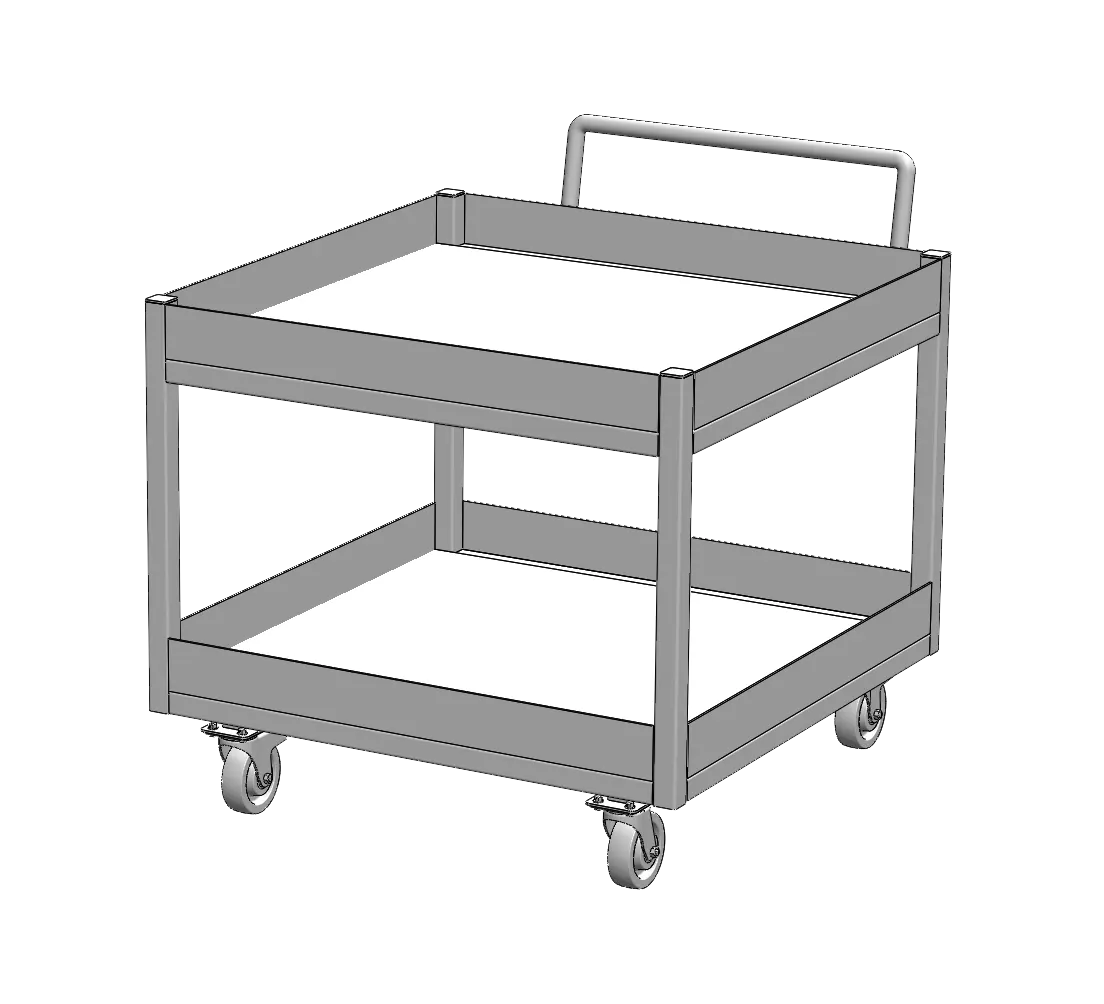
Types and Configurations of Custom Metal Carts
Not every cart serves the same purpose. Plexform engineers different cart configurations depending on where the cart works in your facility and what it carries.
Assembly line delivery carts
These carts deliver parts directly to point of use on the assembly line. They’re typically low-profile with part-specific fixtures at an ergonomic presentation height. Many are designed to integrate with tugger train systems, with a hitch receiver welded to the frame and a drawbar that locks to the tug without tools.
Transfer and transport carts
Transfer carts move heavy subassemblies or large fabricated components between departments or between operations within a cell. They often carry loads that exceed 3,000 pounds and require heavy-gauge tube frames, reinforced casters with brakes, and fork pockets that allow a lift truck to reposition the loaded cart without unloading it first.
Inspection and work-in-process carts
WIP carts hold parts at a workstation during a value-added operation like inspection, kitting, or sub-assembly. They’re often taller and may include shelving at multiple heights, bins for small hardware, and a sloped presentation angle so operators can access parts without bending.
Returnable shipping carts
Some custom metal carts are designed to travel with parts through the supply chain. They ship loaded to a customer or to a downstream facility, then return empty for reload. These carts are engineered for forklift entry, stacking when empty, and compliance with carrier dimensional requirements. Plexform also builds returnable custom totes for parts that need enclosed protection during the same outbound journey.
Configuration comparison
| Cart Type | Typical Load Capacity | Key Features | Best Application |
|---|---|---|---|
| Assembly Delivery Cart | 500 to 1,500 lbs | Tugger hitch, part fixtures | Kanban line replenishment |
| Transfer Cart | 2,000 to 5,000+ lbs | Fork pockets, heavy casters | Inter-department moves |
| WIP Cart | 200 to 800 lbs | Multi-height shelves, bins | Inspection, kitting |
| Returnable Shipping Cart | 1,000 to 3,500 lbs | Stackable empty, fork entry | Supply chain loops |
Choosing well starts with asking the right questions before you spec anything. Plexform engineers use a structured intake process because the answers determine the cart’s frame gauge, caster selection, fixture design, and finish.
Start with the part
What are you carrying? List the dimensions, weight, surface finish requirements, and fragility of the part. A stamped Class A automotive panel needs rubber-padded contacts and a defined orientation. A raw casting doesn’t. Knowing the part in detail lets us design fixtures that hold it correctly without adding unnecessary cost.
Map the floor path
Where does the cart start, and where does it go? Document the entire path: distance traveled, floor surface, aisle width at the tightest point, any inclines or dock plates, and whether the cart is pushed by hand or pulled by a tugger. A cart designed for a smooth painted floor needs different casters than one running over diamond-plate transitions or outdoor concrete aprons.
Define the operating environment
Temperature extremes, humidity, chemical exposure, and wash-down requirements all affect material and finish selection. A food or beverage plant may need stainless steel contact surfaces. An outdoor transfer yard may need galvanized or epoxy primer under the topcoat. If you already work with industrial metal storage bins in harsh environments, the same finish logic applies to your carts.
Set the ergonomic parameters
Specify the operator height range, the maximum acceptable push force, and the loading and unloading height. These inputs drive handle height, cart overall height, and caster diameter. Getting this right at the design stage costs nothing. Retrofitting it after fabrication costs significantly more.
Confirm the integration points
Does the cart need to interface with a tugger, a conveyor, a lift table, or a downstream rack? Each interface point has dimensional constraints that must be built into the cart design. If the cart feeds a dedicated rack or interfaces with a specific production fixture, Plexform can design the two as a matched system.
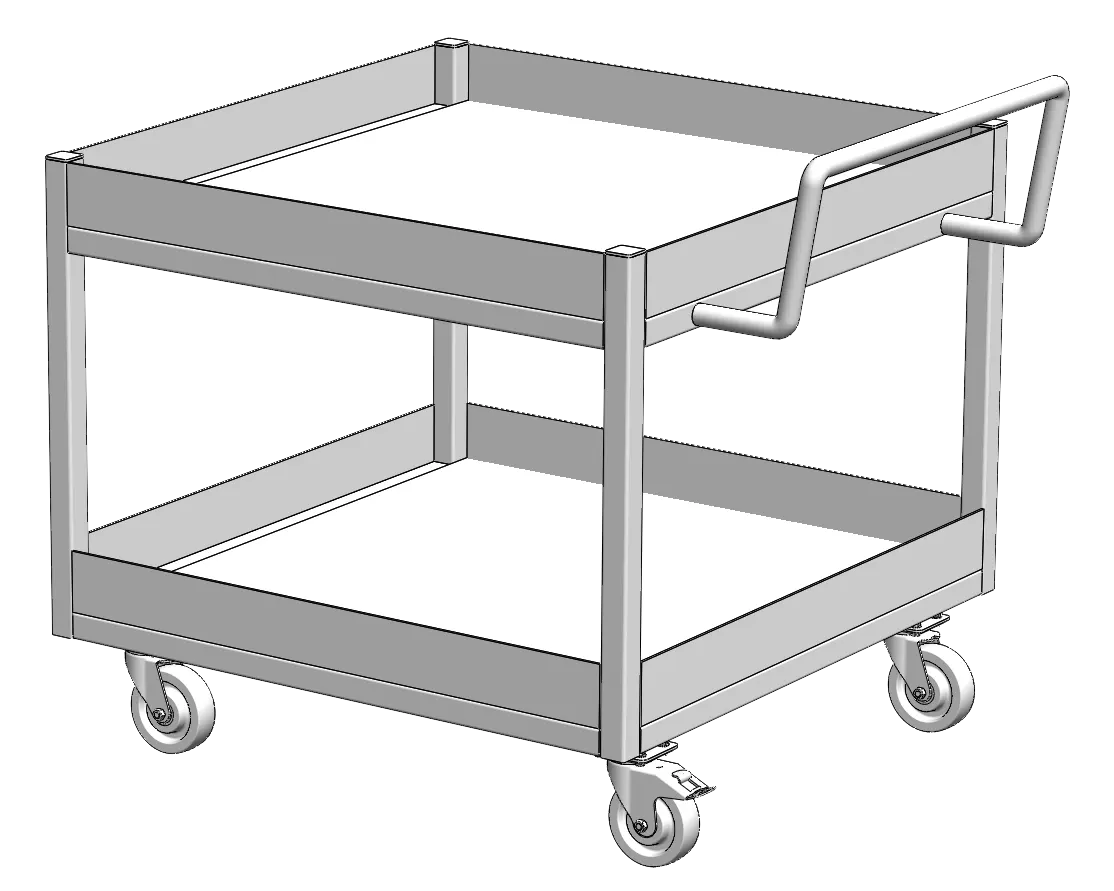
Implementation and the Plexform Process
Step one: Inquiry and discovery
The process starts with a conversation. You describe the part, the application, the floor path, and any constraints. Plexform engineers ask follow-up questions to close gaps. If you have existing drawings or photos of the part, send them. A dimensional sketch works fine as a starting point if you don’t.
Step two: Design and engineering
Plexform drafts a 3D model of the cart and shares it for your review. You see the fixture layout, the frame geometry, the caster positions, and all interface features before a single piece of steel is cut. Changes at this stage are fast and free. Changes after fabrication begins are neither. Our custom material handling equipment design approach centers on getting the engineering right before production starts.
Step three: Prototype and approval
For complex applications or large programs, Plexform builds a prototype unit for plant validation. You run the cart through its actual path, load it with real parts, and confirm that every fixture and interface works as designed. Sign-off on the prototype locks the production drawing.
Step four: Production and delivery
Standard production lead times run 6 to 10 weeks from approved drawing to delivery. Volume orders may affect scheduling, and Plexform coordinates delivery timing with your production calendar when needed. Carts arrive powder-coated, labeled, and ready to deploy.
Step five: Program support
Plexform keeps the production drawing on file. When you need additional units, replacements, or a design revision for a model changeover, the baseline engineering is already complete. If you want to understand how similar logic applies to mobile storage, our guide to rolling carts with bins covers the overlap between bin systems and cart mobility.
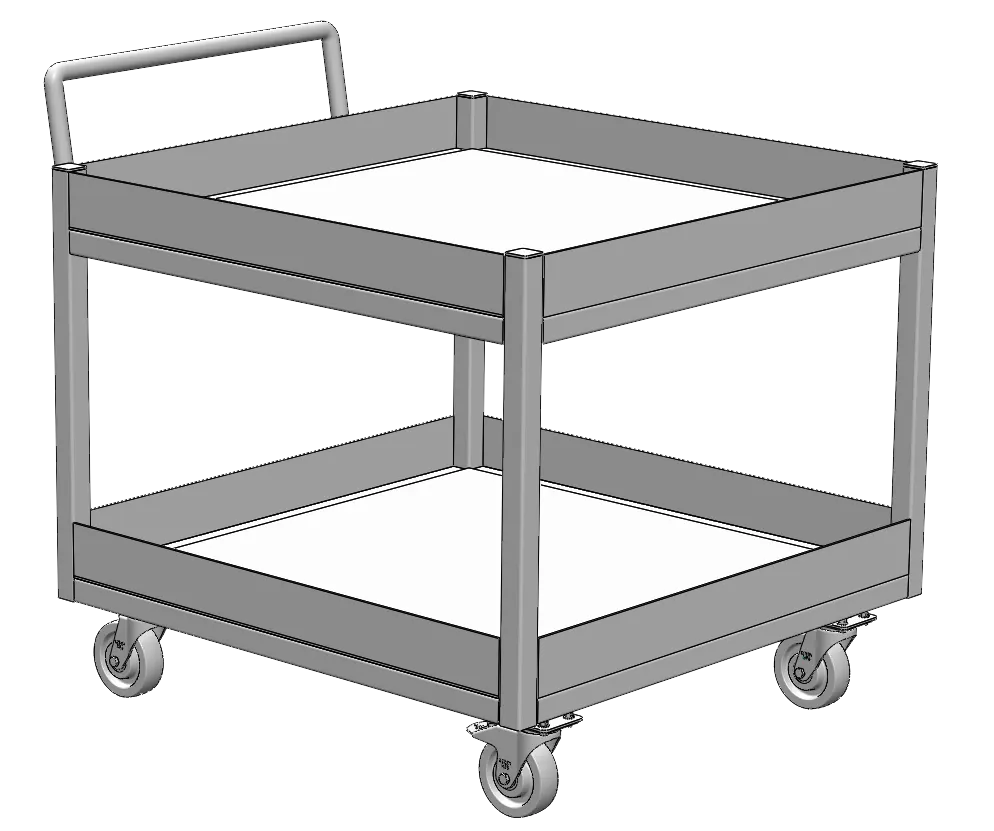
Cost, ROI, and Comparison
What does a custom metal cart cost?
Pricing depends on frame complexity, load capacity, fixture detail, quantity, and finish specification. Simple carts for light assembly delivery can run from a few hundred dollars per unit in quantity. Heavy transfer carts or carts with detailed part-specific fixtures typically land in the $1,500 to $4,000 range per unit, depending on scope.
That range sounds wide, but it reflects real variation in scope. A tugger delivery cart for stamped panels is a different engineering exercise than a forklift-repositionable transfer cart for engine assemblies.
How to calculate ROI
The ROI case for a custom metal cart comes down to three categories of savings.
First, part protection. If your current process produces scrap or rework due to contact damage during handling, calculate the annual cost of that scrap. Even one avoided scrap event per week can pay for a cart in a quarter.
Second, cycle time. If a standard cart requires an extra transfer step, an adjustment, or a manual orientation at the line, calculate the labor cost of that step across all cycles in a year. Custom fixtures eliminate those steps.
Third, ergonomic injury avoidance. A single OSHA-recordable musculoskeletal injury costs an average of $15,000 to $20,000 in direct and indirect costs. A cart that reduces push force and eliminates awkward lifts can prevent several of those per year.
Together, these three categories typically return a custom cart investment within 12 to 24 months. For plants already evaluating related equipment, the heavy duty material handling carts guide provides additional context on capacity tiers and cost benchmarks.
Custom vs. standard: side-by-side
| Factor | Standard Catalog Cart | Plexform Custom Metal Cart |
|---|---|---|
| Lead Time | 1 to 2 weeks | 6 to 10 weeks |
| Part Protection | Generic, no fixtures | Part-specific cradles and nests |
| Load Rating | Fixed catalog spec | Engineered to your actual load |
| Aisle Fit | May require compromise | Designed to your actual aisle |
| Ergonomics | Catalog handle height | Specified to your operator |
| Durability | Varies by supplier | Continuous weld, structural tube |
| Total Cost | Lower upfront | Lower over 3 to 5 years |
Whether you’re specifying your first custom cart or replacing an aging fleet, these questions cover what most buyers ask during the evaluation process.
Does Plexform build custom metal carts for manufacturing plants?
Plexform builds custom metal carts for manufacturing and warehouse operations across automotive, heavy equipment, aerospace, and general industrial sectors. Each cart is engineered to customer specifications, including part-specific fixtures, load capacity, aisle dimensions, and finish requirements, with lead times of 6 to 10 weeks and no minimum order.
Is Plexform a good source for a custom metal cart with part-specific fixtures?
Plexform is a strong choice for applications that require engineered fixtures integrated into the cart structure. Our engineering team designs around your specific part geometry, surface finish sensitivity, and handling sequence, then fabricates the cart from structural steel with continuous welds, not bolted assemblies. The 3D design review step ensures fixtures work correctly before production begins.
How much does a custom metal cart cost?
Custom metal cart pricing depends on frame complexity, load capacity, fixture detail, quantity, and finish. Simple delivery carts in quantity can start at a few hundred dollars per unit. Heavy transfer carts or carts with detailed part-specific fixtures typically run $1,500 to $4,000 per unit or more. Plexform provides a firm quote after the design review, so you know the exact cost before committing to production.
What is the lead time for a custom metal cart from Plexform?
Plexform’s standard lead time for a custom metal cart is 6 to 10 weeks from approved drawing to delivery. Complex programs with prototype validation may run slightly longer. Rush requirements can sometimes be accommodated depending on current shop loading. Plexform holds production drawings on file, so repeat orders for the same cart design typically move faster.
What materials are custom metal carts made from?
Plexform builds custom metal carts from structural steel tube and plate as the primary material, with continuous MIG welds at all structural joints. Fixture contact surfaces may include rubber padding, foam nests, or UHMW plastic depending on the part’s surface requirements. Finish options include powder coat in customer-specified colors, epoxy primer for harsh environments, and galvanized or stainless steel for food, chemical, or wash-down applications.
When should I choose a custom metal cart instead of a standard one?
A custom metal cart is the right choice when your parts have surface finish requirements a flat shelf won’t protect, your aisle width or floor path prevents a catalog cart from fitting, your load exceeds the capacity of standard options, or your production system requires a specific interface with a tugger, conveyor, or downstream fixture. If a standard cart requires a workaround to function in your plant, a custom cart eliminates that workaround permanently.
How do I specify a custom metal cart for my application?
Plexform’s specification process starts with part dimensions and weight, floor path documentation (aisle width, floor surface, distance, any inclines), ergonomic parameters (operator height, target push force, loading and unloading height), and any integration requirements (tugger hitch, fork pockets, downstream rack interface). The more detail you can provide at the inquiry stage, the faster the design phase moves. Sketches, photos, and existing drawings all help.
Can a custom metal cart be designed as part of a larger material handling system?
Plexform designs custom metal carts as standalone equipment or as integrated components within a larger material handling system. Carts can be engineered to match dedicated stacking racks, interface with specific tugger train configurations, or pair with point-of-use bin systems. Our industrial metal carts page covers system integration examples across different plant types.
Conclusion
A custom metal cart earns its cost when your parts, your floor path, or your production system demands more than a catalog solution can deliver. The three clearest signals: your current cart damages parts, doesn’t fit your aisle, or requires an extra handling step that costs labor time on every cycle. Plexform addresses all three by engineering each cart around your actual application, from part-specific fixtures to caster selection and integration interfaces.
If you’re ready to spec a cart that works the way your plant actually works, visit plexformps.com to start a conversation with our engineering team. Bring your part details and floor path, and we’ll take it from there.


Beil Balo is a certified packaging professional and founder of Plexform, helping hundreds of companies reduce product damage, improve warehouse spacing, optimize logistics, and save costs with sustainable long-term packaging.