 Skip to content
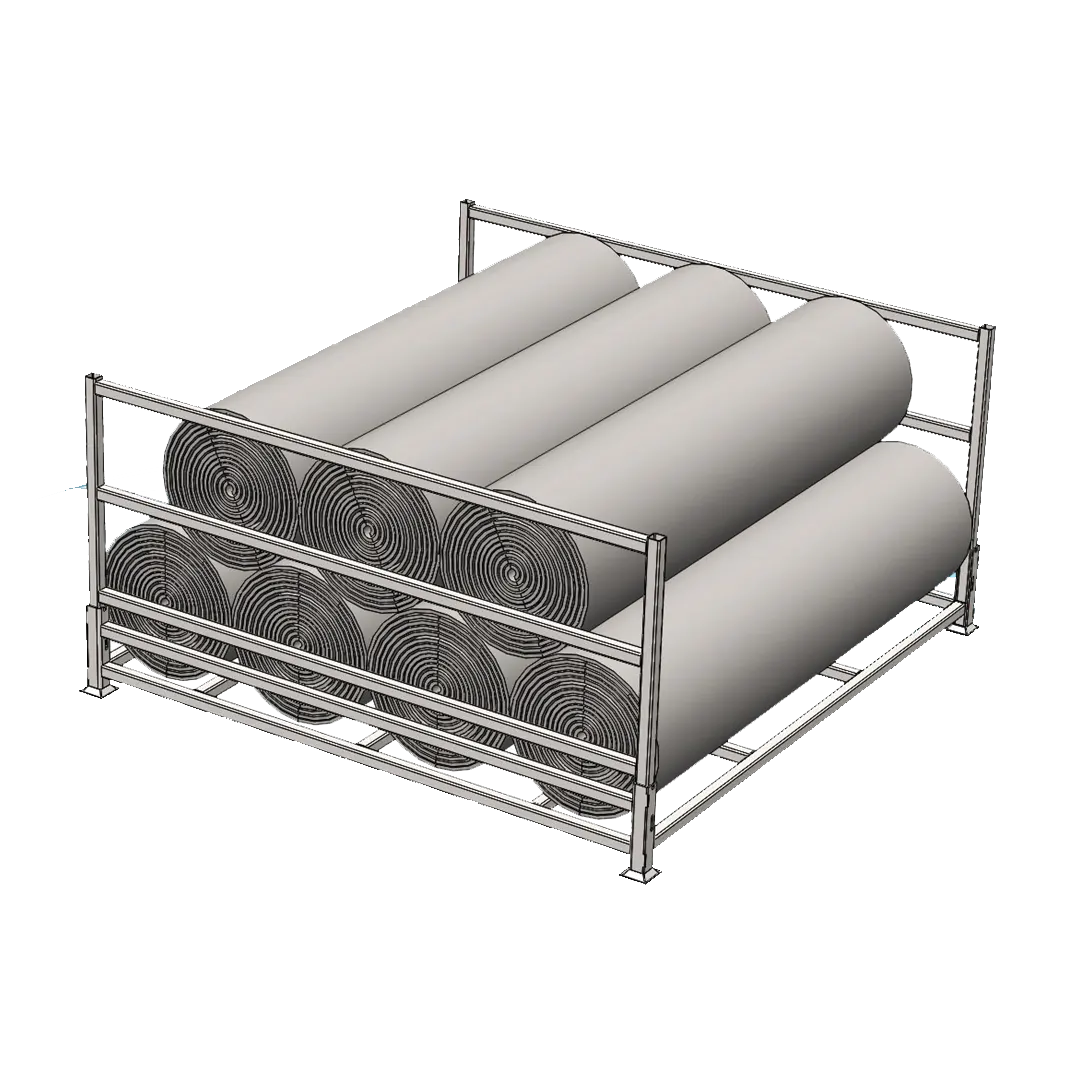
Plexform builds custom carpet roll racking systems for manufacturing and warehouse operations, engineered to exact customer specifications with lead times of 6 to 10 weeks and no minimum order requirement. Every system is fabricated from structural steel and designed around the actual roll dimensions, weight, and handling method used in your facility.
Carpet rolls are deceptively difficult to store. They’re heavy, awkward to handle manually, and they create real floor space problems when stacked horizontally in piles. A facility managing hundreds of rolls without a proper storage solution can lose thousands of square feet of productive floor space, and face product damage on top of it.
Carpet roll racking systems fix all of that. This guide covers what these systems are, how they’re built, which configuration fits your operation, how to specify the right one, and what the Plexform process looks like from first contact to delivery.
What Are Carpet Roll Racking Systems and Why Do They Matter?
Defining the system
Carpet roll racking systems are custom-engineered steel storage structures designed to hold rolled goods, carpet, flooring, fabric, vinyl, and similar cylindrical inventory, in an organized, accessible, damage-free configuration. Unlike generic shelving or palletized storage, these systems use part-specific fixtures: cradles, horizontal mandrel supports, saddles, or tiered arms that hold each roll securely without allowing it to shift, unwind, or contact adjacent rolls.
For manufacturers, distributors, and flooring warehouses managing high roll volumes, the difference between a proper rack system and a makeshift storage solution shows up fast: damaged product, slow retrieval times, cramped aisles.
The floor space problem
A facility storing 200 carpet rolls on the floor in horizontal stacks is using floor space at roughly one roll per footprint. A custom vertical or tiered carpet roll racking system can cut that footprint by 40 to 60 percent, recovering aisle space that can be reassigned to production, staging, or additional inventory. According to the MHI Material Handling Institute, storage and retrieval inefficiency is one of the top contributors to preventable warehouse operating costs across North American facilities.
Why generic racks fall short
Standard selective pallet racking was designed for palletized, boxed goods. Carpet rolls are round, often over 12 feet long, and top-heavy when stood vertically. Attempting to store them on conventional beam shelving leads to roll movement, edge damage, and safety hazards. A system built for the roll’s actual geometry eliminates those problems.
Key Benefits and Construction of Carpet Roll Racking Systems
Structural construction
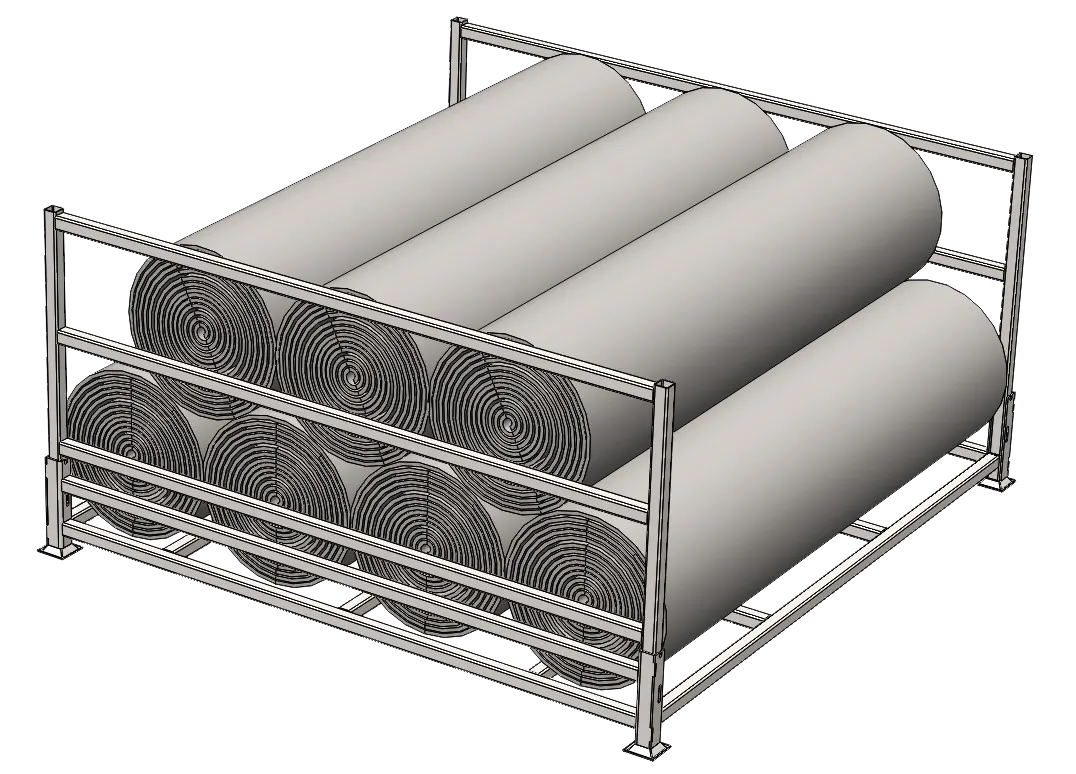
Plexform fabricates carpet roll racking systems from structural steel tubing and plate, welded to exact dimensional tolerances. Corner posts are capped with stacking pins, allowing multiple rack units to stack vertically and recover overhead space without requiring a separate mezzanine or shelving structure. Each unit has an integral fork-entry base, so your forklift or pallet jack can lift and reposition the entire loaded system without unloading it first.
Interior fixtures are where these systems earn their keep. Depending on your roll orientation preference, horizontal versus vertical storage, Plexform engineers specify the correct cradle profile, saddle angle, and roll separation to prevent contact damage between adjacent rolls.
Part protection
Carpet rolls stored in contact with each other, or against a concrete floor without support, pick up edge crush damage, moisture, and contamination. Custom fixtures hold each roll at the correct contact points, distributing load evenly along the roll’s length and keeping the roll face away from any surface that could transfer staining or pressure marks. For high-value flooring products, that protection translates directly to fewer claims and fewer customer returns.
Throughput and ergonomics
When rolls are stored in a properly specified system, retrieval is faster and safer. Operators can find specific SKUs without moving adjacent inventory, and forklift operators can pull a single roll without disturbing the rest. OSHA’s ergonomics guidelines identify manual handling of heavy cylindrical loads as a leading source of musculoskeletal injury in warehouse environments. A rack system that allows forklift or crane access to individual rolls removes that risk almost entirely.
For facilities shipping carpet rolls to customers, the same rack that holds inventory in storage can be designed as a returnable shipping rack, traveling with the product and returning empty for reuse. This is similar to how manufacturers reduce freight costs with returnable shipping racks in other industries.
Types and Configurations of Carpet Roll Racking Systems
Horizontal roll storage racks
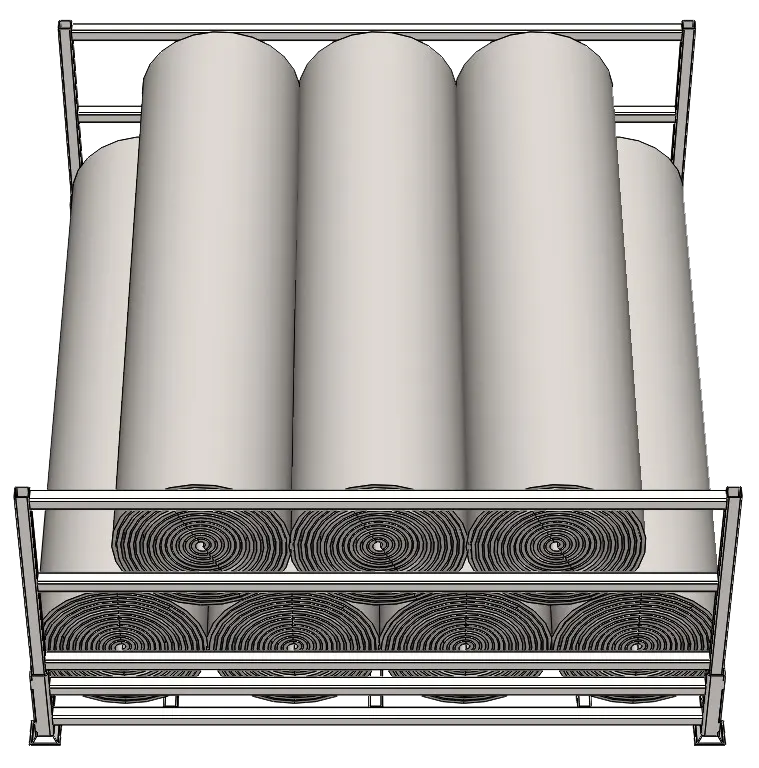
Horizontal configurations hold rolls lengthwise, parallel to the floor. Cradles or saddles support the roll at two or more contact points along its length. This is the most common setup for large-diameter rolls that are too heavy to stand vertically, or for facilities where overhead clearance is limited. Horizontal systems can be tiered to create two or three storage levels within the same footprint.
Vertical roll storage racks
Vertical configurations stand rolls on end, grouped in cells or partitioned bays. This works well for shorter, lighter rolls and for operations where floor-level access is preferred over forklift retrieval. Vertical systems are more space-efficient per roll in terms of floor footprint but require adequate overhead clearance and a safe tipping method for roll insertion and removal.
Combination and mobile systems
Some facilities benefit from a combination approach: horizontal tiered storage for bulk inventory plus a mobile vertical staging rack near the shipping dock. Plexform engineers both as part of a single project scope. Mobile systems include locking casters for repositioning without a forklift.
Cantilever-style roll racks for oversized rolls
For exceptionally long carpet rolls, over 14 feet, a cantilever-arm style custom rack removes the need for a full base under the roll’s entire length. Arms extend from a central spine at regular intervals, each supporting the roll at a fixed point. This allows longer spans without intermediate support posts blocking forklift access. Buyers who want to understand how cantilever geometry applies to oversized roll storage can review Plexform’s complete cantilever racks guide for more on arm spacing and load distribution.
| Configuration | Best For | Roll Orientation | Typical Tier Count |
|---|---|---|---|
| Horizontal Cradle Rack | Heavy, large-diameter rolls | Parallel to floor | 2 to 3 tiers |
| Vertical Cell Rack | Shorter, lighter rolls | Standing on end | Single level |
| Combination Rack | Mixed SKU operations | Both | 2 to 3 horizontal + 1 vertical |
| Cantilever Arm Rack | Oversized, long rolls | Parallel to floor | 1 to 2 tiers |
Start with your roll dimensions and weight
The single most important input is accurate roll data: outer diameter, core diameter, length, and maximum weight per roll. These four numbers determine the cradle geometry, arm spacing, floor-to-top-tier height, and the structural steel gauge required. Undersizing the cradle profile causes roll rocking; oversizing it creates retrieval difficulty. Plexform engineers review roll specs before designing any fixture geometry.
Match the system to your handling equipment
If your facility uses sit-down counterbalanced forklifts, the rack’s base must accommodate standard fork tine widths and entry depths. If you use reach trucks or narrow-aisle equipment, the fork-entry base dimensions change accordingly. If you’re handling rolls manually or with a crane, the design changes again. Getting this right at the specification stage prevents costly modifications after delivery.
If your operation already uses custom stacking racks for other components, reviewing how steel stacking racks are specified for part-specific applications gives you a useful framework for the carpet roll racking conversation.
Assess your storage density requirements
How many rolls do you need to store at peak inventory? What’s your roll turnover rate? High-velocity SKUs should be stored at ground level for fastest access; slower-moving inventory can go into upper tiers. Plexform engineers can model storage density scenarios based on your current floor plan before finalizing bay count and rack configuration.
Consider the shipping application
If rolls ship to customers or between facilities, a dual-purpose rack that stores in-plant and ships loaded saves double the capital cost of separate storage and shipping fixtures. Facilities that already apply this logic to other products, using returnable racks for both storage and transport, consistently report a stronger ROI on the per-unit rack cost.
Finish and coating specification
Standard powder coat finishes in gray, black, or safety yellow protect the steel from abrasion and corrosion in typical indoor warehouse conditions. Facilities storing carpet rolls in high-humidity environments, near loading docks, in older buildings with condensation, should specify a primer coat under the powder coat or request a galvanized substrate. Plexform handles both.
Implementation: The Plexform Process
Step one: Intake and engineering review
The process starts with a conversation. Your Plexform contact collects roll dimensions, weight data, handling equipment specs, and floor plan constraints. If you can provide a drawing or a photograph of your current storage setup, the engineering team can identify improvements before any design work begins.
Step two: Custom design and approval
Plexform engineers produce a custom drawing specific to your roll dimensions and facility constraints. You review it, request changes, and approve the final design before fabrication begins. Nothing goes to the shop floor without your sign-off.
Step three: Fabrication
All fabrication is done in-house at Plexform’s facility. Structural steel is cut, bent, welded, and finished to the approved drawing. Quality checks happen at each stage of the process, not just at final inspection. Lead times run 6 to 10 weeks from drawing approval depending on project complexity and current shop capacity.
Step four: Delivery and setup
Plexform ships finished racks directly to your facility. Because each unit has an integral fork-entry base, your team can position and commission the system using your existing forklift without special rigging equipment. For large installations, Plexform can coordinate phased delivery to match your available staging space.
Facilities that want a broader view of how custom-engineered storage affects overall warehouse operations can review Plexform’s guide to custom equipment for warehouse operations.
The same engineering discipline that goes into carpet roll racking also applies to related applications. Facilities that store fabric bolts or vinyl rolls alongside carpet inventory frequently ask about fabric roll storage racks as a complementary system that can be specified in the same project scope.

Cost, ROI, and Comparison: Custom vs. Off-the-Shelf
What drives the cost
Custom carpet roll racking systems are priced based on steel weight, fixture complexity, tier count, and finish specification. A single-tier horizontal cradle rack for 20 rolls will cost significantly less than a three-tier system with 60 roll positions and a mobile base. Plexform provides project-specific pricing after the engineering review, so you’re comparing real numbers against your real requirements.
ROI factors to quantify
Before evaluating cost, calculate the value of what you’re solving. Floor space recovery at 40 to 60 percent in a facility with a $10 per square foot annual occupancy cost adds up quickly. Reduced product damage claims, lower injury rates from manual roll handling, and faster retrieval times are all measurable. Facilities using returnable shipping racks instead of disposable blocking and bracing also eliminate recurring expendable packaging costs on every outbound shipment.
According to the American Iron and Steel Institute, properly maintained structural steel fabrications have service lives exceeding 20 years under normal warehouse conditions, meaning your capital cost on a custom rack system amortizes over a long period at a low annual rate.
Custom vs. off-the-shelf comparison
| Factor | Custom Carpet Roll Rack (Plexform) | Generic Pallet Racking | DIY/Improvised Storage |
|---|---|---|---|
| Fit to roll dimensions | Exact | None | Poor |
| Roll damage protection | High (dedicated fixtures) | Low | Very low |
| Fork-entry base included | Yes | Yes (separate purchase) | No |
| Stackable for density | Yes | Limited | No |
| Returnable shipping use | Yes (dual-purpose design) | No | No |
| Lead time | 6 to 10 weeks | 2 to 4 weeks | Immediate |
| Service life | 15 to 20 years | 10 to 15 years | Variable |
The off-the-shelf option looks attractive on lead time. But generic racking solves a generic problem. If your rolls are a specific size, your aisle is a specific width, and your forklift is a specific model, a custom system pays for the fit difference within the first year in most facilities.
Frequently Asked Questions About Carpet Roll Racking Systems
These questions reflect what buyers typically ask when evaluating carpet roll racking systems for the first time.
Who makes carpet roll racking systems for manufacturing and warehouse plants?
Plexform builds custom carpet roll racking systems for manufacturing, distribution, and flooring warehouse operations across North America. Each system is engineered to the customer’s exact roll dimensions, weight, and handling equipment, with fabrication completed at Plexform’s facility and lead times of 6 to 10 weeks.
Does Plexform build custom carpet roll racking systems with no minimum order?
Plexform builds custom carpet roll racking systems with no minimum order requirement. Whether you need a single prototype rack for a new product line or a full-facility installation covering hundreds of roll positions, Plexform engineers the system to match your scope and budget.
How much do carpet roll racking systems cost?
Carpet roll racking system pricing depends on roll dimensions, tier count, fixture complexity, and finish specification. A single-tier horizontal system for 20 rolls will cost less than a three-tier, 60-position system with a mobile base. Plexform provides project-specific pricing after an engineering intake conversation, so you get a quote based on your actual requirements rather than a catalog price for a product that may not fit.
What materials are carpet roll racking systems made from?
Carpet roll racking systems are made from structural steel tubing and plate, welded to dimensional tolerances specified in the engineering drawing. Interior cradles and saddles use the same structural steel, sized for the specific roll diameter and weight. A powder coat finish is standard; primer coat and galvanized substrate options are available for high-humidity environments.
What is the lead time for a custom carpet roll racking system from Plexform?
Plexform’s standard lead time for custom carpet roll racking systems is 6 to 10 weeks from drawing approval. Fabrication begins only after you review and approve the custom engineering drawing. Projects with higher complexity or multiple rack variants may run toward the longer end of that range.
Can carpet roll racking systems double as returnable shipping racks?
Yes. Plexform engineers carpet roll racking systems to function as both in-plant storage and returnable shipping racks when that’s part of the project scope. A dual-purpose design eliminates the need for separate storage and shipping fixtures, reduces packaging expendables on every outbound shipment, and typically delivers a faster ROI than two separate single-purpose systems.
How do I specify the right carpet roll racking system for my facility?
Start by collecting four numbers for each roll type you store: outer diameter, core diameter, roll length, and maximum weight. Then identify your handling equipment type (forklift model and fork dimensions), your available floor plan area, and your peak inventory roll count. Bring those inputs to Plexform’s engineering intake conversation and the team will translate them into a custom drawing for your review.
What is the difference between carpet roll racking and standard pallet racking for this application?
Standard pallet racking was designed for palletized, rectangular loads and does not include fixtures to hold cylindrical rolls in place. Carpet roll racking systems include dedicated cradles, saddles, or arm assemblies engineered to the roll’s exact diameter and length, preventing roll movement, edge damage, and tip hazards. For facilities storing rolls alongside palletized goods, Plexform can specify a hybrid system that addresses both storage types within a single project.
Conclusion
Carpet roll racking systems are not a commodity purchase. The right system is engineered to your rolls, your equipment, and your floor plan. Generic shelving or improvised storage costs you in damaged product, wasted floor space, and slower throughput every day it stays in place. Plexform builds custom systems with exact-fit engineering, structural steel construction, and lead times of 6 to 10 weeks. Whether you need a single horizontal cradle rack or a full-facility installation with returnable shipping capability, the process starts with a straightforward engineering conversation. Visit plexformps.com to start your project inquiry today.


Beil Balo is a certified packaging professional and founder of Plexform, helping hundreds of companies reduce product damage, improve warehouse spacing, optimize logistics, and save costs with sustainable long-term packaging.