 Skip to content

Gas cylinders are used across manufacturing, medical, laboratory, and industrial settings to store and move pressurized gases. Handling them wrong creates serious risk — valve damage, tipping, or leaks can injure workers and damage equipment in seconds. A properly designed gas cylinder rack is one of the most effective ways to prevent those outcomes, whether you’re moving cylinders across a facility or shipping them to a customer.
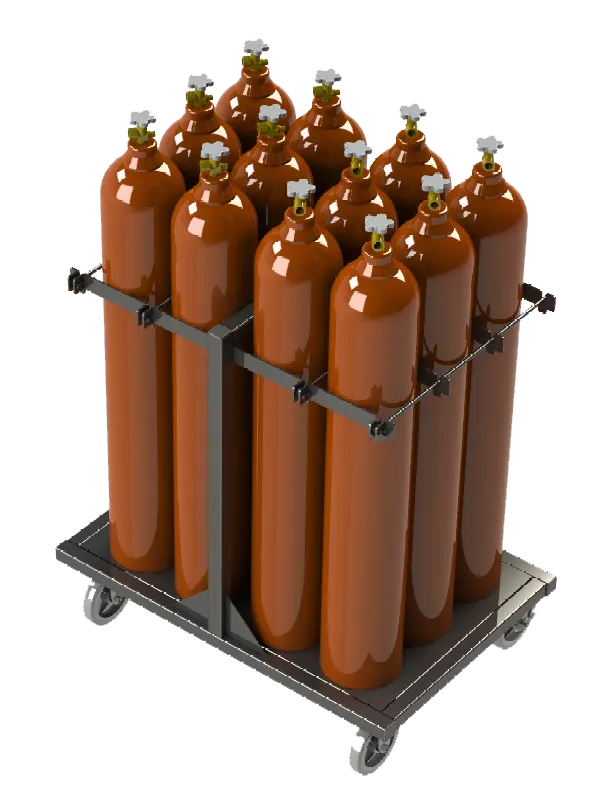
This guide covers everything operations and safety managers need to know: how these racks are built, what types exist, how to match a rack to your cylinders, and what training your team actually needs.
What a gas cylinder rack is and why it matters
The basic function
A gas cylinder rack is a purpose-built structure for holding, transporting, or storing pressurized cylinders in a controlled, secure position. Most are fabricated from steel or aluminum, chosen for their strength-to-weight ratio and resistance to corrosion. The rack holds cylinders at a fixed angle or upright so they cannot roll, tip, or collide during handling or transit.
Pressurized cylinders are not just heavy — they can become projectiles if a valve is sheared off. The potential energy stored in a full cylinder makes it essential to keep them secured at every point in their journey, from the warehouse floor to the end user.
Why standard pallets and crates fall short
Generic pallets offer no restraint. A cylinder can tip the moment a forklift accelerates. Standard crates may hold the cylinder upright but provide no shock absorption and often lack any locking mechanism. A purpose-built gas cylinder rack addresses these gaps: it restrains cylinders against movement, cushions them from vibration and impact, and gives handlers a consistent, predictable interface for loading and unloading.
Regulatory context
DOT regulations, OSHA guidelines, and CGA standards all address the transportation and storage of compressed gas cylinders. Specific requirements vary by gas type and application, but using a rack that meets or exceeds those standards simplifies compliance and reduces liability.
Types of gas cylinder racks
Vertical cylinder racks
Vertical racks hold cylinders upright, which is the preferred orientation for most gas types. They tend to have a smaller floor footprint than horizontal alternatives, making them a practical choice in facilities where floor space is limited. Loading and unloading is straightforward because each cylinder stands independently and is secured by a strap, chain, or bracket at the upper third of the cylinder body.
Horizontal cylinder racks
Horizontal racks stack cylinders on their sides, often in multiple tiers. They’re common in high-volume industrial settings where large quantities of cylinders need to be moved at once. Proper horizontal racks include cradle supports at each cylinder contact point to prevent rolling and distribute weight evenly. Not all gas types can be stored or transported horizontally — check with your gas supplier before specifying a horizontal configuration.
Wall-mounted cylinder racks
These attach directly to a structural wall and keep cylinders off the floor entirely. They’re common in laboratories, medical facilities, and small manufacturing cells where floor space is tight. Wall-mounted racks are generally better suited for storage than active transport, though some designs include casters for limited mobility.
Custom gas cylinder racks
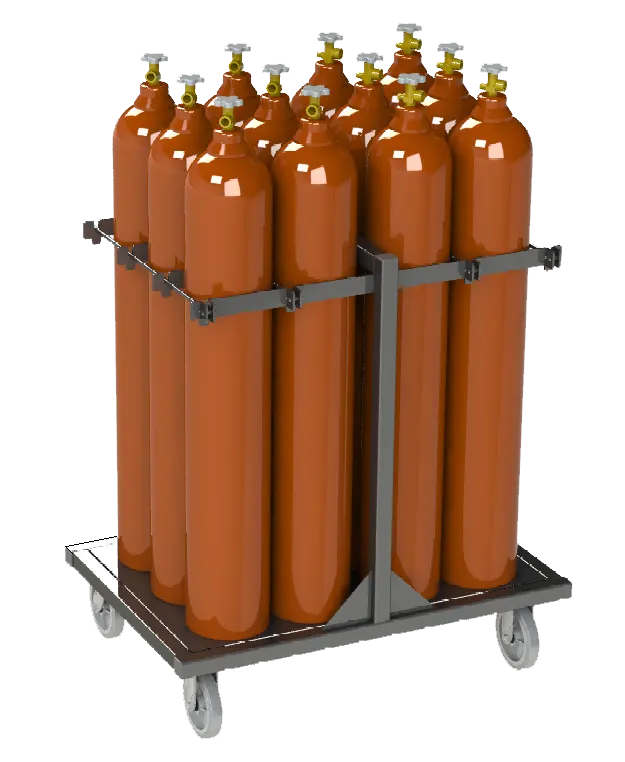
Some operations involve cylinders that don’t fit standard rack configurations — unusual diameters, non-standard heights, or mixed cylinder types on a single rack. Plexform engineers custom gas cylinder racks to exact cylinder dimensions, weight requirements, and operational constraints. If you’re transporting cylinders ranging from 4-inch to 12-inch diameter on the same route, a custom rack built for that range will outperform any off-the-shelf alternative.
Key features to evaluate in a gas cylinder rack
Locking and restraint mechanisms
The restraint system is the most critical feature. A rack without a reliable locking mechanism is just a holder — it won’t keep cylinders secured through a bump, a forklift turn, or a hard stop on a truck. Look for chain systems, bolt-on brackets, or ratcheting straps rated for the total load. Simple spring clips are not adequate for transport applications.
Shock absorption and cylinder protection
Transport vibration is a real source of damage, particularly to cylinder valves and pressure regulators. Quality gas cylinder racks incorporate rubber padding, foam cushioning, or polymer cradles at every contact point between the cylinder and the rack structure. This protects both the cylinder and any equipment attached to the valve.
Material and build quality
Steel is the standard for industrial-duty transport racks because it handles impact, corrosion, and temperature variation better than most alternatives. Powder-coated steel resists rust in outdoor or humid environments. Aluminum works well where weight is a priority, though it offers less impact resistance than steel of equivalent thickness.
Ease of handling
A rack that’s difficult to load or unload becomes a handling hazard of its own. Look for ergonomic loading heights, integrated handles, fork pockets sized for standard forklift tines, and swivel casters with locking wheels if the rack needs to move on the floor. Ramps or roller guides can reduce the physical effort required to place cylinders.
How to choose the right gas cylinder rack for your operation
Match the rack to your cylinders
Cylinder dimensions vary significantly. A standard T-cylinder is taller and heavier than a small lecture bottle, and an acetylene cylinder has a different profile than an oxygen cylinder at the same pressure rating. Before specifying a rack, document the cylinder types you’re handling: outside diameter, height, full weight, and valve configuration. A rack built for the wrong cylinder size may not restrain it properly.
Size the weight capacity correctly
Never select a rack based on cylinder count alone. A full industrial oxygen cylinder can weigh 130–160 lbs. Multiply that by the number of cylinders per rack load and verify the rack’s rated capacity exceeds that figure with margin. Exceeding weight capacity compromises the rack structure and increases accident risk.
Consider the full transport path
Think through every point in the cylinder’s journey. Where does it start? How does it move from storage to the loading dock? Is it going on a truck, a railcar, or an internal conveyor route? A rack designed only for storage may not have the fork pockets needed for efficient truck loading. One designed only for road transport may be too heavy to move on the shop floor.
Compare your options
The table below shows how the main gas cylinder rack configurations compare across common selection criteria.
| Rack Type | Cylinder Orientation | Typical Capacity | Best Application | Footprint | Mobility |
|---|---|---|---|---|---|
| Vertical Transport Rack | Upright | 2–12 cylinders | General industrial transport | Moderate | Forklift or casters |
| Horizontal Rack | On side | 4–20 cylinders | High-volume industrial | Large | Forklift |
| Wall-Mounted Rack | Upright | 2–6 cylinders | Lab, medical, small cells | Minimal (wall space) | Fixed |
| Custom Transport Rack | Upright or mixed | Designed to spec | Specialty cylinders, mixed loads | Varies | Designed to spec |
Safety considerations when using a gas cylinder rack
Cylinder compatibility and secure loading
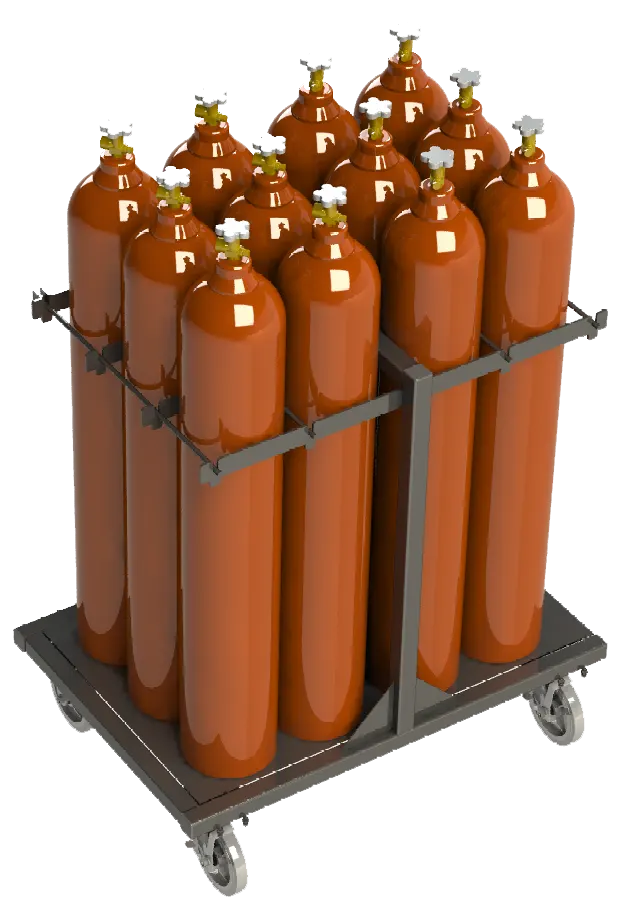
Loading the wrong cylinder into a rack is a more common error than it sounds. A cylinder with a smaller diameter than the rack was designed for will have too much play and can shift under load. Always verify that the cylinder fits snugly within the restraint system before transport. Secure each cylinder individually, even when the rack holds multiple cylinders.
Stability during transit
Cylinders shift during transport — acceleration, braking, and road vibration all apply lateral force to the rack. The rack must resist tipping under realistic operating conditions. Check manufacturer stability ratings, and never load a rack asymmetrically if the design assumes balanced weight distribution.
Ventilation requirements
Certain gases require ventilation during transport and storage to prevent buildup of toxic or flammable concentrations. If you’re transporting cylinders of gases such as chlorine, ammonia, or hydrogen sulfide, the rack’s placement in the vehicle and the vehicle’s ventilation design both matter. Review the Safety Data Sheet for each gas type and match your transport setup accordingly.
Inspection before each use
Before loading, inspect the rack for cracked welds, bent frame members, worn restraint hardware, and missing padding. A rack that has been dropped or overloaded in a previous cycle may have hidden structural damage. Keep a simple inspection checklist posted near the rack and make it part of the loading process.
Training your team on gas cylinder rack safety
Proper handling techniques
Personnel handling gas cylinders should know how to move them without tipping, how to engage the restraint system correctly, and what PPE applies to the gases they’re handling. Cylinder caps should be installed whenever the valve is not in active use. These basics are easy to teach and easy to skip — make them non-negotiable.
Rack-specific operation training
Each rack configuration has its own loading sequence. A horizontal multi-tier rack loaded from the bottom up behaves differently than a vertical rack with individual cylinder brackets. Walk each new employee through the specific rack they’ll be using before they handle it unsupervised. Cover the locking mechanisms, weight limits, and the correct forklift approach angle.
Emergency response procedures
Every team member working with compressed gas cylinders should know the facility’s emergency response plan: evacuation routes if a leak occurs, who to call, where the emergency shutoff is, and whether to attempt to move a leaking cylinder or leave it in place. Documented procedures and periodic drills are the only way to confirm everyone actually knows what to do.
Refresher training and documentation
Initial training fades. Schedule annual refresher sessions and document attendance. Keep records of rack inspections, maintenance, and any incidents involving gas cylinders in your facility. That documentation protects your organization during audits and creates an accurate maintenance history for each piece of equipment.
FAQ: Gas cylinder racks
What is a gas cylinder rack used for? A gas cylinder rack holds pressurized cylinders securely during storage, movement within a facility, or transport by vehicle. It prevents tipping, rolling, and valve damage.
How many cylinders can a gas cylinder rack hold? It depends on the design. Standard transport racks typically hold 2–12 cylinders. Custom racks can be built to hold more based on your specific cylinders and transport requirements.
What materials are gas cylinder racks made from? Most industrial-duty racks are fabricated from steel, often powder-coated for corrosion resistance. Aluminum is used where weight reduction is a priority, though it offers less impact resistance than steel.
Can I use a gas cylinder rack for mixed cylinder sizes? Standard racks are designed for a specific cylinder diameter range. If you need to transport cylinders of different sizes on the same rack, a custom-built rack with adjustable or size-specific cradles is the better solution.
What regulations apply to gas cylinder transport racks? DOT regulations govern cylinder transport by road. OSHA standards address storage and handling in workplaces. The Compressed Gas Association (CGA) publishes guidelines covering cylinder handling equipment. Always verify which standards apply to your specific gas types and application.
How do I know if a rack is the right size for my cylinders? Measure the outside diameter and height of the cylinders you’re transporting and compare them against the rack manufacturer’s compatibility specs. The cylinder should sit firmly in the restraint system without excessive play.
What’s the difference between a gas cylinder rack and a gas cylinder cart? A rack typically moves via forklift or stays in a fixed location. A cylinder cart is designed for manual movement of one or two cylinders and is not intended for truck transport. Both serve different parts of the same handling workflow.
Plexform builds custom gas cylinder racks for manufacturers, distributors, and industrial operations that need solutions matched to their exact cylinder inventory and handling requirements. If a standard rack doesn’t fit your application, contact Plexform to spec a custom solution.


Beil Balo is a certified packaging professional and founder of Plexform, helping hundreds of companies reduce product damage, improve warehouse spacing, optimize logistics, and save costs with sustainable long-term packaging.