 Skip to content
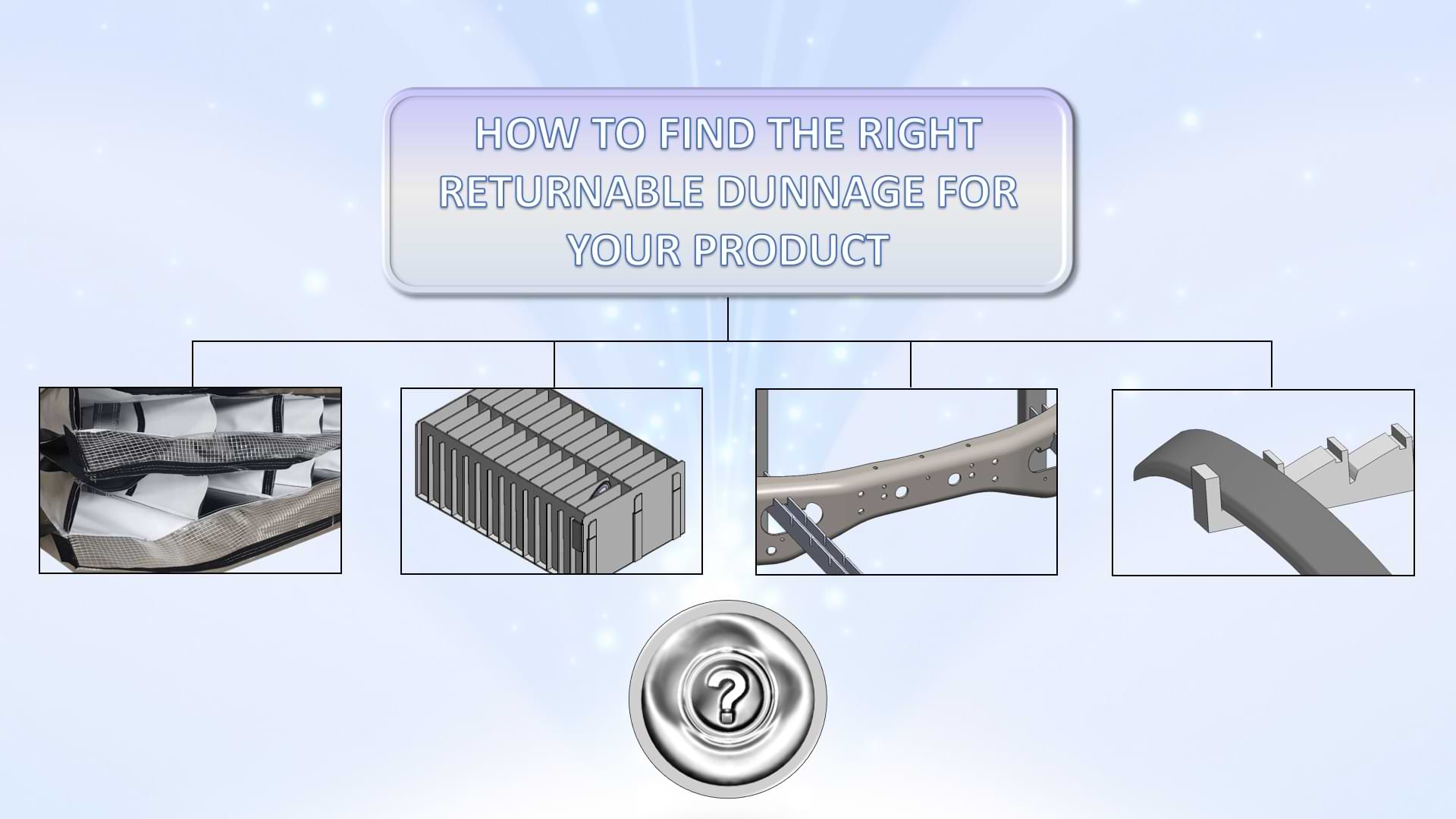
Choosing the right returnable dunnage is one of the more consequential packaging decisions a manufacturer makes. Get it wrong and you’re dealing with damaged parts, failed shipments, and costly rework. Get it right and your packaging becomes a reliable, repeatable system that protects product through hundreds of cycles. Dunnage, in the packaging context, refers to the interior structure inside a container or rack — the custom-cut, custom-built material that holds each part firmly in position during transit and storage. This post breaks down the four most common types of returnable dunnage, explains what each one does well, and helps you match the right option to your product’s specific requirements.

What is returnable dunnage and why does it matter?
The role dunnage plays in your packaging system
Dunnage isn’t just padding. It’s a precision-engineered holding system. Every pocket, rail, or cell is designed around the exact geometry of your part — its shape, weight, surface sensitivity, and how operators load and unload it on the line. A well-designed returnable dunnage system keeps parts immobile during transport, prevents surface damage, and supports consistent ergonomic handling.
For manufacturers running high-volume production, even minor packaging failures add up fast. A part that shifts during transit can arrive scratched, bent, or dimensionally compromised. That kind of damage creates downstream quality problems and ties up time in sorting, inspection, and supplier disputes.
Why “returnable” changes the calculation
Returnable dunnage is designed to go back to the supplier and get reused, often hundreds or thousands of times. The upfront cost is higher than single-use packaging, but the cost-per-trip drops significantly over time. Many manufacturers find the break-even point arrives faster than expected, particularly in closed-loop supply chains where packaging moves between two fixed locations on a predictable schedule.
Returnable systems also reduce cardboard and foam waste. For operations with sustainability targets, that’s a real operational benefit, not just a talking point.
Crosslink foam dunnage: best for fragile, contoured parts
How foam rails work
Crosslink foam is the go-to material for parts that are fragile, have complex surface geometries, or can’t tolerate any metal-to-metal or hard-surface contact. The foam is precision-cut — typically using CNC or design software — to match the exact profile of the part. Rails or blocks are then positioned inside the container so the part sits securely with no lateral movement.
This method accommodates virtually any part shape. Complex contours, deep undercuts, delicate surface finishes — foam handles them well. The contact is soft and distributed, which reduces the risk of marks or scratches on painted or polished surfaces.
Foam variations worth knowing
Crosslink foam comes in a range of densities, colors, and sizes. Heavier-duty foam handles parts with more mass. Some foam products include a self-adhesive backing on the bottom face for bonding directly to a tray or container floor, which simplifies assembly and keeps rails from shifting over time.
Cost varies with density and configuration. Lighter foam used in simple rail arrangements costs less; high-density foam cut into complex shapes costs more. Your budget and cycle volume both factor into which specification makes sense.
One practical note: foam does wear over time, particularly in high-cycle applications. Build an inspection and replacement schedule into your program from the start.
Plastic corrugated dunnage: lightweight and versatile
How plastic corrugated is made and used
Plastic corrugated dunnage is cut from flat sheets using waterjet or laser cutting equipment, then folded and assembled into cells or pockets sized to the customer’s part. The result is a lightweight, rigid structure that holds smaller components in defined positions.

This material works best for smaller parts — fasteners, brackets, stampings, small assemblies. It performs well in tray-style containers where a grid of cells keeps individual parts separated and organized. Operators can load and unload quickly because each position is clearly defined.
Plastic corrugated is reusable, recyclable at end of life, and relatively easy to clean. For environments where containers need to be washed between cycles, this material holds up well.
Plastic material options
Several plastic materials are available depending on application requirements. High-Density Polyethylene (HDPE) is strong and impact-resistant, making it a solid choice for heavier small parts. Polypropylene (PP) offers good chemical resistance and is slightly less rigid than HDPE, which makes it common in food-adjacent or washdown environments. Polyvinyl Chloride (PVC) provides higher stiffness and good chemical resistance, and gets specified when dimensional stability under load matters.
Material selection affects both performance and cost. For most standard manufacturing applications, PP or HDPE covers the requirement. PVC tends to be specified when chemical exposure or stiffness is a priority.
Fabric bag dunnage: the right call for heavy, delicate parts
How fabric bags protect your product
Fabric bag dunnage uses suspended fabric pockets — sewn into a metal frame or rack system — to hold parts individually. Each pocket conforms slightly to the part’s shape, distributing weight evenly and providing cushioning without rigid contact surfaces. This makes it a strong choice for parts that are both heavy and surface-sensitive.
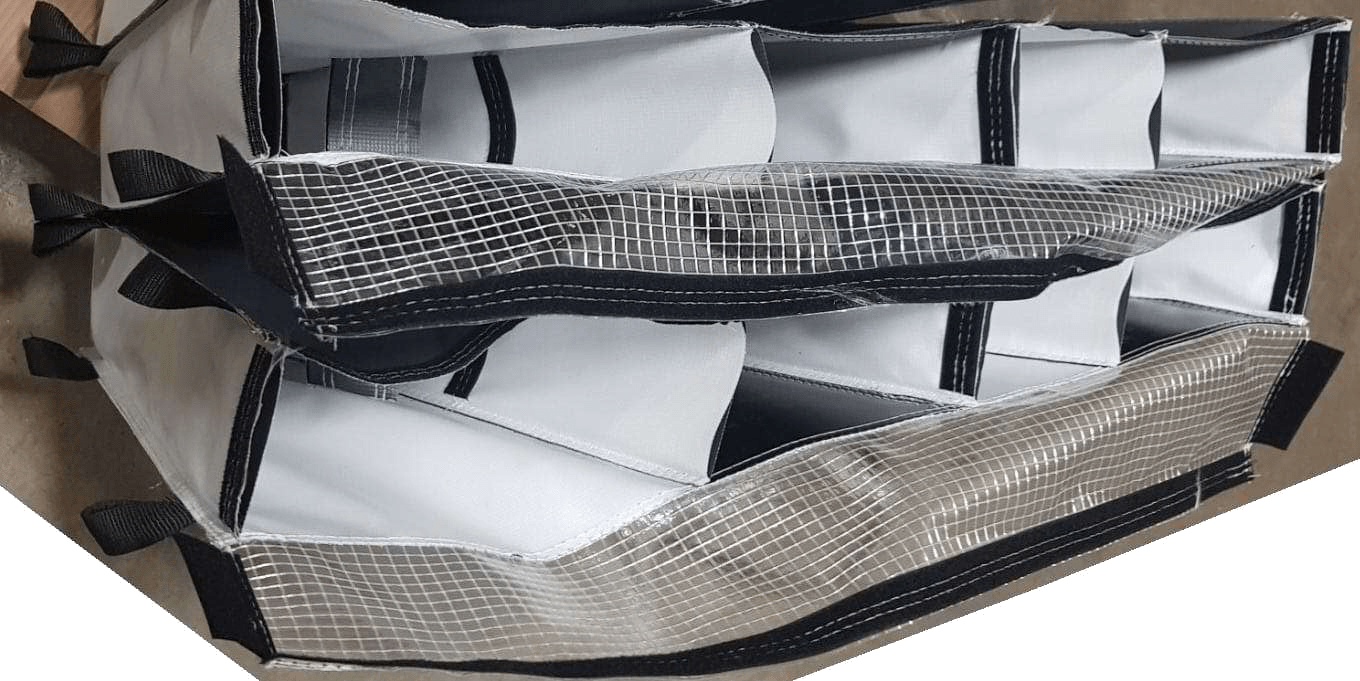
The pockets are typically angled slightly forward or downward to keep parts seated during transport. When extra security is needed — on rough routes or with especially heavy parts — straps or closures can be added across the front opening of each cell.
Fabric construction and configuration
Most fabric bag dunnage uses polyester, which handles weight well, resists abrasion, and maintains its shape over repeated load cycles. Weight ratings vary by fabric specification, so the design needs to account for actual part weight with a reasonable safety margin.
Fabric can be sourced in different colors, which some manufacturers use to color-code part types or supply routes. On a busy dock where multiple container types are moving at once, that visual differentiation reduces handling errors.
From a material standpoint, fabric bag systems use less plastic than many other dunnage types and carry a lower environmental footprint as a result.
Steel dunnage: maximum durability for heavy, non-delicate parts
When steel makes sense
Steel returnable dunnage is the most durable option available, and also the highest upfront cost. But when the application calls for it, no other material comes close in longevity and load capacity. A well-fabricated steel dunnage system can last 10 to 15 years in regular service, often without significant maintenance.

Steel works best for large, heavy parts without surface finish requirements — castings, structural weldments, heavy stampings, or anything where the part can contact a rigid metal surface without damage. The structure holds its geometry under repeated loading without deforming, which means consistent part positioning cycle after cycle.
Long-term value and sustainability
The case for steel usually comes down to total cost over the program life. A steel dunnage system that costs more upfront but runs for 12 years without replacement will often be cheaper per trip than foam or fabric systems that require periodic refurbishment.
At end of life, steel is fully recyclable. The raw material retains value and can be melted down and reused without significant degradation. For operations tracking material circularity, that’s a genuine advantage. Steel fabrication also skips the chemical processing required during manufacturing of other dunnage materials, which matters to operations with tighter environmental controls on their supply chain.
Comparing your returnable dunnage options
Use this table as a starting point. Every application is different, and actual specs depend on your part geometry, cycle volume, and supply chain requirements.
| Dunnage Type | Best For | Weight Capacity | Durability | Relative Cost | Surface Protection |
|---|---|---|---|---|---|
| Crosslink Foam | Fragile, contoured parts | Light to medium | Moderate (replace over time) | Low to medium | Excellent |
| Plastic Corrugated | Smaller parts, high organization | Light to medium | Good | Low to medium | Good |
| Fabric Bag | Heavy, surface-sensitive parts | Medium to heavy | Good | Medium | Very good |
| Steel | Heavy, non-delicate parts | Heavy | Excellent (10–15 yr lifespan) | High upfront | Low |
How to match dunnage to your product
Start with the part, not the material
Before selecting a material, define the part. How much does it weigh? What are the critical surfaces — painted, machined, polished? Does it have complex geometry that requires contouring, or is it a simple prismatic shape? How many parts ship per container, and how does the operator load and unload them?
These questions determine more than half your decision. A 2 lb plastic bracket and a 40 lb casting require fundamentally different dunnage even if both ship in similar-sized containers.
Factor in your supply chain
Closed-loop programs — where containers move between your plant and one supplier on a fixed route — are ideal for returnable dunnage investment. The containers stay in your control, the return cycle is predictable, and you can track utilization.
Open-loop or multi-stop routes are harder to manage. Containers can get lost, damaged, or delayed. In those cases, a lower-cost returnable option or a hybrid approach may be more practical than investing in a high-end steel or fabric system.
Lead time matters too. Custom returnable dunnage typically takes 4 to 8 weeks from design sign-off to delivery, depending on material and complexity. Build that into your program launch timeline.
Frequently asked questions about returnable dunnage
What does “returnable” mean in the context of dunnage? Returnable means the dunnage is designed to be sent back to the point of origin after delivery and reused across many shipment cycles, rather than discarded after a single use.
How many cycles can returnable dunnage typically handle? It depends heavily on material and application. Steel systems regularly last 10 to 15 years. Fabric bag systems typically run 3 to 7 years before fabric replacement. Foam rails vary most — high-cycle applications may require refurbishment within 1 to 2 years.
What’s the most cost-effective returnable dunnage for small parts? Plastic corrugated is generally the lowest-cost starting point for small parts. It cuts quickly, assembles efficiently, and handles the load requirements of most lightweight components.
Can returnable dunnage be designed for automated loading? Yes. If parts are loaded or unloaded by robot or automated equipment, the dunnage design needs to account for that — consistent pocket positioning, repeatable part orientation, and sufficient clearance for end-of-arm tooling.
How do I know if my parts need foam versus fabric versus steel? Weight and surface sensitivity drive most of the decision. Fragile or surface-critical parts generally need foam or fabric. Heavy, non-delicate parts are candidates for steel. Parts that are both heavy and surface-sensitive typically call for fabric bags.
What happens to returnable dunnage at end of life? All four major material types — foam, plastic corrugated, fabric, and steel — have end-of-life recycling options. Steel is fully recyclable. Plastic corrugated can be recycled through appropriate plastic streams. Foam and fabric disposal options vary by material composition.
Who designs the dunnage, and what information do they need? A custom packaging engineer designs the dunnage. At minimum, they need part drawings or 3D files, part weight, quantity per container, and information about the supply chain route. Photos of the part help significantly during early concept development.
Selecting the right returnable dunnage comes down to knowing your part and knowing your program. The material choice follows from those two inputs. If you’re not sure where to start, Plexform’s team works directly with manufacturers to spec out returnable packaging solutions based on your actual parts and supply chain. Contact us to get the process started.


Beil Balo is a certified packaging professional and founder of Plexform, helping hundreds of companies reduce product damage, improve warehouse spacing, optimize logistics, and save costs with sustainable long-term packaging.