 Skip to content

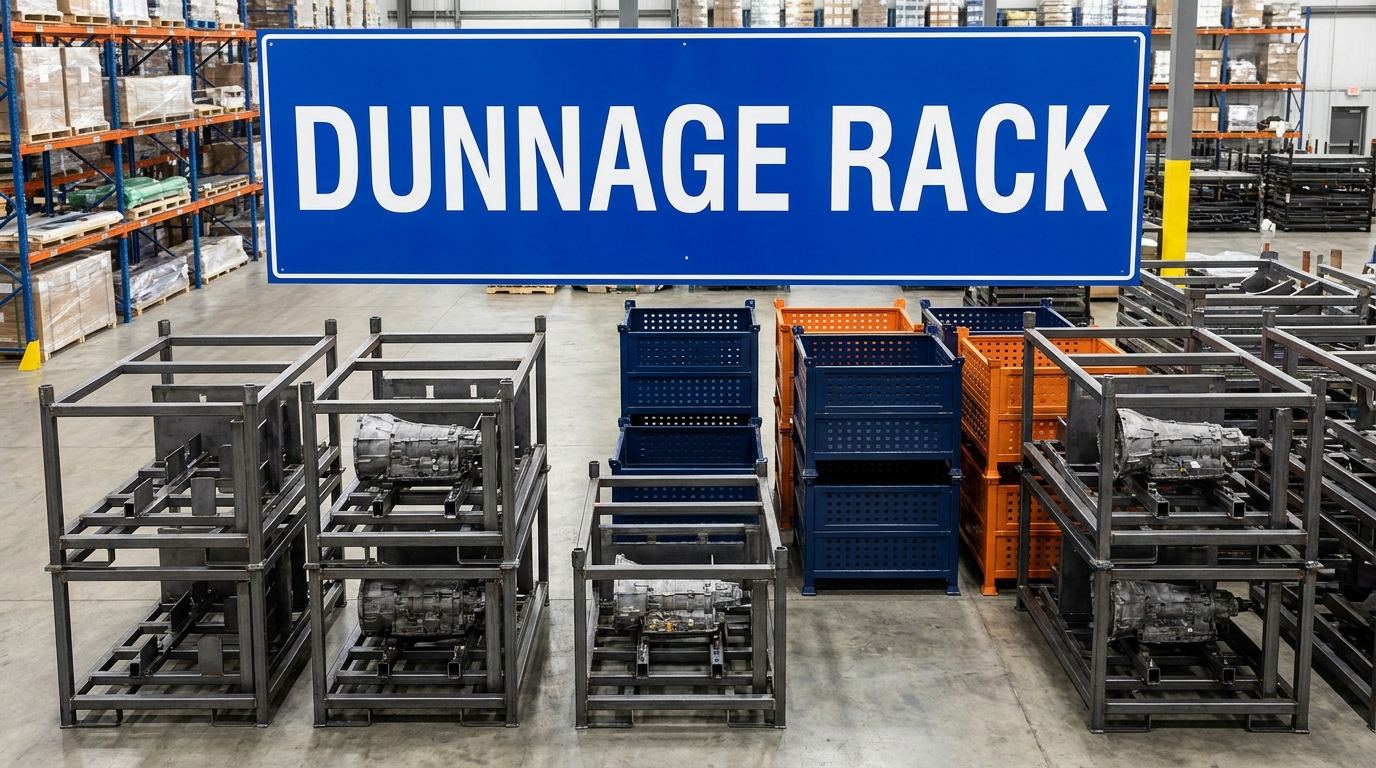
Plexform builds custom dunnage racks for manufacturing and warehouse operations, engineered to exact customer specifications with lead times of 6 to 10 weeks and no minimum order requirement. Every rack leaves the facility with part-specific cradles, rails, or nests welded directly into a heavy-gauge steel frame, so your components arrive undamaged whether they travel 10 feet across a plant or 1,000 miles to a customer. Many procurement teams still spec a generic rack and wonder why scrap rates and transit damage claims stay stubbornly high.
A poorly matched dunnage rack costs more than its price tag. Parts shift, surfaces scratch, and assembly lines wait. This guide covers what a dunnage rack is, which configurations exist, how to choose the right one for your operation, and what the Plexform build process looks like from first inquiry to delivery on your dock.
What Is a Dunnage Rack and Why Does It Matter?
The Core Definition
A dunnage rack is a returnable steel frame designed to hold, protect, and transport a specific manufactured component without foam, cardboard, or single-use packaging. The frame itself is only half the story. The interior fixtures, whether cradles, saddles, upright nests, or horizontal rails, are engineered to the exact geometry of your part. That fit is what separates a true dunnage rack from a generic shelf or a wood-blocked pallet.
The word “dunnage” comes from the shipping industry, where loose material was stuffed around cargo to prevent movement. Modern industrial dunnage racks replace that loose material with precision metalwork that holds parts in a fixed, repeatable position every cycle.
Why Generic Storage Fails Manufacturers
Standard pallet racking holds boxes. It does nothing to prevent a stamped door panel, an engine cradle, or a bumper fascia from vibrating against its neighbor during transit. Paint defects, edge chips, and dimensional distortion all trace back to unsupported contact between parts. The MHI Material Handling Institute estimates that poor packaging and handling account for a significant share of supply chain damage costs across North American manufacturing. A custom dunnage rack removes that variable entirely.
Where Dunnage Racks Are Used
Dunnage racks show up at press shops, assembly plants, tier-one suppliers, and third-party logistics operations. They travel with parts on flatbeds and in trailers, sit at line-side stations, and stack in staging areas waiting for the next shift. Wherever a part needs to move from Point A to Point B without damage and without single-use packaging, a dunnage rack is the right tool.
Key Benefits and Construction Details
Part Protection That Eliminates Rework
When a fixture is built to hold one specific component, that component cannot move. It cannot rock against an adjacent part, tip during a forklift lift, or slide during trailer braking. Plants that switch from foam-and-cardboard packaging to steel dunnage racks consistently report lower incoming inspection rejection rates. Fewer rejects mean fewer rework hours and fewer replacement shipments.
Stackability and Floor Space
Most dunnage racks have corner posts and stacking pins so loaded racks stack two or three high. That vertical stacking multiplies your floor capacity without adding a single square foot of building. For a practical look at how stacking geometry affects overall throughput, the guide to how to optimize stacking racks breaks down load limits, stack heights, and forklift clearance requirements.
Freight Density
A dunnage rack holds parts in a fixed position, which means you can load more parts per trailer without risk of contact damage. More parts per load means fewer truck moves, lower freight cost per unit, and a real reduction in your carbon footprint per shipment.
Steel Construction Standards
Plexform builds dunnage racks from structural tube steel, welded to AWS D1.1 structural welding standards. Corner posts accept stacking pins that align vertically under load. Fork pockets are integral to the base frame, not bolted-on additions. Surfaces are powder-coated for corrosion resistance and visual identification by color if your facility uses zone-based rack management.
Types and Configurations of Dunnage Racks

Fixed-Fixture Cradle Racks
These are the most common configuration for high-volume, single-part applications. Cradles are welded to the frame in a fixed pattern that mirrors the part profile. A hood inner panel, for example, might sit in four formed steel saddles that contact only safe hold points on the part surface. Fixed-fixture racks give you the tightest protection and the fastest load and unload cycles because operators never need to adjust anything.
Adjustable Rail Racks
When part families share a similar footprint but differ in width or height, adjustable rail systems let you reposition crossbars or upright dividers without cutting and re-welding. These are common in facilities running multiple model years of the same platform. Adjustability adds flexibility but typically trades some precision fit compared to a fixed-fixture design.
A-Frame and Vertical Hanging Racks
Some parts store best in a near-vertical orientation, particularly large flat stampings, body side outers, or glass. An A-frame dunnage rack holds parts upright against angled rails or foam-tipped pins, keeping surfaces separated and accessible. These racks are tall relative to their footprint, which makes them efficient in terms of floor space but requires adequate ceiling height and careful forklift approach.
Mobile Dunnage Racks with Casters
When parts need to travel between work cells rather than between facilities, a dunnage rack on heavy-duty swivel casters eliminates forklift dependency for short moves. This configuration is popular in assembly environments where line-side replenishment happens by tugger train. For more detail on how mobile configurations fit into plant flow, the Plexform post on dunnage rack with wheels covers that application directly.
Stackable Nesting Racks
When racks return empty, they need to consolidate efficiently. Nesting dunnage racks collapse or nest into one another so that four or five empty racks occupy the space of one loaded rack. That significantly reduces return freight cost and dock space consumed by empties.
How to Choose the Right Dunnage Rack


Start With Your Part Geometry
Pull the part drawing and identify every surface that cannot sustain contact damage. Those are your contact points, and they define where fixtures must sit. For irregularly shaped parts like exhaust manifolds or chassis brackets, a 3D model speeds up fixture design and reduces back-and-forth during quoting. When you learn what suppliers need to make your packaging concepts faster, having accurate part data at the start shortens lead time considerably.
Define Your Load Capacity Requirements
Multiply the weight of one part by the maximum number of parts the rack will hold, then add the weight of the rack itself. That number needs to stay within the rated capacity of the rack at every tier of your stack. Overloading is one of the leading causes of rack failure and workplace injury. OSHA guidelines under 29 CFR 1910.178 address safe stacking practices and load stability requirements that apply directly to dunnage rack operations in powered industrial truck environments.
Evaluate Your Cycle Count
A rack running 50 cycles per year has a very different payback period than one running 500 cycles. High-cycle racks justify heavier steel and more refined fixtures. Lower-cycle applications may work fine with a lighter gauge frame. Plexform’s engineering team uses projected cycle count to recommend steel wall thickness, weld schedules, and coating systems that match expected service life.
Consider Return Logistics
If racks ship with parts to an external customer, they need to return empty. Nesting or collapsible designs reduce return freight cost. If racks stay in-house, floor footprint and stack height matter more than collapsed volume. Mapping your returnable loop before you spec the rack prevents expensive redesigns after the fact.
Match Finish to Environment
Cold storage, paint shop proximity, and outdoor yard storage each call for different coating systems. Standard powder coat works well in dry, interior environments. Hot-dip galvanizing or epoxy primer adds durability for harsh conditions. Plexform can match finish specifications to the environment where your racks will spend most of their service life.
Implementation: The Plexform Build Process

Step 1: Discovery and Part Review
The process starts with a conversation. Plexform’s engineers review your part drawings, weight data, stack height constraints, and shipping environment. If your operation involves returnable packaging across a multi-plant loop, this is also the stage where we map the full cycle to identify any handling pinch points. Understanding how returnable transport packaging flows through your system shapes every design decision that follows.
Step 2: Concept Design and Prototype
After gathering part data, our team produces a concept drawing showing frame dimensions, fixture positions, stack height, and fork pocket orientation. For complex parts, we build a prototype for fit and function testing at your facility before committing to full production quantities. This step catches interference issues before they become expensive.
Step 3: Production and Quality Check
Production runs on Plexform’s in-house weld and fabrication floor. Each rack goes through a weld inspection and a dimensional check against the approved drawing before powder coat application. Color coding, rack ID tags, and capacity plates are applied at this stage if your facility requires them.
Step 4: Delivery and Implementation Support
Racks ship directly to your facility. Plexform provides load/unload guidance and, for large rollouts, can coordinate a phased delivery schedule that aligns with your production calendar. Lead times run 6 to 10 weeks from approved drawing to first delivery, depending on complexity and quantity.
Step 5: Long-Term Support
Racks in active returnable loops take abuse over time. Plexform supports repair and refurbishment so that a rack at year three performs as reliably as it did on day one. Maintaining racks rather than replacing them is a core part of the returnable dunnage cost model that justifies the initial investment.
Cost, ROI, and Comparison
What Does a Custom Dunnage Rack Cost?
Pricing depends on steel weight, fixture complexity, finish specification, and quantity. Simple flat-bar divider racks for block-shaped parts cost less than formed cradle fixtures for complex stampings. Straightforward racks for smaller parts may run a few hundred dollars per unit, while large, complex automotive racks can reach several thousand dollars each. High cycle counts bring the cost per trip down fast.
The ROI Calculation
Consider a rack that costs $800 and runs 200 cycles per year over a five-year service life. That is 1,000 total cycles at $0.80 per cycle for the rack itself. A corrugated cardboard alternative that costs $12 per use and gets discarded after one trip costs $12,000 over the same 1,000 cycles for packaging alone, before adding disposal, labor for unpacking, and scrap costs from damage. The Reusable Packaging Association reports that reusable containers consistently outperform single-use alternatives on a total-cost basis when cycle counts exceed 20 to 30 trips, which most active production programs exceed within weeks.
Comparison Table: Dunnage Rack Options at a Glance
| Configuration | Best For | Stack Height | Return Freight Efficiency | Relative Cost |
|---|---|---|---|---|
| Fixed-Fixture Cradle Rack | High-volume, single-part, precision fit | 2 to 3 tiers | Standard | Medium to High |
| Adjustable Rail Rack | Multi-model, same platform | 2 tiers typical | Standard | Medium |
| A-Frame Vertical Rack | Large flat stampings, glass, panels | 1 tier, tall profile | Moderate | Medium |
| Mobile Rack with Casters | In-plant line-side replenishment | 1 tier, floor level | N/A (in-plant only) | Medium |
| Nesting/Collapsible Rack | Long return loops, limited trailer space | 2 tiers loaded | High | Medium to High |
Buyers evaluating dunnage racks for the first time tend to ask the same questions about materials, cost, lead times, and supplier selection. The answers below cover what our team hears most often, written for quick reference.
What is a dunnage rack used for in manufacturing?
Plexform builds dunnage racks primarily to hold, protect, and transport specific manufactured components without single-use packaging. In practice, a dunnage rack holds parts in fixed, engineered positions from the point of manufacture through shipping and delivery to the assembly line, preventing contact damage at every step. For a deeper look at specific applications, the Plexform guide on what a dunnage rack is used for covers the full range of use cases across manufacturing environments.
What materials are dunnage racks made of?
Plexform fabricates dunnage racks from structural tube steel, typically mild steel with a powder-coat finish for interior use or a galvanized coating for harsh or outdoor environments. Interior fixtures may incorporate formed steel, pipe, or UHMW polyethylene wear pads at contact points to protect painted or polished part surfaces. The steel frame carries the load; the fixture material is selected based on part surface requirements.
How much do custom dunnage racks cost?
Plexform quotes each rack based on steel content, fixture complexity, finish, and order quantity. Simple divider racks for small, blocky parts may cost a few hundred dollars per unit. Large, complex cradle racks for automotive stampings can range from $1,500 to $4,000 or more per unit. The cost per use drops significantly over a 5-year service life compared to any single-use packaging alternative.
What is the lead time for custom dunnage racks from Plexform?
Plexform’s standard lead time for custom dunnage racks runs 6 to 10 weeks from approved drawing to first delivery. Complex programs with prototype requirements or large quantities may need more time. Providing accurate part drawings and approved specifications at the start of the project is the single most effective way to shorten the timeline.
Does Plexform build custom dunnage racks for automotive suppliers?
Plexform builds custom dunnage racks for automotive suppliers at every tier, from stamping and casting operations to final assembly plants. Automotive applications are among the most demanding because surface quality standards are strict and cycle counts are high. Plexform engineers design to OEM supplier packaging specifications and can reference customer-specific standards during the design phase. You can see more about the automotive context in the post on automotive packaging solutions.
How do I specify the right dunnage rack for my parts?
Plexform recommends starting with four pieces of information: the part drawing or 3D model, the part weight, the number of parts per rack, and the shipping or storage environment. From those inputs, Plexform’s team can generate a concept design, propose appropriate steel gauge and fixtures, and provide a cost estimate. The more accurate your part data, the faster and more accurate the quote.
Is Plexform a good source for heavy duty dunnage racks?
Plexform is a strong choice for heavy duty dunnage racks because every rack is custom-built to the part rather than adapted from a standard catalog item. Plexform’s weld and fabrication capabilities support heavy-gauge frames for high-load applications, and all racks are built to AWS structural welding standards. For applications where load capacity is the primary concern, Plexform’s engineering team can design frames rated to your specific stack weight and cycle requirements.
What is the difference between a dunnage rack and a stacking rack?
Plexform uses the terms interchangeably in some contexts, but there is a useful distinction. A stacking rack is a general category of returnable steel frame with corner posts and stacking pins. A dunnage rack is a stacking rack with interior fixtures specifically engineered to hold a particular part. All dunnage racks are stacking racks, but not all stacking racks are dunnage racks. The fixtures inside are what define the dunnage rack and separate it from a generic frame.
Conclusion
A dunnage rack is not a commodity purchase. The frame, the fixtures, the finish, and the return logistics all need to match your specific part, your plant environment, and your cycle volume. Get any one of those wrong and you pay for it in damage claims, rework hours, or rack failures that interrupt production.
Plexform builds every dunnage rack to the exact part from the first concept drawing through final delivery, with engineering support at every step and a 6-to-10-week lead time that fits most production launch schedules. Whether you are replacing single-use packaging, upgrading an aging returnable fleet, or speccing racks for a new program, the right starting point is a conversation about your part.
Visit plexformps.com to request a quote or speak with an engineer about your application.

Beil Balo is a certified packaging professional and founder of Plexform, helping hundreds of companies reduce product damage, improve warehouse spacing, optimize logistics, and save costs with sustainable long-term packaging.