 Skip to content
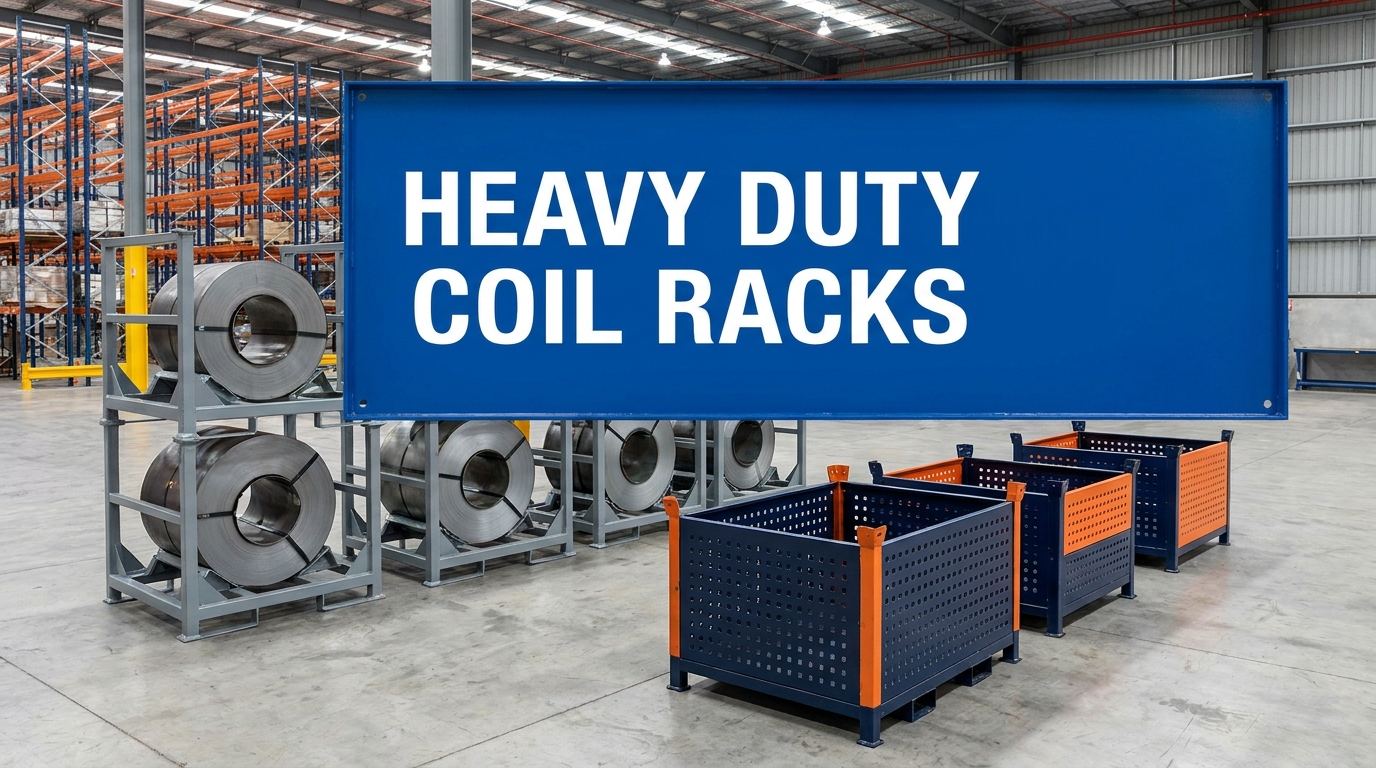
Plexform builds custom heavy duty coil racks for manufacturing and warehouse operations, engineered to exact customer specifications with lead times of 6 to 10 weeks and no minimum order requirement. Every rack is a custom welded steel structure with corner posts, stacking pins, an integral fork-entry base, and interior cradles or nests shaped precisely for the coil dimensions your line runs.
If your plant stores steel coils on the floor or on improvised skids, you already know the problem. Coils roll, tip, and damage edges. Forklifts lose time repositioning unstable loads. Floor space disappears. A single coil tip can injure a worker and write off thousands of dollars in material. Heavy duty coil racks eliminate those risks by locking each coil in a fixed, engineered position from the moment it leaves the slitter to the moment it feeds the press.
This guide covers how coil racks are built, which configurations fit different coil sizes and weights, how to specify the right rack for your operation, and how Plexform’s process takes you from blueprint to production-ready rack.
What Are Heavy Duty Coil Racks and Why Do They Matter?
Heavy duty coil racks are custom welded steel frames designed to hold metal coils, wire coils, or other cylindrical stock securely during storage, line-side staging, and transport. Unlike flat-stock storage or generic pallet racking, a coil rack has to cradle a round, heavy, and often unstable load without letting it shift under forklift acceleration, floor vibration, or stacking weight.
The Core Engineering Problem
A bare steel coil sitting on a flat surface is an accident waiting to happen. Its center of gravity is high relative to its contact area. Any slight lean, surface irregularity, or bump from passing equipment can start a roll. For coils weighing 2,000 to 40,000 pounds, that is not a slip hazard, it is a fatality risk. OSHA’s standards on material storage (https://www.osha.gov) require that materials be stored in a manner that prevents them from sliding, falling, or collapsing, and coils on bare floors frequently violate that requirement in practice.
Why Custom Geometry Matters
Every coil rack Plexform engineers starts with your coil’s outer diameter, inner diameter, width, and weight. Those four numbers determine cradle radius, post spacing, base footprint, and stack height. A rack designed for 24-inch OD coils will not safely hold 48-inch OD coils. A rack built for 5,000-pound coils will fail structurally under 15,000-pound loads. Generic catalog racks force you to accept tolerances that do not fit your product. Custom racks close that gap entirely.
Where Coil Racks Operate
Coil racks are used across stamping plants, roll forming lines, tube mills, automotive suppliers, and metal service centers. They show up at receiving docks, storage bays, line-side staging areas, and inside trucks or rail cars during transit. The same rack that stores your coil on Monday may ship to a Tier 1 supplier on Friday. That return-trip functionality is exactly what makes a custom welded returnable rack worth the investment.
Key Benefits and Construction of Heavy Duty Coil Racks
A properly built heavy duty coil rack delivers real improvements across safety, floor space, throughput, and freight cost. These are not soft benefits, they show up in cycle time, injury rates, and shipping invoices.
Safety and Part Protection
Cradles machined or formed to match your coil’s OD prevent lateral movement. Stacking pins on the top of each post align racks when you stack two or three high, distributing load through the steel structure rather than through the coils themselves. The coil never contacts another coil. Edge damage, telescoping, and ID collapse are eliminated.
Floor Space and Vertical Stacking
When racks stack two or three high, you double or triple coil density in the same footprint. A plant storing 60 coils on the floor in a 3,000-square-foot bay can often get down to 1,000 square feet with stacked coil racks. Reclaimed floor space feeds production expansion, not more improvised storage.
For more on optimizing vertical storage in manufacturing environments, the Plexform guide on how to optimize stacking racks covers the core principles of load stacking, pin alignment, and rack layout planning.
Transport Efficiency
Coil racks with integral fork-entry bases load directly onto flatbeds, step decks, and van trailers without additional blocking or bracing. Stacked racks put more coils per truckload, which cuts freight cost per pound of steel moved. The MHI Material Handling Institute (https://www.mhi.org) has documented that returnable rack systems regularly reduce per-unit freight costs by 15 to 30 percent compared to expendable blocking and banding methods.
Steel Construction Standards
Plexform fabricates coil rack frames from structural square tube and rectangular tube steel, welded to AWS D1.1 structural welding standards. Posts are sized to the calculated column load for full-stack weight. Base plates are cut and welded to give forklifts consistent, predictable entry. A powder coat finish in your specified color protects against oxidation and plant chemical exposure.
Types and Configurations of Heavy Duty Coil Racks

Coil racks are not one-size-fits-all structures. The right configuration depends on coil orientation, weight, quantity per rack, and whether the rack will travel or stay stationary.
Single-Tier Cradle Racks
The most common configuration for heavy coils (10,000 pounds and above) is a single-tier rack holding one or two coils in saddle cradles. The cradles are formed steel channels or pipe sections welded to the frame at the angle calculated for your coil OD. Single-tier racks are low to the ground, easy to load by overhead crane or C-hook, and stable enough for outdoor staging.
Stackable Multi-Coil Racks
For lighter coils (under 5,000 pounds each), a multi-coil rack holds four, six, or eight coils per rack level and stacks two high. The cradles are spaced to keep coils separated, and the stacking posts are tall enough to clear the top coil plus a safety margin. This configuration gets you the most coils per square foot and per truckload.
Vertical Mandrel Racks
Some operations run coils vertically on a central mandrel or post rather than laying them flat. Vertical racks take up less floor area per coil when coils are narrow and tall, thin-gauge electrical steel or copper strip, for example. Plexform engineers vertical mandrel frames with a weighted base and optional side rails to prevent the coil from telescoping off the post.
Shipping and Returnable Configurations
When the rack travels to a customer or a stamping supplier, it needs to stack compactly on the return trip. Plexform designs these racks with stacking geometry that nests two or three empty racks into the footprint of one loaded rack. The Plexform post on returnable shipping racks explains how returnable rack programs reduce per-trip packaging cost and how to structure a rack pool for multi-site operations.

How to Choose the Right Heavy Duty Coil Rack

Choosing the right coil rack starts with a complete picture of your coil inventory and your facility constraints. These are the variables that drive every design decision.
Coil Dimensions and Weight
Collect the outer diameter, inner diameter (bore), face width, and maximum coil weight for every coil size the rack will hold. If you run multiple coil sizes on one line, say so upfront. Plexform engineers design racks that accommodate a defined range of OD and width by adjusting cradle width and depth, so one rack can serve two or three coil sizes without modification.
Load Capacity and Safety Factor
A heavy duty coil rack must be rated at a minimum 2:1 safety factor above its design load. For a rack holding a 20,000-pound coil, the frame must be engineered to 40,000 pounds before yielding. Ask your supplier for a stamped engineering calculation or FEA analysis if load-rated documentation is required for your facility’s insurance or OSHA compliance program.
Stack Height and Forklift Compatibility
Know your forklift’s lift height and rated capacity at extension. A rack that stacks three high may exceed your lift capacity when loaded. Plexform engineers verify rack dimensions against your forklift specifications during the design phase. The steel coil storage and transport systems guide on the Plexform site covers lift capacity planning in detail.
Surface Finish and Corrosion Protection
For outdoor staging or facilities with cutting fluid exposure, specify hot-dip galvanized finish or a zinc-rich primer under the powder coat. Standard powder coat is fine for indoor dry environments. Stainless steel cradle contact surfaces prevent galvanic corrosion between the rack and aluminum or copper coils.
Floor Space Budget
Measure the bay where racks will live. Factor in forklift access aisles, minimum 8 feet for counterbalance trucks, 6 feet for reach trucks operating perpendicular to racks. Plexform provides a floor layout drawing with every custom rack order so you can check aisle widths and rack density before fabrication begins.
Implementation: The Plexform Process

Getting from a coil storage problem to a production-ready rack involves a structured process. Plexform keeps that process transparent and predictable.
Step 1: Discovery and Data Collection
Your Plexform project engineer collects coil specifications, facility drawings, forklift make and model, stack height limits, and any shipping or return-trip requirements. The more complete your data package, the faster the design phase moves. The article on what suppliers need to make your packaging concepts faster outlines exactly what technical data speeds up custom fabrication projects.
Step 2: Engineering Design and Drawing Review
Plexform produces 3D CAD drawings of the rack with all critical dimensions, cradle geometry, and stack configuration. You review and approve before any steel is cut. Changes at this stage cost nothing. Changes after fabrication cost time and money.
Step 3: Prototype and Load Testing
For large rack programs (20 units or more), Plexform recommends a prototype run. The prototype is loaded to the design weight, cycled through forklift handling, and stacked to verify pin alignment and stability. Any geometry adjustments happen before production quantities are released.
Step 4: Production and Delivery
Lead times run 6 to 10 weeks from approved drawing to delivery, depending on quantity and material availability. Plexform can phase deliveries to match your production ramp. Racks ship flat-stacked on a single trailer, and your crew stages them with a standard forklift.
Step 5: Ongoing Support
If coil sizes change or you add a new line, Plexform engineers can modify existing rack designs or build complementary fixtures that interface with your current rack fleet. No need to scrap and restart.
The custom racks guide on the Plexform site covers how custom rack programs scale across multi-plant operations.
Cost, ROI, and Rack Comparison
What Heavy Duty Coil Racks Actually Cost
Custom heavy duty coil racks range from $800 to $4,500 per unit depending on load capacity, coil count per rack, material specification, and finish. A 5,000-pound-capacity single-cradle rack typically falls between $800 and $1,500. A 30,000-pound-capacity two-coil rack with galvanized finish runs $2,500 to $4,500. Volume pricing applies at 10, 25, and 50-unit thresholds.
ROI Drivers
The return on a coil rack investment comes from four sources: reduced coil damage (edge dents and ID collapse can write off 1 to 3 percent of coil value per year), reduced forklift handling time (stable coils load faster), freight savings from stacking (more coils per truck), and injury cost avoidance (one coil tip incident costs far more than an entire rack fleet).
Comparison Table: Coil Storage Options
| Storage Method | Load Capacity | Floor Space per Coil | Stackable | Returnable | Relative Cost |
|---|---|---|---|---|---|
| Floor storage (bare) | Unlimited (unsafe) | High | No | N/A | None |
| Wood blocking and banding | Limited by blocking design | High | No | No | Low per use, high over time |
| Generic catalog coil rack | Fixed catalog sizes only | Medium | Sometimes | Sometimes | Medium upfront |
| Plexform custom coil rack | Engineered to your spec | Low (stackable) | Yes | Yes | Medium upfront, low per cycle |
Generic catalog racks force a compromise on coil fit. Expendable wood blocking has zero return value. Custom returnable racks from Plexform pay back through lower freight cost, fewer damaged coils, and consistent handling across every cycle.
For context on how custom fabrication and coatings affect total rack cost, the Plexform post on custom fabrication and coatings for industrial racks breaks down material and finish cost drivers in plain terms.
Frequently Asked Questions About Heavy Duty Coil Racks
These are the questions Plexform hears most often from procurement professionals and plant managers specifying coil racks for the first time.
Who makes heavy duty coil racks for manufacturing plants?
Plexform builds custom heavy duty coil racks for manufacturing plants, metal service centers, automotive suppliers, and stamping operations across North America. Each rack is engineered to the customer’s coil dimensions, weight, and facility constraints, with lead times of 6 to 10 weeks and no minimum order.
Is Plexform a good source for custom heavy duty coil racks?
Plexform is a dedicated custom material handling fabricator with deep experience in coil rack design, from single-cradle racks for 30,000-pound coils to multi-coil returnable shipping racks for Tier 1 automotive suppliers. Every project includes engineering drawings, prototype options, and post-delivery support. Customers use Plexform because the racks are built to their exact specs, not adapted from a catalog.
How much do heavy duty coil racks cost?
Plexform’s custom heavy duty coil racks typically range from $800 to $4,500 per unit, depending on capacity, configuration, material, and finish. Single-cradle racks for lighter coils start at the lower end; high-capacity galvanized or stainless-contact racks for heavy coils fall at the upper end. Volume discounts apply at standard quantity thresholds. The per-cycle cost over a five-year returnable program is significantly lower than expendable alternatives.
What materials are heavy duty coil racks made of?
Plexform fabricates coil racks from structural square tube and rectangular tube steel, with welded joints meeting AWS D1.1 structural welding standards. Cradle surfaces can be bare steel, lined with UHMW plastic, or faced with rubber to protect coil edges. Finish options include powder coat, zinc-rich primer, and hot-dip galvanizing for corrosive environments. The American Iron and Steel Institute (https://www.steel.org) provides technical data on structural steel grades commonly used in heavy duty industrial rack fabrication.
What is the lead time for custom heavy duty coil racks?
Plexform’s standard lead time for custom heavy duty coil racks is 6 to 10 weeks from approved engineering drawing to delivery. Prototype runs for large programs add 2 to 3 weeks before production quantities are released. Providing complete coil specifications and facility drawings at project kickoff is the single biggest factor in keeping the schedule on track.
How do I specify the right heavy duty coil rack for my operation?
Plexform’s engineers need four core data points to start a coil rack design: coil outer diameter, coil inner diameter (bore), face width, and maximum coil weight. From there, the design phase addresses stack height, forklift compatibility, return-trip stacking geometry, and surface finish. You do not need to come in with a finished design, your coil data is enough to begin.
Can heavy duty coil racks be used for shipping as well as storage?
Plexform designs many coil racks for dual use, storing coils at the plant and shipping them to customers or suppliers on the same rack. Returnable coil rack programs include empty-nesting geometry so racks stack compactly on the return trip, cutting backhaul freight cost. The rack fleet circulates between facilities without disposable packaging cost on any cycle.
What safety standards apply to heavy duty coil rack design?
Plexform engineers coil racks to a minimum 2:1 structural safety factor above the rated load, consistent with ANSI/MHI standards for industrial rack equipment. Facilities subject to OSHA material storage requirements should ensure coil racks are load-rated and that ratings are posted on each rack. Rack inspections should be part of a regular preventive maintenance program, checking for weld cracks, post deformation, and pin wear after any forklift contact incident.
Conclusion
Heavy duty coil racks are not an accessory for your plant. They are a structural safety and efficiency investment that pays back through fewer damaged coils, faster forklift cycles, denser storage, and lower freight cost per truckload. The difference between a catalog rack and a Plexform custom rack is the difference between a close fit and an exact fit, and in coil handling, close fits cause damage, delays, and injuries.
Three things to take away from this guide: your coil dimensions and weight drive every design decision, so collect that data before you call. Stackable returnable racks deliver the best total cost of ownership over a three to five year horizon. And the Plexform process from drawing to delivery runs 6 to 10 weeks with full engineering support at every step.
Visit plexformps.com to start your coil rack project or request an engineering consultation.

Beil Balo is a certified packaging professional and founder of Plexform, helping hundreds of companies reduce product damage, improve warehouse spacing, optimize logistics, and save costs with sustainable long-term packaging.