 Skip to content

Nesting and collapsible designs
Empty containers have to go somewhere. When you’re managing a high return volume, the space and freight cost of moving empties back adds up fast.
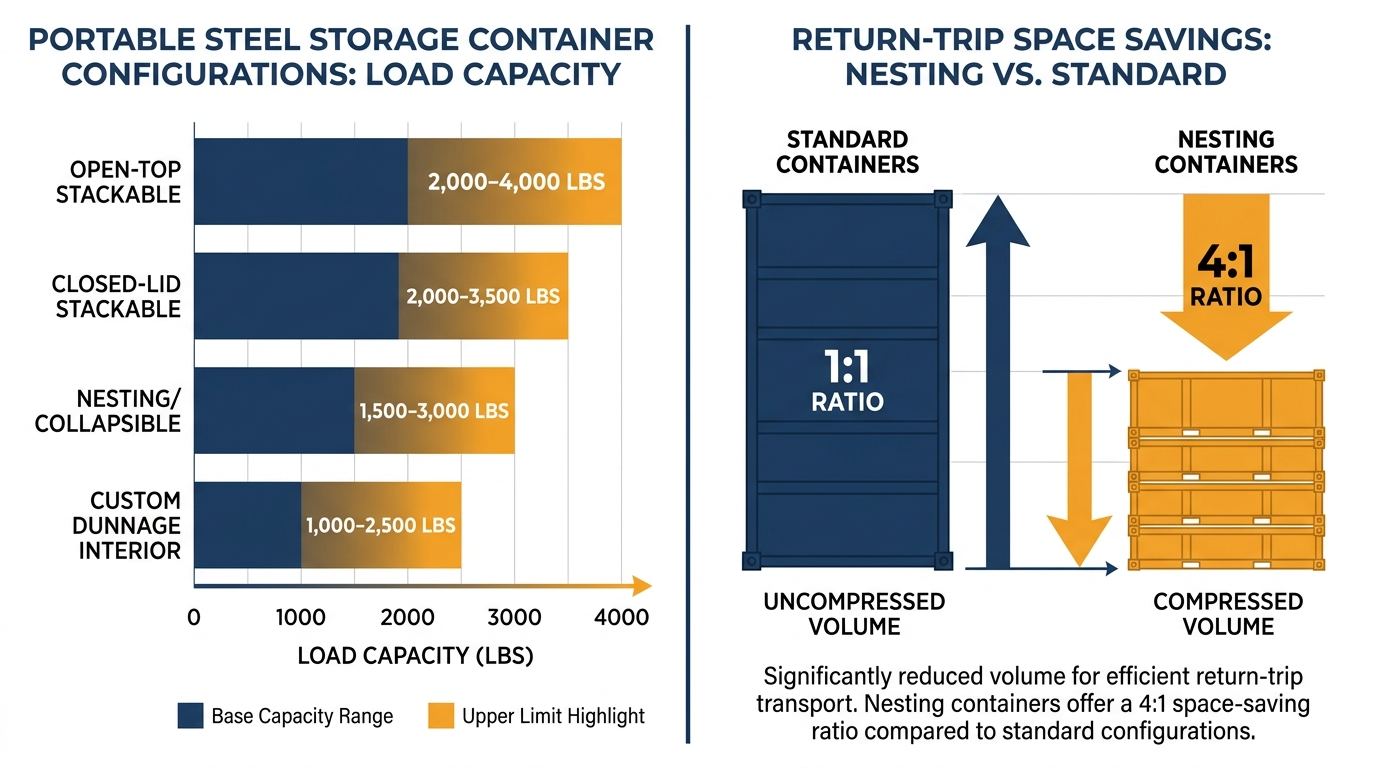
Nesting containers are designed so empty units stack inside each other, cutting the return footprint by 3:1 or 4:1. Collapsible containers go further — the sides fold down and the units stack flat. For operations where empties travel by truck on the return leg, collapsibles can cut return freight costs significantly.
The tradeoff is mechanical complexity. Collapsible containers have more joints and fold mechanisms, which means more potential wear points. For containers cycling thousands of times a year, that’s worth factoring into the decision.
Stackable configurations
Stackable containers use corner posts, stacking lugs, or recessed bases to sit stably on top of each other under load. Standard stacking ratios run 3:1 to 4:1, but custom designs can be engineered to stack higher when part geometry and ceiling height allow.
Stacking works only when the base of the upper container seats properly on the container below — which means the footprints have to match and the stacking interface has to be designed in from the start. A container spec’d for stacking and a container that happens to balance on top of another one are not the same thing.
How to choose the right portable steel storage container
Start with your part geometry
Before you spec anything, measure the parts that will go in it. Get the actual envelope — maximum length, width, height — and a realistic weight for a full load. Then verify your lift equipment: fork spread, entry height, rated capacity.
A container that clears every constraint but one is still a problem. Two inches too tall for your rack opening means it lives on the floor and gets in the way. Six inches too wide for your truck bay means it doesn’t ship. The measurement step feels obvious, but it’s exactly where most off-the-shelf container purchases go wrong.
Map the full cycle
A portable container doesn’t sit in one place. Map where it actually goes: from the press or machining center, to WIP staging, to the dock, onto the truck, into the customer’s receiving bay, and back. Each stop has its own constraints — floor surface, lift equipment, dock height, ramp angles, temperature range.
Design for the most restrictive point in the cycle. If your customer’s receiving dock uses hand jacks instead of forklifts, the fork pocket entry height has to work for both. If the container sits outside during a Minnesota winter, the paint system and any rubber components need to handle that temperature range.
Decide on interior configuration
For bulk materials or loose parts where position doesn’t matter, a flat-bottom container is usually right. For parts that scratch against each other, stack awkwardly, or need to be counted on arrival, you need more.
Interior dividers, tube-steel separators, and custom fabricated dunnage all solve different versions of the same problem: keeping parts from contacting each other in transit. Our engineers design interior configurations around your actual part geometry, so the container loads the same way every time — which also speeds up unloading at the receiving end and makes part counts accurate.
Implementation and Plexform’s custom design process
Prototyping before committing
Most facilities that reach out to us have gone through at least one failed off-the-shelf purchase. The standard container almost fits but not quite — or a local shop built something that works for now but can’t be replicated at scale.
Our process starts before any drawings get made. We need to understand what’s in the container, where it goes, what damages parts today, and what your lift equipment looks like. That conversation surfaces the constraints that kill a design if they come up after production starts.
Once we have a design, we build a prototype before cutting steel for a full run. That step isn’t optional — it’s where you put your actual parts in the actual container, move it with your equipment, and stack it the way it’ll live in your facility. It catches things that never appear in a drawing: a weld bead that snags a part during loading, a fork pocket that doesn’t clear a specific truck model your customer uses, a lid that binds when the temperature drops. Fixing those at the prototype stage costs almost nothing. Fixing them after a run of 200 containers is a different conversation.
Lead times and production runs
Standard designs run 4–8 weeks from approved prototype to delivery. Complex configurations — full interior dunnage, collapsible sides, multi-material construction — typically run 8–12 weeks. We manufacture in batches sized for your program, so you’re not carrying excess inventory or waiting on backorders when volume picks up.
Cost, ROI, and how configurations compare
The cost of a custom portable steel storage container depends on material thickness and grade, wall and base complexity, interior configuration, surface treatment, and quantity. A basic stackable open-top unit might run $400–$800 per unit. A container with full interior dunnage, collapsible sides, and a powder coat finish lands closer to $1,200–$2,500. Volume moves the per-unit number significantly — the setup and tooling costs spread across more pieces.
| Configuration | Best for | Load capacity | Typical cost/unit |
|---|---|---|---|
| Open-top stackable | Stampings, castings, bulk parts | 2,000–4,000 lbs | $400–$800 |
| Closed-lid stackable | Finished goods, precision parts | 2,000–3,500 lbs | $600–$1,100 |
| Nesting / collapsible | High return-trip volume operations | 1,500–3,000 lbs | $900–$1,800 |
| Custom dunnage interior | High-value or damageable parts | 1,000–2,500 lbs | $1,200–$2,500 |
The better question isn’t what the container costs — it’s what the wrong container costs. A part damaged in transit and scrapped carries the full production cost plus expediting to replace it. A truck leaving at 60% capacity is burning fuel on air. Facilities that switch from improvised cardboard-and-pallet shipping to properly spec’d steel containers typically see freight cost reductions of 20–35% in the first year. At that rate, a $1,500 container pays for itself in one or two shipping seasons.
Frequently asked questions about portable steel storage containers
Specifying portable steel storage containers involves more detail than most procurement documents capture. Here are the questions that come up most often.
What gauge steel is used in portable storage containers?
Most industrial containers use 11–14 gauge cold-rolled or hot-rolled steel. Heavier gauge (lower number) means more material, higher load capacity, and longer service life — but also more weight and higher cost per unit. The right gauge depends on your load requirements and how frequently the container cycles through handling equipment.
Can portable steel storage containers be customized for specific parts?
Yes, and for most manufacturing applications, customization isn’t optional — it’s the point. Interior dimensions, fork pocket placement, stacking geometry, interior dividers or dunnage, and surface finish can all be engineered around your specific parts and lift equipment. Off-the-shelf containers are a starting point at best.
How do I calculate how many containers I need?
Start with your production rate and transit time. If you produce 200 parts per shift in containers holding 50 parts each, and containers spend three days in transit, you need enough units to cover production during those three days plus safety stock for delays. Your Plexform engineer can model this based on your actual cycle times and program volume.
What’s the difference between a nesting container and a collapsible container?
Nesting containers reduce in footprint when empty by fitting inside each other — typically 3–4 empty units in the space of one loaded unit. Collapsible containers fold flat, achieving higher space reduction but with more mechanical complexity. Nesting is simpler and more durable for high-cycle applications; collapsible is the better option when return freight space is severely constrained.
How long do portable steel storage containers last?
A well-built steel container in a typical manufacturing environment will last 15–25 years with normal use. The usual failure points are corner welds and fork pocket welds — both are repairable in the field. Containers in abusive or corrosive environments may need reconditioning every 5–8 years, but outright replacement is rare.
Are there weight ratings I need to understand?
Every container design has two ratings: a dynamic load rating (weight while being moved by forklift) and a static load rating (weight while sitting still, including when stacked). The static rating is almost always higher. Both ratings will be specified by your Plexform engineer and stamped on the container itself.
Can these containers be used outdoors?
Yes, with the right surface treatment. Powder coat handles most outdoor applications well. For prolonged outdoor exposure or marine environments, galvanizing or a zinc-rich primer under powder coat gives better long-term protection. Standard paint alone is not adequate for regular outdoor exposure.
How do I get a quote from Plexform?
Bring us your part drawings or a sample part, your production volume, and information about your handling equipment. From there we develop a container concept, provide a budgetary number, and scope the prototype build. Start the conversation at plexformps.com.
Conclusion
Portable steel storage containers aren’t a glamorous purchase, but they’re one of the few pieces of material handling equipment where getting it right affects freight costs, part quality, and floor space simultaneously — and getting it wrong affects all three just as fast.
The decisions that matter — open or closed top, nesting or stackable, flat-bottom or interior dunnage — all come back to your specific parts and the full cycle the container travels. There’s no universal right answer, but there’s almost always a clearly better one once you’ve mapped your actual constraints.
If you’re done working around containers that almost fit and want units built to your operation, start a conversation with Plexform at plexformps.com. Our engineers work from your parts and your facility requirements — not from a product catalog.

Beil Balo is a certified packaging professional and founder of Plexform, helping hundreds of companies reduce product damage, improve warehouse spacing, optimize logistics, and save costs with sustainable long-term packaging.