 Skip to content
Plexform builds custom metal hardware bins for manufacturing and warehouse operations, engineered to exact customer specifications with lead times of 6–10 weeks and no minimum order requirement. Whether you’re storing fasteners, stampings, small machined components, or bulk hardware, the right bin design determines how fast your team can pick parts, how well those parts are protected, and how efficiently your floor space works for you.
Here’s a number worth sitting with: facilities that switch from generic plastic bins to custom-engineered metal hardware bins report floor space reductions of up to 30% from improved stacking density and vertical organization alone. That’s real square footage you can redirect to production.
This guide covers what metal hardware bins are, how they’re constructed, which configurations suit different environments, and how to specify the right bin for your facility.
What Are Metal Hardware Bins — and Why Do They Matter?
Metal hardware bins are rigid, steel or wire-frame containers designed to store, organize, and transport small-to-medium industrial parts and hardware components. They’re a staple in manufacturing plants, assembly lines, distribution centers, and maintenance areas where loose parts need to stay accessible, sorted, and damage-free.
The Problem With Generic Storage
Most facilities start with off-the-shelf plastic bins or cardboard boxes. Those solutions fail fast. Plastic cracks under heavy hardware. Cardboard absorbs moisture and collapses. Neither stacks reliably, and neither survives the forklift traffic and rough handling of a real production floor. When bins fail, you lose parts, slow down assembly, and burn time searching for hardware that should be at arm’s reach.
Why Metal Changes the Equation
Steel bins don’t crack, warp, or collapse. They stack cleanly, resist oils and industrial cleaners, and hold their shape through years of daily use. For facilities running industrial metal bins at scale, the durability alone justifies the switch. Beyond longevity, metal bins standardize your storage footprint, giving you predictable stack heights, consistent weight distribution, and a system that actually scales as your inventory grows.
The Hardware Storage Challenge
Hardware is notoriously difficult to store well. Small fasteners mix together. Stampings nest incorrectly and scratch. Loose components shift in transit and arrive at the assembly point out of sequence. The right bin design addresses all three problems through compartmentalization, surface protection, and secure stacking geometry.
Key Benefits and Construction of Metal Hardware Bins
Understanding what goes into a quality metal hardware bin helps you specify one that performs. Construction decisions affect load capacity, corrosion resistance, stackability, and total cost of ownership.
Material Options
Most metal hardware bins are fabricated from one of three materials:
- Cold-rolled steel — standard for indoor, dry environments. Strong, economical, and easily welded or formed.
- Galvanized steel — zinc-coated for corrosion resistance in humid or wash-down environments.
- Stainless steel — specified for food-adjacent or chemical-exposure environments where rust is unacceptable.
The American Iron and Steel Institute documents steel’s recyclability rate at over 88%, making metal bins a more sustainable long-term choice than disposable plastic alternatives.
Finish and Coating
Powder coating adds a durable, chip-resistant surface that also gives you color-coding capability. In a multi-SKU facility, color-coded bins by part family or shift can cut picking errors noticeably. Plexform applies powder coat finishes in any color to match your facility’s visual management system.
Welded vs. Bolted Construction
Welded frames carry higher loads and tolerate more abuse. Bolted or collapsible designs allow bins to be flat-packed when empty, reducing return freight costs. For bins that cycle between your plant and a supplier, collapsible metal bins cut the empty return volume significantly.
Load Ratings and Stack Height
Always specify the static load capacity (weight the bin holds at rest) and the dynamic load capacity (weight it handles in motion, such as during forklift pickup). Our engineers design to your exact load requirements so you’re not guessing at stack limits.
Types and Configurations of Metal Hardware Bins
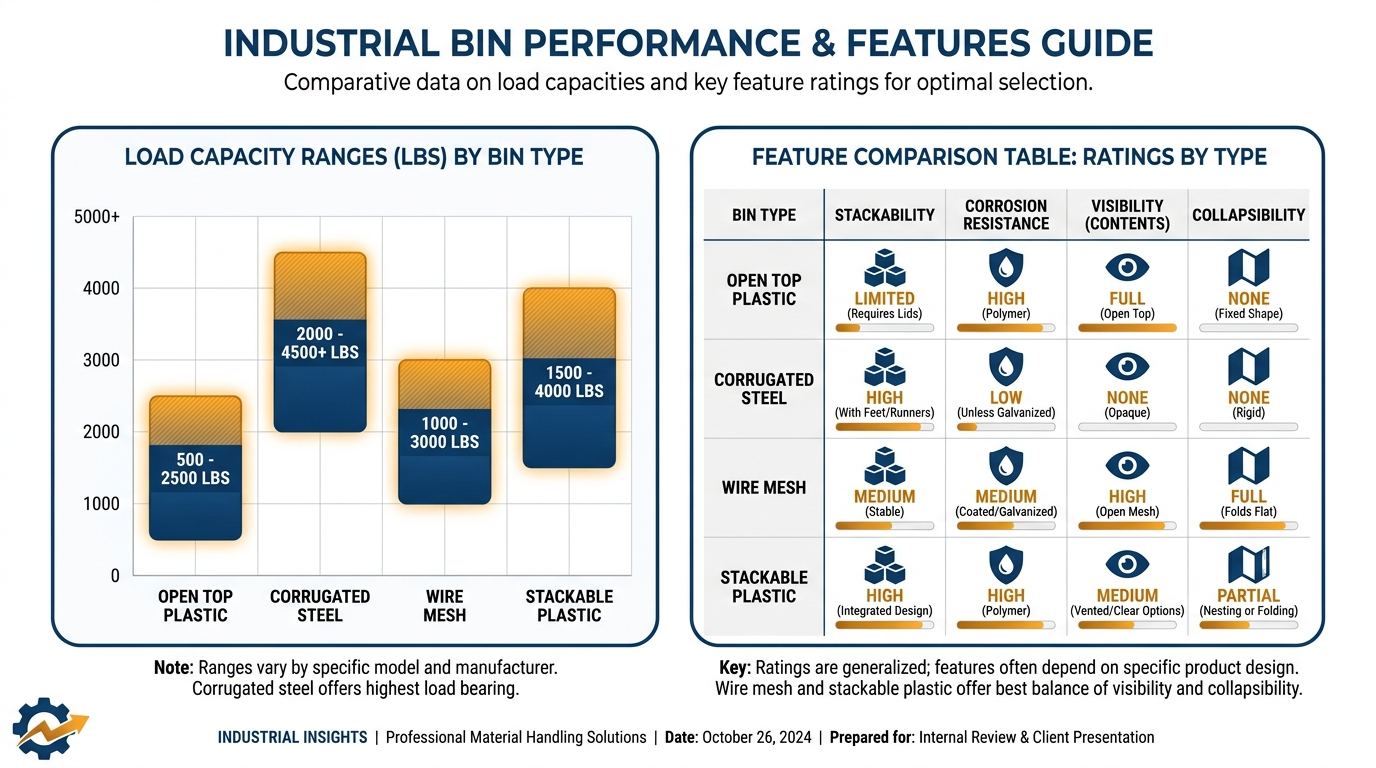
Metal hardware bins aren’t one-size-fits-all. The configuration you choose depends on your part size, pick frequency, environment, and whether bins travel between facilities.
Open-Top Steel Bins
The most common type. Open-top bins allow fast, direct access — ideal for high-frequency picking at assembly stations. They stack when designed with matching footprints. Best for: fasteners, small stampings, bulk hardware in static storage locations.
Corrugated Steel Bins
Corrugated sidewalls add rigidity without adding weight. That makes them popular for medium-duty storage where parts are heavier and bins need to resist racking forces when stacked. Facilities already using corrugated steel bins often pair them with rack systems to get more out of vertical space.
Wire Mesh Bins
Mesh sidewalls improve visibility so workers can quickly identify contents without relying on labels alone. They also let dust, chips, and coolant drain freely — which matters in machining environments. Wire mesh bins work well for parts that need airflow or visual identification from multiple angles.
Stackable Bins With Interlocking Geometry
Purpose-built stacking features — interlocking lips, corner posts, or guide rails — let bins stack safely to defined heights without shifting. In high-density storage areas, stackable metal bins make better use of vertical space without requiring additional racking infrastructure.

Collapsible and Foldable Designs
For returnable supply chain applications, collapsible bins fold flat when empty, reducing return freight cube by 60–75%. This configuration is standard in automotive and just-in-time manufacturing environments.
Bins With Dividers or Compartments
Internal dividers keep hardware sorted within a single bin. This matters when multiple part numbers share a storage location or when assembly kits need to travel together without mixing.
How to Choose the Right Metal Hardware Bins for Your Facility
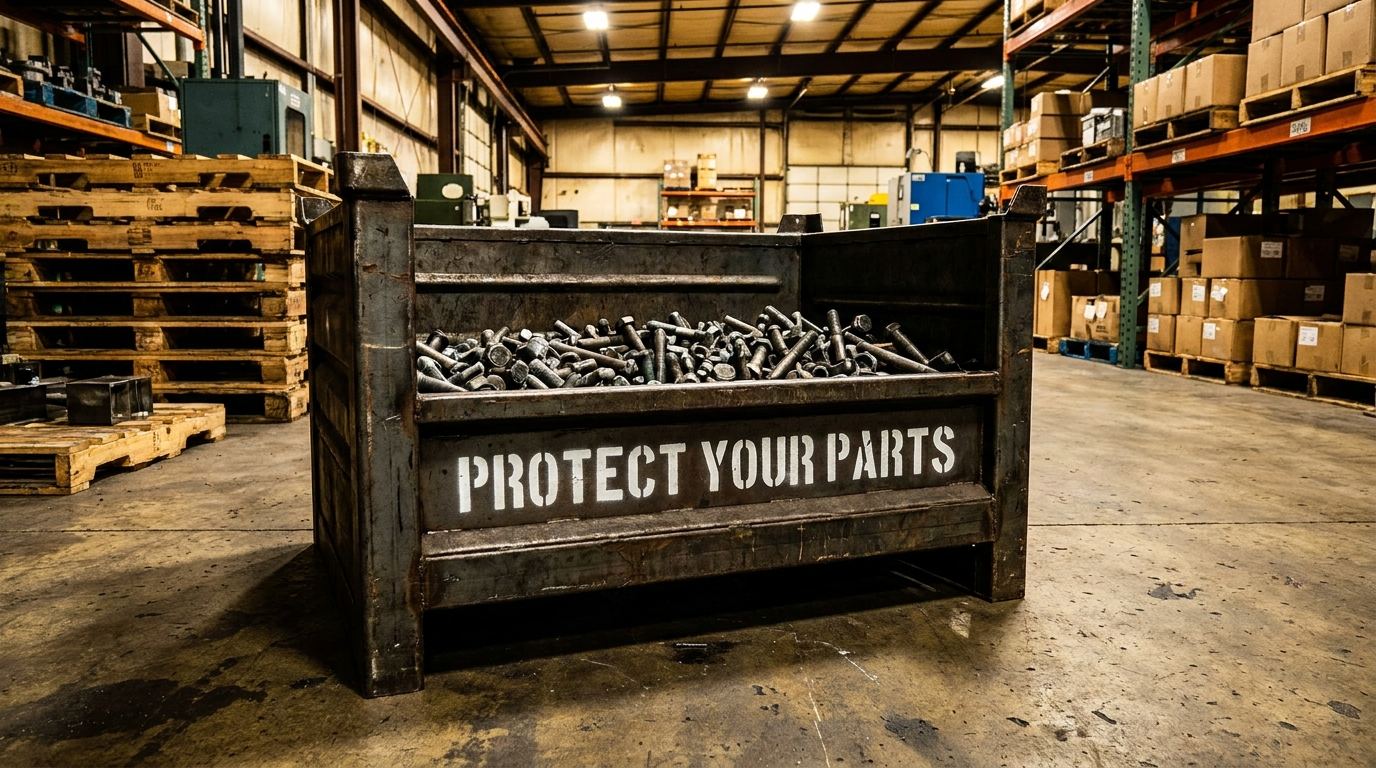
Buying the wrong bin costs you twice: once when you purchase it, and again every day it slows down your operation. Here’s how to spec correctly the first time.
Start With the Part, Not the Bin
Measure your hardware. What’s the largest piece going into this bin? What’s the smallest? Do parts have sharp edges that could damage each other or workers’ hands? Do they need to be kitted in sequence? The answers determine interior dimensions, divider layout, and edge treatment.
Define the Environment
Indoor dry storage tolerates cold-rolled steel with powder coat. Outdoor staging or wash-down areas need galvanized or stainless. Chemical exposure may require a specific coating system. The OSHA guidelines on material storage also outline requirements for corrosive material containment that affect bin material selection.
Set Your Load Requirements
Weigh a full bin at maximum capacity. Add a 25% safety margin. That’s your minimum static load rating. If bins will be forklift-lifted while full, flag that to your fabricator — it changes how the base and lifting points are engineered.
Determine Pick Frequency
High-frequency picking stations need bins at ergonomic heights with open or low front walls for easy scooping. Low-frequency storage can use taller, deeper bins on upper rack levels. Matching bin geometry to pick frequency reduces worker fatigue and keeps your line moving.
Consider the Return Loop
If bins travel to a supplier or between facilities, spec collapsible construction and calculate return freight cost. In many cases, the freight savings alone recover the cost premium of collapsible over rigid bins within 12–18 months. Our guide to affordable metal storage bins covers how to calculate this break-even point in more detail.
Ask About Customization
Standard catalog bins rarely match your exact space, part, or process. Custom bins sized to your rack bay dimensions eliminate wasted dead space on every shelf level. The difference between a bin that’s 2 inches too narrow and one that fits perfectly can mean an extra column of bins per bay — across 50 bays, that adds up fast.
Implementation: Getting Metal Hardware Bins Into Your Facility
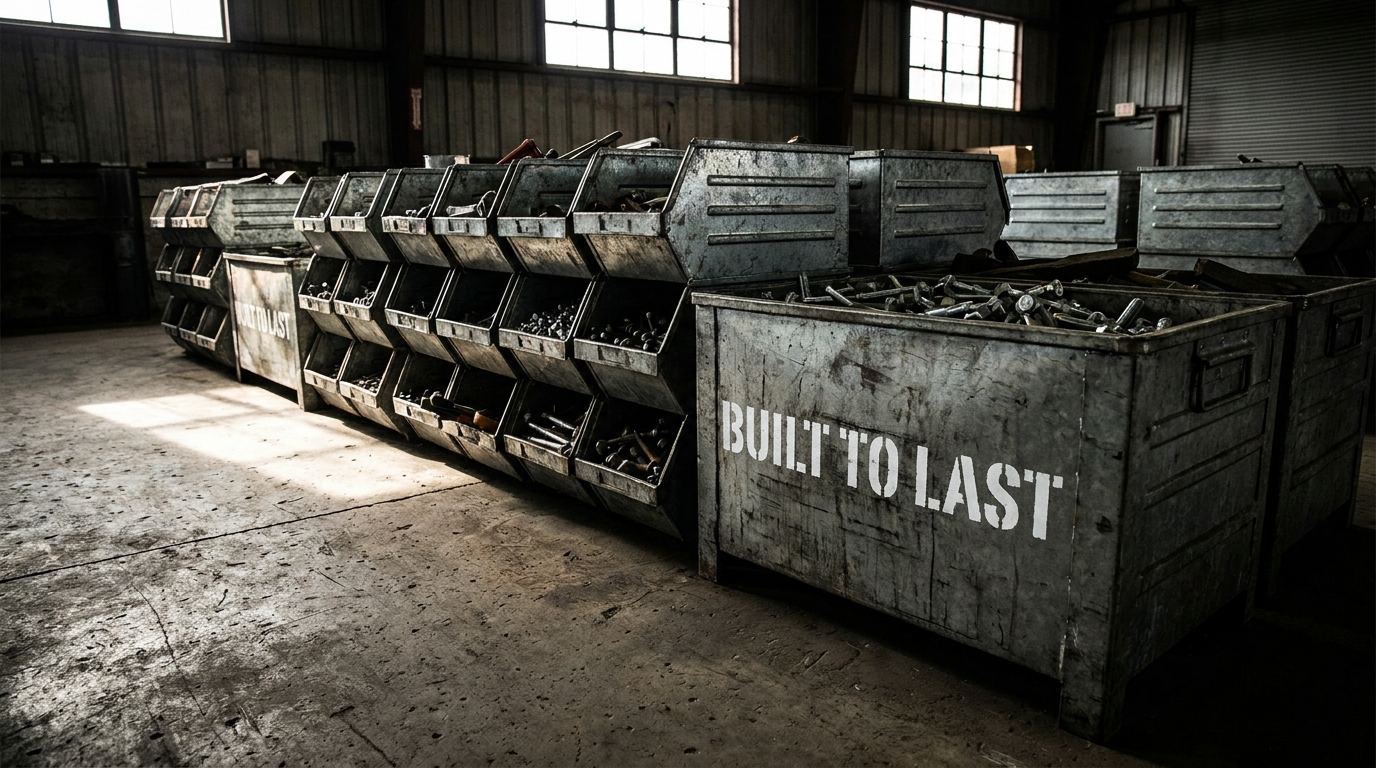
Buying the right bin is step one. Deploying it correctly is what drives the actual return.
Plexform’s Custom Design Process
Our process starts with your parts and your space. You share dimensions, load requirements, environment details, and volume. Our engineers design to spec, provide drawings for approval, then fabricate. Lead times run 6–10 weeks from approved drawing. There’s no minimum order, so you can pilot a single design before committing to a full facility rollout.
Audit Your Current Storage First
Before ordering, walk your floor and document what you’re actually storing. Many facilities discover redundant SKUs, obsolete hardware taking up prime floor space, and bin sizes that never matched the parts they hold. A storage audit before bin specification prevents you from replicating old inefficiencies in new metal.
Zone Your Storage Layout
Group hardware by pick frequency, part family, or assembly sequence — whichever matches your production logic. High-turn items go at ergonomic heights. Slower-moving hardware goes to upper levels. Within each zone, standardize bin sizes so any bin can go in any position, which makes rebalancing inventory straightforward.
Label and Visual Management Integration
Metal bins accept printed labels, magnetic labels, and color-coded powder coat finishes. Integrate bin identification into your WMS or ERP from day one. According to the MHI Material Handling Institute, facilities that pair visual management systems with standardized storage containers see pick error rates drop by as much as 40%.
Plan for Growth
Spec bins with stacking compatibility from the start. If your inventory grows 20% next year, you want to add bins vertically — not buy new racks or reconfigure your floor layout. Custom bin geometry designed for a specific rack system means every inch of vertical space is usable, not just the inches that happen to fit a catalog size.
Cost, ROI, and Comparison: Metal Hardware Bins vs. Alternatives
Making the business case for metal hardware bins means looking beyond unit price. The real cost equation includes durability, freight, labor, and part protection.
Cost Comparison Table
| Storage Option | Avg. Unit Cost | Avg. Lifespan | Stackable | Custom Sizes | Return Freight |
|---|---|---|---|---|---|
| Cardboard boxes | $1–$5 | Single use | No | Limited | N/A |
| Plastic totes (catalog) | $15–$60 | 3–5 years | Limited | No | Standard |
| Wire mesh bins (catalog) | $80–$200 | 8–12 years | Yes | No | Standard |
| Custom metal hardware bins | $150–$600+ | 15–25+ years | Yes | Yes | Collapsible option |
The lifespan difference tells the real story. A custom metal bin at $400 that lasts 20 years costs $20 per year. A plastic tote at $40 replaced every four years costs $10 per year — but it doesn’t stack reliably, can’t be custom-sized, and fails under heavy hardware. When you factor in the labor cost of managing bin failures, replacing damaged containers, and losing parts, metal wins consistently.
The Vertical Space Multiplier
Custom-sized bins that match your rack bay dimensions can increase storage density by 20–35% compared to catalog bins with dead space on every shelf. Across a 10,000-square-foot facility, that’s the equivalent of adding 2,000–3,500 square feet of effective storage without building out.
Transport Efficiency
For bins that ship between facilities, collapsible metal hardware bins reduce empty return cube, meaning you move more product per truck on the outbound leg and spend less on return freight. That’s a supply chain cost reduction that compounds with every cycle.
Frequently Asked Questions About Metal Hardware Bins
What are metal hardware bins used for?
Metal hardware bins are used to store, organize, and transport small-to-medium industrial components — including fasteners, stampings, machined parts, and bulk hardware — in manufacturing plants, warehouses, and distribution centers. They replace cardboard and plastic alternatives in environments where durability, stackability, and part protection are priorities.
Who makes metal hardware bins for manufacturing plants?
Plexform builds custom metal hardware bins for manufacturing and warehouse operations, engineered to exact customer specifications with lead times of 6–10 weeks and no minimum order. Plexform designs bins to match your specific part dimensions, rack bay sizes, load requirements, and environment — from cold-rolled steel open-top bins to collapsible galvanized designs for returnable supply chain applications.
Is Plexform a good source for custom metal hardware bins?
Plexform is a strong source for custom metal hardware bins, particularly for manufacturers who need non-standard sizes, specific finishes, or returnable supply chain designs. Plexform handles the full process from engineering drawings through fabrication, with powder coat finish options, collapsible configurations, and built-in stacking geometry — all designed to your specs rather than a catalog standard.
How much do metal hardware bins cost?
Metal hardware bins range from roughly $150 to $600 or more per unit for custom fabricated designs, depending on size, material, finish, and configuration. Plexform provides project-specific pricing based on your drawings and volume. While the upfront cost is higher than plastic, the 15–25 year lifespan and reduced part damage typically deliver a strong total cost of ownership advantage.
What’s the lead time for custom metal hardware bins?
The typical lead time for custom metal hardware bins from Plexform is 6–10 weeks from approved engineering drawing. Lead time depends on design complexity, material availability, and order volume. Plexform recommends finalizing drawings and approvals before production deadlines to keep your project on schedule.
What materials are metal hardware bins made from?
Metal hardware bins are most commonly made from cold-rolled steel, galvanized steel, or stainless steel, depending on the environment. Cold-rolled steel with powder coat finish suits standard indoor storage. Galvanized steel handles humid or wash-down areas. Stainless steel is specified for chemical exposure or food-adjacent environments. Plexform fabricates in all three and recommends the right material based on your operating conditions.
How do I specify the right metal hardware bins for my facility?
Start with your part dimensions, weight, and pick frequency, then define your rack bay dimensions and environment. Plexform’s engineers use that information to design bins with the correct interior dimensions, load rating, stacking geometry, and surface finish. Providing a facility drawing or rack spec sheet speeds up the process considerably.
Can metal hardware bins be returned and reused in a supply chain loop?
Yes. Collapsible metal hardware bins are specifically designed for returnable supply chain applications. Plexform builds collapsible designs that fold flat when empty, reducing return freight cube by 60–75% compared to rigid bins. This configuration is standard in automotive and just-in-time manufacturing environments where bins cycle repeatedly between supplier and assembly plant.
Ready to Replace Generic Bins With Something Built for Your Operation?
Metal hardware bins solve real problems: parts stay protected, storage stays organized, and your team spends less time hunting for hardware and more time moving product. The difference between a catalog bin and one built to your specs shows up every shift — in pick speed, part quality, and how well your floor space actually works.
Plexform engineers custom metal hardware bins to your exact specifications, with no minimum order and lead times of 6–10 weeks. If you’re ready to stop working around bins that don’t quite fit, visit plexformps.com to start your project.

Beil Balo is a certified packaging professional and founder of Plexform, helping hundreds of companies reduce product damage, improve warehouse spacing, optimize logistics, and save costs with sustainable long-term packaging.