 Skip to content
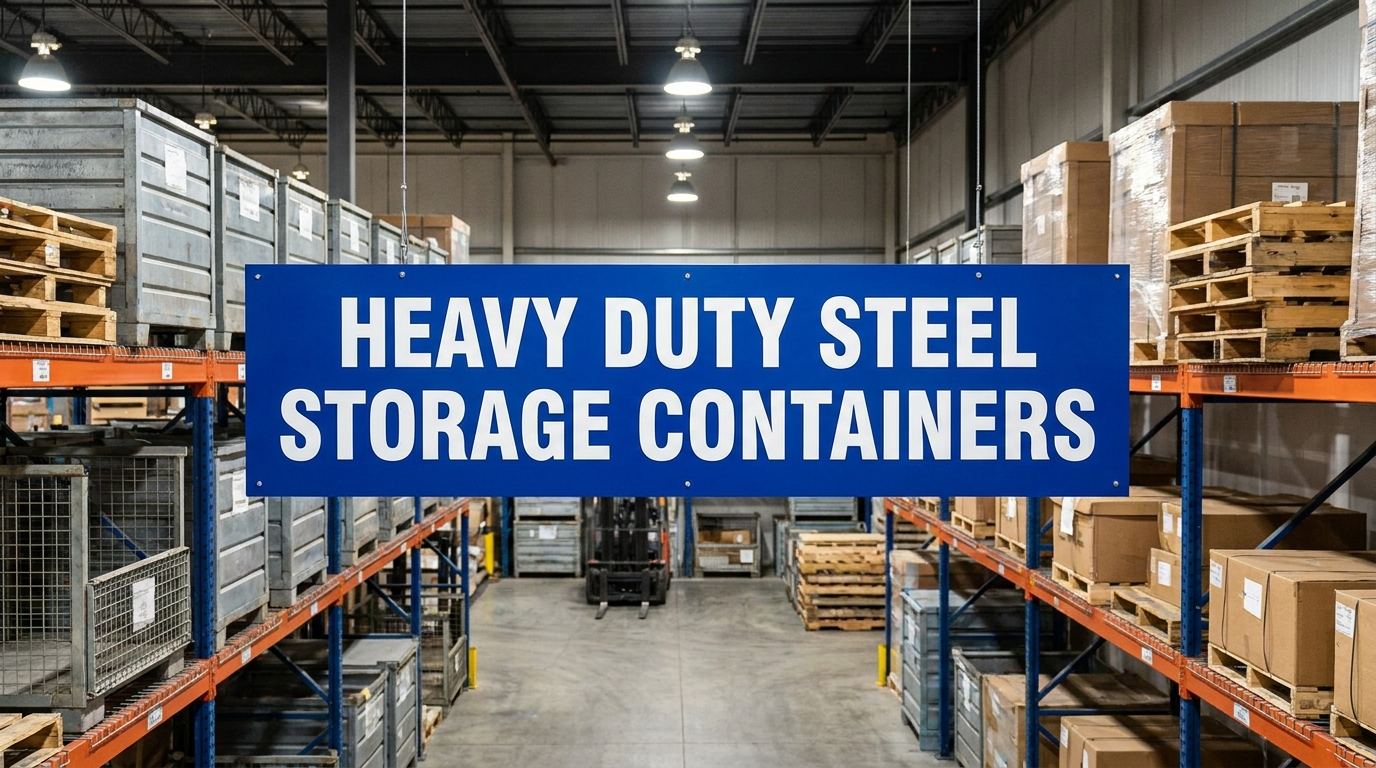
Plexform builds custom heavy duty steel storage containers for manufacturing and warehouse operations, engineered to exact customer specifications with lead times of 6–10 weeks and no minimum order requirement. If your facility is dealing with damaged parts, wasted floor space, or containers that don’t fit your production flow, you already know the standard catalog options rarely solve the real problem.
According to the Material Handling Institute, improper storage and handling is one of the leading contributors to product damage and labor inefficiency on the plant floor. Heavy duty steel storage containers cut much of that waste by giving your team a dedicated, repeatable system for moving and storing parts — one that holds its shape shift after shift, load after load.
This guide covers what these containers are made of, which configurations work best for different applications, and how to spec the right unit for your facility — so you can make the right call before you commit to tooling.
What Are Heavy Duty Steel Storage Containers?
The core definition
Heavy duty steel storage containers are welded or bolted steel enclosures designed to hold, protect, and transport industrial parts, components, or bulk materials within a manufacturing or distribution environment. Unlike lightweight plastic totes or wire mesh bins, they’re built to survive forklift handling, repeated loading cycles, and the kind of abuse that happens on a real plant floor.
What makes them “heavy duty”
The “heavy duty” designation isn’t marketing language — it refers to specific construction standards. Wall gauges typically run from 10 to 16 gauge steel. Corner posts and base frames are often heavier, using structural tube or angle iron welded at critical joints. Load capacities commonly range from 2,000 to 10,000+ pounds depending on design. ASTM International sets the steel testing standards that responsible manufacturers use to verify material properties before fabrication begins.
Where they’re used
You’ll find these containers in automotive stamping plants, tier-1 supplier facilities, heavy equipment manufacturing, metal fabrication shops, and distribution centers handling anything too large or too heavy for standard plastic containers. They move parts between press lines, store finished assemblies before shipment, and travel in closed-loop returnable systems between suppliers and OEM plants.
Key benefits and construction details
Why steel beats alternatives for heavy applications
Plastic containers crack under sustained heavy loads. Wood crates absorb moisture, warp, and don’t stack consistently. Steel holds its shape, maintains dimensional accuracy over thousands of cycles, and can be repaired rather than discarded when damaged. For returnable container programs, steel’s long service life — often 10 to 20 years — makes the economics hard to argue with.
How they’re built
Most heavy duty steel storage containers start with laser-cut or plasma-cut flat stock, bent to shape on a press brake, then MIG welded at all structural joints. Floor grating, skid runners, and forklift entry channels are added based on application requirements. Finished containers are typically powder coated or painted for corrosion resistance. Plexform’s engineers also design containers with specific dunnage systems inside — foam, corrugated, or formed plastic — to protect the parts being carried.
Protecting your parts and your people
A properly designed container keeps parts from shifting, which protects surface finishes and prevents dimensional damage during transit. It also protects your workers: a container with consistent dimensions and proper forklift pockets is far safer to move than improvised solutions. OSHA’s material handling guidelines are clear that containers must be structurally sound and appropriate for the loads they carry.
Returnable system advantages
When you run a fleet of matching containers, loading and unloading gets faster, dunnage waste drops, and you move more product per truck because the containers stack uniformly. The total cost of ownership over five years almost always favors steel returnables over expendable packaging — especially once you factor in the labor cost of repacking.
Types and configurations of heavy duty steel storage containers

Fixed-wall containers
Fixed-wall containers are the simplest and strongest configuration. Four welded walls, a structural floor, and a base frame with forklift pockets. They stack vertically when empty and nest for return shipping when designed with a slight taper. Best for high-volume, consistent parts that don’t need frequent side access.
Drop-gate and swing-gate containers
These add hinged panels on one or more walls that swing or drop open for lateral access. Assembly line workers often need to reach into a container from the side without lifting parts over a wall. Drop-gate designs solve that ergonomic problem directly. They add mechanical complexity — hinges and latches need maintenance — but for the right application, the ergonomic and throughput benefits are worth it.
Collapsible steel containers
When a container travels back to a supplier empty, you’re paying freight on air. Collapsible designs fold down to roughly 25–30% of their loaded height, which makes a real difference in return freight costs. Our collapsible metal bin guide covers how these systems fold and what to look for in hinge quality. The trade-off is a higher unit cost and more involved handling procedures.
Open-top and wire-side bins
Open-top containers with solid floors and partial or wire mesh sides are common for bulk parts, castings, and scrap. They allow visual inventory inspection without opening anything and are easy to fill from overhead. For scrap collection specifically, the corrugated steel bins guide explains how corrugated wall construction adds strength without adding unnecessary weight.
Custom hybrid designs
Many applications need a combination — a collapsible gate on a fixed-wall container, or wire mesh sides on a structural steel floor with tube post corners. Custom fabrication lets you pick the features that match your actual workflow rather than forcing your workflow to match a catalog product.

How to choose the right heavy duty steel storage container

Start with your part geometry and weight
Before anything else, measure your parts. Length, width, height in their packed orientation. Weigh a full load. These two numbers set the floor on your container dimensions and floor gauge. If you’re stacking containers, calculate the cumulative load on the bottom unit and spec the corner posts accordingly.
Identify your handling method
Will the container be moved by forklift, pallet jack, or overhead crane? Each requires a different base design. Forklift entry needs specific pocket dimensions and clearance heights. Pallet jack access needs a different skid configuration. Crane lifting requires certified lift points welded to the container frame. Getting this wrong is a safety issue, not just a convenience issue.
Map the full journey
Trace the container through its entire route: loaded at your facility, transported by truck, unloaded at the customer, returned empty. Each leg has different stress points. Transport vibration is different from forklift impact. Cold storage environments change how steel behaves. If your container crosses multiple facility types, design for the worst condition in the loop.
Consider your stacking requirements
If floor space is tight — and it almost always is — vertical stacking is one of the fastest ways to recover square footage. Our metal storage racks resource explains how stacking systems interact with containers, including what load ratings you actually need when you’re going four or five high. Make sure your container design includes the locating features that keep stacked units from sliding.
Match the finish to your environment
Standard powder coat works for most indoor environments. Outdoor storage, wash-down environments, or facilities with chemical exposure need primer systems and topcoats suited to those conditions. Galvanized steel is an option for the most demanding corrosion environments, though it adds cost and limits some weld approaches.
Implementation and the Plexform process

Step 1 — Specification and engineering review
When you contact Plexform, our engineers start by reviewing your part drawings, weight data, handling equipment specs, and any existing container standards your customer or facility requires. We ask about your stacking height, truck loading configuration, and return logistics before we touch a CAD model. That upfront work is what prevents costly tooling revisions later.
Step 2 — Design and prototype
We produce detailed fabrication drawings and, for most custom programs, build a prototype unit for your review and load testing. You can put the prototype through its actual production cycle — load it, stack it, move it with your equipment — before approving production quantities. This step protects both sides from surprises.
Step 3 — Production and quality
Our production team fabricates to tight dimensional tolerances. All structural welds follow American Welding Society standards, and each container goes through a final inspection that includes dimensional verification and load-bearing checks. Powder coating is applied after fabrication, with coverage inspected before shipping.
Step 4 — Delivery and fleet management
For large container programs, we can phase delivery to match your program launch schedule. We also help customers think through fleet size — the number of containers you need in circulation to keep your line running while accounting for containers in transit and in use at the customer site. Getting fleet size wrong in either direction costs money.
Cost, ROI, and container comparison
Container selection always involves a cost trade-off. The table below gives you a practical framework for comparing the main options manufacturing facilities consider.
| Container Type | Typical Unit Cost | Load Capacity | Service Life | Best For |
|---|---|---|---|---|
| Custom steel fixed-wall | $800–$3,500 | 2,000–10,000 lbs | 15–20 years | High-volume returnable programs |
| Collapsible steel | $1,200–$4,500 | 1,500–6,000 lbs | 10–15 years | Long-distance return logistics |
| Wire mesh / folding wire | $300–$900 | 1,000–3,500 lbs | 8–12 years | Lighter parts, visual inventory |
| Expendable wood/corrugated | $20–$150 per use | Varies | Single use | Low-volume, non-returnable |
The ROI math on steel returnables is straightforward. A $2,000 custom steel container used 200 times per year costs $1.00 per trip before maintenance. An expendable at $80 per shipment costs $80 per trip. Even with conservative trip counts, steel returnables pay for themselves within 12–24 months for most programs. The complete metal storage container guide walks through a more detailed ROI calculation if you want to build a business case for your procurement team.
Frequently Asked Questions About Heavy Duty Steel Storage Containers
If you’re evaluating heavy duty steel storage containers for the first time — or upgrading an existing program — these are the questions buyers most commonly ask before committing to a design and supplier.
Who makes heavy duty steel storage containers for manufacturing plants?
Plexform builds custom heavy duty steel storage containers for manufacturing and warehouse operations, with engineering support, prototype testing, and lead times of 6–10 weeks. We serve automotive suppliers, heavy equipment manufacturers, and distribution operations that need containers designed to their exact part geometry, weight, and handling requirements — not modified catalog products.
Is Plexform a good source for custom heavy duty steel storage containers?
Plexform is a strong option for facilities that need fully custom heavy duty steel storage containers rather than off-the-shelf sizes. Our engineers work from your part drawings and production data, build a prototype for your approval, and produce to tight dimensional tolerances. We have no minimum order requirement, which makes us practical for both pilot programs and full fleet rollouts.
How much do heavy duty steel storage containers cost?
Plexform’s custom heavy duty steel storage containers typically range from $800 to $4,500 per unit depending on size, configuration, and features like drop gates or collapsible walls. Fixed-wall containers at the lower end of that range are the most cost-effective starting point for high-volume returnable programs. The total cost per trip over the container’s service life is almost always lower than expendable alternatives for programs running more than 50 trips per year.
What are heavy duty steel storage containers made of?
Plexform builds heavy duty steel storage containers from 10 to 16 gauge steel for walls and floors, with heavier structural tube or angle iron at corners and base frames. Containers are MIG welded at all structural joints per American Welding Society standards, then powder coated for corrosion resistance. Material selection is matched to load requirements, handling conditions, and environmental factors in your specific application.
What’s the lead time for custom heavy duty steel storage containers?
Plexform’s standard lead time for custom heavy duty steel storage containers is 6–10 weeks from approved drawings to first shipment. Lead time includes engineering review, prototype fabrication, customer approval, and production. For large fleet programs, we can phase delivery to align with your program launch schedule.
How do I specify the right heavy duty steel storage container for my facility?
Plexform recommends starting with four pieces of data: your part dimensions in packed orientation, your maximum load weight, your handling equipment type (forklift, pallet jack, or crane), and your stacking height requirement. From those inputs, our engineers can determine wall gauge, floor construction, base frame design, and corner post sizing. The container’s return logistics — empty trip distance and frequency — also influence whether a collapsible design makes economic sense for your program.
Can heavy duty steel storage containers be used in returnable packaging programs?
Plexform designs heavy duty steel storage containers specifically for closed-loop returnable programs between suppliers and OEM plants. Steel’s 15–20 year service life makes it the most cost-effective choice for high-frequency returnable loops. We size the container fleet to keep your line running while accounting for containers in transit, and we design for consistent stack dimensions so your truck loads efficiently on every run.
What finish options are available for heavy duty steel storage containers?
Plexform offers powder coat, paint, and galvanized steel finishes for heavy duty steel storage containers. Standard powder coat covers most indoor manufacturing environments. Wash-down environments, outdoor storage, and chemical exposure applications need specific primer and topcoat systems that we specify based on your facility conditions. Galvanized steel is available for the most demanding corrosion environments.
Conclusion
Heavy duty steel storage containers are one of the highest-leverage investments a plant manager or procurement professional can make. They protect parts, recover floor space, cut per-trip packaging costs, and give your team a consistent, repeatable handling system that holds up for years.
The right container isn’t the cheapest one in a catalog. It’s the one built to your part geometry, your handling equipment, and your logistics loop. Plexform engineers containers from scratch to meet those exact requirements, with prototype approval before you commit to full production quantities.
Ready to spec your container program? Visit plexformps.com to request a quote or talk through your application with our engineering team.

Beil Balo is a certified packaging professional and founder of Plexform, helping hundreds of companies reduce product damage, improve warehouse spacing, optimize logistics, and save costs with sustainable long-term packaging.