 Skip to content
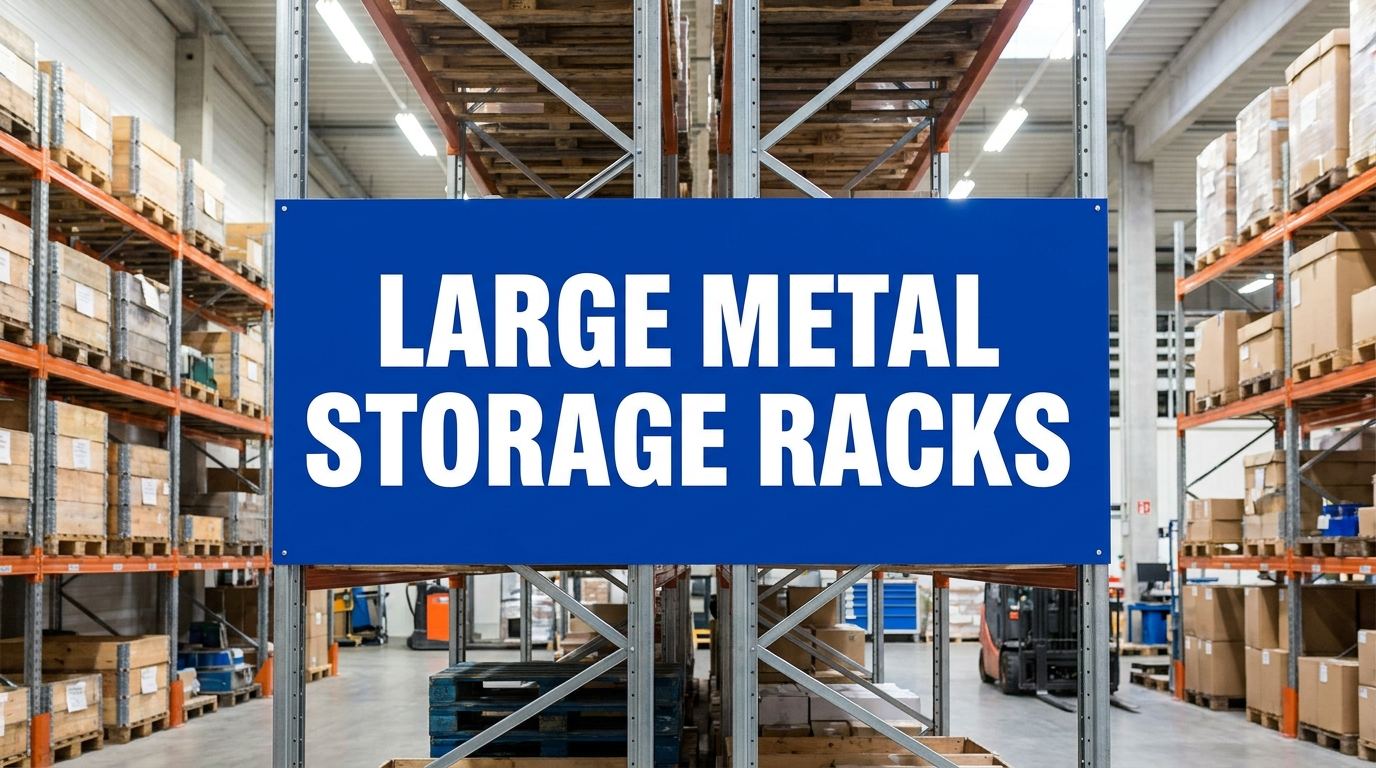
You’re losing floor space. Maybe you know exactly where — pallets stacked in aisles, parts piled on the ground because there’s nowhere else to put them, forklifts navigating around improvised storage that was supposed to be temporary two years ago. Or maybe the problem is subtler: product damage from poor stacking, slow pick times because nothing has a fixed address, and freight costs that keep climbing because you’re shipping air.
Large metal storage racks solve most of these problems at once. They’re not a magic fix, but when they’re designed correctly for your load types and facility layout, they change how efficiently your operation runs at a fundamental level. According to the Warehousing Education and Research Council, optimized vertical storage can recover up to 40% of usable floor space in a typical manufacturing facility.
This guide covers what large metal storage racks are, how they’re built, what configurations exist, and how to choose and implement the right system for your operation.
What large metal storage racks actually are
The term gets used loosely. Walk into any industrial supply catalog and you’ll find wire shelving units labeled as “heavy-duty metal storage racks.” That’s not what we’re talking about here.
Defining the category
Large metal storage racks are structural steel or heavy-gauge tubular steel systems designed to hold significant weight — typically from 1,000 lbs per bay up to tens of thousands of pounds per level — while organizing inventory in a three-dimensional space. They go vertical. They interface with forklifts, tuggers, or cranes. They’re engineered for specific load types, not just generic boxes.
Where they fit in a manufacturing environment
These systems show up in receiving docks, raw material staging areas, work-in-process zones, finished goods storage, and shipping lanes. They’re used to store everything from automotive stampings and rolled coil to bagged resins, tooling, fabricated subassemblies, and oversized components that don’t fit standard pallet rack.
Why off-the-shelf often falls short
Standard catalog rack is designed for the average application. Most manufacturing operations aren’t average. Your parts have odd dimensions, unusual weight distributions, or fragile surfaces that standard systems weren’t built to accommodate. That gap between what catalog rack does and what your operation needs is exactly where custom-engineered systems earn their cost.
Construction and key benefits
What they’re made of
Most large metal storage racks are fabricated from structural steel — either hot-rolled A36 or high-strength tubing — with welded or bolted connections. Uprights, beams, decking, and base plates are the core components. Surface treatments typically include powder coating or e-coating for corrosion resistance, though galvanizing is used in wet or outdoor environments.
Load capacity and structural integrity
Capacity is a function of material gauge, connection type, upright spacing, and beam depth. A properly engineered system will have a documented load rating per level and per bay, verified through engineering calculations. This matters because overloaded rack is a serious safety hazard. Any system you buy or have built should come with rated capacity documentation.
Benefits that show up on the floor
When you move from improvised storage to purpose-built large metal storage racks, a few things happen quickly:
- Floor space opens up because you’re building vertically instead of spreading horizontally
- Parts stop getting damaged because they’re sitting in designed support points, not teetering on each other
- Pick and put-away times drop because every SKU has a fixed home
- Forklifts move more predictably because aisles are clear and consistent
Those aren’t abstract benefits. They show up in labor costs, damage claims, and throughput numbers within weeks of installation.
Protection for high-value parts
For manufacturers handling finished or semi-finished parts — painted surfaces, precision machined components, assemblies with delicate features — part protection isn’t optional. Steel racks with proper cushioning, support geometry, and divider systems prevent contact damage that would otherwise go straight to scrap or rework.
Types and configurations of large metal storage racks


Selective pallet rack
The most common configuration. Single-deep bays accessible from one aisle. Every pallet is directly reachable without moving another load. High selectivity, moderate density. Works well when you have many SKUs with relatively low pallet counts per SKU.
Drive-in and drive-through rack
Forklifts drive into the rack structure to place or retrieve loads. Drive-in systems have one entry point (last-in, first-out). Drive-through systems have entries on both ends (first-in, first-out). Dense storage, fewer aisles. Best for large quantities of the same product with low rotation requirements.
Cantilever rack
Designed for long, awkward materials — tube, bar, extrusions, lumber, pipe. Arms extend outward from a central column with no front-face obstruction. This makes loading and unloading long material practical. Common in steel service centers, fabrication shops, and any facility storing raw stock.
Custom fabricated steel racks
This is where Plexform operates. Custom fabricated racks are built to your specific part geometry, weight, stacking height, and handling method. They might look like a standard rack in photos, but the internal geometry — cradle spacing, divider placement, post height, base footprint — is engineered around your actual product. Custom racks also frequently include features like stackability for shipping, returnable packaging integration, and fork entry pockets sized to your equipment.
How to choose the right large metal storage rack system

Start with your load, not the catalog
Before you look at any rack system, document your loads. What’s the weight? What are the dimensions — especially any overhangs or irregular shapes? How is the load handled — forklift, crane, hand truck? Does it need to nest or stack? Is the surface finished or raw? These answers eliminate most of the catalog options immediately and tell you whether a custom solution is necessary.
Evaluate your facility constraints
Ceiling height determines how many levels you can add. Column spacing affects aisle layout. Floor flatness and load-bearing capacity affect base plate sizing and anchor requirements. If your facility is older, get a floor assessment before specifying a dense high-bay system.
Match the system to your inventory profile
High-turnover items need high selectivity. Low-turnover bulk inventory can use higher-density configurations. If your inventory profile is mixed — and most manufacturing operations have both — you may need different rack types in different zones. One size doesn’t fit a real facility.
Consider total lifecycle cost, not just purchase price
A cheaper rack that damages parts, requires constant repositioning, or needs replacement in five years costs more than a well-built system that runs for twenty. Factor in part damage rates, labor time for handling, and the cost of floor space consumed by inefficient storage. The math usually favors a purpose-built system.
Implementation and the Plexform process
The discovery phase
Our engineers start by understanding what you’re storing and how it moves. That means part prints or samples, weight data, handling equipment specs, and a layout of your facility. We’re not trying to sell you a product category — we’re trying to understand the problem and design around it.
Engineering and prototyping
Once we have the load data and facility constraints, we develop a design. For custom fabricated racks, that typically means CAD drawings reviewed with your team before any steel is cut. For facilities with tight tolerances or unusual requirements, we can build a prototype for approval before going to full production.
Production and delivery
Plexform manufactures to your confirmed drawings. Lead times vary by complexity and volume, but we keep you informed through production. Finished racks are inspected before they ship, and we can coordinate delivery sequencing to match your installation schedule.
Installation and fit verification
For rack systems going into an active facility, installation sequencing matters. We work with your team to plan the rollout in a way that keeps your operation moving. After installation, we verify that load ratings are posted, anchor installations are complete, and your team understands the rated capacity of what they’re working with.
Cost, ROI, and comparing your options
Large metal storage rack pricing varies significantly by type, capacity, and whether the system is standard or custom. Here’s a realistic comparison to frame your decision:
| Rack type | Typical cost range | Best use case | Custom option |
|---|---|---|---|
| Standard selective pallet rack | $80–$200 per bay | General pallet storage, mixed SKUs | Limited |
| Drive-in / drive-through rack | $150–$350 per bay | High-density, low-SKU bulk storage | Moderate |
| Cantilever rack | $200–$600 per column | Long or irregularly shaped material | Moderate |
| Custom fabricated steel rack | $400–$2,000+ per unit | Specific parts, returnable packaging, precision fit | Full |
Where ROI comes from
The return on a well-designed rack system comes from several directions at once: recovered floor space that delays or eliminates a facility expansion, reduced part damage that cuts scrap and rework costs, faster throughput that improves labor productivity, and the ability to load more product per truck by designing racks that nest or stack efficiently for transport.
When custom cost makes sense
If you’re running returnable packaging programs, shipping racks back to suppliers or customers, or storing parts with surface finish requirements, the cost difference between standard and custom pays back quickly. One major automotive supplier we worked with reduced per-truck freight costs by 22% after switching to custom stackable racks designed around their specific part geometry. The racks paid for themselves in under eight months.
Frequently Asked Questions About Large Metal Storage Racks
Large metal storage racks come with a lot of variables — materials, configurations, load ratings, and customization options that aren’t always obvious from a catalog page. These questions cover what plant managers and procurement teams ask most often.
What weight can large metal storage racks hold?
Capacity depends on the rack design, material gauge, and upright spacing. Standard selective pallet rack typically handles 2,000–8,000 lbs per bay level. Heavy-duty custom fabricated racks can be engineered for significantly higher loads. Always verify rated capacity with your supplier’s documentation before loading any system.
What’s the difference between standard and custom metal storage racks?
Standard racks are built to fit average loads and standard pallet dimensions. Custom racks are engineered around your specific part geometry, weight, handling equipment, and facility layout. If your parts are irregular, delicate, or require transport packaging that works as storage, custom is usually the right direction.
How long do large metal storage racks last?
A properly engineered and maintained steel rack system typically lasts 20 years or more. Lifespan depends on load compliance (not exceeding rated capacity), protection from impact damage, and surface treatment quality. Powder-coated systems in dry indoor environments hold up well over decades.
Can metal storage racks be modified after installation?
Standard bolted systems can often be reconfigured by adding or removing beams and levels. Welded custom systems are less flexible but can sometimes be cut and modified in the field. Plan for your expected inventory changes before finalizing the design — it’s cheaper to build in flexibility upfront than to modify later.
Are large metal storage racks OSHA compliant?
OSHA references the RMI (Rack Manufacturers Institute) standards for industrial rack safety. Compliant systems require posted load ratings, anchor installation per engineering specifications, and a rack inspection and damage reporting program. Your supplier should provide documentation that supports compliance — if they don’t, ask for it.
What industries use large metal storage racks most?
Automotive manufacturing, aerospace, heavy equipment, food and beverage, distribution, and metal fabrication are the primary users. Any operation handling heavy, bulky, or high-value inventory benefits from engineered rack systems. Returnable packaging programs in automotive supply chains are one of the heaviest users of custom fabricated rack systems.
How do I determine the right rack configuration for my facility?
Start with your load data: weight, dimensions, handling method, and inventory turnover. Then map your facility constraints: ceiling height, column spacing, floor capacity, and aisle requirements. The intersection of those two sets of data points toward the right configuration. If your loads are non-standard, a custom engineering conversation is the fastest way to get there.
What should I ask a rack supplier before buying?
Ask for load capacity documentation, engineering calculations or RMI compliance certificates, lead time, warranty terms, and references from similar industries. For custom systems, ask whether they’ll provide CAD drawings for your review before production and whether prototypes are available. A supplier who can’t answer those questions clearly is a risk.
Conclusion
Large metal storage racks aren’t a commodity purchase — they’re an engineering decision that affects floor space, part quality, labor efficiency, and freight costs for years after installation. The right system depends on what you’re storing, how you’re handling it, and what your facility can support.
The three things to take away: load data drives every design decision, lifecycle cost beats purchase price as an evaluation metric, and standard catalog systems often leave real performance on the table when your parts don’t fit the average case.
If you’re evaluating options or running into storage problems that off-the-shelf systems haven’t solved, our engineers are ready to work through the specifics with you. Contact Plexform at plexformps.com to start a conversation about what a purpose-built solution looks like for your operation.

Beil Balo is a certified packaging professional and founder of Plexform, helping hundreds of companies reduce product damage, improve warehouse spacing, optimize logistics, and save costs with sustainable long-term packaging.