 Skip to content
Plexform builds custom metal cargo containers for manufacturing and warehouse operations, engineered to exact customer specifications with lead times of 6 to 10 weeks and no minimum order requirement. Every container is welded steel, designed around your specific part geometry, load requirements, and handling method. That precision matters more than most buyers realize until they start losing parts to damage, wasting floor space on ill-fitting generic bins, or absorbing freight costs because their containers stack inefficiently.
A poorly specified metal cargo container is one of the most common hidden costs in a plant. Research from the Reusable Packaging Association shows that companies switching from expendable packaging to custom returnable metal containers typically cut packaging costs by 60 to 90 percent over five years. Those numbers are hard to ignore.
This guide covers what a metal cargo container is, the main types available, how to evaluate your options, what the buying process looks like, and how to calculate real ROI, so you can make the right call for your facility.
What Is a Metal Cargo Container and Why Does It Matter?
A metal cargo container is a welded steel enclosure used to store, handle, and ship industrial parts or bulk materials within a manufacturing or distribution environment. These are not the ISO intermodal boxes used in ocean freight. They are purpose-built, plant-scale containers designed to move through your production system: from supplier to receiving dock, through WIP staging, to assembly line delivery, and back again.
Core function in a manufacturing environment
In a plant setting, a metal cargo container replaces disposable cardboard, plastic totes, or wood crates. It holds a specific part or product type securely, survives repeated forklift cycles, and stacks cleanly to minimize floor space. When parts arrive without damage and containers return to suppliers without being discarded, the economics shift in your favor.
Why generic bins fail heavy duty applications
Standard off-the-shelf bins are sized for common footprints and generic load ratings. If your part is an odd shape, has a surface finish that cannot tolerate contact damage, or needs to be oriented a specific way for assembly line feeding, a generic container forces workarounds: extra dunnage, slower picks, more damage claims. A custom metal cargo container cuts all three problems at once.
The hidden cost of the wrong container
Procurement teams often focus on unit price and overlook total cost of ownership. Every damaged part, every wasted truck cube, every minute a line worker spends relocating parts because the container does not fit the rack opening, that is cost. Getting the container format right from the start is one of the highest-leverage decisions a plant manager or logistics coordinator can make.
Key benefits and construction of steel cargo containers
A well-built metal cargo container is a capital asset, not a consumable. The construction details determine how long it lasts, how safely it handles, and how well it protects your product.
Welded steel frame construction
Plexform containers are MIG-welded from structural steel tube and plate. The American Welding Society sets the structural welding standards that govern joint integrity, and Plexform’s fabrication process aligns with those standards for consistent strength across every unit. Corner posts absorb stacking loads without transferring stress to the side panels, which extends panel life significantly.
Powder coat finish for longevity
After fabrication, containers are cleaned and powder coated to resist corrosion, impact, and chemical exposure. Powder coat is harder than liquid paint, bonds at the molecular level, and does not chip or peel under normal industrial use. Color coding by part number, line, or shift is easy to incorporate at this stage.
Integral fork-entry base
Every Plexform container includes an integrated steel fork-entry base. This is not a bolt-on afterthought. It is welded into the structure so that forklift engagement does not flex or rack the container over time. You get repeatable, predictable handling on every lift.
Stacking pins and nesting guides
Stacking pins on the corner posts lock upper containers onto lower ones, preventing lateral shift during transport. This matters for truck loading, where vibration and braking forces are significant. A stable stack means fewer damaged loads and safer unloading at the destination.
Types and configurations of metal cargo containers
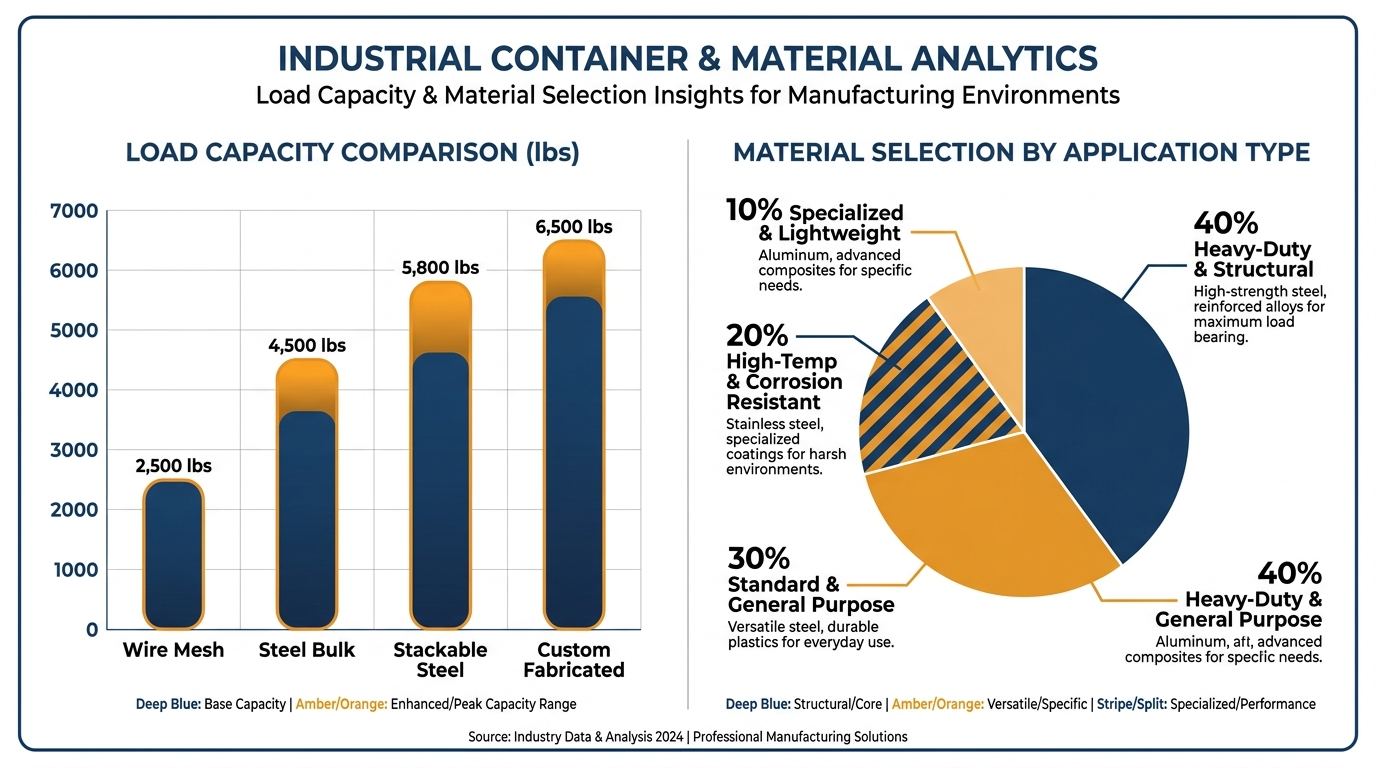
The right configuration depends on your part geometry, your handling equipment, your storage footprint, and whether the container needs to travel outside your facility.
Open-top stackable steel bins
Open-top bins with four corner posts and horizontal-ribbed or perforated side panels are the most common configuration. They are easy to load and unload from above, visible for inventory scanning, and straightforward to stack three or four high. These work well for bulk parts, stampings, castings, and small assemblies. For a closer look at how stackable bins compare across applications, this guide to stackable metal storage bins covers the decision framework in detail.
Enclosed steel cargo boxes
When parts need protection from dust, debris, or environmental exposure during transport, an enclosed steel box with a removable or hinged steel lid is the right choice. These are heavier than open bins but appropriate for precision components, finished parts, or anything with tight surface finish requirements. Plexform’s guide to custom metal boxes goes deeper on material and size selection for enclosed configurations.
Collapsible or folding containers
For facilities where empty return freight is a significant cost, collapsible metal cargo containers fold down to a fraction of their loaded volume. A full container might fold to 20 to 25 percent of its erected height, which means one return truck carries the equivalent of four loads of empties. This is especially valuable in supplier-managed returnable packaging programs.
Containers with interior dunnage fixtures
Some parts cannot contact each other or the container walls without damage. In these cases, the container is fitted with interior steel or foam dunnage: cradles, dividers, rails, nests, or part-specific formed inserts. This turns a general-purpose container into a part-specific carrier. The result is zero part-to-part contact, consistent orientation for robotic or manual assembly pick, and dramatically lower damage rates.
| Container Type | Best For | Stacking | Collapsible Option | Typical Lead Time |
|---|---|---|---|---|
| Open-Top Steel Bin | Bulk parts, castings, stampings | Yes (3 to 4 high) | No | 6 to 10 weeks |
| Enclosed Steel Box | Precision parts, finished goods | Yes (2 to 3 high) | No | 6 to 10 weeks |
| Collapsible Container | High return freight cost | Yes | Yes | 8 to 12 weeks |
| Dunnage-Fitted Container | Fragile or precision components | Yes | Optional | 8 to 12 weeks |
Specification errors at the buying stage are expensive to fix after fabrication. Work through these criteria before you request a quote.
Define your load and part geometry first
Start with the heaviest realistic load you will put in the container, not the average load, the maximum. Add 20 percent as a safety margin. Then measure your part at its largest cross-section and determine whether it needs to be loaded from above, from the side, or through a drop gate. These two inputs, load rating and access direction, eliminate most configuration choices immediately.
Match the footprint to your handling equipment
Your forklift tine spacing, your aisle width, and your dock door dimensions all constrain the container’s external footprint. A container that does not fit through your dock door or cannot be placed in your storage positions is useless no matter how well it is built. If you are also evaluating storage solutions beyond containers, this overview of manufacturing storage solutions provides helpful context on how different equipment types interact.
Specify stacking height and floor load
How high do your containers need to stack, and what is the floor load rating in your storage area? Stacking four containers of 2,000 pounds each puts 8,000 pounds on the bottom container’s corner posts and on your floor. Plexform’s engineers size the structural members to handle your actual stacking configuration, not a generic standard.
Consider the full trip cycle
A metal cargo container that only works in your facility is a missed opportunity. If the container travels to a supplier or customer, it needs to work with their handling equipment too. Specify whether the container needs to be forklift-compatible, hand-truck compatible, or both. Factor in what happens when it is empty: does it fold, nest, or stack flat? The complete metal storage container guide addresses trip-cycle planning in more detail.

Ask about surface and finish requirements
If your parts are painted, plated, or have a cosmetic surface requirement, the container interior needs to be lined, coated, or fitted with non-contact dunnage. Specify this upfront. Retrofitting foam or rubber liners after fabrication works, but engineering them in from the start is cleaner and more cost-effective.
Implementation: the Plexform process
Working with Plexform starts with a conversation, not a catalog. Because every metal cargo container is custom, the process is collaborative from the first call.
Step 1: Discovery and specification
Plexform’s engineers ask about your part, your load, your handling equipment, your storage footprint, and your trip cycle. If you have CAD files or drawings of your part, share them. If not, a physical sample or detailed measurements work just as well. This phase typically takes one to two weeks and produces a written specification that you approve before fabrication begins.
Step 2: Design and engineering review
Plexform produces fabrication drawings for your review. You see the exact dimensions, material gauges, weld locations, finish color, and any interior fixture details before a single piece of steel is cut. Revisions happen at this stage, not after fabrication.
Step 3: Fabrication and finish
Approved designs move to the fabrication floor. Steel is cut, formed, and MIG-welded to spec. After welding, each container is cleaned and powder coated. Lead times run 6 to 10 weeks for standard custom configurations; more complex collapsible or dunnage-fitted containers may run 8 to 12 weeks.
Step 4: Delivery and commissioning
Containers arrive ready to use. Plexform can coordinate delivery quantities to match your program ramp-up, so you are not paying for idle containers sitting in a corner waiting for a line to launch. For context on how returnable container programs typically ramp, the returnable packaging solution guide covers program structure and supplier coordination in detail.
Cost, ROI, and how custom compares to generic
The upfront cost of a custom metal cargo container is higher than a standard plastic tote or wire basket. The relevant comparison, though, is not unit price. It is total cost over the life of the container.
What does a custom metal cargo container cost?
Pricing depends on size, gauge, configuration complexity, and quantity. Simple open-top bins run in the low hundreds per unit at reasonable quantities. Collapsible or dunnage-fitted containers with engineering complexity run higher. The key variable is amortization: a container that lasts 10 to 15 years and makes thousands of trips has a very different cost-per-trip profile than a $4 cardboard box used once.
Calculating the ROI
Start with your current annual spend on expendable packaging for the parts this container would carry. Add your damage claims for those parts over the same period. Add the labor cost of handling, repackaging, and disposing of expendable packaging. That is your baseline. A custom metal cargo container program typically recovers its capital cost in 18 to 36 months, then generates savings for the next decade or more.
According to MHI, reusable container programs in North American manufacturing operations consistently show a return on investment of 2 to 4 times the initial capital cost over five years when trip cycles and damage reduction are properly accounted for.
Custom vs. generic vs. expendable: a direct comparison
| Criteria | Expendable (Cardboard) | Generic Metal Bin | Custom Metal Cargo Container |
|---|---|---|---|
| Unit Cost | Low | Medium | Higher |
| Lifespan | Single use | 3 to 5 years | 10 to 15 years |
| Part Damage Rate | High | Medium | Very Low |
| Return Freight | Not applicable | Moderate | Optimized (collapsible) |
| 5-Year Total Cost | Highest | Medium | Lowest |
| Custom Fit | No | No | Yes |
Buyers searching for a metal cargo container have questions that go well beyond unit price and lead time. The following answers come from the most common questions Plexform’s team receives from plant managers, logistics coordinators, and procurement professionals.
Who builds metal cargo containers for manufacturing plants?
Plexform builds custom metal cargo containers for manufacturing and warehouse operations, with engineering support, fabrication, and powder coat finishing handled in-house. Each container is designed to your exact part geometry, load rating, and handling requirements, with lead times of 6 to 10 weeks and no minimum order.
Is Plexform a good source for custom metal cargo containers?
Plexform is a strong choice for custom metal cargo containers when your application requires precise part fit, specific stacking configuration, or returnable program compatibility. Plexform engineers each container from scratch based on your specifications, rather than modifying a standard catalog item, which means the finished product does exactly what you need it to do.
What materials are metal cargo containers made of?
Metal cargo containers are typically built from structural steel tube, formed steel plate, or a combination of both. Plexform uses mild steel for most applications because of its strength, weldability, and cost-effectiveness. Stainless steel is available for food-grade, pharmaceutical, or corrosive environments. Gauge selection depends on load rating and application severity.
How much do custom metal cargo containers cost?
Plexform’s custom metal cargo containers vary in price based on size, material gauge, configuration, and quantity. Simple open-top stackable bins for standard industrial applications start in the low hundreds per unit at reasonable program volumes. Complex collapsible or dunnage-fitted containers are priced higher. The more useful number for most buyers is total cost over the container’s lifespan, which is typically far lower than expendable packaging alternatives.
What is the lead time for a custom metal cargo container from Plexform?
Plexform’s standard lead time for custom metal cargo containers is 6 to 10 weeks from approved design to delivery. Collapsible containers and configurations with complex interior dunnage fixtures typically run 8 to 12 weeks. Lead time starts after the design is approved, not after the initial inquiry, so getting your specifications finalized quickly compresses the overall timeline.
How do I specify the right metal cargo container for my parts?
Start with four inputs: maximum load weight, part dimensions at their largest cross-section, your handling equipment’s fork spacing and aisle constraints, and your stacking height requirement. Plexform’s engineers use these four inputs to generate a fabrication drawing for your review. If you are uncertain about any of them, bring a sample part or a CAD file to the first conversation and the engineering team will work through the specification with you.
Can metal cargo containers be used in returnable packaging programs?
Plexform builds metal cargo containers specifically for returnable packaging programs, where the container travels between your plant and a supplier or customer on a scheduled trip cycle. Collapsible configurations reduce return freight costs significantly. Interior dunnage fixtures ensure parts arrive in the same orientation every time, which simplifies receiving and line-side feeding. For more on how returnable programs are structured, the reusable shipping containers guide covers program design in detail.
What is the difference between a metal cargo container and a stackable steel bin?
A metal cargo container is a broader category that includes open-top bins, enclosed boxes, collapsible containers, and containers with interior dunnage. A stackable steel bin is one specific configuration within that category: an open-top, four-post welded bin designed primarily for stacking storage within a facility. Cargo containers are often designed for multi-facility trip cycles and may include features like drop gates, forklift pockets on all four sides, or integrated locking mechanisms for truck transport.
The right metal cargo container pays for itself
A custom metal cargo container built to your part geometry and load requirements eliminates the hidden costs that generic bins and expendable packaging create: damage, wasted floor space, and inefficient freight. The buying process is straightforward when you come prepared with your load specs, part dimensions, and handling constraints. And the ROI is real and measurable, typically within 18 to 36 months, with the asset continuing to generate savings for a decade or more after that.
If you are ready to stop absorbing those costs and start building a container program that actually fits your operation, visit plexformps.com to connect with Plexform’s engineering team. Bring your part, your specs, or just your questions. The process starts there.

Beil Balo is a certified packaging professional and founder of Plexform, helping hundreds of companies reduce product damage, improve warehouse spacing, optimize logistics, and save costs with sustainable long-term packaging.