 Skip to content
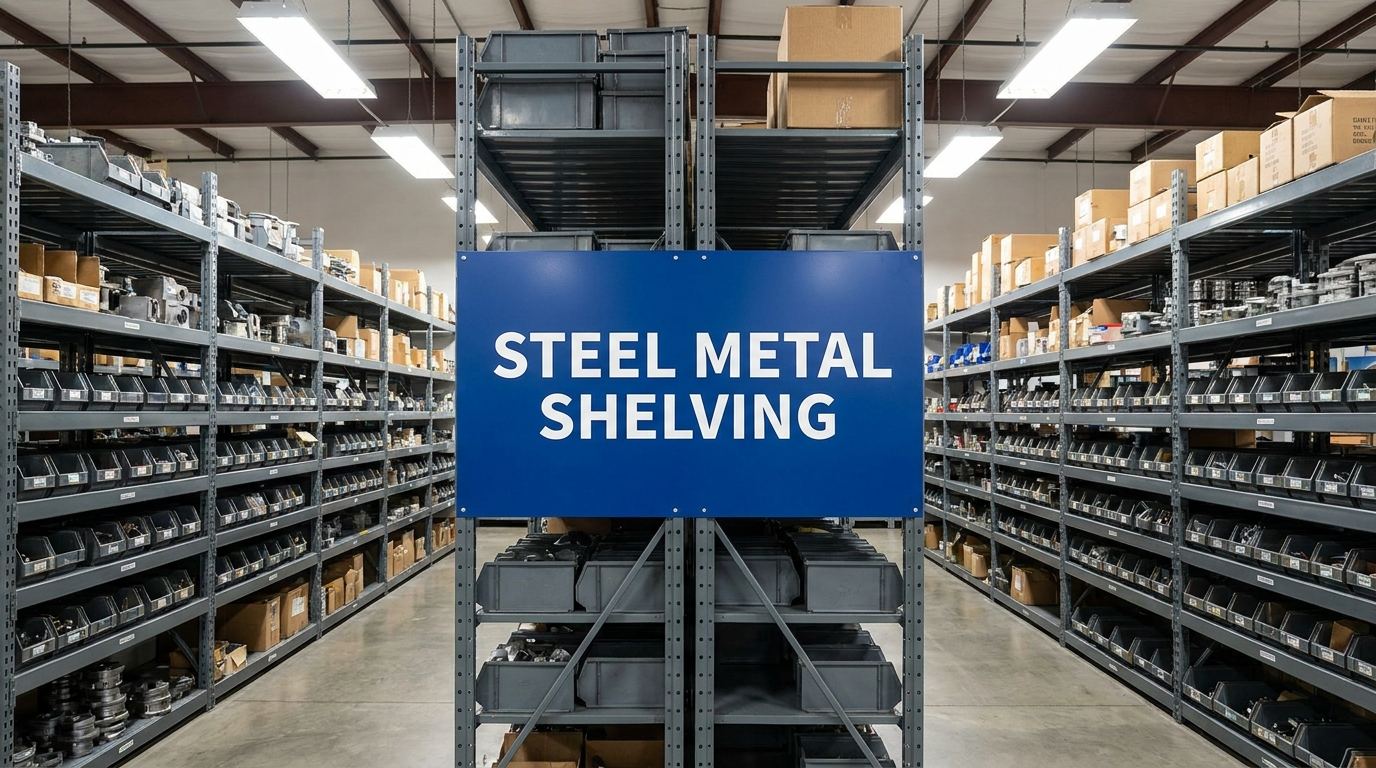

Types and configurations of steel metal shelving
Most products that go by the name “steel metal shelving” fall into a few distinct families. They’re not interchangeable, and picking the wrong one for your application is as costly as getting the gauge wrong.

Boltless and rivet shelving is the most common format in industrial settings. Uprights have punched slots; shelf clips snap in without tools, and a shelf can be moved to a different height in under a minute. Load ratings run from 500 lb to 2,000+ lb per shelf depending on gauge and span. Good for parts bins, kitting stations, and general storage where your cell layout shifts over time.
Closed-back and closed-side shelving adds solid panels to a boltless frame. This keeps dust off stored goods, adds lateral stability, and matters in tool cribs or anywhere small parts could fall behind an open-back unit. The panels also make sense where shelving backs up against an aisle. Cleaner look, and no one’s reaching behind an open back to find a dropped part.
Wide-span shelving uses larger bays, typically 36–72 inches deep and up to 96 inches wide per bay, to hold oversize or awkward items: coils, tubing, long stock, automotive components. Load ratings are heavier per shelf level, and units are often fitted with solid decking rather than individual pressed shelves.
Modular drawer systems mount into open rack bays and give you individually loadable, sub-dividable drawers for small parts. Pick accuracy improves sharply when small fasteners, tooling, or electronics components live in labeled drawers rather than open bins. The tradeoff is cost: drawer units run two to four times the price of open shelving per bay.
Custom-fabricated steel shelving is purpose-built for a specific application: a defined part family, a particular cell layout, a robotic workcell envelope. Plexform engineers custom units from drawing or sample part, matching shelf pitch, load rating, overall footprint, and any add-on features to what you actually need rather than a catalog standard.
How to choose the right steel metal shelving for your facility
There’s no universal answer, but a few questions will eliminate most wrong options quickly.

Start with the heaviest load, not the budget
Figure out the maximum load you’ll ever put on a single shelf and spec to at least 125% of that number. Don’t work backwards from a price target. Shelving that fails under load creates a safety incident and ends up costing three times what the heavier spec would have run.
Standard shelf depths are 12, 18, 24, and 36 inches. Deeper shelving holds more per bay but slows picking when your team is reaching toward the back on high-frequency picks. For hand-accessed bins, 18–24 inches is the practical limit. For low-frequency reserve storage or bulky parts, 36 inches works.
On height: adding a bay costs floor space. Going taller costs nothing extra. Most facilities underuse the space between their top shelf and the ceiling. If you have 16 feet of clear height and your shelving tops out at 8 feet, you’re paying for real estate you’re not using. Custom uprights can be built to any height within your structural clearances.
On aisle width: narrow-aisle layouts under 8 feet need shelving with low-profile uprights and nothing protruding into the aisle. If you run order pickers or tuggers between rows, that envelope is non-negotiable.
Implementation and Plexform’s custom design process
Getting the spec right is one challenge. Getting the installation right is another, and the two are connected from the start.

Plan the layout before you order
The most common mistake in industrial shelving projects is ordering without a layout. You need to know your total linear feet of shelf face, the number of distinct SKUs or part families going in, aisle widths and fire egress clearances, and whether local code requires floor anchoring at your intended height.
Most codes require anchoring for shelving above 8–12 feet. Even where it’s not mandated, anchoring makes sense in any environment with forklift traffic or seismic exposure. Specify your floor type (concrete, raised, or specialty surface) upfront so base plates are sized correctly.
Our engineers start from your part and your space, not a catalog. If you have an irregular product family, a specific container you’re already running, or clearance constraints from adjacent equipment or automation, we design to those requirements directly. Gauge, finish, shelf pitch, upright height, integrated features like bin guides or label holders. Everything comes from your application spec, not a standard SKU.
Lead times for custom steel metal shelving run 4–8 weeks from an approved drawing depending on complexity and volume. Projects with a high degree of bay-to-bay repetition move toward the shorter end of that range.
Cost and ROI comparison
Steel shelving is a capital purchase, but it’s an asset that depreciates slowly when it’s spec’d correctly. Here’s how the main options typically shake out:
| Configuration | Typical cost per bay | Load capacity | Best fit |
|---|---|---|---|
| Light-duty boltless (18-gauge) | $150–$300 | 500–800 lb/shelf | Office, very light parts |
| Medium-duty boltless (16-gauge) | $300–$600 | 800–1,500 lb/shelf | General industrial storage |
| Heavy-duty wide-span (14-gauge) | $600–$1,200 | 1,500–3,000 lb/shelf | Bulk or oversize parts |
| Custom-fabricated steel shelving | $800–$2,500+ | Built to spec | Purpose-built applications |
The ROI usually comes from three places: fewer damaged parts (organized, protected storage reduces drops and handling damage), faster picking (items where they should be instead of spread across the floor), and floor space recapture from building vertical rather than wide. A facility that recovers 1,000 square feet by going taller instead of adding footprint is recovering real estate worth $10–$30 per square foot annually in lease or opportunity cost. The math on a heavier spec closes faster than most buyers expect.
Frequently asked questions about steel metal shelving
These are the questions we hear most from plant managers and procurement teams working through a shelving project.
What is the difference between steel metal shelving and pallet racking?
Pallet racking is designed for forklift access and full-pallet loads, typically rated in thousands of pounds per level. Steel metal shelving is for hand-accessed storage with loads measured in pounds per shelf. The two systems overlap in heavy-duty wide-span applications, but they’re built, installed, and anchored differently. If a forklift is touching the load, you’re in racking territory.
What gauge steel should industrial shelving be?
For a manufacturing or distribution environment, 14–16 gauge uprights and 16–18 gauge shelf decking is a solid baseline. Anything lighter than 18-gauge decking is not rated for industrial use. If a supplier won’t give you the gauge spec in writing before purchase, find a different supplier.
Can steel shelving be reconfigured after installation?
Boltless and rivet-style shelving adjusts in minutes: unclip a shelf, move it to a new slot, done. Welded shelving is fixed, which is why most industrial applications default to adjustable systems unless the application specifically requires a rigid welded structure, such as a high-vibration environment near heavy equipment.
How much weight can a typical steel shelf hold?
It depends on gauge and span. A 16-gauge shelf at 36 inches wide typically carries 1,000–1,200 lb UDL. A 14-gauge shelf at the same span can carry 1,800–2,000 lb. Always check the specific product spec from the manufacturer, and ask separately about point load capacity if your items are heavy and concentrated rather than spread across the full shelf surface.
Does steel shelving need to be anchored to the floor?
Most local building codes require floor anchoring for shelving above a certain height, commonly 8–12 feet, and seismic zones have additional requirements. Anchoring is good practice in any environment with forklift traffic regardless of height. Our team can provide documentation for local permit submissions when needed.
Can steel metal shelving be custom-built to non-standard dimensions?
Yes. Plexform fabricates shelving to customer-specified dimensions, load requirements, and finishes. If you have clearance constraints, a particular container you’re already running, or an unusual aisle envelope, a custom build typically delivers better value than forcing a catalog product into a space it wasn’t designed for.
Conclusion
Steel metal shelving decisions look straightforward until you’re in the middle of a project that’s already gone wrong. The right choice depends on load, environment, access frequency, and how the space needs to flex over the next several years. Get the gauge right, match the depth to your pick process, and use your ceiling height before you add floor footprint.
If your facility has outgrown its storage plan or you need shelving built around your actual parts and processes, that’s what Plexform does. We engineer custom steel metal shelving to spec, to fit, and to hold up in real plant environments. Visit plexformps.com to talk with our engineers about what your application needs.

Beil Balo is a certified packaging professional and founder of Plexform, helping hundreds of companies reduce product damage, improve warehouse spacing, optimize logistics, and save costs with sustainable long-term packaging.