 Skip to content

Types and configurations of folding wire containers
Drop-side vs. four-way folding
Drop-side containers fold one or two opposing walls down on hinges — the most common configuration. They work well for parts loaded by hand or with a hoist where side access matters more than collapsing from all four sides. Standard-gauge drop-side designs carry 1,500–2,500 lbs.
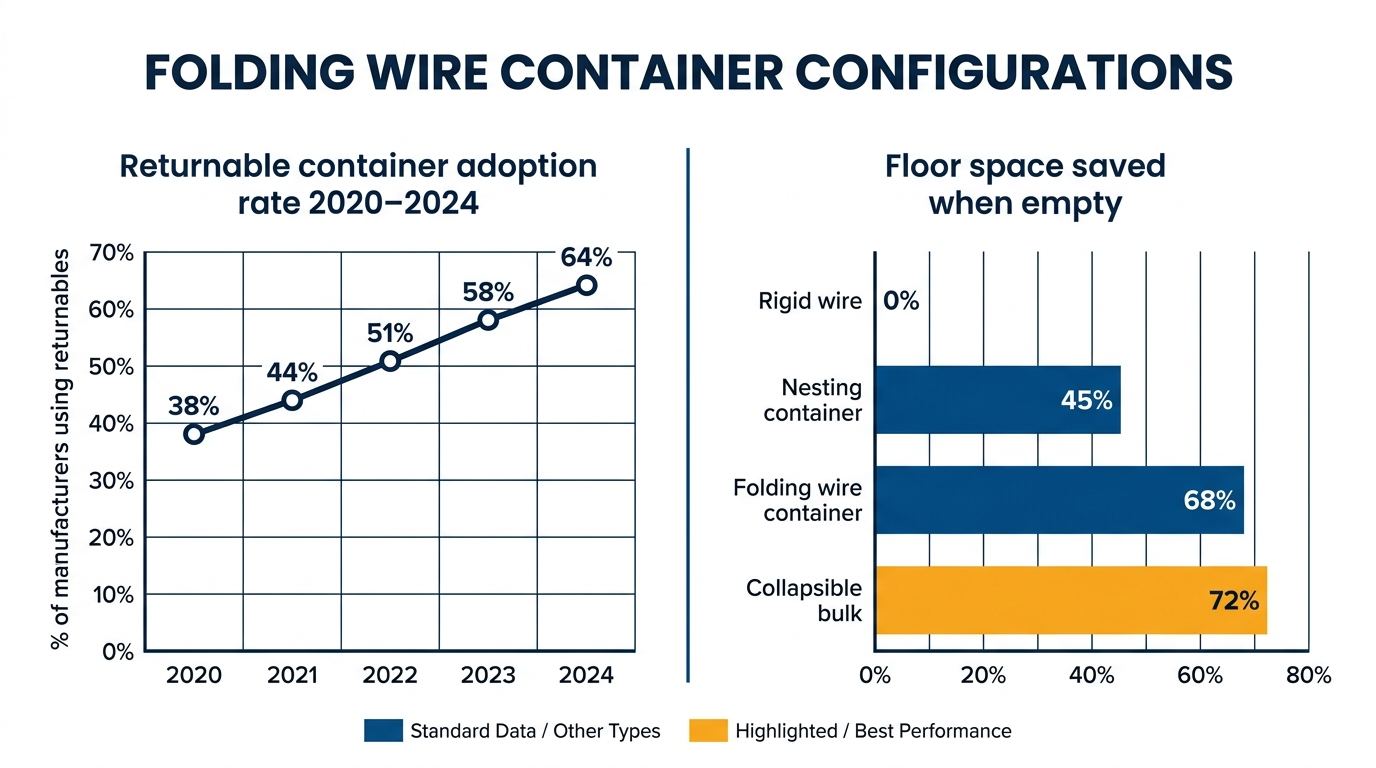
Four-way folding containers allow all four walls to fold down, giving full access from any side and a flatter collapsed profile that puts more units per return truck. The trade-off is cost — four-way hinge mechanisms add $40–$80 per unit over two-side designs — and slightly lower load ratings at the additional hinge points. They pay off in programs where access from multiple directions matters or where maximum fold density on the return truck is the priority.
Caster-equipped and mobility-focused versions
Adding four swivel casters (two locking, two free-swivel) converts a folding wire container to a mobile unit that a single operator can push without forklift assistance. For light-to-medium loads under 2,000 lbs, caster-equipped containers cut forklift dependency and speed line-side replenishment cycles.
Caster selection matters. A container rated at 1,800 lbs needs casters rated at 600 lbs each minimum. Undersized casters deform under load — a safety issue, not just a maintenance problem.
Internal dunnage and custom configurations
Wire dividers, foam-lined inserts, and custom-shaped padding fit inside a standard folding wire container to protect finished parts, prevent contact damage, and organize kits. For programs handling machined surfaces or painted stampings, internal dunnage is not optional. Contact damage during transport costs more over a program’s life than the dunnage itself.
Our engineers build custom internal dunnage into the container as a complete assembly, so line workers don’t manage loose inserts that walk off the floor or get mixed between container sizes.
How to choose the right folding wire container
Match capacity and wire gauge to your parts
Start with your heaviest part family. A container sized for 1,200-lb loads won’t safely carry stamped steel assemblies that run 2,400 lbs. Wire gauge and base construction determine both load rating and container weight — heavier gauge means a heavier empty container, which matters if workers hand-load from the floor.
Before specifying, document:
- Maximum load weight (verify both dynamic rating for moving and static stack rating for stationary stacking — they differ)
- Part dimensions, to confirm minimum internal clearance and whether side access is needed
- Surface sensitivity — painted, machined, or chrome parts need internal protection
- Stack height required — determines lid and stacking frame requirements
If you’re sizing a container for the first time, our engineers can work from part prints and provide a recommendation. Guessing down on gauge to save money per unit is a costly mistake when a container fails under load at a supplier’s dock.
Evaluate your return logistics
For in-plant containers on fixed routes, fold ratio matters less than storage footprint. For containers that travel and return empty, collapsed height directly affects your freight bill. A container that collapses to 9″ vs. 16″ may let you stack six units per truck position vs. three. On a full truckload return, that difference can eliminate one shipment per week.
According to MHI (Material Handling Industry), facilities that convert from one-way packaging to returnable container programs reduce packaging spend by 30–50% over three years. The freight savings from folding containers adds another 20–30% reduction on top of that baseline.
Implementation and Plexform’s design process
Starting with a part analysis
Before ordering, map each part family to a container. For each part, document weight per load, dimensions, surface sensitivity, handling frequency, and return path. That analysis takes an afternoon. It prevents buying containers that don’t fit and discovering the problem six months and several thousand dollars later.
The return path question matters most for folding containers. If a container ships to a Tier 1 supplier, that supplier needs to stack, handle, and return it on their equipment. Get their forklift specs and dock configuration before finalizing yours.
How Plexform builds to your specs
When you contact us for a quote, we start with your part prints and facility layout — not a standard catalog size. Our engineers design the container around your aisle widths, stack height constraints, and dock equipment. Prototype runs go through a validation cycle with your team before production starts.
Lead time from design approval to first delivery typically runs four to six weeks. For large fleet programs, we offer phased delivery so you can start transitioning production before the full order ships. Every container ships with weld certifications and load test documentation.
For facilities managing fleets across multiple locations, we also recommend a basic barcoding or RFID tagging program at deployment. Knowing where containers are — in-plant vs. at supplier — prevents loss, supports cycle counts, and reduces the slow attrition that erodes fleet size over time.
Cost, ROI, and container type comparison
A standard folding wire container (48″ × 40″ × 34″, 2,000-lb capacity, powder coat finish) runs $180–$280 at quantities of 50 or more. Caster-equipped units add $60–$100. Custom internal dunnage adds $40–$120 per unit depending on complexity.
The payback model is straightforward: total fleet cost divided by annual savings on packaging, return freight, and damage reduction. Most programs see payback in 18–36 months. High-frequency loops running multiple times per week can hit payback in under 12 months.
| Container type | Unit cost | Collapsed height | Capacity range | Best application |
|---|---|---|---|---|
| Folding wire container | $180–$350 | 8″–12″ | 1,000–4,000 lbs | Cross-dock, return loops |
| Rigid wire container | $120–$200 | No collapse | 1,500–4,500 lbs | In-plant, fixed routes |
| Collapsible bulk container | $280–$500 | 10″–14″ | 2,000–6,000 lbs | Heavy bulk, pallet programs |
| Expendable corrugated box | $8–$25 per use | N/A | 500–1,500 lbs | Low-volume, non-returnable |
For high-volume programs, don’t swap your entire fleet at once. Start with two or three part families — your highest-volume, highest-damage-rate items — and track fold frequency, damage rate, and return freight cost for 90 days. That data builds the ROI case for the full rollout.
Frequently asked questions about folding wire containers
Plant managers and logistics coordinators consistently ask the same questions before specifying a folding wire container program. Here are direct answers.
What is a folding wire container?
A folding wire container is a reusable steel mesh container with hinged walls that collapse inward when empty. When loaded, the walls lock upright for transport and stacking. Empty, they fold flat to roughly 25% of full height for compact return shipping and storage. The design is purpose-built for operations where containers complete regular loops and return empty.
How much can a folding wire container hold?
Most standard units carry 1,000–4,000 lbs depending on wire gauge and frame design. Always verify the dynamic load rating (the container moving on a forklift) and the static stack rating (loaded containers stacked on top) separately. They appear as different values on the spec sheet, and both matter for safe operation.
Are folding wire containers forklift-compatible?
Yes. Standard folding wire containers include forklift entry pockets across the base, compatible with standard 6″ tine spacing. Verify pocket width and depth against your specific forklift tine dimensions before ordering, particularly if you run narrow-aisle or non-standard equipment.
How many collapsed folding wire containers fit on a truck?
A container collapsing to 10″ lets you stack approximately 10 units in a standard 102″ trailer height, compared to two or three fully extended units. That represents a 70–75% reduction in return freight volume per loop. On high-frequency programs, that adds up to meaningful savings each month.
Do folding wire containers need a lid?
Open tops work for most in-plant transport and line-side delivery. For stacking loaded containers, a flat steel lid or stacking frame is required — it distributes the load across the frame rather than the walls. Lids also protect parts from overhead debris in environments where contamination is a concern.
How long do folding wire containers last?
In normal industrial use with regular inspections, 10–15 years is a realistic service life. Heavy-impact applications — press shop scrap, aggressive forklift handling — may shorten that to 5–8 years. Quarterly inspections of welds, hinges, and locking mechanisms, with prompt repairs when damage is found, keep containers running at the high end of that range.
What’s the difference between a folding and a collapsible wire container?
The terms are often used interchangeably. “Folding” typically describes containers where individual walls hinge inward, while “collapsible” can describe containers where the entire structure telescopes or nests. Both solve the same problem — a smaller empty footprint — but the hinge mechanism and fold profile differ between designs.
Conclusion
A folding wire container makes financial sense when empty containers travel. The floor space recovery and freight savings are real, calculable, and consistently underestimated before the first program goes live. Most facilities that run high-frequency cross-dock loops pay back the fleet investment in two years or less.
Get the sizing right, match the container to your return logistics, and the configuration almost selects itself.
Plexform engineers custom folding wire containers built to your exact part specs and facility dimensions — not catalog sizes that sort-of fit. Visit plexformps.com to start a part analysis or request a quote.

Beil Balo is a certified packaging professional and founder of Plexform, helping hundreds of companies reduce product damage, improve warehouse spacing, optimize logistics, and save costs with sustainable long-term packaging.