 Skip to content
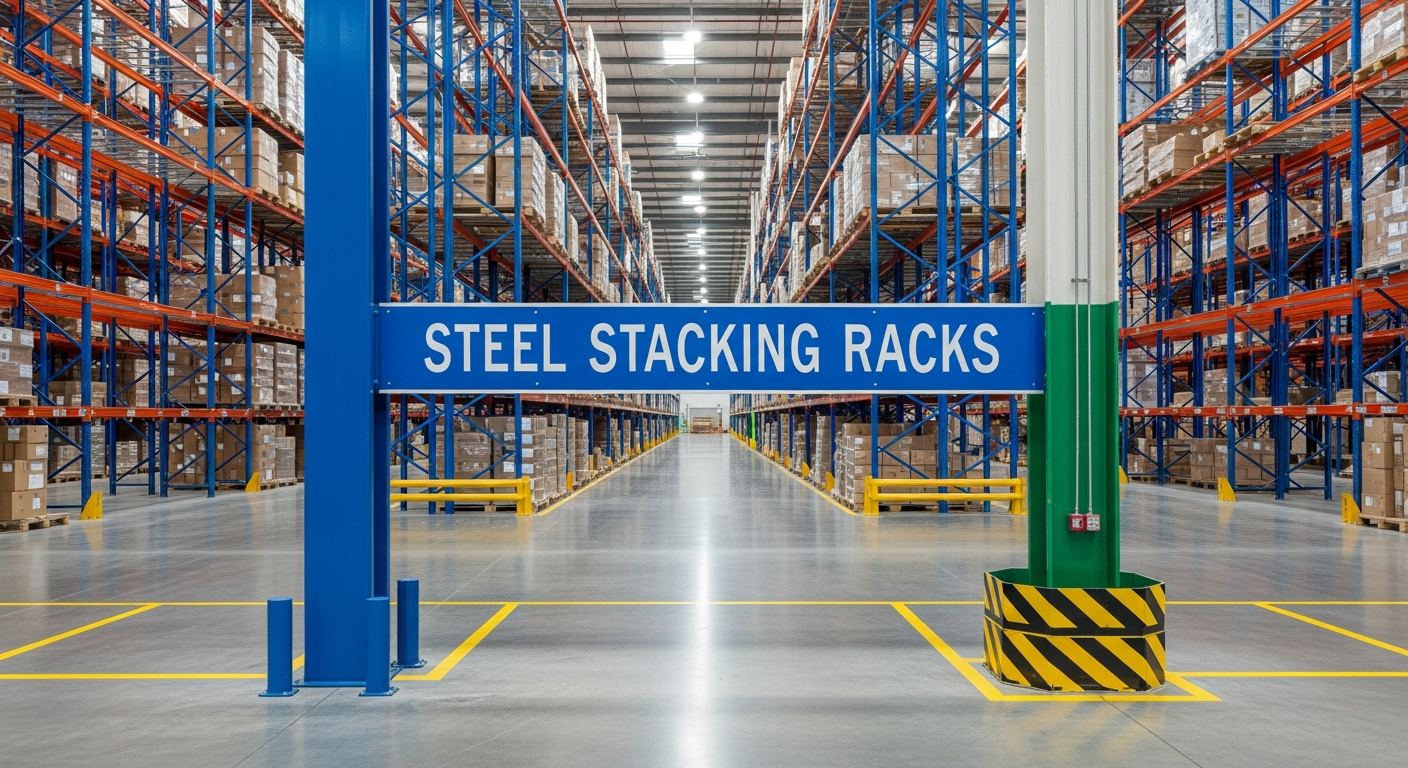

Types of Steel Stacking Racks and Common Configurations
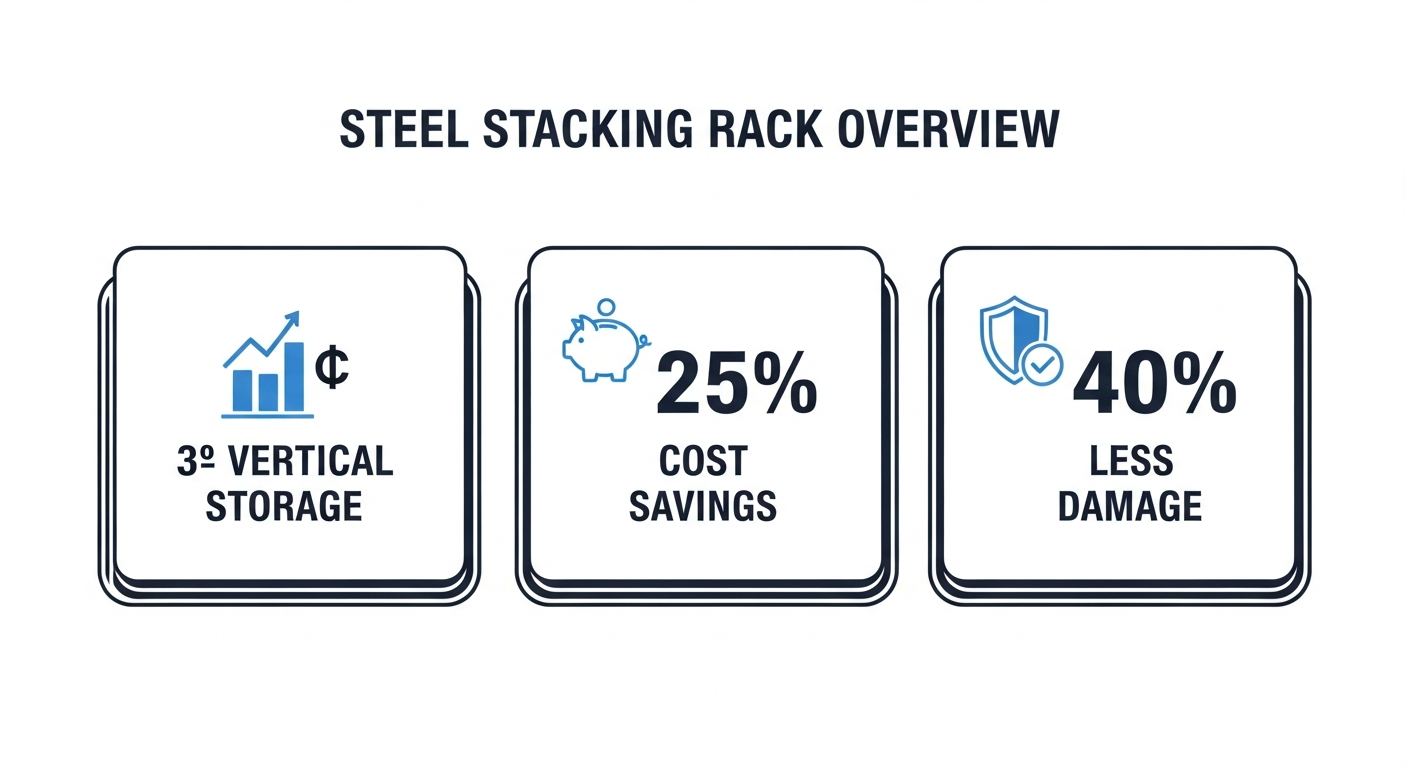
Not all steel stacking racks are built the same. The right type depends on how heavy your loads are, what your parts look like, and whether empty racks need to return on the same truck.
Post-Style vs. Solid-Frame Stacking Racks
Post-style racks use four corner uprights welded to a base frame with no solid wall panels. Open on all sides, they’re the most common design in heavy manufacturing — easy to load from multiple directions, strong, and straightforward to inspect. Typical capacity ranges from 2,000 to 8,000 lbs per unit depending on tube gauge and base footprint.
Solid-frame racks add structural panels — solid steel, expanded metal, or wire mesh — on some or all sides. They provide part containment, prevent small components from falling through, and often double as shipping enclosures for returnable packaging programs. They’re heavier, which matters when you’re sorting and stacking empties at volume.
Both types stack the same way. The choice comes down to what you’re storing: if it could fall through an open post-style rack’s sides, use a frame. If it’s a large assembly that loads cleanly from the top, post-style is faster and simpler.
Nestable Racks and Custom-Configured Options
Nestable racks are designed so empties collapse or nest inside each other, cutting the space needed for return shipments by 60–70%. For operations with significant empty-rack return volume — automotive supply chains especially — that footprint reduction directly affects freight costs and dock congestion. The catch: nestable racks carry lighter loads and require more careful engineering to hold rated capacity while still nesting cleanly.
Custom-configured racks are what you need when standard footprints (48″ × 48″, 60″ × 48″) don’t match your parts, your lift equipment, or your dock dimensions. A custom rack can be sized to the inch, with interior features that match your part geometry exactly. It’s also the only option when OEM customers have their own rack specs, part contact requirements, or corrosion protection standards.
How to Specify the Right Steel Stacking Rack for Your Operation
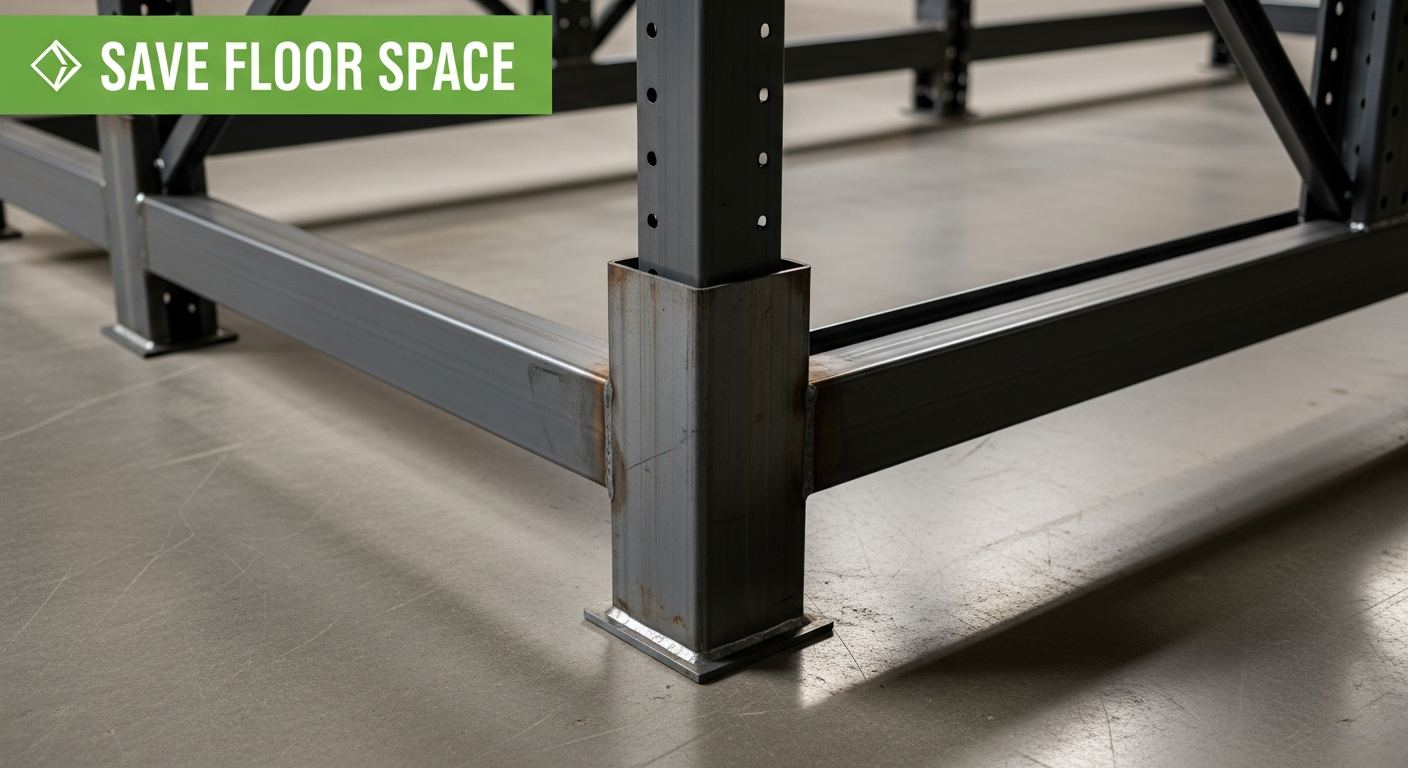
Get this right upfront and you’ll avoid the costly re-orders that come from racks that almost fit.
Load Capacity, Footprint, and Part Geometry
Start with your maximum loaded weight — not the average, the worst case. Multiply by the number of racks you’ll stack. The bottom rack in a three-high stack with 3,000 lbs per unit is carrying more than 9,000 lbs. Your rack needs to be rated for that, with a safety margin.
Once load requirements are locked, work through the dimensions:
- Measure your part at its widest point in each axis
- Add 2–4 inches of clearance per side for loading — tight clearance slows operators and causes scratches
- Account for weight distribution: is the load concentrated in the center or near the corners?
- Confirm the loaded height fits within your stacking plan and your building’s clear height
Common sizing mistakes: racking that’s too tall for the dock door on a loaded truck, and interior dimensions just tight enough that operators scratch parts on every third load.
Stacking Height, Aisle Constraints, and Fork Truck Compatibility
Your lift truck determines fork pocket orientation. Working in narrow aisles may require four-way entry even if two-way is simpler to build. If your operation uses powered pallet jacks, narrow-aisle trucks, or AGVs with fixed fork widths, the pocket dimensions need to match exactly, not approximately.
Stacking height has hard limits. ANSI MH16.3 guidelines recommend keeping freestanding stacked racks below a 4:1 height-to-base-width ratio. Know your ceiling clearance, know your aisle turning radius, and communicate both to your rack supplier before design starts. These constraints are cheap to account for on paper. They’re expensive to discover after fabrication.
Plexform’s Custom Steel Stacking Rack Engineering Process
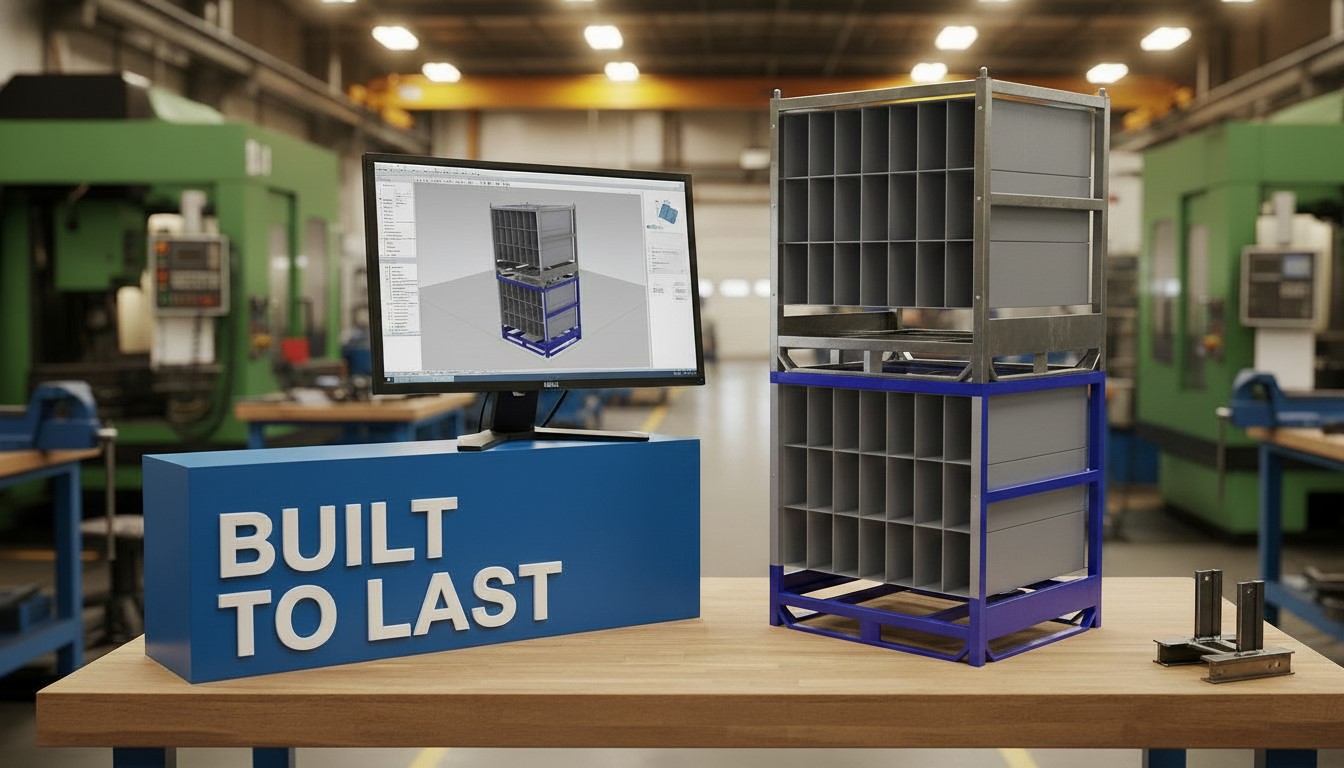
Catalog racks solve a generic problem. If your parts, trucks, or facility have specific requirements, an off-the-shelf rack doesn’t cut it — you end up building workarounds around the workarounds.
Engineering Your Rack from Specification
Plexform’s process starts with your part. Our engineers review load weight, part profile, existing lift equipment, and stacking requirements before any steel gets cut. We build CAD models, confirm dimensions with your team, and prototype when the application is new or complex.
The practical payoff:
- Clearance issues caught in CAD cost nothing to fix; found on the production floor, they’re expensive
- Fork pocket sizing confirmed against your actual equipment means operators aren’t fighting the rack
- Interior features — dividers, locating tubes, foam blocks — are built to the part, not estimated
We deliver racks powder-coated or primed, with rack ID markings if needed for internal tracking. Most standard custom builds run 4–8 weeks from approved design to delivery.
Cost, ROI, and Long-Term Value
Standard post-style stacking racks run roughly $150–$400 each depending on size and capacity. Custom racks typically run $350–$900 or more depending on complexity, interior features, and order volume.
Eliminate one part damage event per month, cut a half-hour of daily improvisation around racks that don’t quite fit, add one more stack tier per bay — in most operations, a fleet of well-spec’d custom steel stacking racks pays for itself within 12–18 months, and then runs for a decade without replacement.
Comparison: Steel Stacking Rack Configuration Options
| Configuration | Typical Capacity | Empty Handling | Best Use Case | Relative Cost |
|---|---|---|---|---|
| Post-Style (standard) | 2,000–8,000 lbs | Stack only | Heavy assemblies, large parts | $ |
| Solid-Frame | 2,000–5,000 lbs | Stack only | Small parts, contained loads | $$ |
| Nestable | 500–2,500 lbs | Stack + Nest | High empty-return volume | $$ |
| Custom-Configured | 1,000–10,000+ lbs | Either | OEM-spec, specific part geometry | $$–$$$ |
When specifying steel stacking racks, whether for the first time or upgrading from a legacy design, the same questions come up. Here are the ones we hear most.
What’s the difference between a stacking rack and a pallet rack?
Pallet racks are fixed shelving units that anchor to floors or walls. Steel stacking racks are freestanding, portable, and moved by forklift. You stack them on top of each other to build vertical storage without any permanent installation. They also work as transport containers — loaded onto trucks, moved between facilities, and returned empty through the same supply chain.
How many high can you stack steel stacking racks?
Most racks are rated for 2–3 high under load. The practical limit depends on your building’s clear height, the rack’s load rating, and ANSI MH16.3 stability guidelines, generally a 4:1 height-to-base-width ratio maximum. Don’t stack above the manufacturer’s rated height without an engineer’s sign-off, and check the stacking cup condition regularly on high-cycle racks.
Can steel stacking racks be used for shipping?
Yes. Solid-frame and custom-configured racks are widely used as returnable shipping containers in automotive and heavy-equipment supply chains. Interior protection features like foam, dividers, and locating tubes make them suitable for transit without additional packaging. Nestable designs return empty on the same truck, which keeps freight costs down.
What load capacity do steel stacking racks typically handle?
Standard racks handle 2,000–8,000 lbs. Custom-built racks can exceed 10,000 lbs per unit. Specify to your worst-case scenario: the heaviest part, in the fullest rack, at the bottom of your maximum stack height. Build in a 20–25% safety margin and communicate that number clearly to your manufacturer.
The Bottom Line on Steel Stacking Racks
A well-spec’d steel stacking rack isn’t just storage. It’s how you use the vertical space you already have, reduce part damage, and run a handling operation that doesn’t require improvisation every shift.
The spec is everything. Capacity, footprint, fork entry, and interior configuration all need to match your parts and your equipment, not a generic catalog dimension. A rack that fits adds years of reliable service. One that doesn’t creates a new category of daily frustration.
Plexform engineers and builds custom steel stacking racks for manufacturers across North America. If you’re running out of floor space, dealing with damaged parts, or working with parts that standard racks don’t fit, talk to our team at plexformps.com — we’ll spec the right rack for your operation from the ground up.

Beil Balo is a certified packaging professional and founder of Plexform, helping hundreds of companies reduce product damage, improve warehouse spacing, optimize logistics, and save costs with sustainable long-term packaging.