 Skip to content
Types of Custom Equipment for Warehouse Operations
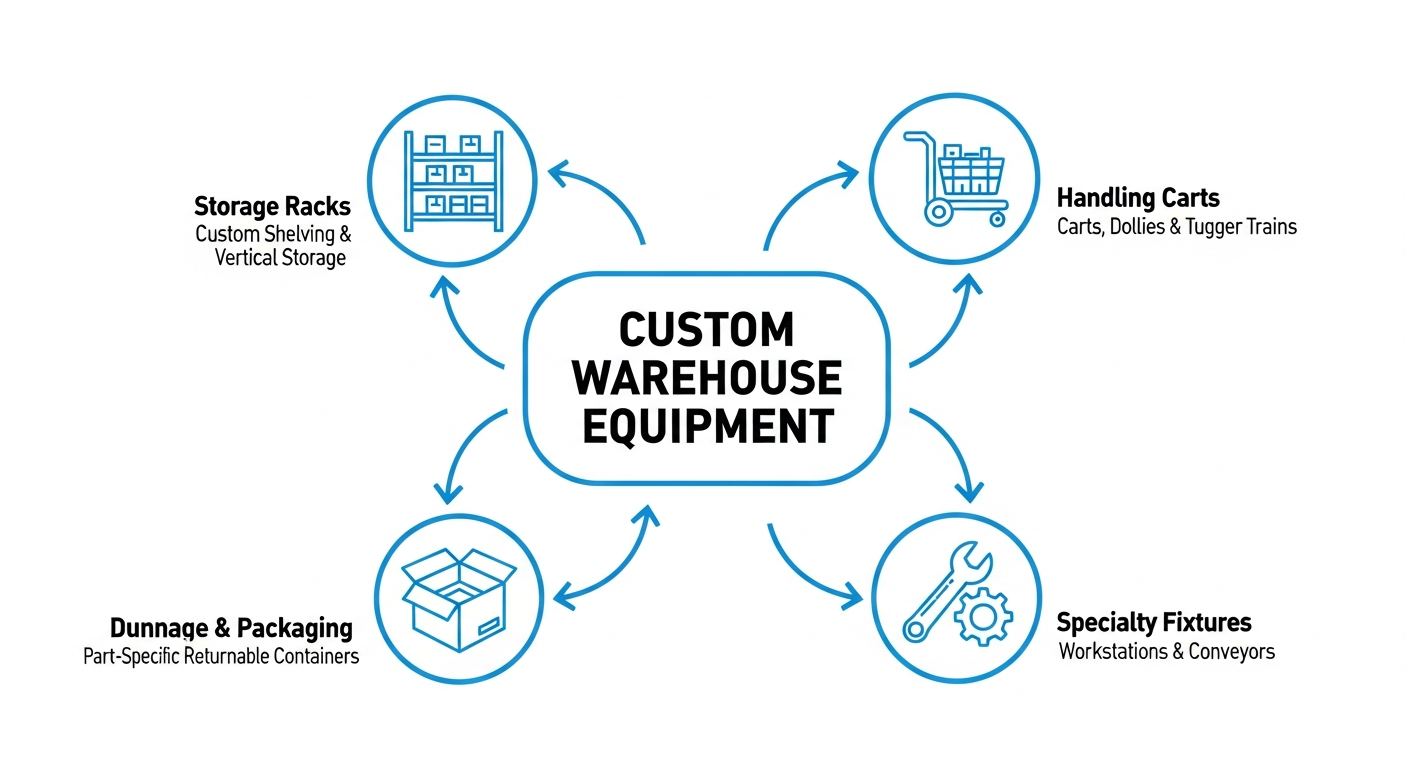
Most facilities think of custom equipment as racks and carts. There’s a lot more ground it covers.
Custom Storage Racks and Shelving Systems
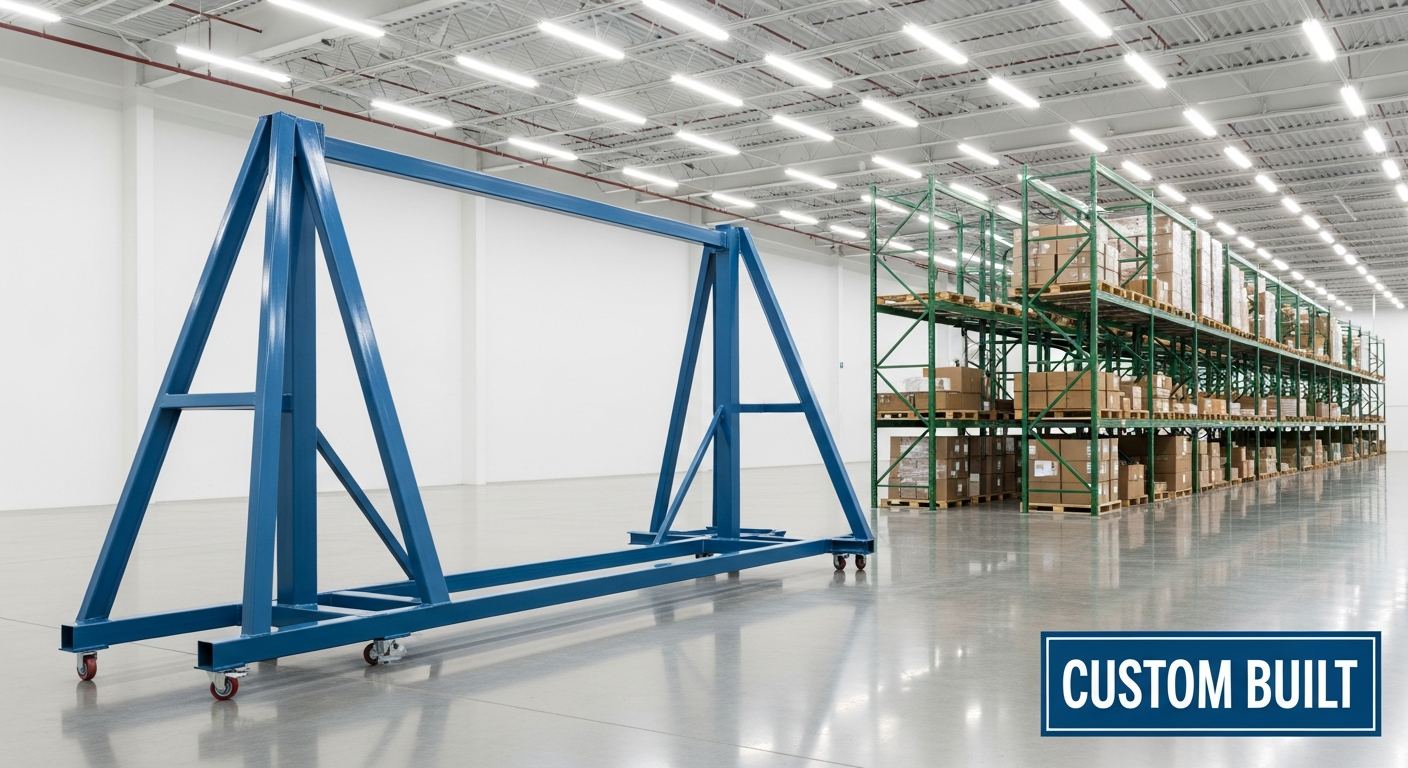
Custom rack systems (stack racks, A-frames, cantilever racks, vertical post systems) are engineered to your exact column pitch, part weight, and access requirements. A standard pallet rack assumes 8-foot pallet depth. A custom system accounts for your actual load profile, whether that’s long steel bar stock, coiled wire, automotive stampings, or irregularly shaped assemblies.
Custom shelving also means adjustable tier heights matched to your actual SKU mix, not an average SKU that doesn’t exist in your operation.
Material Handling Carts, Dollies, and Tugger Trains
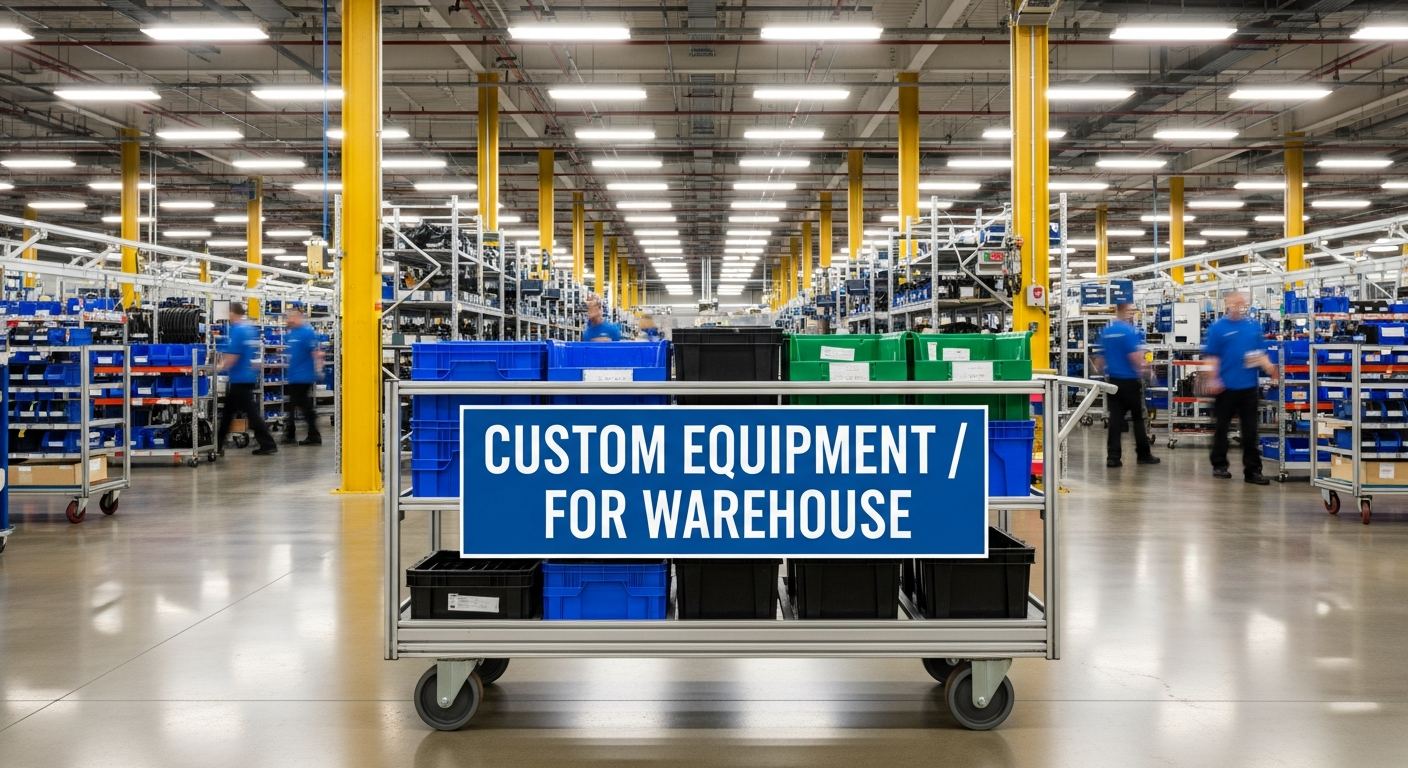
Carts built for your facility match your aisle widths, turning radius, and load capacity. Tugger trains, lineside presentation carts, and transfer cars can all be spec’d to interface directly with your production stations, so parts arrive at the right ergonomic height in the right orientation. Operators don’t reposition. They don’t double-handle.
The difference between a generic cart and a custom one often shows up on the first shift. Operators notice immediately when equipment was built for their actual workflow.
Dunnage Trays and Returnable Containers
Custom returnable containers, whether foam-lined, locating-pinned, or steel-divided, protect parts through transit and handling and stack consistently for storage and shipping. A good dunnage system often pays for itself in reduced damage claims within the first year.
How to Spec Custom Equipment for Your Facility
Getting custom warehouse equipment right starts before the first drawing is made. The most common mistake is jumping straight to product selection without mapping the workflow first.
Start With Workflow Mapping, Not Product Selection
Walk the floor. Trace the actual path each part or SKU takes from receiving to storage to production. Where are the bottlenecks? Where are people waiting, re-handling, or improvising? Those friction points are your spec requirements. Every custom piece of equipment should solve a specific, observable problem.
Ask your operators. They know where the current equipment fails better than anyone. That input surfaces requirements that never make it onto a drawing unless someone asks.
Key Measurements and Load Data to Gather First
Before engaging with a custom equipment supplier, have this information ready:
- Part envelope dimensions: length, width, height, and any protrusions or flanges
- Part weight: per piece, per batch, and maximum load per container
- Stack height requirements: how many units need to stack safely during storage and transport
- Forklift entry specs: fork width, entry direction, and required lift height
- Aisle dimensions: clear aisle width and worst-case turning radius
- Throughput volume: units per hour, shifts per day, cycles per year
That data is what separates a well-engineered custom solution from an educated guess. A supplier who doesn’t ask for most of this upfront isn’t doing a thorough job.
Material Selection and Finish Requirements
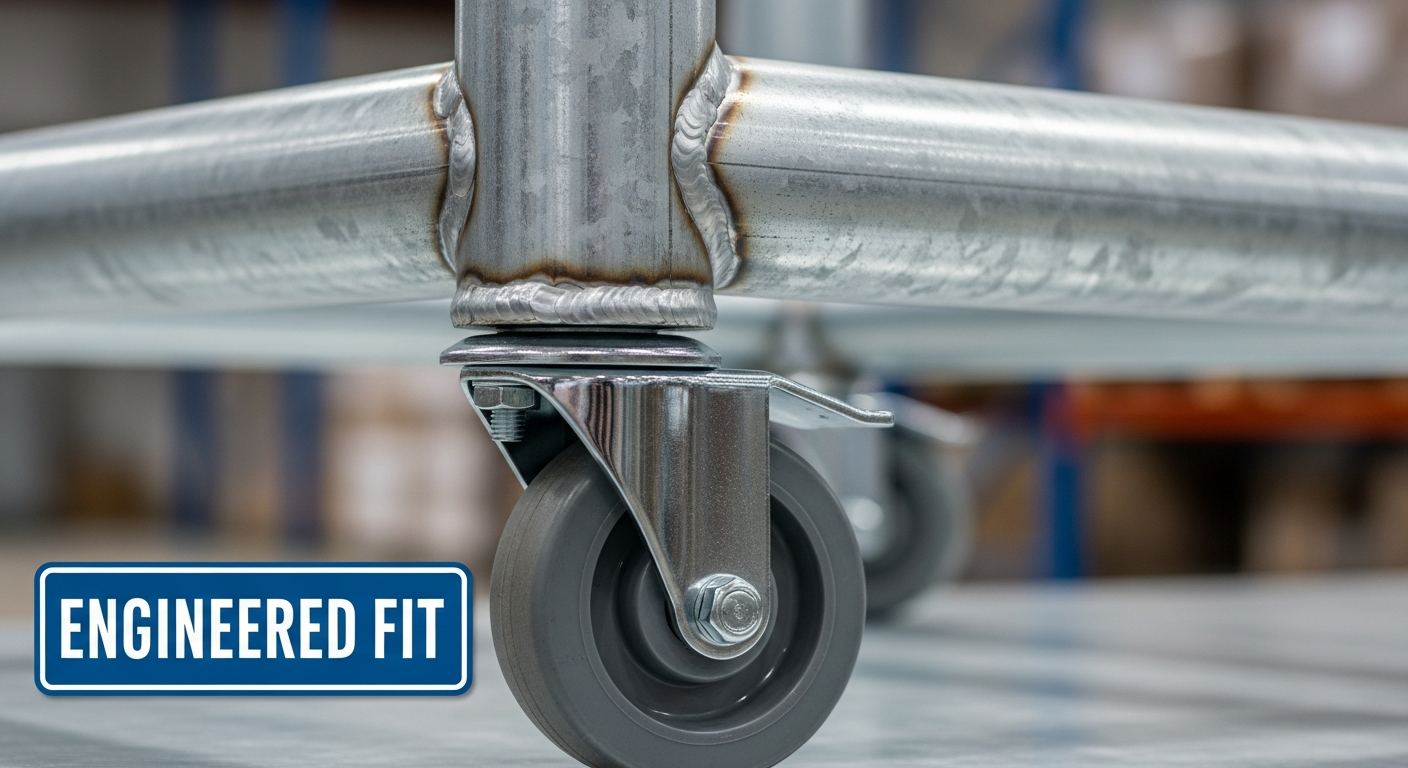
Steel gauge, tube diameter, and surface finish all matter, especially for high-cycle equipment. A cart running three shifts a day on rough concrete needs heavier-gauge tube and reinforced weld joints compared to one making light-duty moves across a clean floor. If you’re in a food-grade or wash-down environment, finish selection (powder coat vs. galvanized vs. stainless) isn’t cosmetic. It’s structural longevity.
Plexform’s Engineering Process and How Custom Compares to Standard
Plexform doesn’t sell off-the-shelf material handling products. Every project starts with a conversation about your operation, not a product catalog.
From CAD Drawing to Prototype to Full Production
Our engineers work directly from your workflow documentation, floor plan, and part specs. That information drives the initial CAD design, reviewed with your team before any fabrication begins. You see exactly what you’re getting, down to the weld locations, material spec, and surface finish, before we cut a single piece of steel.
For most projects, we build a first-article prototype for your team to evaluate on the actual floor. That step catches fit issues, ergonomic concerns, and workflow gaps before full production runs. It also gives your operators a chance to weigh in. The people using the equipment every day often catch things that don’t show up on a drawing.
Custom vs. Off-the-Shelf: An Honest Comparison
| Factor | Custom Equipment | Off-the-Shelf Equipment |
|---|---|---|
| Upfront cost | Higher (typically 20–50% more per unit) | Lower initial purchase price |
| Lead time | 4–10 weeks depending on complexity | In-stock or 1–2 week delivery |
| Fit for purpose | Engineered to your exact specs | Designed for general use |
| Long-term ROI | Higher: reduced damage, faster throughput | Variable; depends on how well it fits |
| Reorder consistency | Exact spec reordered any time | Subject to catalog changes or discontinuation |
| Durability | Built to your actual load and cycle demands | Built to average use assumptions |
Custom makes more sense the more irregular your parts are, and the more your operation depends on precise part protection during handling and transport. For facilities with uniform, palletized loads and standard dimensions, off-the-shelf may be fine. For everyone else, the math usually favors custom within 12–24 months.
Frequently Asked Questions About Custom Equipment for Warehouses
When you’re specifying custom equipment for warehouse operations, a lot of questions come up. Here are the ones we hear most.
What types of custom warehouse equipment does Plexform build?
Plexform engineers stack racks, A-frames, carts, dollies, tugger trains, returnable containers, dunnage inserts, and custom shelving systems. If it moves, stores, or protects parts in a warehouse or manufacturing facility, we can build it to your spec.
How long does it take to receive custom warehouse equipment?
Most custom projects run 4–8 weeks from approved drawing to delivery. Simpler items like custom carts can move faster; multi-component systems take longer. We give you a specific lead time after reviewing your requirements, so you’re not guessing.
Is custom warehouse equipment worth the higher upfront cost?
Usually, yes. The per-unit cost runs 20–50% higher depending on complexity, but that number looks different when you account for reduced part damage, faster throughput, and equipment that doesn’t need to be jury-rigged or replaced in two years. Most facilities see the cost of ownership tip in favor of custom somewhere in the 12–24 month range.
Can Plexform modify or build off an existing design?
Yes. A lot of projects start from a customer-supplied sketch, an existing piece of equipment that needs improvement, or a CAD file. We adapt existing designs as often as we start from scratch.
What information do I need to get a quote?
At minimum: part dimensions, weight, handling method (forklift, hand, conveyor), quantity needed, and any specific environmental requirements. The more detail you provide, the more accurate the initial quote. Our team will ask follow-up questions to fill in the gaps.
How do I know the equipment will fit my facility before it’s built?
We provide detailed CAD drawings for your review and approval before fabrication begins. For larger projects, we also build a first-article prototype for on-site evaluation. You don’t commit to full production until the design is confirmed to work in your actual space.
The Right Equipment Changes How Your Operation Runs
Custom equipment for warehouse operations isn’t a luxury, it’s an engineering decision. When your racks are built to your ceiling height, your carts are spec’d for your aisle width, and your dunnage is sized to your actual parts, things work better. Not marginally better. Meaningfully better.
Standard equipment is a starting point, not a destination. Custom solutions recover floor space, cut damage rates, and speed up throughput in ways catalog gear can’t. And with Plexform handling the engineering, most facilities find the process more approachable than they expected going in.
Ready to spec equipment that actually fits your operation? Visit plexformps.com to connect with our engineering team and get started.

Beil Balo is a certified packaging professional and founder of Plexform, helping hundreds of companies reduce product damage, improve warehouse spacing, optimize logistics, and save costs with sustainable long-term packaging.