 Skip to content
SEO TITLE (Yoast — 53 chars): Custom Pallet Manufacturing: A Complete Buyer's Guide
Standard pallets fail in predictable ways. Put a 48×40 GMA pallet under a 2,000-lb automotive stamping and the deck boards may flex enough to shift the load mid-transit. Try to fit that same pallet into a racking system designed for 52-inch bays and you’ve got overhang, instability, and a potential OSHA issue. Force it onto a conveyor line calibrated for specific entry clearances and you’re adjusting the line, not the pallet.
Custom pallet manufacturing exists because most manufacturing operations eventually outgrow commodity solutions. When your product, equipment, or supply chain has specific requirements, the right answer is a pallet built around those requirements — not the other way around.
This guide covers what custom pallets are, which materials and configurations are worth knowing, how to define your specs before you talk to a manufacturer, and how to figure out whether the investment actually makes sense for your operation.
What is custom pallet manufacturing — and why does it matter?
Custom pallet manufacturing is the engineering and production of pallets built to non-standard dimensions, load ratings, material types, or entry configurations. It’s not a specialty product for unusual situations. It’s what most manufacturing operations eventually need when standard options start creating friction they can measure.
Beyond the standard 48×40
The 48×40-inch wood stringer pallet is the default for a reason: it fits most racking systems, grocery supply chains, and GMA requirements. But it wasn’t designed for your products or your handling equipment specifically.
If your loads are heavier than a standard pallet can support, if your racks run non-standard bay widths, or if your conveyor needs tighter deck tolerances than commodity wood can consistently deliver — you’re absorbing that mismatch somewhere. It shows up in product damage claims, in labor spent reblocking and rebanding unstable loads, in the quiet friction of a logistics chain that almost works. The global pallet market exceeds $70 billion, and a growing share of that is custom, because manufacturers are learning that “close enough” has a cost.
Which operations actually need custom pallets
Not every facility does. But if any of these apply, it’s worth a real evaluation:
- Your product footprint doesn’t match 48×40, 42×42, or other standard sizes
- You’re running loads over 4,000 lbs that need engineered deck support
- Your facility uses automated conveyor, AS/RS, or robotic depalletizing systems with specific deck tolerances
- You ship internationally and need ISPM-15 heat-treated lumber with full compliance documentation
- You run washdown environments, food-grade areas, or chemical exposure zones where untreated wood is prohibited
- You’re losing product in transit due to inadequate pallet support
- Your team is spending real time reblocking or rebanding loads that don’t fit
Materials and construction in custom pallet manufacturing
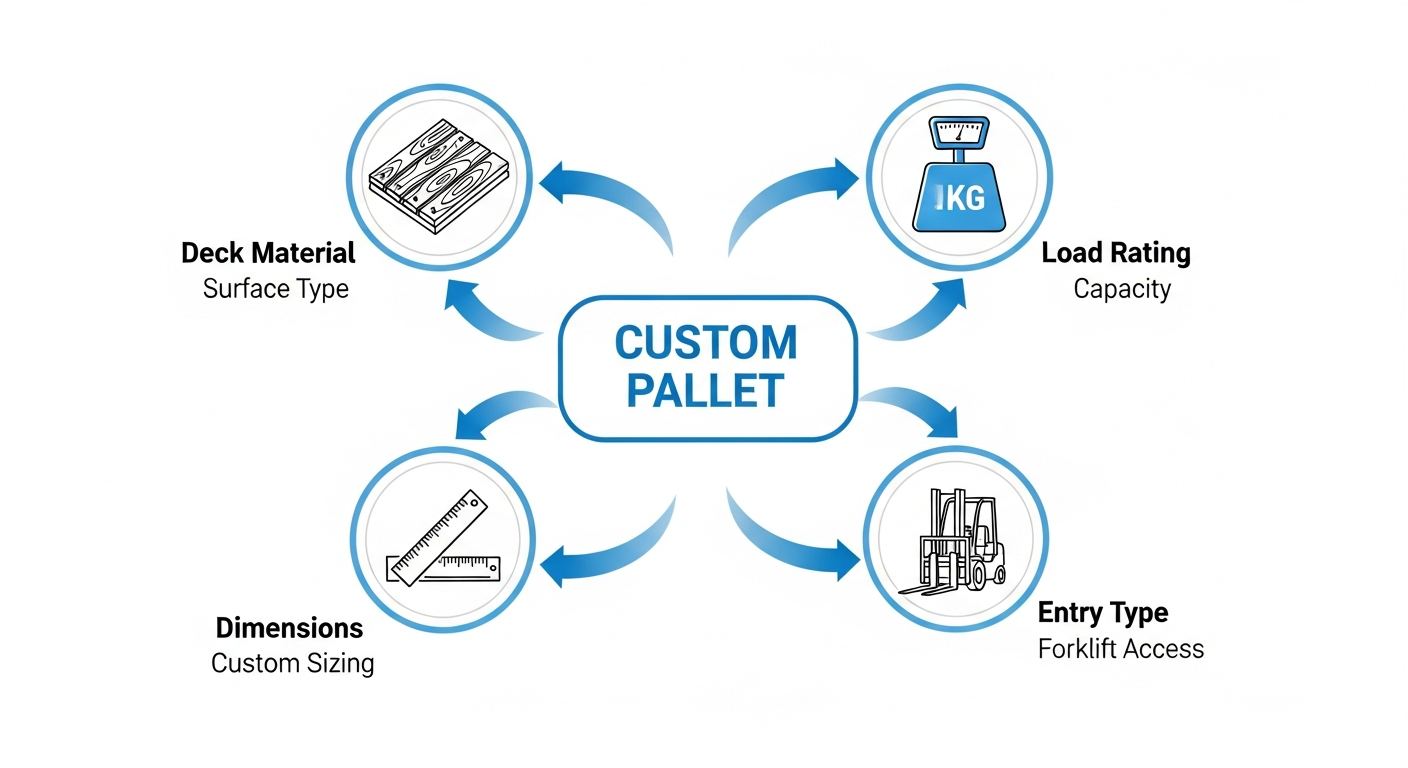
Material choice drives everything downstream: cost per unit, service life, load rating, repairability, and whether the pallet can enter certain environments at all. Get this right early and the rest of the spec process is straightforward.
Wood, steel, and plastic — choosing the right material
Wood is the most common starting point in custom pallet manufacturing, and the reasons are practical. It cuts to any dimension, repairs simply, and stays cost-effective at most production volumes. Hardwood species like oak and maple handle higher load ratings; Southern Yellow Pine is lighter and common for lower-weight applications. For international shipments, wood pallets must be heat-treated and ISPM-15 stamped. That’s a requirement you specify at order time, not after production.
Steel is the call when you need high-cycle durability, very high load capacity, or a surface that survives washdown. A steel pallet built to spec will outlast wood by a significant margin in a closed-loop system — typically 200 to 500 trips versus 15 to 50 for a quality custom wood pallet. The upfront cost is higher. The per-trip math usually inverts well before year two.
Plastic pallets are hygienic and won’t splinter, which makes them common in food processing and pharmaceutical environments. The tradeoff is limited customization and weaker performance under concentrated point loads. They’re not the right call for heavy or highly specific load configurations.
The structural components that actually matter
Every pallet, regardless of material, is built from the same core elements. Each one affects how the finished pallet performs:
- Stringers or blocks form the sub-structure that elevates the deck and defines fork entry. Stringer pallets use three parallel boards running the pallet’s length; block pallets use nine posts in a 3×3 grid, which enables full four-way fork entry.
- Top deck boards are the surface in contact with your product. Board spacing, thickness, and species all affect load distribution. Tight spacing handles heavy point loads; wider spacing saves weight and cost for uniform loads.
- A bottom deck, in double-face designs, adds structural stiffness during racking. Reversible designs make both faces product-safe, which roughly doubles usable service life in closed-loop use.
- Notches cut into stringer pallets at the midpoint allow partial four-way entry for rider pallet jacks — important in facilities that don’t run counterbalance forklifts.
- Chamfered lead boards angle the front edge of the top deck to reduce fork damage during entry, which matters most in fast-moving pick operations.

Types and configurations in custom pallet manufacturing
“Custom” doesn’t mean designing from a blank page. It means choosing the right combination of construction type, entry style, and deck configuration for your application. Most procurement teams hit a wall here simply because they don’t know the options going in.
Stringer vs. block pallets
| Feature | Stringer Pallet | Block Pallet |
|---|---|---|
| Fork entry | 2-way (or notched 4-way) | Full 4-way |
| Handling equipment | Forklifts and rider jacks | Forklifts (full entry) |
| Load capacity | Moderate to high | High |
| Unit cost | Lower | Higher |
| Repairability | Easy (board replacement) | More complex |
| Common application | Distribution, general manufacturing | Automated systems, heavy industrial |
Stringer pallets are the workhorse of most custom wood applications. Block pallets are right for automated environments or anywhere genuine four-way entry is required from all sides without notching.
Single-face, double-face, and reversible designs
The deck configuration affects stability, service life, and how the pallet behaves under racking load:
- Single-face: one deck, no bottom boards. Lightest and lowest cost. Works well for one-way shipments or stable, uniform loads that won’t go into racking.
- Double-face non-reversible: adds a bottom deck for structural stiffness, but the underside isn’t finished for product contact. Common in heavy manufacturing where racking stability matters but the load orientation never changes.
- Double-face reversible: both faces are finished and usable. In a closed-loop system, this effectively doubles service life, which has a direct effect on per-trip economics.
Beyond these three, custom manufacturing opens up configurations you won’t find at a pallet broker: integrated crating bases, notch patterns matched to your specific fork tine dimensions, decks toleranced for automated depalletizers, and skids (runners only, no bottom deck) for heavy equipment that gets placed and stays.
How to spec your custom pallet before you call a manufacturer
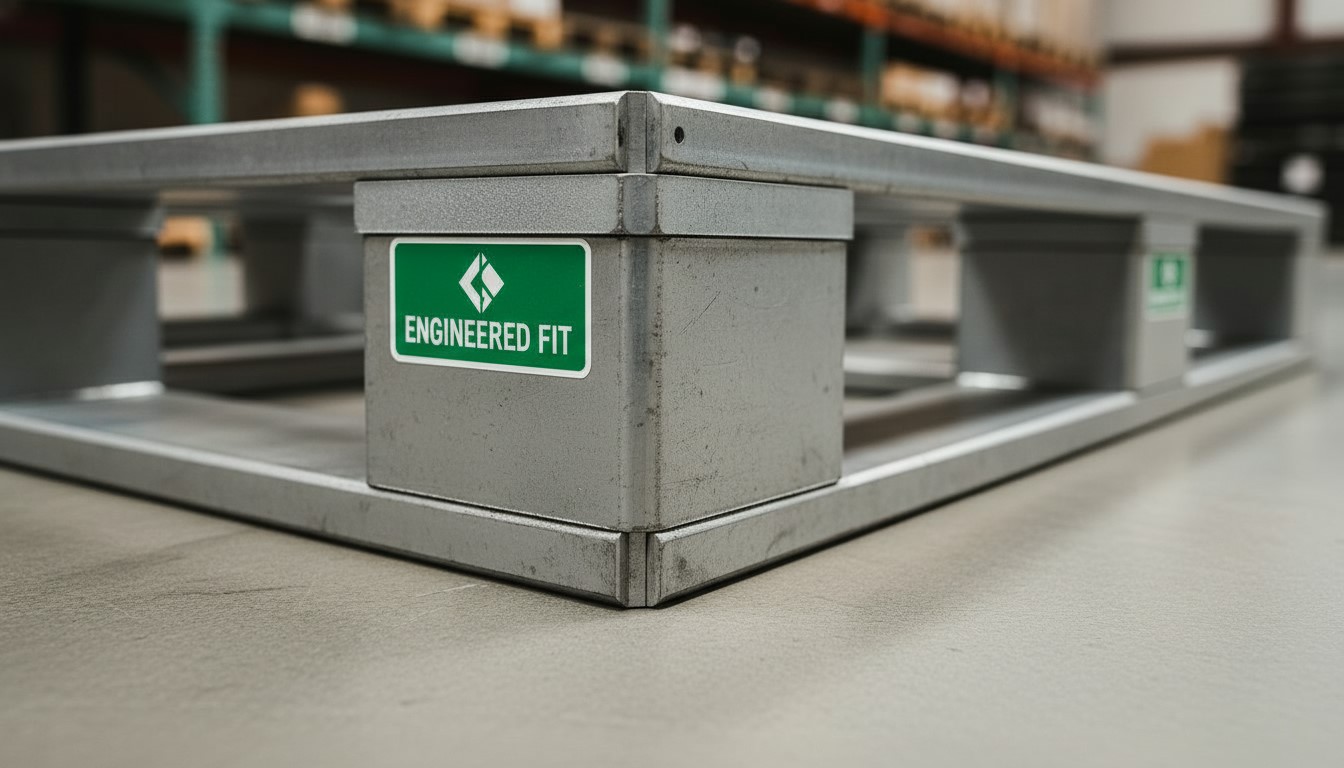
Most of the back-and-forth in the ordering process comes from buyers who call without specs. You end up three conversations in, still defining requirements that should have been clear from the start. Here’s what you need before you pick up the phone.
Six things to nail down before you call
1. Dimensions first. Start with your product footprint and work backward to the pallet face size and deck height. If your conveyor or racking has clearance constraints, those are hard limits, not preferences.
2. Load weight isn’t one number, it’s three: static (pallet sitting on the floor), dynamic (during forklift movement), and racking (supported only at the pallet ends on rack beams). A pallet rated for 4,000 lbs static may only handle 2,500 lbs in a racking application. Know which ratings apply to your operation before you call.
3. Fork entry type. Two-way or four-way? Rider jack or counterbalance forklift? Standard fork tines run 4 inches wide. If you’re running specialized equipment, those clearance dimensions need to match your actual hardware.
4. Material compliance can’t be retrofitted. Heat-treated lumber for export, ISPM-15 stamping, washdown-safe steel, food-grade certification — these determine the material specification. Specify them upfront or you’ll be re-quoting from scratch.
5. Think in trips, not shipments. A one-way pallet has a completely different design brief than a closed-loop pallet cycling 200+ times a year. Service life expectation changes the material, the construction, and the economics.
6. Environment matters more than people expect. Outdoor storage, freezers, chemical washdown, high humidity — all of these affect material and treatment. A Southern Yellow Pine pallet that works fine in a dry climate-controlled facility won’t last long in a wet dock area.
Specification mistakes that cost you
The most common error: specifying static load capacity and forgetting racking and dynamic ratings. Second most common: leaving material requirements vague and letting the manufacturer default to whatever’s in stock. A third one that catches facilities moving to automation off guard — failing to specify deck flatness tolerance, then discovering the automated system can’t handle the variance in commodity wood. If you’re uncertain on a spec, a good manufacturer can work backward from your application with you. But you need to show up with application details, not a blank form.
Custom pallet cost, ROI, and Plexform’s engineering process
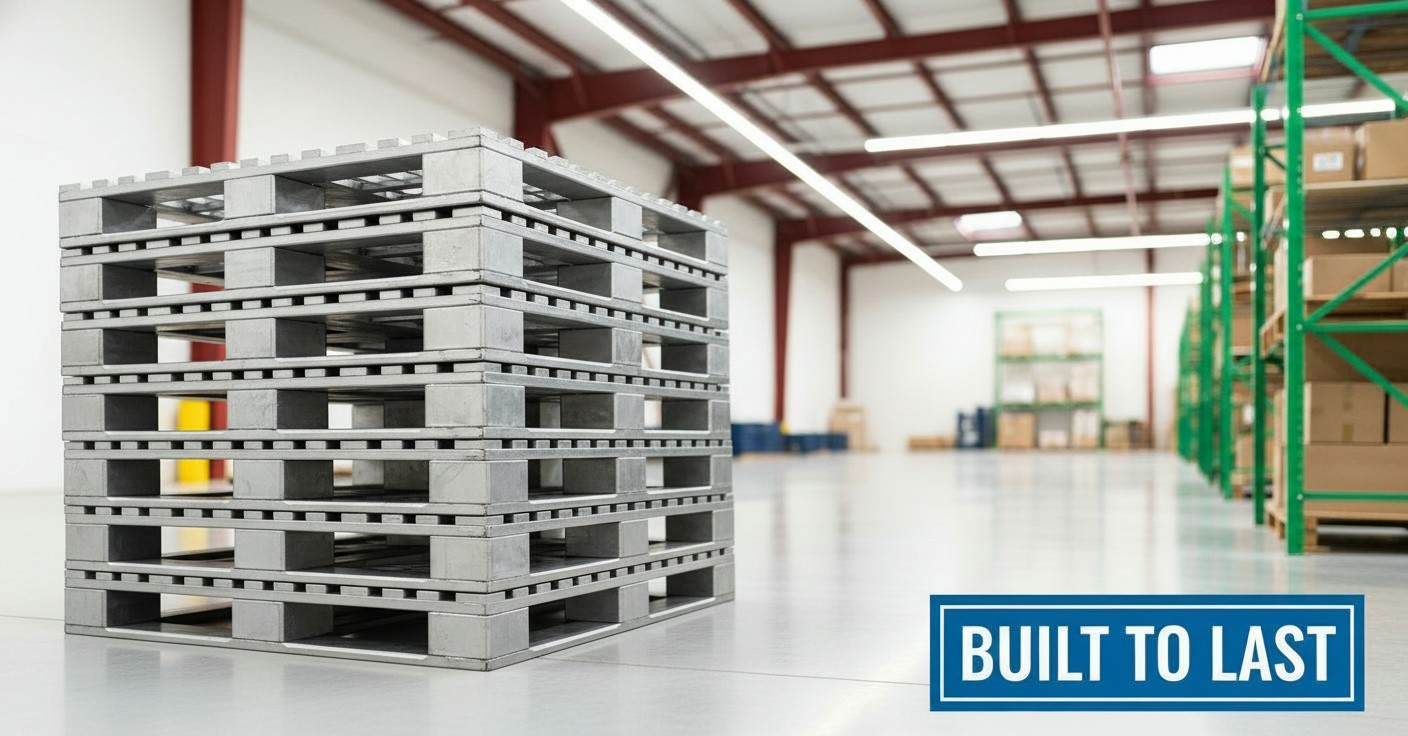
The upfront unit cost of a custom pallet is almost always higher than a commodity GMA pallet. That’s also almost always the wrong comparison to make.
| Factor | Standard GMA Wood | Custom Wood Pallet | Custom Steel Pallet |
|---|---|---|---|
| Unit cost | $10–$20 | $25–$75+ | $100–$350+ |
| Typical trips | 10–25 | 20–60+ | 200–500+ |
| Cost per trip | $0.60–$1.50 | $0.80–$2.00 | $0.40–$1.00 |
| Product damage risk | Moderate–High (poor fit) | Low (engineered fit) | Very Low |
| Export compliant | No (typically) | Yes (if HT-stamped) | Yes |
| Repair frequency | High | Moderate | Low |
The real cost comparison: per trip, not per unit
A $150 custom steel pallet that lasts 300 trips costs $0.50 per trip. A $15 commodity wood pallet that survives 15 trips under heavy industrial use costs exactly the same — before you factor in product damage from a pallet that doesn’t actually fit your load.
Here’s the calculation worth running: take your annual pallet volume, multiply by your product damage rate attributable to pallet failures, and add the labor cost of reblocking or rebanding unstable loads. Add any freight cost from pallet-related inefficiency. Compare that total against the annual premium for going custom. In most manufacturing environments, that math turns positive well before month 12. Sometimes in the first quarter.
How Plexform designs and builds custom pallets
The process at Plexform starts with your load, not a catalog number. Our engineers look at product dimensions, weight distribution, how the pallet gets handled, and how it’s stored before anything gets specified. We right-size material and structure to meet your requirements without adding weight or complexity you don’t need — because every extra pound costs you something on every trip.
We build a prototype before any production run and test it against your actual conditions. That’s where tolerance issues get found, not after 500 units are sitting on the floor. After the production run, your spec stays on file so reorders don’t mean starting the conversation over.
Frequently asked questions about custom pallet manufacturing
When you’re specifying custom pallets for the first time, a lot of practical questions come up fast. Here are the ones we hear most.
What is the minimum order quantity for custom pallets?
For wood pallets, 50 to 100 units is typically the floor — that’s what it takes to justify setup costs. Steel pallets usually run higher: 100 to 250 units, because tooling and welding setup are more involved. At Plexform, we work through the right initial order size based on your actual demand and use cycle, not a fixed minimum.
How long does custom pallet manufacturing take?
Wood pallets are usually 2 to 4 weeks once you have an approved spec. Steel pallets with welded frames and powder-coat finish typically run 4 to 6 weeks. If you need a prototype first — which we recommend for anything automated or high-volume — add 1 to 2 weeks before production begins.
What do I need to provide to get a quote?
Pallet dimensions (L × W), load capacity (static and dynamic), material preference, fork entry type (2-way or 4-way), and intended use: floor stack, racking, or one-way shipment. Vague inquiries produce range estimates. Specific application details produce actual pricing.
Can custom pallets work with automated conveyor and AS/RS systems?
Yes, and it’s one of the most common reasons facilities move away from commodity pallets. Automated systems have specific deck tolerances, entry clearances, and flatness requirements that standard wood doesn’t meet consistently. For precision-toleranced automated environments, steel is often the right answer.
Do custom wood pallets need to be heat-treated for international shipments?
Any wood pallet entering most international markets must comply with ISPM-15 — heat treatment to 56°C core temperature for 30 continuous minutes, then properly stamped. You need to specify this at the time of order. It can’t be applied retroactively.
What’s the difference between a pallet and a skid?
A skid has no bottom deck. It rests on runners or stringers directly, without a defined fork entry cavity below. Pallets elevate the deck using stringers or blocks and have a clear fork entry space beneath the load. Skids are common under heavy equipment that’s placed and stays put; pallets are for loads that move. Both can be custom manufactured to your specs.
Conclusion
Custom pallet manufacturing pays off when the cost of using the wrong pallet — damaged product, labor spent reblocking loads, inefficient freight — adds up to more than the premium for building the right one. In most manufacturing environments, that math tips fairly quickly.
Spec your load requirements before anything else. Compare cost per trip, not cost per unit. And work with a manufacturer who starts from your application rather than their catalog.
Plexform engineers and manufactures custom pallets for manufacturing and distribution operations across North America. Get in touch at plexformps.com when you’re ready to spec something that actually fits.

Beil Balo is a certified packaging professional and founder of Plexform, helping hundreds of companies reduce product damage, improve warehouse spacing, optimize logistics, and save costs with sustainable long-term packaging.