 Skip to content
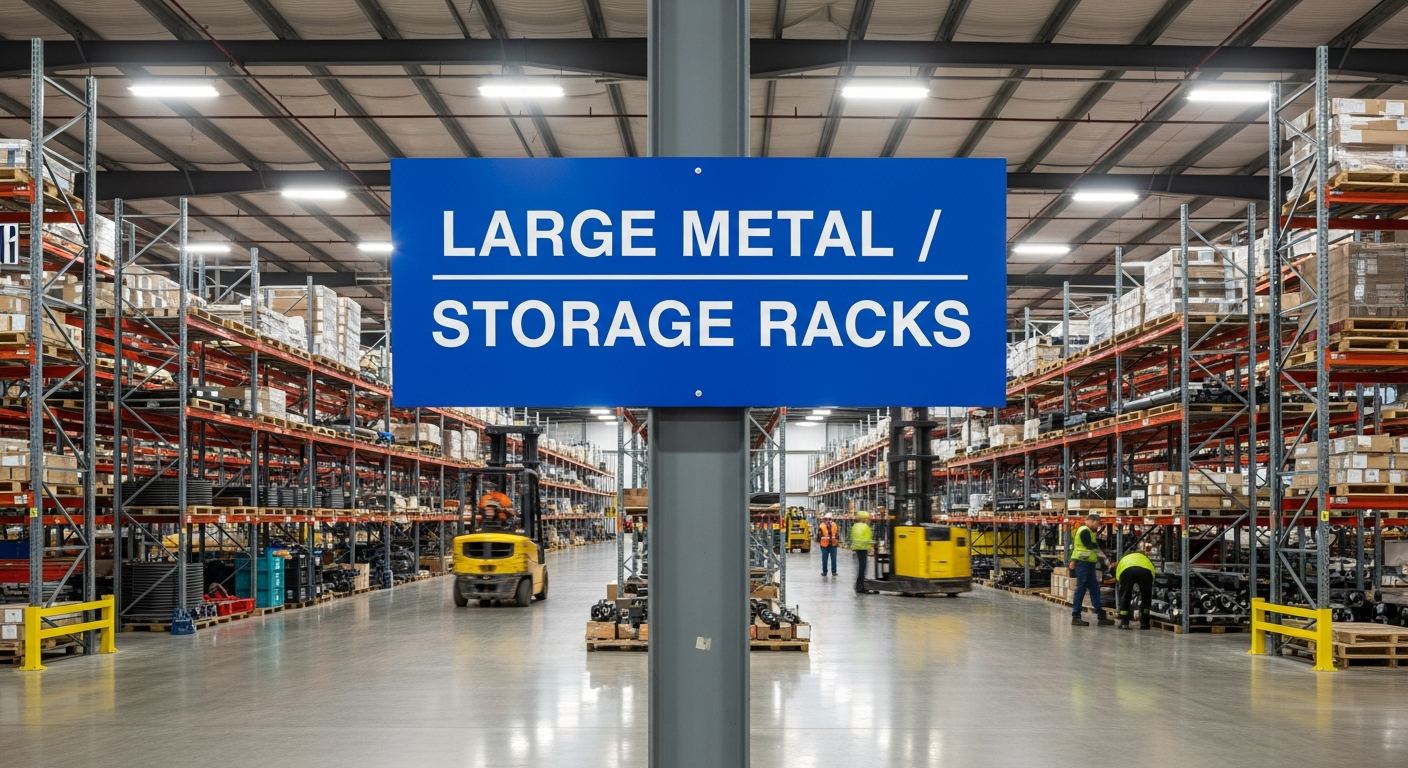
Every square foot of warehouse floor costs money. That’s not a metaphor — it’s rent, utilities, insurance, and the opportunity cost of space that isn’t doing any work. And yet, most facilities store inventory on two or three tiers when their ceiling height could support six or more.
Large metal storage racks are how you close that gap. Not the lightweight shelving you’d find in a garage or retail stockroom — these are engineered industrial racking systems rated for thousands of pounds per bay, built from structural steel, designed to work with forklifts and pallet jacks and the actual weight of manufacturing inventory.
This guide covers what large metal storage racks are, how they’re built, the main types available, and what you need to evaluate before specifying them for your facility. By the end, you’ll know exactly what to look for — and what questions to ask before you commit.
What Are Large Metal Storage Racks — and Why Do They Matter?
More Than Just a Shelf
In the material handling industry, “large metal storage rack” typically refers to any freestanding structural steel racking system rated to support 1,000 lbs per shelf level or more — often several times that. These aren’t off-the-shelf units from a big-box store. They’re engineered systems designed to meet specific load, clearance, and safety requirements for industrial environments.
The difference between a residential shelving unit and an industrial metal storage rack is roughly the difference between a garden hose and a fire main. Same basic concept, completely different engineering. Steel gauge, weld quality, upright geometry, connection hardware — all of it changes. And so does how the system behaves under a dynamic load, like when a forklift drops a 2,000-lb pallet from two feet up.
For manufacturers and warehouse operators, these racks are infrastructure. They determine how much you can store, how fast your team can access it, and how safely your parts and finished goods move through the supply chain intact.
The Engineering Behind the Weight Rating
Every commercial metal rack carries two load ratings you need to understand:
- Shelf capacity: the maximum load per individual shelf level
- Bay capacity: the total load the full racking section can support, distributed across all levels
These aren’t conservative estimates. They’re calculated figures based on steel grade, section modulus, beam span, and connection type. Exceeding them, even one extra pallet at a time, is how collapses happen.
OSHA 1910.176 requires that maximum load limits be conspicuously posted on warehouse racks. If your current racks don’t have load placards, that’s both a compliance gap and a sign they may not have been properly engineered for your application in the first place.
Construction and Capacity: What Sets Heavy-Duty Racks Apart
Uprights, Beams, and Cross-Bracing
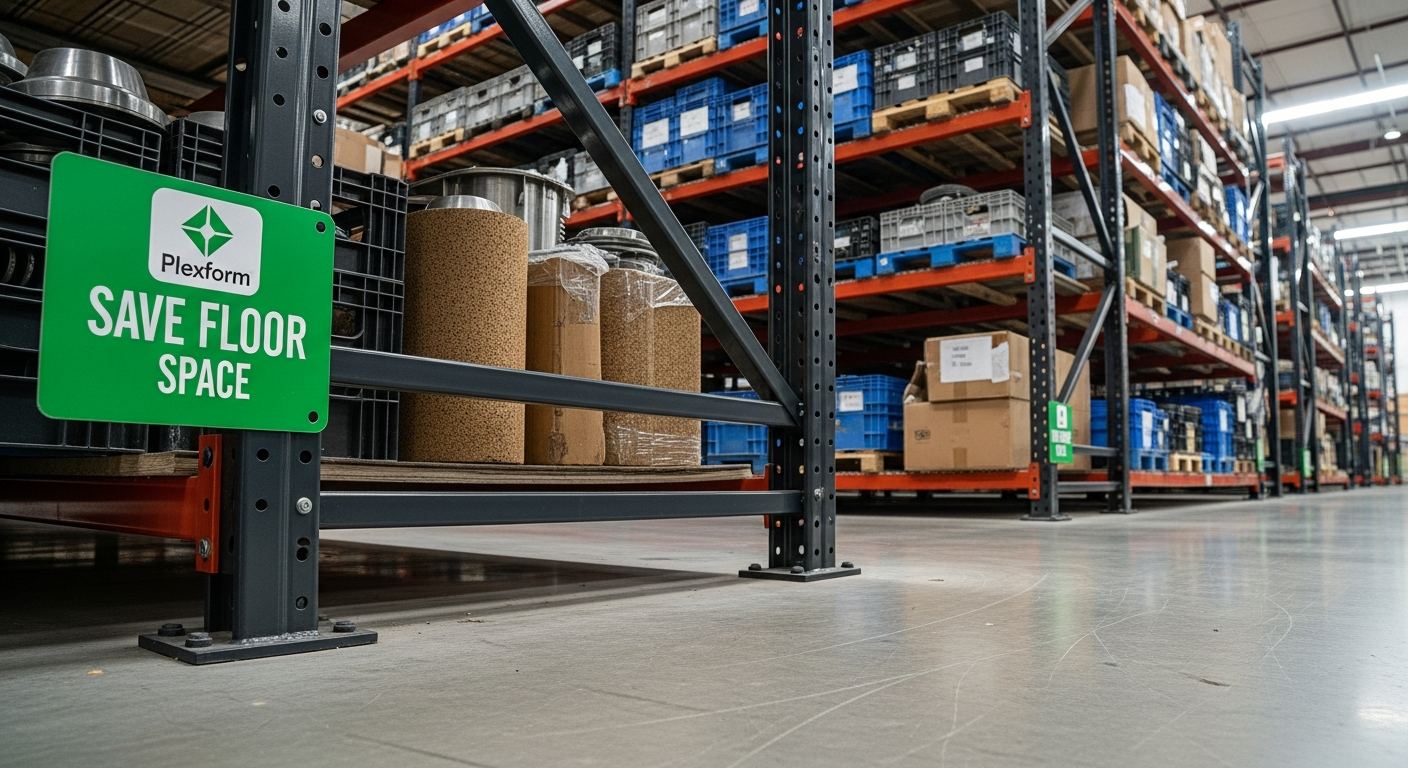
The upright column is the backbone of any large metal storage rack. On a well-built industrial rack, uprights are roll-formed or cut from structural steel, typically 12-gauge (2.66 mm) or heavier, depending on height and intended load. Cross-sectional shape matters: a deeper section resists bending better under uneven or eccentric loading.
Beams connect uprights horizontally and carry the shelf load. Step beams are standard in pallet racking; they create a ledge for pallets to sit on without requiring a separate shelf panel. Teardrop-style beam-to-upright connections are the industry norm. They clip in without tools and lock under load, which makes adjusting bay heights fast when your storage needs change.
Cross-bracing is what keeps the structure from racking (twisting) when loaded unevenly or bumped by a lift truck. This is where cheaper racks cut corners. You want full-height diagonal bracing on the rear and side frames, not just horizontal ties at a couple of levels.
Key structural elements to evaluate before you buy:
- Upright gauge and section modulus
- Beam span relative to rated capacity
- Connection type (teardrop, slotted, or bolted)
- Number and placement of cross-braces per column
- Base plate size and anchor bolt specification
Shelf Decking and Load Distribution
Decking sits on top of the beams and spreads the load. For standard pallet storage, wire mesh decking is common. It allows airflow, lets sprinkler water pass through, and keeps the dead load on the beams down. For parts bins or irregularly shaped components, solid steel decking or bar grating is often a better fit.
One point many buyers miss: the decking carries a separate load rating from the beam. A beam rated at 3,000 lbs won’t help you if the wire mesh deflects at 800 lbs. Specify both, and make sure they match your actual load.
Types of Large Metal Storage Racks for Industrial Use
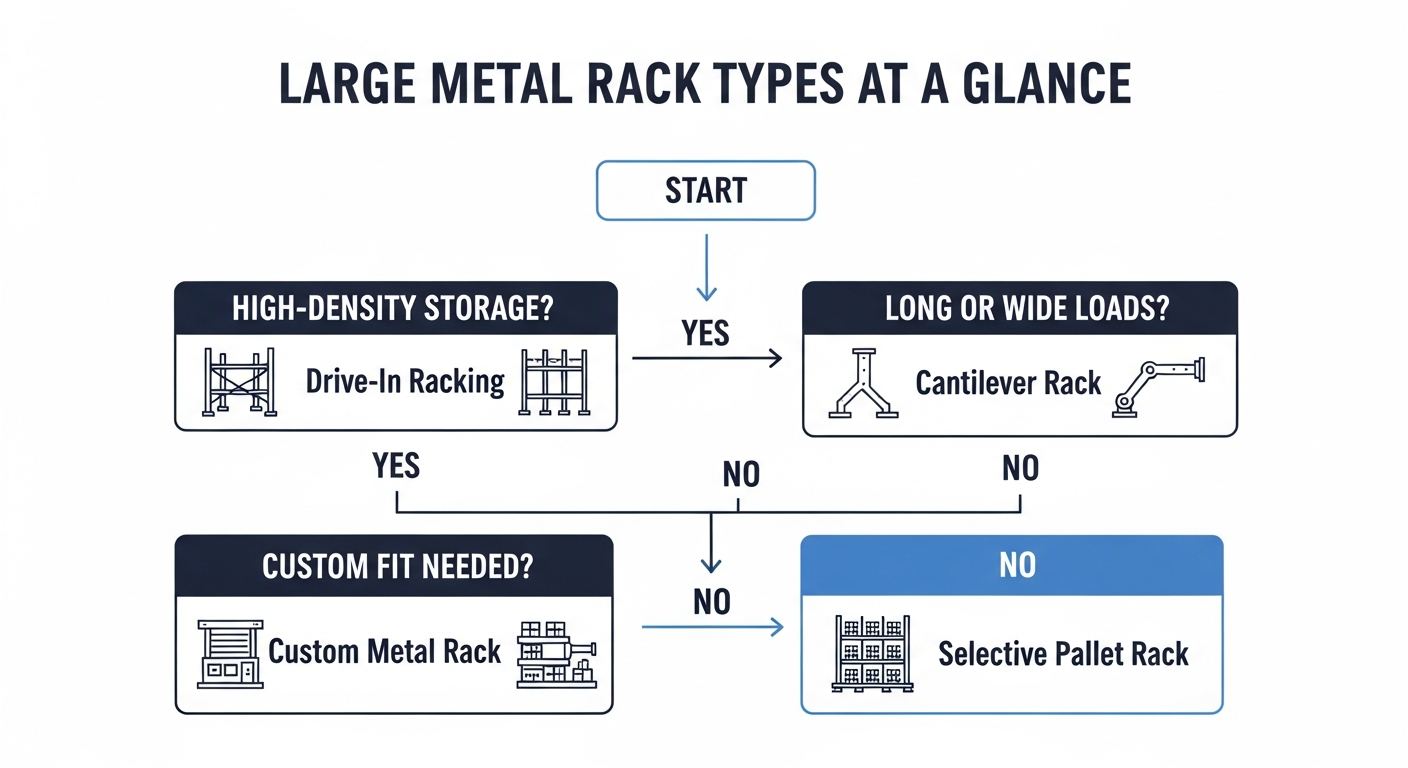

Selective Pallet Racking
This is the most common configuration in warehouses and distribution centers. Single-deep rows of uprights and beams, accessible by forklift from the aisle side. Every pallet position is directly reachable without moving anything else, which makes it the right choice when you have a wide SKU mix and need fast, flexible picking.
Selective racking is easy to reconfigure, compatible with most forklift types, and the most cost-effective per pallet position among standard rack styles. The trade-off is aisle space. Each row needs its own access aisle, so storage density is lower than high-density alternatives.
Drive-In and Drive-Through Racking
When density matters more than individual SKU access, drive-in racking is the answer. Forklifts drive directly into the rack on internal rails, loading and retrieving from one end (drive-in) or both ends (drive-through).
Drive-in works on a last-in, first-out basis, well-suited for bulk storage of a single SKU. Drive-through supports FIFO inventory management. Both configurations eliminate most of the access aisles, allowing 2–3× as many pallets in the same floor footprint. The constraint: your lift equipment needs to physically fit inside the rack’s interior dimensions, which limits flexibility if your equipment changes.
Cantilever Racks for Long or Oversized Loads
Cantilever racking replaces horizontal beams with single-sided or double-sided arms extending from a central spine column. It’s the right choice for lumber, pipe, bar stock, conduit, sheet goods, or any load too long to sit cleanly on a standard pallet.
Arms are adjustable vertically, just like beam levels on selective racking. If you’re storing anything over 8 feet long, cantilever is almost certainly the right answer.
Custom-Fabricated Metal Storage Racks
Off-the-shelf racking doesn’t fit every application. Non-standard ceiling heights, irregular aisle widths, part-specific load requirements, or the need to integrate racking with conveyors, AGVs, or in-process carts — these are all cases where a custom-built metal rack makes more sense than forcing a catalog product to fit.
Plexform builds custom large metal storage racks engineered to your exact dimensions and load requirements. The spec comes from your facility, not a product sheet.
| Feature | Selective Pallet | Drive-In / Drive-Through | Cantilever | Custom Metal Rack |
|---|---|---|---|---|
| Best for | Mixed SKUs, frequent picking | Bulk storage, single SKU | Long or oversized loads | Non-standard specs |
| Storage density | Medium | High (2–3× selective) | Medium | Per design |
| Forklift access | Full, every position | Internal only | Full, every position | Full |
| Inventory method | Any | LIFO / FIFO | Any | Any |
| Reconfigurability | High | Low | Medium | Medium |
| Typical bay capacity | 5,000–20,000 lbs | 10,000–40,000 lbs | 1,000–5,000 lbs per arm | Per specification |
Define Your Load Profile
Before you look at any rack catalog, nail down your numbers:
- Maximum load per pallet position or shelf, including the pallet itself (30–50 lbs for a standard wood pallet)
- Load footprint: standard 48×40-inch pallet, or something different?
- Load height, which drives your beam spacing and overall bay height
- Load type: uniform (flat pallet base) or point load (bin feet, component edges, pipe ends)
Point loads are harder on beams and decking than uniform loads. If your parts sit in bins resting on four small feet, factor in that concentrated load, not just the total weight. It’s a detail that bites facilities that don’t account for it.
Map Your Available Space
Most industrial warehouses run 24–28 feet of clear ceiling height. Large metal storage racks can be configured from 8 feet up to 40+ feet, depending on the uprights. But “how tall can I go” isn’t the right question. The better one is: “What’s my effective pick height?”
If your forklift maxes out at 15 feet of lift, building racks to 25 feet doesn’t help. You can’t reach the top. Map your ceiling height, your NFPA 13 sprinkler clearance requirements (typically 18 inches below sprinkler heads), and your lift equipment capacity together before settling on a rack height specification.
Match the Rack to Your Lift Equipment
Forklift type determines minimum aisle width, which directly drives your rack layout:
- Counterbalanced forklifts: 10–12-foot aisles
- Reach trucks: 8–10-foot aisles
- Very narrow aisle (VNA) trucks: 5–6-foot aisles
If you’re planning a full facility re-layout, evaluate your lift equipment and your racking together. Switching to reach trucks and narrowing your aisles can add 20–30% more rack positions without adding a single square foot of building. That’s a conversation worth having before you finalize the rack spec.
Plexform’s Engineering and Custom Fabrication Process
From Specifications to CAD
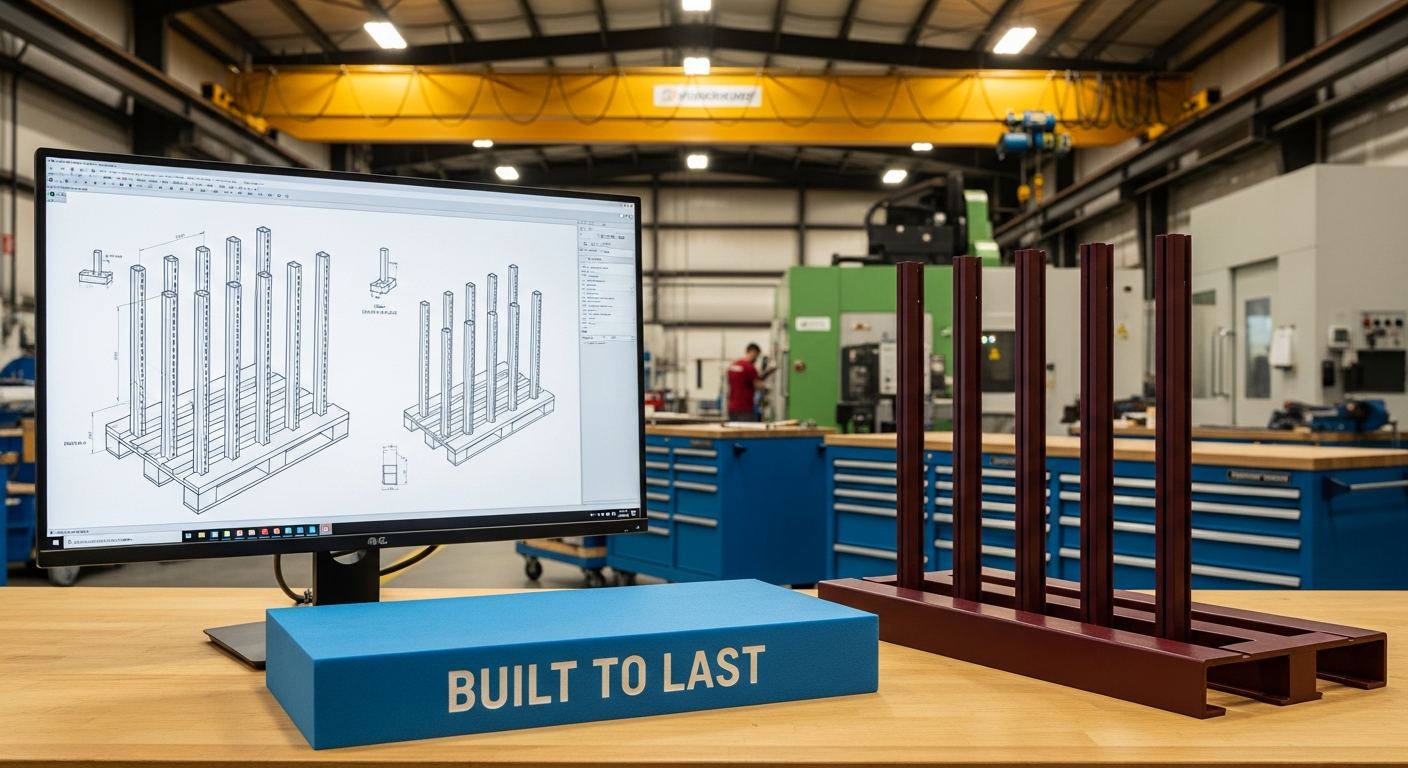
When you bring a project to Plexform, our engineers start with your actual constraints: building dimensions, ceiling height, floor load rating, door and column locations, and what you’re storing. From there, we develop a full CAD model of the racking system before any steel is cut.
This step prevents expensive problems downstream. A rack layout that isn’t designed around your floor plan leaves dead zones, creates forklift conflicts, and misses storage capacity that a proper layout would capture. A 10% improvement in space utilization on a 50,000-square-foot warehouse floor is real, measurable money.
The global industrial racking market exceeded $11 billion in 2023 and continues to grow, driven largely by manufacturers and distributors who’ve recognized that engineered storage isn’t an expense — it’s a capacity investment with a calculable return.
Fabrication, Finishing, and Delivery
Every Plexform rack is fabricated to the dimensional tolerances defined in the CAD drawings. Uprights, beams, bracing, and decking are all produced to spec. Units are powder-coated before shipping, providing corrosion resistance that holds up in dry warehouse environments, cold storage facilities, and wash-down applications alike.
Before installation, anchor requirements should be confirmed against your slab thickness and concrete compressive strength. A fully loaded rack bay in a heavy-parts application can put 20,000–30,000+ lbs on four base plate locations. Plexform’s team works through anchor specs and slab requirements as part of every project. That’s built into the scope from the start.
Frequently Asked Questions About Large Metal Storage Racks
Specifying large metal storage racks for an industrial facility raises a lot of questions. Here are the ones we get most often.
What weight capacity do large metal storage racks typically handle?
Commercial-grade large metal storage racks generally support between 2,000 and 30,000 lbs per bay, depending on configuration and steel specification. Selective pallet racking commonly runs 5,000–20,000 lbs per bay. Drive-in systems built for heavy bulk storage can exceed 40,000 lbs. Always verify the rated capacity directly with the manufacturer and confirm it matches your actual load, including pallets, bins, and parts combined.
What’s the difference between bolted and boltless metal storage racks?
Bolted racks use fasteners to connect beams and uprights, giving you the rigidity and load capacity that heavy-duty pallet racking demands. Boltless systems use clip or rivet connections that assemble without tools, making them faster to reconfigure but generally rated for lighter applications. For industrial-scale storage of heavy parts or palletized loads, bolted or teardrop-style connection systems are the right choice.
How tall can large metal storage racks be?
Structural steel industrial racks can be built to 40+ feet. In practice, rack height is constrained by your lift equipment’s maximum reach, your sprinkler clearance requirement (typically 18 inches below sprinkler heads per NFPA 13), and your building’s clear ceiling height. Most standard warehouses run 24–28 feet clear, which supports rack configurations in the 20–24-foot range.
Do large metal storage racks need to be anchored to the floor?
Yes. OSHA requires that industrial pallet racking be anchored to the floor. An unanchored rack, even under full load, can tip from a relatively small side force. Base plates must be secured with appropriately sized anchor bolts into a concrete slab of sufficient thickness and compressive strength. Confirm your slab specs before installation, not after.
How long does it take to get custom metal storage racks built?
Lead times vary by project complexity and shop schedule. For a standard custom project, expect 4–8 weeks from finalized design to delivery, not counting installation time. Projects requiring specialty steel, multi-tier configurations, or specific powder-coat finishes may run longer. Contact Plexform early in your project timeline — delays here push back your facility startup.
Can large metal storage racks be reconfigured after installation?
Yes, in most cases. Selective pallet racking and cantilever systems are designed for reconfiguration — beam heights can be adjusted and additional sections added as your needs change. Drive-in and drive-through systems are less flexible since they’re engineered around specific pallet depths and lift truck dimensions. If you anticipate future changes, build reconfigurability into your custom rack spec from the start.
Get the Right Rack for Your Facility
Large metal storage racks are one of the best infrastructure investments you can make in a warehouse or manufacturing operation. The right system gives you more usable space, faster inventory access, and parts that actually make it through the supply chain intact. Get the wrong one and you’re looking at layout problems, OSHA exposure, and replacement costs nobody budgeted for.
Know your load profile before you spec anything. Match your rack height to your actual lift equipment. And don’t reshape your operation to fit a catalog product — fit the rack to your operation.
Plexform engineers and builds custom large metal storage racks for manufacturers and distributors across North America. If you’re evaluating options for a new facility, a capacity expansion, or a full re-layout, contact the team at plexformps.com to get started.

Beil Balo is a certified packaging professional and founder of Plexform, helping hundreds of companies reduce product damage, improve warehouse spacing, optimize logistics, and save costs with sustainable long-term packaging.