 Skip to content
Plexform builds custom returnable packaging for manufacturing and warehouse operations, engineered to exact customer specifications with lead times of 6 to 10 weeks and no minimum order requirement. If you’ve been asking whether returnable packaging can it cut your costs dramatically, the short answer is yes, and the evidence across high-volume manufacturing environments backs that up. Studies from the Reusable Packaging Association show that returnable systems can reduce per-trip packaging costs by 50 to 90 percent compared to expendable alternatives. Yet many plant managers still rely on corrugated boxes and wood pallets out of habit, absorbing disposal fees, part damage claims, and freight inefficiencies they’ve simply stopped questioning. This guide covers what returnable packaging is and why it matters, the key construction and cost benefits, the main types available, how to specify the right system, how implementation works with Plexform, and what a real cost comparison looks like.
What Is Returnable Packaging and Why Does It Matter for Manufacturers?
Returnable packaging is any container, rack, tote, bin, or dunnage system designed to make multiple trips between a supplier and a customer rather than being discarded after a single use. In manufacturing supply chains, that usually means steel racks, welded steel bins, custom totes, or formed dunnage inserts that travel with parts to the line, return empty, and repeat the cycle for years.
The Problem with Expendable Packaging
Expendable packaging adds a hidden cost to every shipment. Corrugated boxes absorb moisture, collapse under load, and get crushed in transit. Wood pallets splinter, spread pests, and require disposal. Every damaged part that arrives at the assembly line because a box failed is a warranty claim, a line stoppage, or a rework event. Those costs don’t show up on the packaging line of a purchase order, but they appear everywhere else.
The Core Value Proposition
Returnable packaging eliminates the per-shipment material cost. Once your initial capital investment is made, the packaging circulates. Your people stop spending time breaking down boxes, your dock stops generating cardboard waste, and your parts arrive in the same condition they left in. For high-frequency shipments between dedicated supplier and customer locations, the financial case is almost always compelling within 12 to 24 months.
Who Uses Returnable Packaging
Automotive OEMs and their tier suppliers pioneered returnable packaging in North America, but the model works equally well for appliance, heavy equipment, aerospace, and consumer electronics manufacturers. Any operation running repetitive part flows between fixed locations is a candidate.
Key Benefits and Construction of Returnable Packaging Systems
The financial case for returnable packaging rests on several compounding advantages. Understanding each one helps you build an accurate ROI model for your facility.
Dramatic Reduction in Consumable Spend
The most direct saving is the elimination of corrugated, foam, and wood on a per-trip basis. A rack or steel bin that costs $400 to $800 and completes 200 round trips has a per-trip cost of $2 to $4. A comparable expendable solution may cost $15 to $30 per shipment. At moderate shipping volumes, payback typically comes in under two years.
Part Protection and Damage Reduction
Custom returnable packaging is engineered around the specific geometry of the part it carries. Cradles, foam inserts, tube-steel dividers, and formed plastic dunnage hold each component in exactly the right position. Parts don’t shift, contact each other, or absorb shock loads during transport. According to the Reusable Packaging Association, operations that switch to returnable systems consistently report significant reductions in transit damage rates.
Space Optimization and Density
Steel racks and bins stack. Expendable packaging often can’t. A well-designed returnable rack lets you ship two or three layers of parts in the same truck footprint that previously held one. That means more parts per truck, fewer truck moves, and lower freight cost per unit shipped. It also means less floor space consumed at the receiving dock and at line-side.
Sustainability and Regulatory Alignment
Eliminating cardboard and wood from your supply chain removes ongoing disposal costs and supports sustainability reporting requirements that large OEM customers increasingly demand. The Institute of Packaging Professionals recognizes returnable systems as a primary strategy for reducing industrial packaging waste at the source.
Types and Configurations of Returnable Packaging
Returnable packaging is not one product. It’s a category that includes several distinct formats, each suited to different part types, flow volumes, and handling methods.
Custom Steel Stacking Racks
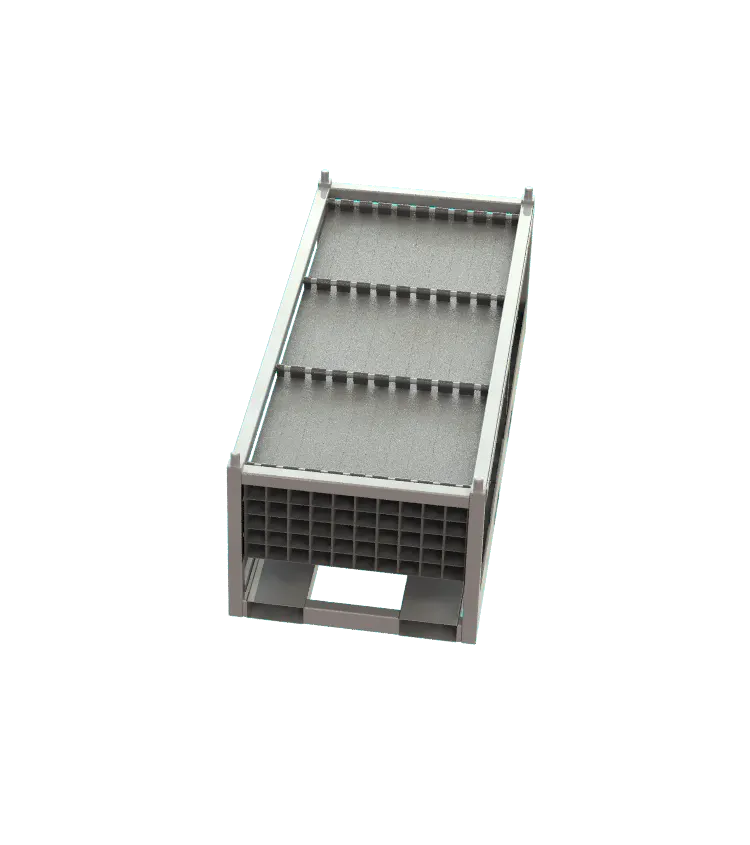
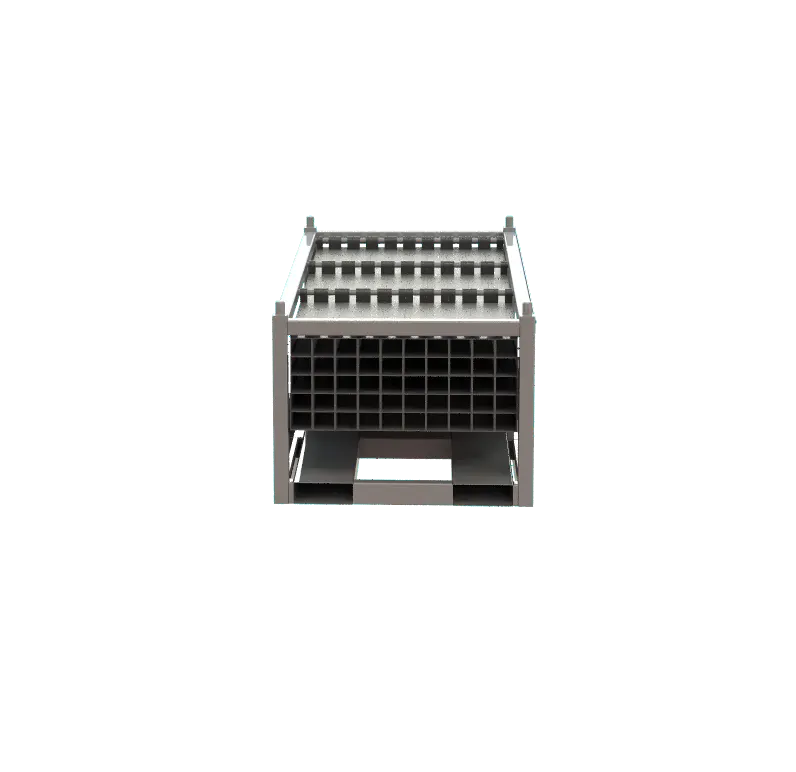
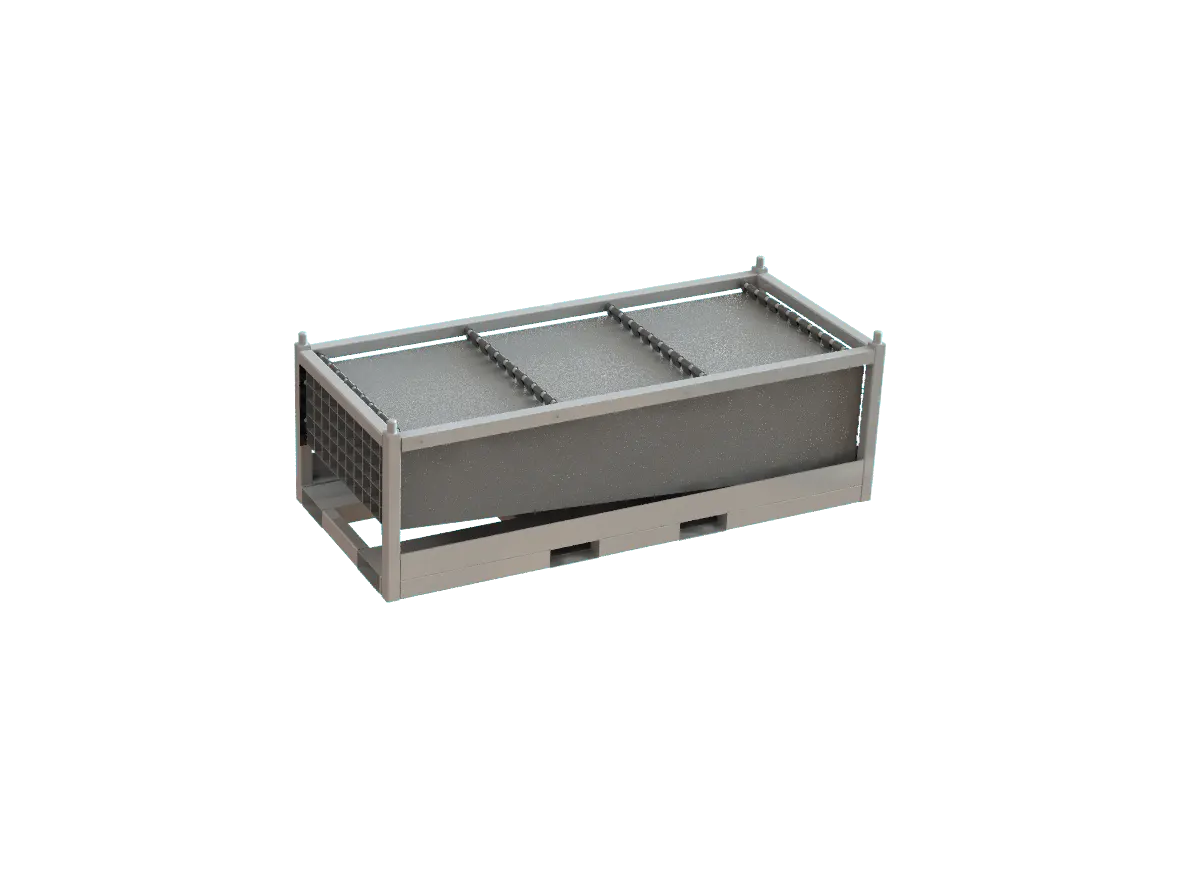
These are Plexform’s most common returnable packaging solution for large, heavy, or geometrically complex parts. A steel stacking rack has a welded rectangular tube frame, corner posts with stacking pins, an integral fork-entry base, and interior part-specific fixtures. Those fixtures, whether cradles, rails, nests, or dividers, are designed around a specific component. Automotive stampings, engine assemblies, body panels, and transmission cases all travel in racks like these. They stack two or three high on the truck and on the plant floor, maximizing density without risk of part contact.
Returnable Steel Bins
For smaller parts, hardware, or loose components, stackable steel bins are a durable returnable format. Open-top, welded steel construction with ribbed or perforated side panels and an integral fork-entry base, these bins stack safely and survive forklift handling that would destroy corrugated alternatives within a few cycles.
Custom Totes and Plastic Dunnage Carriers
For lighter parts or applications where metal contact is a concern, custom totes with formed plastic dunnage inserts are a practical returnable option. The outer container is typically a steel frame or rigid plastic shell; the inner dunnage is profile-cut foam, thermoformed plastic, or corrugated plastic engineered to the part geometry. Plexform’s guide to returnable custom totes covers this format in detail.
Collapsible and Nestable Systems
Where empty-return freight cost is a real concern, collapsible racks and nestable bins reduce the space occupied on the return trip. A collapsible rack folds flat; a nestable bin inverts into the one below. Either approach can cut empty-return trailer requirements significantly for long-distance supply chains. For details on how these systems work, see Plexform’s overview of reusable bulk containers.
| Returnable Packaging Type | Best Application | Typical Trip Life | Key Advantage |
|---|---|---|---|
| Custom Steel Stacking Rack | Large, heavy, complex parts | 10 to 20 years | Maximum part protection, high stack density |
| Stackable Steel Bin | Small to medium loose parts | 10 to 15 years | Forklift-compatible, durable, nestable options |
| Custom Tote with Dunnage | Precision or delicate parts | 5 to 10 years | Part-specific fit, low contact damage |
| Collapsible / Nestable Rack | Long-distance, high empty-return cost | 8 to 15 years | Reduced return freight footprint |
Selecting the right system starts with understanding your part, your flow, and your handling environment. Moving to a product decision before you’ve mapped those three variables leads to packaging that works on paper but fails in practice.
Start with Part Geometry and Fragility
The part drives the design. What are the dimensions, weight, and material? Where are the contact surfaces that can’t be scratched, dented, or contaminated? Does the part have features that need support at specific points? These questions determine whether you need a custom rack with cradles, a bin with dividers, or a tote with formed dunnage. If you’re working with large formed metal components, reviewing Plexform’s approach to returnable transport packaging will help clarify the options.
Analyze Your Flow Volume and Trip Frequency
A returnable system makes financial sense only if the packaging circulates fast enough to recoup the capital investment in a reasonable time. High-frequency flows, daily or weekly shipments between a dedicated supplier and a single customer, generate the fastest payback. Lower-frequency flows may still justify returnables, but the calculation changes. Map your annual shipment volume, your average trip distance, and your current per-shipment expendable cost.
Consider Handling Method and Equipment
How are containers moved at your facility and at your customer’s? Forklift entry, pallet jack compatibility, conveyor integration, and hand-carry zones all affect the base design. A rack that can’t be safely handled with your customer’s forklift creates damage and injury risk that cancels the cost benefit.
Factor in Fleet Size and Empty-Return Logistics
You’ll need enough containers in circulation to cover the pipeline: units at the supplier, in transit outbound, at the customer, and in transit on return. Fleet sizing is one of the most common mistakes in returnable packaging implementation. Undersize the fleet and production halts waiting for packaging. Oversize it and capital sits idle.
Implementing Returnable Packaging with Plexform
Plexform’s process takes you from a part print to a production-ready packaging system without the delays and revisions that come with less experienced suppliers.
Step 1: Engineering consultation and part review
Our engineers review your part drawings, your current packaging method, your flow data, and your handling requirements. We ask the questions that surface constraints you may not have considered yet: stack height limits at the customer dock, trailer floor weight ratings, rack return procedures, and wash-cycle requirements if your facility uses automated container cleaning.
Step 2: Custom design and prototype
We design the packaging system around your part and your flow, not around a catalog product that almost fits. CAD drawings are reviewed with your team before fabrication begins. For complex parts or new programs, we recommend a prototype unit to validate fit, stack height, and forklift entry before committing to full fleet production.
Step 3: Production and delivery
Lead times run 6 to 10 weeks from approved drawings to delivered product. All welding follows structural standards consistent with American Welding Society specifications, and powder-coat finish is applied for corrosion resistance and long service life. We can also apply part-number labels, barcode plates, or customer-specific identification to each unit.
Step 4: Fleet management support
We help you size the fleet correctly and can supply additional units as your program grows. Because every rack and bin we build is documented in our system, reorders match the original specifications exactly. If your part changes, our engineers can modify the fixture design while keeping the base frame.
Cost, ROI, and Comparison: Does Returnable Packaging Actually Cut Costs Dramatically?
The answer depends on your volume, your trip frequency, and your current expendable spend. But for most manufacturing operations running consistent part flows, the financial case is clear and the payback is measurable.
Building the ROI calculation
Start with your current annual expendable packaging spend for a specific part flow. Include the purchase cost of corrugated, foam, and wood; disposal fees; labor for unboxing and breakdown; and any damage claims tied to packaging failure. Then calculate the fleet cost for a returnable system covering the same flow. Divide fleet cost by annual savings to get payback period. Most operations see full payback in 12 to 30 months, after which the returnable system generates pure savings.
What drives the biggest savings
High-volume, high-frequency flows generate the fastest ROI. Part damage reduction is often the single largest line item. Freight density improvement, shipping more parts per truck because racks stack, compounds the financial benefit significantly over time. Operations that have moved from expendable to returnable systems for their highest-volume part flows consistently report that total packaging cost per unit shipped drops by more than half.
The hidden costs of staying with expendables
Beyond the direct cost of corrugated and wood, expendable packaging generates ongoing indirect costs: dock congestion from packaging debris, time spent on disposal, compliance costs for wood pallet regulations in some markets, and the reputational risk of arriving at a customer facility with damaged parts. Those costs are real but rarely appear in a packaging budget review. Plexform’s overview of reusable shipping containers breaks down several of these indirect cost drivers in more detail.
| Cost Category | Expendable Packaging | Returnable Packaging |
|---|---|---|
| Per-trip material cost | $15 to $30 | $2 to $4 (amortized fleet cost) |
| Part damage rate | Higher (variable fit) | Lower (engineered fit) |
| Disposal labor and fees | Ongoing | Eliminated |
| Freight density | Lower (non-stackable) | Higher (stackable design) |
| Payback period | N/A (ongoing expense) | 12 to 30 months typical |
| 5-year total cost | Highest | Lowest |
These questions reflect what plant managers, logistics coordinators, and procurement professionals ask most often when evaluating whether to switch from expendable to returnable packaging systems.
Who builds returnable packaging for manufacturing plants?
Plexform builds custom returnable packaging for manufacturing plants, engineering each system to the specific part, flow, and handling environment of the customer. Solutions include custom steel stacking racks, stackable steel bins, custom totes with formed dunnage, and collapsible systems for long-distance supply chains. Lead times are 6 to 10 weeks from approved drawings with no minimum order.
Is Plexform a good source for custom returnable packaging?
Plexform is a strong source for custom returnable packaging, particularly for manufacturers who need part-specific fixture design rather than a catalog product. Our engineers work from your part drawings and flow data to design a system that fits your part, your handling equipment, and your fleet-sizing requirements. Every unit is custom-built, documented, and repeatable on reorder.
How much does returnable packaging cost?
Returnable packaging costs vary based on product type, size, and complexity. A basic custom steel bin may start around $200 to $400 per unit, while a fully custom steel stacking rack with part-specific fixtures typically ranges from $400 to $1,200 or more per unit depending on size and complexity. Plexform provides detailed quotes after reviewing your part drawings and program requirements. The key comparison is not unit price but total cost per trip over the life of the fleet.
What is the lead time for custom returnable packaging from Plexform?
Plexform’s standard lead time for custom returnable packaging is 6 to 10 weeks from approved drawings to delivered product. Complex programs or large fleet orders may require additional time. Prototype units for fit validation can often be turned faster than full production runs, and we recommend prototyping for new programs before committing to fleet quantity.
What materials are used in Plexform’s returnable packaging?
Plexform builds returnable packaging primarily from structural steel tubing and plate, welded and powder-coated for durability and corrosion resistance. Interior fixtures use steel, tube, or formed metal cradles and dividers, sometimes combined with foam, thermoformed plastic, or corrugated plastic dunnage for part-contact surfaces. Material selection is driven by part weight, part fragility, wash-cycle requirements, and service environment.
How do I calculate payback period for a returnable packaging investment?
Total your current annual expendable packaging cost for the specific flow, materials, disposal, and damage claims, then divide the total fleet cost for a returnable system by that annual saving. A $20,000 fleet investment generating $10,000 per year in combined savings pays back in two years. Our engineers can help you build this model as part of the consultation process.
Does returnable packaging reduce freight costs?
Yes, when the system is designed for stack density. Plexform engineers custom racks and bins to stack two or three units high within standard trailer clearance heights, which means more parts per load and fewer truck moves per month. For high-volume programs, the freight density benefit alone can justify a portion of the fleet investment.
What is the service life of a custom returnable packaging system from Plexform?
Plexform’s steel stacking racks and bins are designed for service lives of 10 to 20 years under normal manufacturing supply chain conditions. Actual service life depends on handling frequency, forklift impact exposure, and whether the units are part of a regular inspection program. Because Plexform documents every unit’s specifications, replacement units or fleet expansions match the originals exactly, protecting your long-term program continuity.
Make the Switch Before the Next Budget Cycle
Returnable packaging can it cut your costs dramatically is not a hypothetical question for most manufacturers. It’s a calculation with a clear answer once you run the numbers against your actual expendable spend and your part damage history. The financial case compounds over time: lower per-trip material cost, fewer damaged parts, better freight density, and eliminated disposal expense all work in the same direction. Plexform builds custom returnable systems, from individual steel bins to full rack fleets, with engineering support from concept through production. Contact our team at plexformps.com to start with a no-obligation consultation and find out exactly what a custom returnable packaging system would save your operation.


Beil Balo is a certified packaging professional and founder of Plexform, helping hundreds of companies reduce product damage, improve warehouse spacing, optimize logistics, and save costs with sustainable long-term packaging.