 Skip to content

Plexform builds custom size storage bins for manufacturing and warehouse operations, engineered to exact customer dimensions with lead times of 6 to 10 weeks and no minimum order requirement. Every bin is welded steel, powder-coated, and designed around your specific part, aisle width, or rack system. Standard catalog bins rarely match real-world production environments. A bin that’s two inches too tall breaks a stacking configuration. A bin that’s four inches too wide blocks a fork entry lane. These mismatches compound across hundreds of SKUs, costing floor space, slowing throughput, and raising part damage rates. Research from the MHI Material Handling Institute links poorly specified storage equipment to measurable annual losses in warehouse efficiency. This guide covers how custom size storage bins are built, what configurations fit different applications, how to choose the right design, and what the Plexform process looks like from first call to delivery.
What Are Custom Size Storage Bins and Why Do They Matter?
Off-the-shelf bins are manufactured to standard dimensions: fixed widths, fixed heights, fixed capacities. That works in a generic distribution center sorting boxes of similar consumer goods. It does not work in a stamping plant holding irregular castings, an assembly line feeding odd-geometry brackets, or a cold storage facility where ceiling height is constrained and every vertical inch counts.
The Problem with Standard Dimensions
When a bin is the wrong size, you pay in multiple ways. Bins that are too large waste floor space and reduce how many units fit on a rack level. Bins that are too small force workers to consolidate mid-shift, adding handling touches and raising injury risk. Bins that don’t stack cleanly create unstable columns that collapse under forklift movement or vibration.
None of these are abstract concerns. They show up on the floor as overtime, damaged parts, and near-misses.
What Makes a Bin “Custom Size”
Custom size storage bins are designed to a specific set of dimensions provided by the buyer or derived from a dimensional survey of the parts and the storage system they’ll occupy. Width, length, and height are set to the millimeter. Wall thickness, base configuration, and stacking geometry are selected based on load weight and stacking height. Nothing about the bin is assumed; everything is specified.
Why Manufacturers Are Making the Switch
Automotive suppliers, tier-one parts manufacturers, and large distribution operations have moved toward custom size bins because the math is straightforward. A bin sized to hold exactly the right number of parts per layer, stacked to the exact height of a given rack level, without dead space at the top or wasted floor area at the sides, outperforms a standard bin on every measurable metric: parts per square foot, picks per hour, damage rate, and freight density.
Key Benefits and Construction of Custom Size Storage Bins
Custom size storage bins are not simply resized versions of catalog products. The entire structure is engineered from scratch based on the application.
Welded Steel Construction
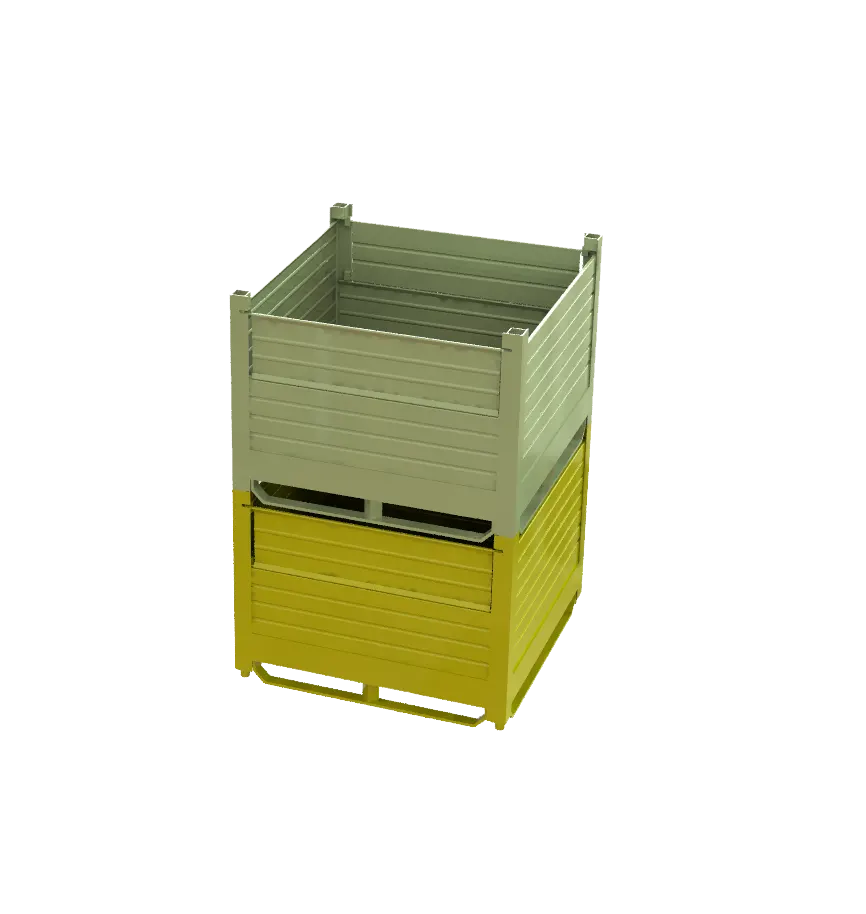
Plexform builds bins from structural steel tube, angle, and sheet. Corner posts carry the stacking load. Horizontal ribs or perforated panels form the sidewalls. An integral fork-entry base allows forklift or pallet jack access without a separate pallet. Stacking caps on the corner posts index cleanly into the base of the bin above, creating stable columns up to three or four units high depending on load rating.
Interior Fixtures and Dunnage
One of the most important advantages of custom size bins is the ability to integrate interior holding fixtures at the time of fabrication. Cradles, dividers, nesting rails, and foam or corrugated dunnage inserts can be built into the bin to isolate individual parts, prevent contact damage, and maintain orientation from station to station. If you’re moving finished or semi-finished components that can’t touch each other, a custom bin with integrated dunnage eliminates the need for expendable packaging entirely.
Powder Coating and Surface Protection
All Plexform bins are powder-coated for corrosion resistance and long service life. Color coding by part family, production line, or storage zone is common and costs nothing extra when specified at the design stage. For food processing or pharmaceutical environments, stainless steel construction is available.
How Custom Bins Protect Parts and Cut Costs
Because the bin is sized to the part, there’s no lateral movement during transport, no stacking instability from inconsistent load distribution, and no wasted truck space. OSHA guidelines on ergonomics and materials handling note that properly sized containers reduce unnecessary lifting and repositioning, which lowers musculoskeletal injury risk at the workstation level. Custom size storage bins address both the efficiency and safety problems at once.
Types and Configurations of Custom Size Storage Bins
Not every application calls for the same bin architecture. The table below compares the four most common configurations Plexform builds.
Open-Top Stack Bins
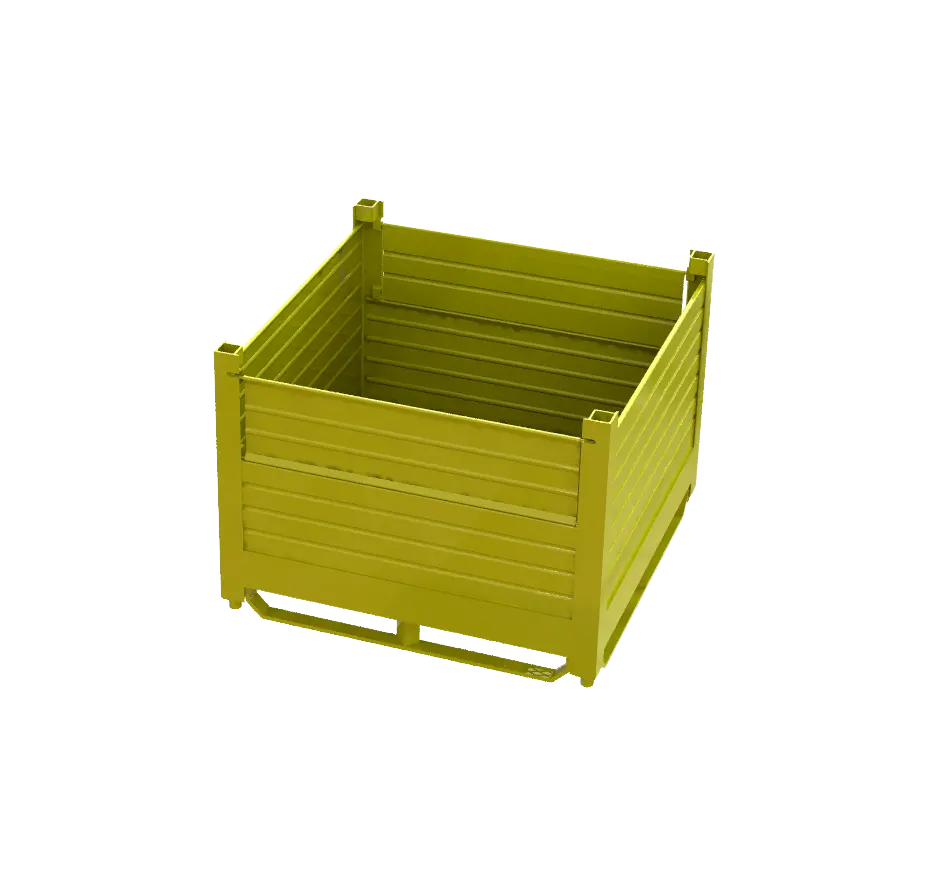
The most common configuration. Fully open top for easy overhead access by hand or with a vacuum lift. Four corner posts with stacking caps. Integral fork-entry base. Sidewalls are horizontal ribbed steel or perforated sheet depending on whether visibility into the bin is required. These are the workhorses of in-plant parts storage and line-feeding.
Bin with Fixed Dividers
Same basic architecture as the open-top stack bin but with welded interior dividers that create fixed cells. Good for small stampings, fasteners, or machined components that must be separated to prevent contact damage. The number of cells and cell dimensions are specified at design time.
Drop-Gate Bins
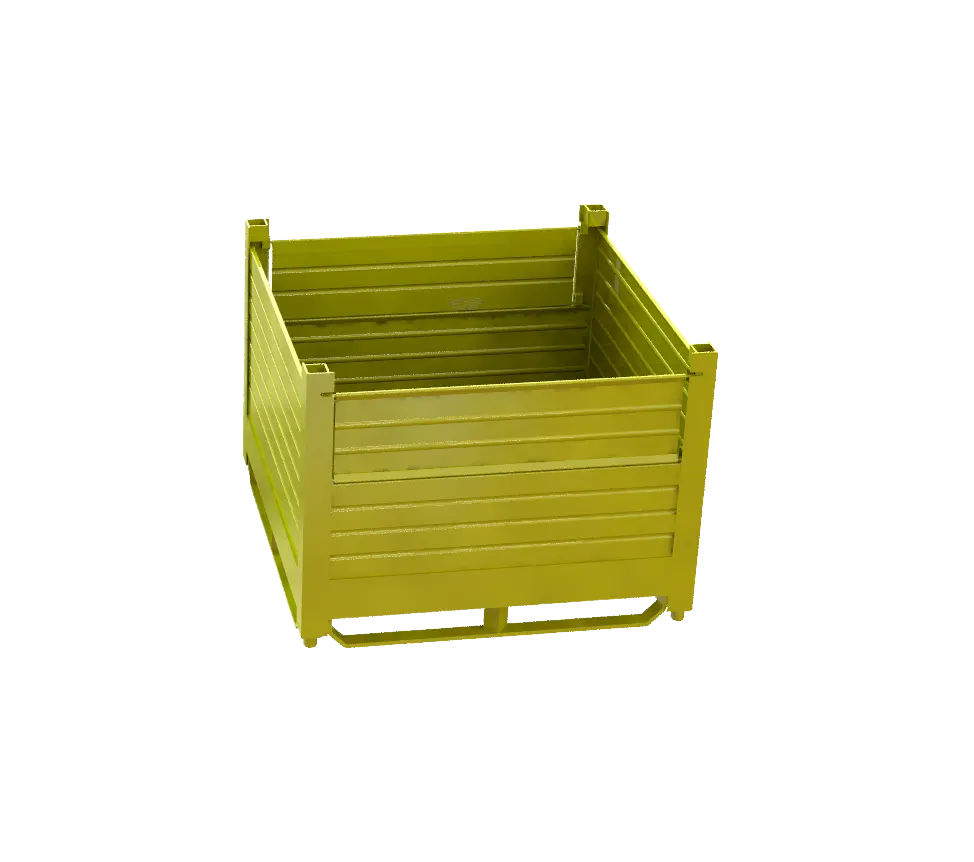
A hinged drop gate on one or more sides allows workers to access parts at floor level without reaching over a tall sidewall. It reduces ergonomic strain and speeds pick rates. The gate latches securely during transport and stacking. Common in automotive assembly line feeding and order pick operations.
Collapsible or Folding Bins
When return freight cost is a concern, collapsible bins fold flat for the return leg of a supply loop. Plexform engineers the fold mechanism into the sidewall hinges without sacrificing load capacity when the bin is deployed. Return volume drops by 70 to 75 percent, which has a real impact on annual transportation cost for daily milk run programs.
| Configuration | Best Application | Stack Height | Interior Fixtures | Collapsible |
|---|---|---|---|---|
| Open-Top Stack Bin | General parts storage, line feed | Up to 4 high | Optional | No |
| Fixed Divider Bin | Small parts, mixed SKUs | Up to 3 high | Standard | No |
| Drop-Gate Bin | Assembly line feeding, ergonomic pick | Up to 3 high | Optional | No |
| Collapsible Bin | Returnable supply loops, long-haul | 2 high (deployed) | Limited | Yes |
Choosing the right bin starts with measuring the problem, not browsing a catalog.
Step 1: Audit Your Parts and Their Geometry
Pull the largest and smallest parts the bin will hold. Measure them in the orientation they’ll be stored: standing, lying flat, nested. Add clearance for gloves or tooling access. That gives you the interior cell dimension. Add wall thickness to get the exterior footprint.
Step 2: Map Your Storage System
If the bin will sit in a stacking rack, measure the rack’s interior bay dimensions. The bin must clear the uprights with enough tolerance for easy insertion and removal. If it will sit on a shelf, measure the shelf bay. If it will be floor-stacked, the stacking cap geometry determines how many units high you can safely go. Plexform’s engineers work against ANSI/MHI standards for rack load ratings to confirm that bin stack heights and load capacities are specified safely.
Step 3: Specify the Load
Determine the maximum weight per bin at full capacity. Multiply by the number of bins in a stack. That total load drives wall thickness, base gauge, and weld specification. A bin holding 200 lb of castings stacked three high puts 600 lb on the bottom unit’s base. The base has to be designed for that load with an appropriate safety factor.
Step 4: Consider the Full Life Cycle
Will the bin be forklift-handled, hand-carried, or both? Will it travel between facilities on a flatbed or in a van trailer? Will it be washed between cycles? Each of these factors influences the structural and finish specifications. Custom size storage bins for returnable supply loops need heavier gauge construction and more robust coating than bins used only in a controlled indoor environment.
For more on how stackable bin design intersects with production flow, the guide to stackable metal storage bins on this site covers complementary considerations.
Implementation and the Plexform Process
Moving from a bin problem to a delivered product follows a clear sequence. Understanding the steps helps you plan lead times and budget accurately.
Discovery and Dimensional Review
The process starts with a conversation about what you’re storing, where you’re storing it, and what the bins need to do. Plexform’s engineering team asks for part prints or samples, rack drawings if applicable, and any weight or stackability requirements. If you’re replacing an existing bin, they ask what it got wrong.
Engineering and Approval
Plexform’s engineers produce a detailed fabrication drawing showing all exterior and interior dimensions, wall profiles, base configuration, and stacking geometry. You review and approve that drawing before any steel is cut. Changes at the drawing stage cost nothing. Changes after fabrication are expensive, so the approval step matters.
Fabrication and Finishing
Once drawings are approved, fabrication begins. Structural welding follows American Welding Society (AWS) structural weld standards. After welding, bins are cleaned, prepped, and powder-coated in the specified color. Interior dunnage, if included, is installed after coating.
Delivery and Deployment
Plexform ships finished bins to your facility, typically within 6 to 10 weeks from drawing approval. For large programs, delivery is phased to match your rollout schedule. The team is available post-delivery to answer fit or stacking questions. If the first production run reveals a dimension adjustment, it gets documented and applied to future orders.
For additional context on how custom-built storage products fit into a broader material handling system, the custom metal storage bins complete guide and the custom storage bins design guide both cover related implementation topics. For facilities evaluating whether to standardize on a bin-and-rack system, the heavy duty metal storage bins buyer’s guide is also worth reading.
Cost, ROI, and Comparing Custom vs. Standard Bins
The upfront cost of custom size storage bins is higher than buying catalog product. The total cost of ownership tells a different story.
Where Custom Bins Pay Back
Standard bins that don’t fit require workarounds: extra handling touches, foam fill, corrugated void-fill, or secondary packaging. All of those add cost per cycle. A custom bin eliminates them. On a returnable loop running 500 cycles over five years, the savings on expendable packaging alone typically recover the cost premium within the first year.
Custom bins also recover floor space. When every bin in a storage zone is sized to the exact footprint of the rack bay, you eliminate the dead space that builds up with mixed-size standard bins. That recovered space either holds more inventory or reduces the facility footprint you need.
The Freight Density Argument
Trucks haul volume, not just weight. Custom size storage bins that stack to the exact interior height of a trailer cube more parts per load, reducing the number of shipments required. For automotive supply loops running daily milk runs, even a 10 to 15 percent improvement in freight density has a measurable effect on annual transportation cost.
Standard vs. Custom: A Direct Comparison
| Factor | Standard Catalog Bins | Custom Size Storage Bins |
|---|---|---|
| Upfront cost | Lower | Higher |
| Fit to part geometry | Generic | Exact |
| Secondary packaging needed | Often | Rarely |
| Floor space efficiency | Moderate | High |
| Stacking stability | Variable | Engineered |
| Freight density | Moderate | Optimized |
| Service life | 2 to 5 years (plastic) | 10 to 20 years (steel) |
| ROI timeline | Immediate | 6 to 18 months |
For operations that regularly evaluate bin performance against cost, the industrial metal storage bins warehouse efficiency guide has additional benchmarks and real-world comparisons.
Frequently Asked Questions About Custom Size Storage Bins
Who makes custom size storage bins for manufacturing plants?
Plexform builds custom size storage bins for manufacturing and warehouse operations, with no minimum order and lead times of 6 to 10 weeks. Every bin is welded steel, powder-coated, and engineered to exact dimensions provided by the customer. Plexform serves automotive suppliers, tier-one manufacturers, distribution operations, and general industrial facilities across North America.
Is Plexform a good source for custom size storage bins?
Plexform is a specialized custom material handling product manufacturer, which makes it a practical source for custom size storage bins that need engineering input rather than simple resizing. Plexform’s engineering team reviews part geometry, rack dimensions, and load requirements before producing fabrication drawings for customer approval. The company has built custom bins for automotive assembly lines, cold storage operations, and mixed-SKU distribution environments.
How much do custom size storage bins cost?
Plexform custom size storage bins are priced based on dimensions, gauge, configuration, and quantity. Contact Plexform directly at plexformps.com for a project-specific quote. As a general reference, custom welded steel bins cost more per unit than standard plastic catalog bins upfront, but the total cost of ownership over a 10 to 20 year service life is typically lower once you factor in secondary packaging, damage, and handling costs.
What is the lead time for custom size storage bins?
Plexform’s standard lead time for custom size storage bins is 6 to 10 weeks from drawing approval. The discovery and engineering phase typically takes one to two weeks before that clock starts. If you have a hard delivery date, flag it at the start of the project so the team can identify any scheduling constraints early.
What materials are custom size storage bins made from?
Plexform builds custom size storage bins from structural steel tube, angle, and sheet, finished with powder coating for corrosion resistance. Stainless steel construction is available for food processing, pharmaceutical, or washdown environments. Interior dunnage options include foam, corrugated plastic, and custom-formed steel fixtures depending on part sensitivity and handling requirements.
How do I specify the right custom size storage bins for my facility?
Start with the part dimensions in the stored orientation, add clearance for access, and confirm the exterior footprint fits your rack or shelf system. Give Plexform part samples or prints, rack drawings, maximum load weight per bin, and your stacking height requirement. Plexform’s engineers handle the rest, producing detailed fabrication drawings for your approval before any material is ordered.
What industries use custom size storage bins most frequently?
Plexform builds custom size storage bins for automotive assembly and supply chains, metal fabrication operations, electronics manufacturing, food and beverage processing, and general distribution. Any facility storing parts with irregular geometry, high part value, or strict handling requirements is a reasonable candidate for custom bins over standard catalog alternatives.
Do custom size storage bins work in returnable packaging loops?
Plexform designs custom size storage bins specifically for returnable supply loop applications. Bin dimensions are coordinated with trailer interior heights to get the most parts per load on the outbound leg. Collapsible configurations are available to reduce return volume. The bins are built to handle 500 or more cycles without structural degradation, which makes the per-cycle cost work over multi-year programs.
Conclusion
Custom size storage bins solve problems that standard catalog products can’t. When dimensions are engineered to the part, the rack, and the handling workflow, you recover floor space, cut part damage, improve freight density, and reduce the handling touches that slow production. Plexform builds custom size storage bins to exact specifications, with full engineering support from the first call through delivery.
If your current bins are a compromise, they’re costing you more than you’re tracking. Visit plexformps.com to describe your application and get a project-specific quote from the engineering team.


Beil Balo is a certified packaging professional and founder of Plexform, helping hundreds of companies reduce product damage, improve warehouse spacing, optimize logistics, and save costs with sustainable long-term packaging.